
September 7, 2026•20 min read
8 best AI ecommerce automation tools in 2026
AI can now run big parts of an online store: email flows, support tickets, ad creative, repricing, and restocks. We compared 8 AI ecommerce automation tools, one per operations domain, with honest pros, cons, and verified pricing so you can build a stack that fits your store.
Picture of 8 best AI ecommerce automation tools in 2026 article
AI ecommerce automation tools now cover almost every repetitive job in an online store: sending the right email at the right moment, answering support tickets, writing product descriptions, adjusting prices against competitors, and forecasting restocks. Done manually, each of those tasks eats hours every week and scales badly as order volume grows.
The payoff for automating is direct. Stores that automate marketing, support, and operations respond faster, waste less ad spend, and free their teams to work on product and growth instead of admin.
In this guide, we compare 8 AI ecommerce automation tools, each covering a different job: email and SMS marketing, customer support, cross-app workflows, onsite personalization, product content, ad creative, repricing, and inventory. You'll get current pricing, honest pros and cons, and a framework for choosing your stack. If you run a fashion or apparel brand specifically, we also keep a companion guide to the best automation tools for fashion businesses.
Best AI ecommerce automation tools: a brief overview
- Klaviyo: Best for AI email and SMS marketing automation: builds flows from a text prompt and triggers them off live store data.
- Gorgias: Best for automating customer support: its AI Agent resolves tickets and takes real actions like refunds and order edits.
- Zapier: Best for cross-app workflow automation: connects 9,000+ apps and lets you run AI agents across all of them.
- Rebuy: Best for onsite personalization on Shopify: AI recommendations in the cart, checkout, search, and post-purchase flow.
- Hypotenuse AI: Best for product content at catalog scale: generates and governs on-brand product descriptions across thousands of SKUs.
- Creatify: Best for ad creative automation: turns a product URL into AI video ads for TikTok, Meta, and Google.
- Prisync: Best for repricing: tracks competitor prices and applies dynamic pricing rules automatically.
- Prediko: Best for inventory automation on Shopify: AI demand forecasts plus purchase orders in one workflow.
| Tool name | Key strength | Pricing | Platforms |
|---|---|---|---|
| Klaviyo | AI-built email and SMS flows tied to store data | Free up to 250 profiles; email plans from $20/month | Web + 350+ integrations |
| Gorgias | AI support agent that acts on orders, not just replies | From $10/month; AI Agent about $1 per resolution | Web + ecommerce platform integrations |
| Zapier | Workflow automation and AI agents across 9,000+ apps | Free tier (100 tasks/month); from $19.99/month billed annually | Web + 9,000+ app integrations |
| Rebuy | Personalization across cart, checkout, and search | Free Monetize tier; paid plans from $25/month | Shopify and Shopify Plus |
| Hypotenuse AI | Bulk product content with brand and SEO governance | Custom pricing; free trial available | Web + PIM/ERP integrations |
| Creatify | Product URL to ready-to-run video ads | Free tier (10 credits/month); from $39/month | Web; exports for TikTok, Meta, Google |
| Prisync | Competitor price tracking with automated repricing | From $99/month; 14-day free trial | Web + API |
| Prediko | AI demand forecasting with purchase order management | From $49/month; 14-day free trial | Shopify |
1. Klaviyo, best for AI email and SMS marketing automation
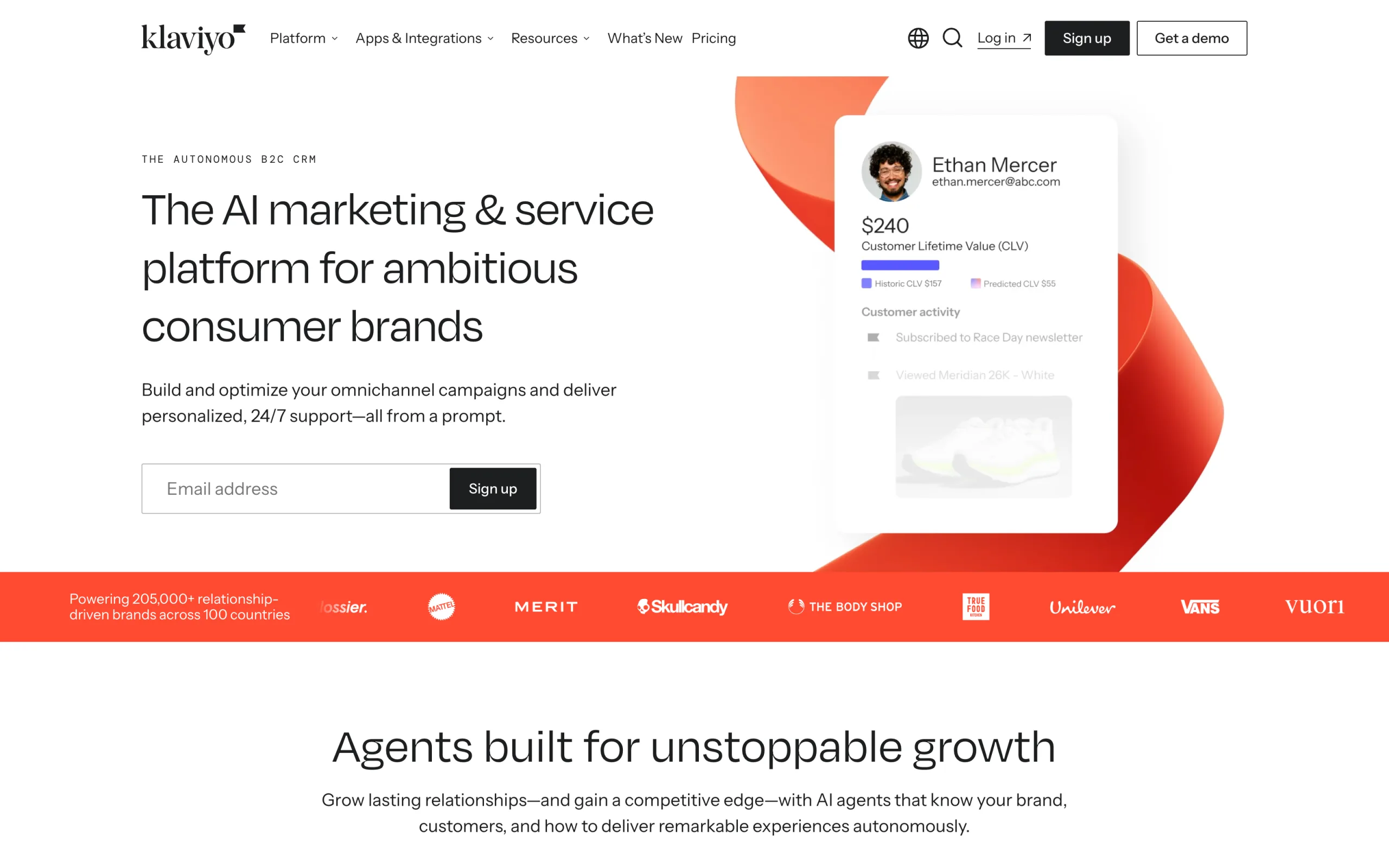
AI Ecommerce Automation with Klaviyo
Klaviyo is the marketing automation layer most ecommerce stacks are built around. It syncs customer and order data from your store, then uses that data to trigger email, SMS, and push messages at the moments that drive revenue: a cart left behind, a price drop on a viewed product, an item back in stock.
The AI side removes most of the setup work. You describe the automation you want in plain language and Klaviyo AI assembles the flow, or you start from one of 60+ prebuilt templates like welcome series and post-purchase follow-ups. Conditional splits then route each customer down a different path based on cart value, location, or purchase history, so one flow can behave like ten.
Key features
- AI flow builder that creates automations from a text prompt
- 60+ prebuilt flow templates (abandoned cart, welcome series, back in stock, price drop)
- Email, SMS, and push notifications in a single automation
- Conditional and trigger splits for behavior-based branching
- AI subject line generation and A/B testing
- 350+ integrations plus webhooks for triggering external systems
Best for
- Stores that want owned-channel revenue (email and SMS) on autopilot
- Teams that have outgrown basic newsletter tools and need behavior-triggered flows
Pricing
- Free plan for up to 250 profiles and 500 email sends per month
- Paid email plans start from $20 per month for up to 500 contacts, scaling with list size
- SMS is billed separately on top of the email plan
Pros
- Deep ecommerce data integration makes segments and triggers genuinely behavioral
- The AI flow builder cuts setup from hours to minutes for non-specialists
- Free tier is enough to prove value before paying
Cons
- Costs climb steeply as your contact list grows, and inactive profiles count
- SMS pricing on top of email can surprise budget-conscious stores
2. Gorgias, best for automating ecommerce customer support
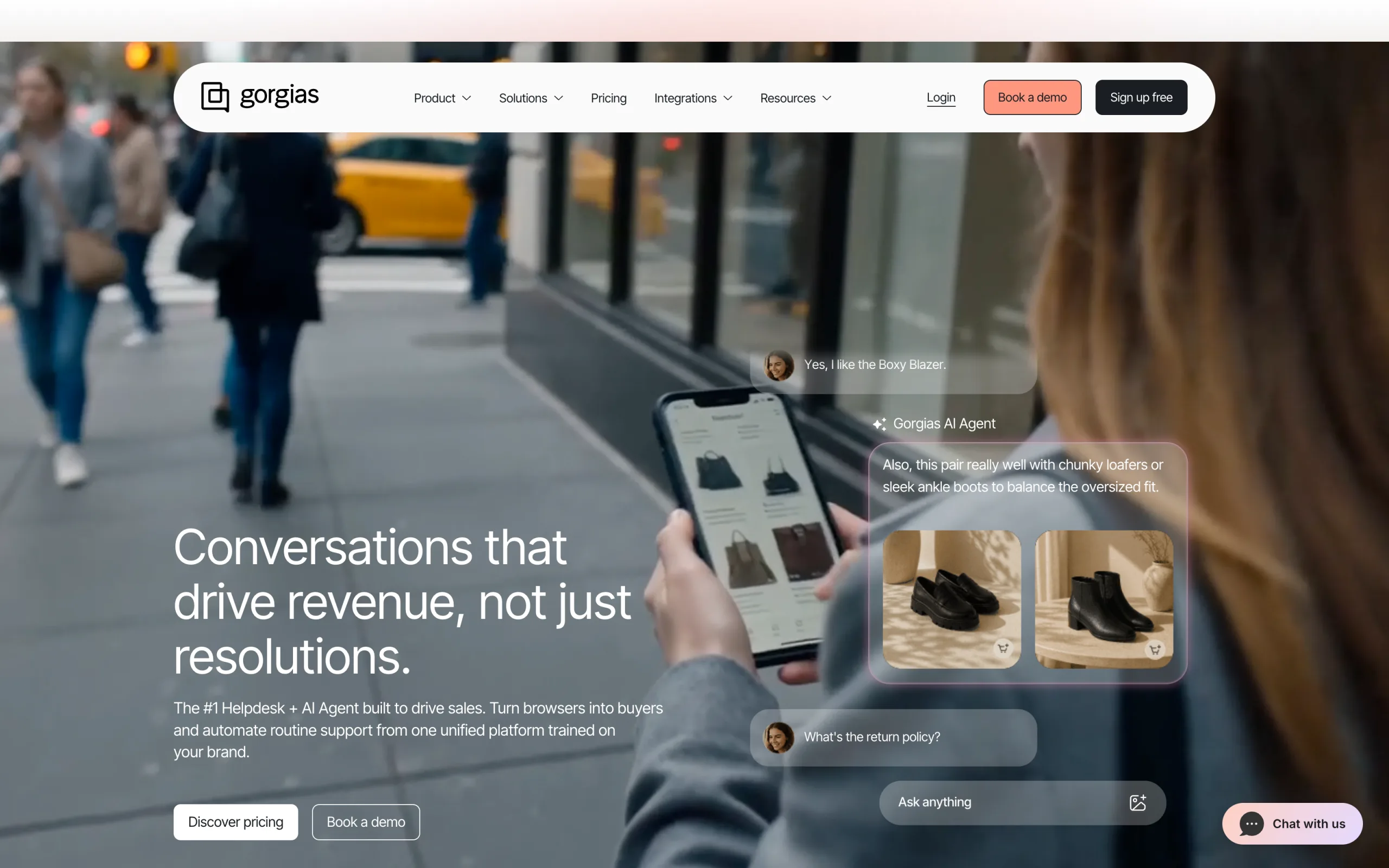
AI Ecommerce Automation with Gorgias
Gorgias is a helpdesk built specifically for online stores, and its AI Agent is the automation piece: it answers customers and takes action on their orders. Connected to your store, the agent can look up tracking, start a return, issue a refund against your policy, edit a subscription, or update a shipping address inside the conversation, without a human touching the ticket.
That action-taking is what separates it from generic chatbots. A "where is my order" ticket gets resolved with live order data, not a canned reply. Gorgias markets the AI Agent as able to handle up to 60 percent of email and chat volume, and pricing is tied to outcomes: you pay per conversation the AI actually resolves.
Key features
- AI Agent that resolves tickets end to end on email and chat
- Real order actions: refunds, returns, order edits, address changes, subscription changes
- Unified inbox across email, chat, social, and voice channels
- Automation rules and macros for repetitive replies
- Pre-purchase shopping assistant that recommends products and answers sizing questions
- Ticket allowances scale from 50 to 5,000 per month without per-agent pricing
Best for
- Direct-to-consumer brands drowning in repetitive support tickets
- Stores that want support automation to actually execute refunds and edits, not just deflect
Pricing
- Helpdesk plans start from $10 per month (Starter, 50 tickets), with Basic at $60 per month for 300 tickets
- AI Agent is billed per resolved conversation, about $1 per resolution on monthly billing ($0.90 on annual)
- Overage fees apply beyond each plan's included ticket allowance
Pros
- Automation resolves tickets with real actions instead of deflecting them
- Outcome-based AI pricing means you pay only for resolved conversations
- Purpose-built for ecommerce, so store integrations are first-class
Cons
- Combined ticket fees plus per-resolution fees make costs harder to predict at scale
- SMS support requires a separate add-on
3. Zapier, best for cross-app workflow automation and AI agents
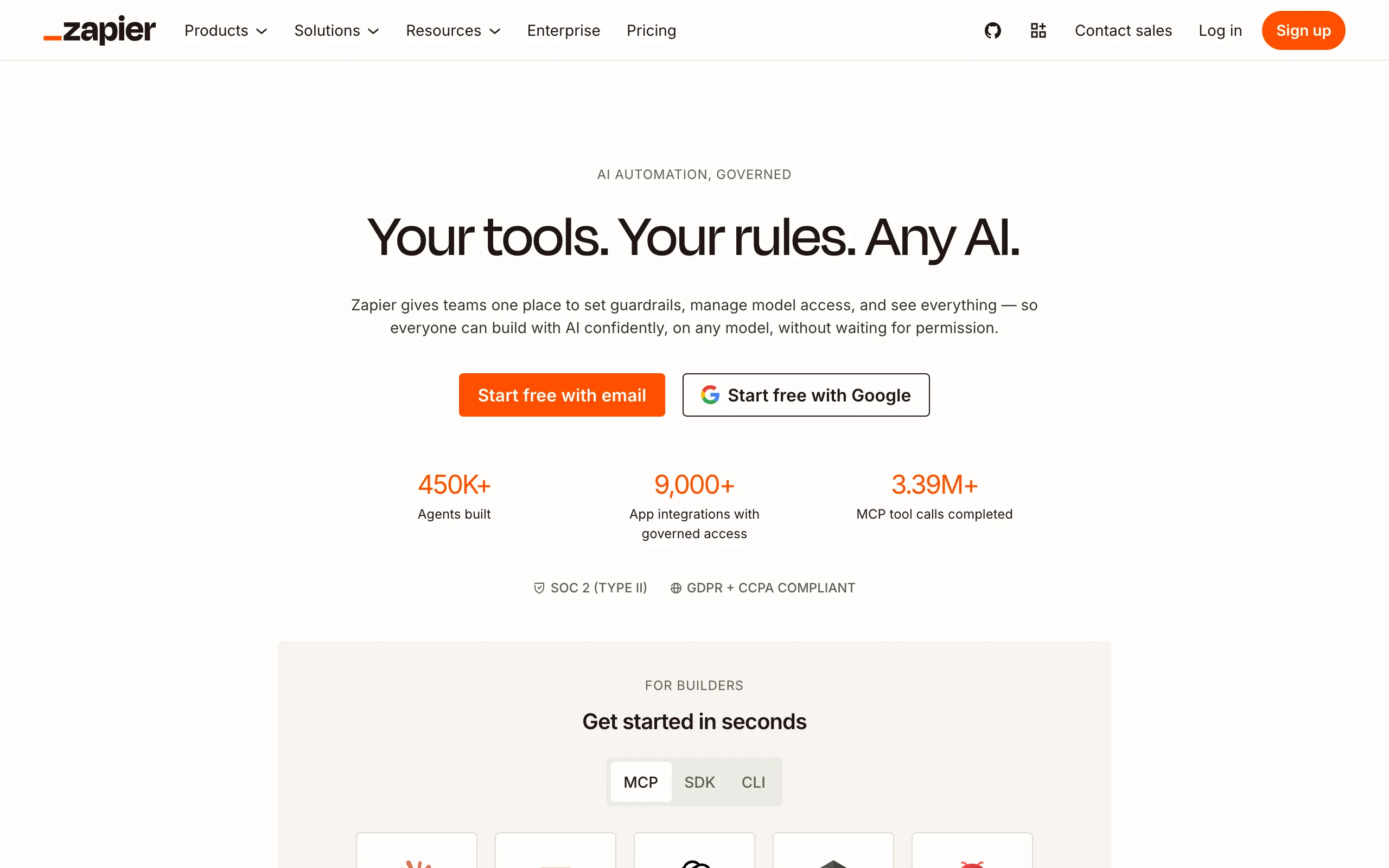
AI Ecommerce Automation with Zapier
Zapier is the connective tissue between every other tool on this list. It links 9,000+ apps, so when something happens in one system (a new order, a refund, a low-stock alert), Zapier can push data and trigger actions anywhere else: your spreadsheet, your Slack, your accounting tool, your ad platform.
The AI layer has grown well beyond simple triggers. Copilot builds workflows from a plain-language description, AI by Zapier adds steps that extract data, classify messages, or draft content inside a workflow, and Zapier Agents run autonomously against goals like scoring leads or routing tickets. For ecommerce operators, it is the fastest way to automate the glue work no single-purpose tool covers.
Key features
- 9,000+ app integrations, the largest catalog in the category
- Copilot that builds workflows from a text description
- AI by Zapier steps for extraction, classification, and content generation inside flows
- Autonomous AI agents that work toward goals across your tools
- Multi-step workflows with branching, filters, and scheduling
- SOC 2 Type II compliance for teams with security requirements
Best for
- Operators stitching together a stack of specialized tools without developers
- Teams automating back-office busywork: reporting, tagging, notifications, data syncs
Pricing
- Free plan includes 100 tasks per month
- Professional plans start from $19.99 per month billed annually ($29.99 monthly)
- Team plans from $69 per month billed annually
Pros
- Automates the gaps between tools that nothing else on this list covers
- No-code, and the AI Copilot lowers the bar further
- Free tier is genuinely usable for light automations
Cons
- Task-based pricing gets expensive for high-volume stores
- It orchestrates other tools rather than replacing any of them, so it is an addition to your stack, not a consolidation
4. Rebuy, best for onsite personalization on Shopify
AI Ecommerce Automation with Rebuy
Rebuy automates merchandising decisions on Shopify storefronts. Instead of manually curating which products to cross-sell where, its AI decides what each shopper sees: recommendations on the product detail page, upsells in the cart, offers at checkout, and a personalized post-purchase page after payment.
The Smart Cart is the flagship: a customizable cart with built-in AI recommendations designed to lift average order value. Around it sit Smart Search, dynamic bundles, checkout extensions for Shopify Plus, and no-code Smart Flows for building personalized journeys. Rebuy reports its merchants have generated $3.8B+ in additional revenue through the platform.
Key features
- Smart Cart with AI-driven upsells and cross-sells
- Personalized recommendation widgets for any page
- Post-purchase offers between checkout and the thank-you page
- AI-powered Smart Search with personalized results
- Dynamic bundles and a no-code bundle builder
- A/B testing to validate what actually lifts revenue
Best for
- Shopify and Shopify Plus brands focused on raising average order value
- Merchandising teams that want personalization without engineering sprints
Pricing
- Free Monetize tier (earns revenue from partner offers on your post-purchase page)
- Build-your-own plans start from $25 per month with a 14-day free trial
- The full Platform One suite starts at $534 per month with a 30-day free trial and a 10 percent annual-billing discount
Pros
- Covers the whole onsite journey from product page to post-purchase in one system
- Modular pricing lets smaller stores start with just the pieces they need
- A/B testing is built in, so revenue claims can be verified on your own traffic
Cons
- Shopify-only, so it is off the table for other platforms
- Order-volume-based pricing means costs rise as you grow, and the full suite is a real budget line
5. Hypotenuse AI, best for product content automation at catalog scale
AI Ecommerce Automation with Hypotenuse AI
Hypotenuse AI automates the writing work behind a product catalog. Rather than a general-purpose AI writer, it is built as an AI-first product experience management (PXM) platform: it generates on-brand product descriptions, titles, and meta content in bulk, enriches missing product attributes, and keeps everything consistent across thousands of SKUs.
That governance angle matters for larger catalogs. The platform tags and categorizes products, follows your brand voice rules, supports 40+ languages, and plugs into PIM and ERP systems, so generated content flows into the systems your team already uses. It also optimizes copy for both traditional search and AI-driven search results.
Key features
- Bulk product description generation with brand voice controls
- Product attribute enrichment, tagging, and categorization
- 20+ content types including meta titles, category pages, and blog articles
- 40+ language support for international catalogs
- Custom PIM and ERP integrations for enterprise workflows
- SOC 2 compliance and AI image editing for catalog visuals
Best for
- Retailers and marketplaces with thousands of SKUs and thin or inconsistent product data
- Teams localizing product detail pages into multiple languages
Pricing
- Custom pricing: a Basic plan for catalogs under 100 products and an Ecommerce Enterprise plan for larger teams
- Free trial available with no credit card required
- Exact rates require contacting sales
Pros
- Built for catalog structure and governance, not one-off copywriting
- Attribute enrichment fixes the messy product data that blocks other automations
- Enterprise integrations mean content lands where it is needed
Cons
- No public pricing makes budgeting harder for small stores
- Overkill if you only need a few dozen descriptions written
6. Creatify, best for automating ad creative production
AI Ecommerce Automation with Creatify
Creatify automates the most expensive bottleneck in paid social: making the ads. Paste a product URL and it generates video ads with AI avatars presenting your product, ready for TikTok, Meta, and Google. The pitch is scale, from 10 ads a month to 10,000, which matches how performance marketing actually works in 2026: test many creatives, kill losers fast.
For ecommerce teams, that means creative iteration stops depending on shoots, editors, or agencies. You can produce dozens of variations of hooks, scripts, and formats from the same product page, push them into your ad account, and let performance data pick winners.
Key features
- Product URL to video ad generation in minutes
- Hundreds of AI avatars, with custom avatar options on higher plans
- Script generation and text-to-speech voiceovers
- 200+ ad templates for social formats
- Batch creation for testing many creative variations
- Team seats for collaborative workflows on the Pro plan
Best for
- Stores spending on TikTok, Meta, or Google ads that need creative volume
- Lean teams replacing agency retainers for everyday performance creative
Pricing
- Free plan with 10 credits per month (enough for about 2 video ads, watermarked)
- Starter at $39 per month for 100 credits
- Pro at $99 per month for 300 credits and up to 5 team seats; enterprise plans are custom
Pros
- Removes the production bottleneck from creative testing
- Credit model maps cleanly to how many ads you actually produce
- Free tier lets you judge output quality before paying
Cons
- AI avatar ads have a recognizable look, and quality varies by product category
- Winning creative still needs human strategy; volume alone does not fix weak offers
7. Prisync, best for competitor price tracking and dynamic repricing
AI Ecommerce Automation with Prisync
Prisync automates a job most stores do badly in spreadsheets: knowing what competitors charge and reacting to it. It monitors competitor product pages and updates prices up to 3 times a day, then its Dynamic Pricing Engine applies your rules automatically, for example staying 2 percent below a named competitor while protecting your margin floor.
This is quiet, back-office automation with a direct profit impact. Price too high on a comparison-shopped stock keeping unit and you lose the sale; too low and you burn margin. Automated repricing keeps every SKU inside the band you define without anyone checking dashboards daily.
Key features
- Competitor price and stock monitoring with updates up to 3 times daily
- Dynamic Pricing Engine for automated rule-based repricing
- Margin-aware rules so automation never prices below your floor
- Price history tracking on higher tiers
- Email alerts on competitor price movements
- API access for feeding pricing data into other systems
Best for
- Stores selling comparison-shopped products (electronics, appliances, sporting goods) where price drives the buying decision
- Teams managing hundreds to thousands of SKUs across competitor sets
Pricing
- URL-based plans start at $99 per month for up to 100 products
- The Premium plan at $199 per month (up to 1,000 products) adds the Dynamic Pricing Engine
- Platinum at $399 per month covers up to 5,000 products; 14-day free trial, no credit card required; API access costs an extra 20 percent
Pros
- Direct, measurable margin impact from day one
- Rule-based repricing keeps a human-defined guardrail on the automation
- Transparent, product-count-based pricing
Cons
- Dynamic repricing requires the mid tier, not the entry plan
- Less useful for unique or own-brand products with no direct competitor prices
8. Prediko, best for AI inventory forecasting on Shopify
AI Ecommerce Automation with Prediko
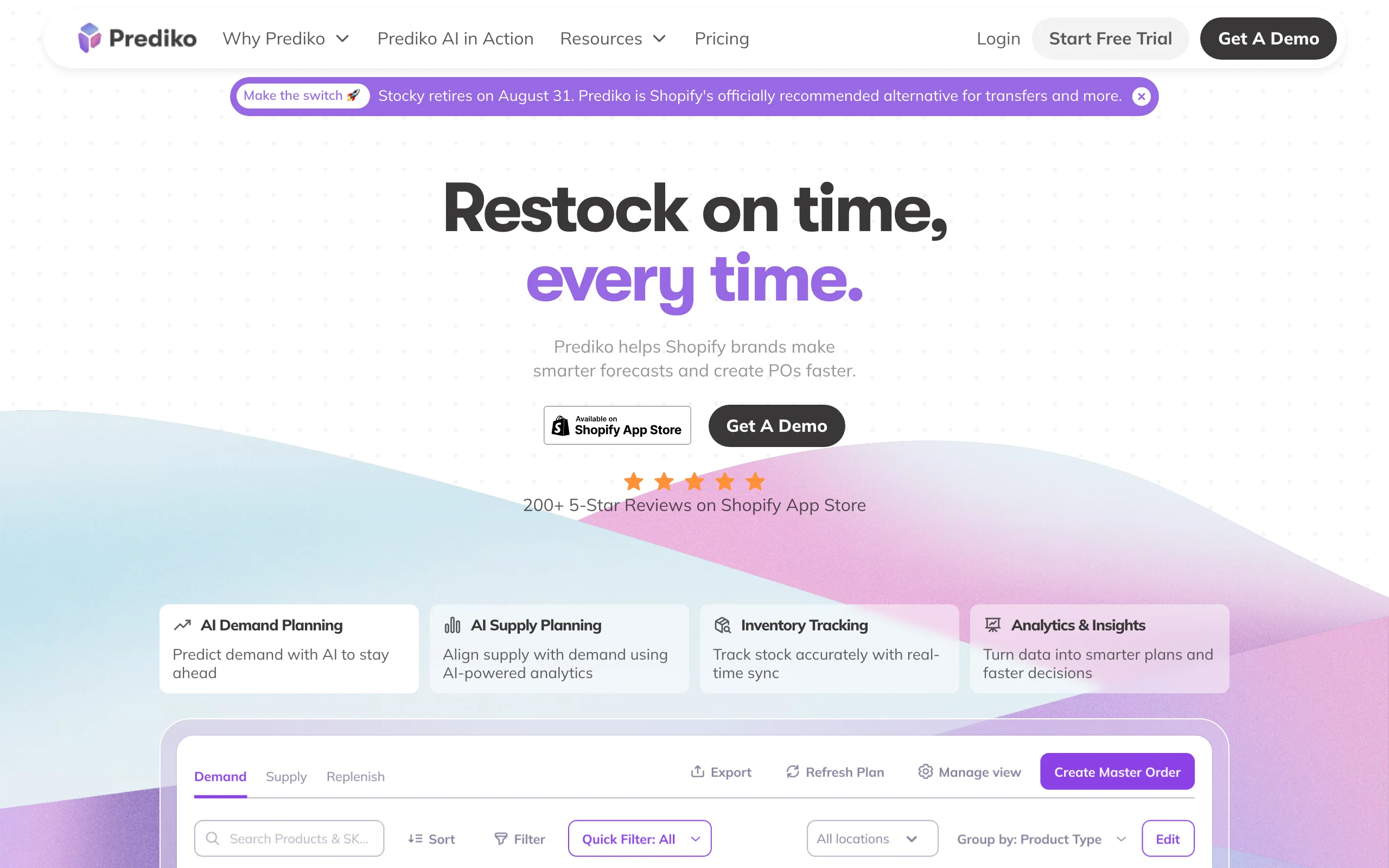
Prediko automates the least glamorous, highest-stakes decision in ecommerce: how much stock to buy and when. It ingests your Shopify sales history, forecasts demand per SKU with AI, and turns those forecasts into buying alerts and ready-to-send purchase orders. With Shopify's own Stocky app retiring, Prediko positions itself as the natural replacement for Stocky users.
The workflow covers demand planning, supply planning, and inventory tracking with real-time sync, plus an AI assistant (Pia) you can query about stock positions in plain language. For growing brands, that replaces the weekly spreadsheet ritual where overbuying ties up cash and underbuying kills the sell-through of your best products.
Key features
- AI demand forecasting per SKU from live Shopify data
- Buying alerts and purchase order creation in one flow
- Unlimited users, SKUs, and purchase orders on all plans
- Multi-store and multi-location support
- Pia, an AI inventory assistant for plain-language stock queries
- Raw materials and bill-of-materials forecasting as an add-on
Best for
- Shopify brands past the spreadsheet stage of inventory planning
- Operators who want restock decisions backed by forecasts, not gut feel
Pricing
- From $49 per month for stores under $100k GMV in the trailing 12 months, scaling with GMV
- 14-day free trial, billed through Shopify Billing
- Raw materials and BOM forecasting add-on at $20 per month
Pros
- Forecast-to-purchase-order workflow, not just reporting
- Unlimited SKUs and users at every tier
- GMV-based pricing stays cheap for smaller stores
Cons
- Shopify-only, so multi-platform sellers need something else
- Forecast quality depends on clean sales history; new stores with thin data get weaker predictions
How to choose the best AI ecommerce automation tools for your store
1) Automate revenue moments or back-office work first?
Revenue-side automation (marketing, personalization, support) shows up in this month's numbers. Back-office automation (repricing, inventory, content) compounds more quietly.
- If you need visible wins fast: start with Klaviyo for owned-channel revenue and Gorgias to cut support load
- If margins and cash flow are the pain: Prisync and Prediko attack pricing and stock, the two biggest silent profit leaks
Most stores sequence it: one revenue tool, then one operations tool, rather than adopting five platforms in a quarter.
2) Point solutions or connective automation?
Every tool here except Zapier automates one domain deeply. Zapier automates the seams between them.
- If your pain lives inside one function (support tickets piling up, ad creative too slow): buy the point solution for that function
- If your pain is glue work (copying data between systems, manual reports, unrouted notifications): Zapier fixes more per dollar than any single-domain tool
For a broader look beyond automation, including SEO, imagery, and copywriting picks, see our roundup of AI tools for ecommerce teams across every category.
3) Match the pricing model to your volume
Each tool on this list bills on a different axis: Klaviyo on contacts, Gorgias on tickets and resolutions, Zapier on tasks, Rebuy and Prediko on order volume or GMV, Creatify on credits, Prisync on product count.
- Model your real monthly volume before committing; a $49 entry price can become a four-figure bill at scale
- Favor outcome-linked pricing (like Gorgias's per-resolution fee) when you are unsure of adoption, and flat product-count pricing (like Prisync) when volume is predictable
- Run every free tier and trial against your live data first; 14 days of real tickets or real SKUs tells you more than any demo
4) Check platform fit before falling for features
Rebuy and Prediko are Shopify-only. Klaviyo, Gorgias, Zapier, Prisync, Creatify, and Hypotenuse AI work across platforms.
- If you are on Shopify: the whole list is open to you, and the Shopify-native tools integrate deepest
- If you sell on BigCommerce, WooCommerce, or Magento: shortlist the platform-agnostic six and verify your specific integration before buying
FAQ
What are AI ecommerce automation tools?
AI ecommerce automation tools are software that handles repetitive store operations, such as email marketing, support tickets, pricing, and inventory planning, using AI to make decisions a human would otherwise make manually. Unlike simple rule-based automation, they adapt to data: forecasting demand, personalizing recommendations, or writing responses in context.
What should an online store automate first?
Start where the manual hours are worst. For most stores, that is either email marketing (Klaviyo can rebuild your flows in an afternoon) or customer support, where a tool like Gorgias can resolve a large share of repetitive tickets. Both show measurable results within one billing cycle.
Are there free AI ecommerce automation tools?
Several tools here have usable free tiers: Klaviyo (up to 250 profiles), Zapier (100 tasks per month), Creatify (10 credits per month), and Rebuy's Monetize tier. Free tiers are best treated as extended trials; meaningful volume eventually needs a paid plan.
Which AI automation tools work best for Shopify stores?
All 8 tools in this guide integrate with Shopify, but Rebuy and Prediko are built exclusively for it, which makes their integrations the deepest. Prediko also markets itself as a replacement for Shopify's retiring Stocky app. Platform-agnostic tools like Klaviyo, Gorgias, and Zapier also treat Shopify as a first-class integration.
How much do AI ecommerce automation tools cost?
Entry points range from free tiers to about $99 per month, but almost every tool scales its price with your volume: contacts, tickets, tasks, orders, products, or GMV. A realistic mid-size store budget for a stack of three to four tools is a few hundred dollars per month, which typically still undercuts the manual labor it replaces.
Can AI fully replace a customer support team?
No, and the honest vendors do not claim it. Gorgias markets its AI Agent at up to 60 percent of email and chat volume, which matches the realistic ceiling: repetitive tickets automate well, while complex complaints, edge cases, and high-value customers still need humans. The win is that your team handles only the conversations that need judgment.
Do these tools actually improve conversion rate?
Automation lifts conversion indirectly but measurably: faster support answers keep buyers from abandoning, personalized recommendations surface the right products, and competitive pricing wins comparison shoppers. Tools with built-in A/B testing, like Rebuy, let you verify the lift on your own traffic. For the on-page side of the equation, see our step-by-step guide to raising your store's conversion rate.
Do I need developers to run AI automation?
For everything in this list, no. These tools are no-code by design: Klaviyo flows, Zapier workflows, Rebuy widgets, and Prediko purchase orders are all built in visual interfaces. Developers only enter the picture for custom API work, such as feeding Prisync pricing data into an in-house system.

WearView Team
WearView Content & Research Team
WearView Team is a group of fashion technology specialists focused on AI fashion models, virtual try-on, and AI product photography for e-commerce brands. We publish in-depth guides, case studies, and practical insights to help fashion businesses improve conversion rates and scale faster using AI.