
April 1, 2026•27 min read
10 Best AI Tools for E-commerce in 2026
Compare the 10 best AI tools for ecommerce in 2026. Covers product imagery, copywriting, email marketing, customer service, SEO, personalization, and inventory.
Picture of 10 best AI tools for ecommerce in 2026 article
AI tools have reshaped how ecommerce teams operate, from generating product photos to writing descriptions, forecasting demand, and personalizing the shopping experience. The challenge is no longer whether to use AI but which tools deserve a spot in your stack.
In this guide, we compare the 10 best AI tools for ecommerce in 2026, spanning product imagery, copywriting, email marketing, customer service, SEO, personalization, and search optimization. Each tool is evaluated on pricing, key strengths, and which type of ecommerce business it fits best.
Best AI tools for ecommerce: a brief overview
If you need AI-powered product imagery:
- Start with WearView for the most complete fashion photography workflow: virtual try-on, AI model creation, product-to-model conversion, and video in one platform.
- Use Canva for affordable, all-in-one design with AI background removal and image generation, especially if you also need listing and social graphics.
If you need AI content and marketing automation:
- Use Jasper AI for product descriptions, ad copy, and marketing content at scale with brand voice consistency.
- Use Klaviyo for AI-driven email and SMS campaigns with deep ecommerce data integrations.
If you need AI customer service and operations:
- Use Gorgias for purpose-built ecommerce support with proactive AI agents that drive conversions.
- Use HubSpot Breeze Customer Agent for AI-powered customer engagement that can answer questions, qualify buyers, resolve common inquiries, and hand conversations off to your team when needed.
- Use Shopify Magic if you're on Shopify and want free AI tools built directly into your admin.
If you need AI-driven growth and optimization:
- Use Surfer SEO for content that ranks in search engines and AI overviews.
- Use Nosto for personalized product recommendations and shopping experiences.
- Use YesPlz AI for autonomous AI-powered fashion search optimization.
| Tool name | Key strength | Pricing | Platforms |
|---|---|---|---|
| WearView | Complete fashion AI suite: try-on, model creation, and video | From $29/month | Web |
| HubSpot Breeze Customer Agent | AI-powered customer engagement and support | HubSpot subscription + usage-based credits | Web + integrations |
| Shopify Magic | Free AI suite built into Shopify admin | Free with any Shopify plan (from $39/month) | Shopify admin |
| Klaviyo | AI email and SMS marketing with deep ecommerce data | Free up to 250 contacts; from $20/month | Web + integrations |
| Jasper AI | AI copywriting with brand voice training | From $59/month; 7-day free trial | Web + browser extension |
| Canva | All-in-one design with AI background removal and image gen | Free tier; Pro from ~$15/month | Web, iOS, Android, desktop |
| Gorgias | AI customer service built for ecommerce | From $10/month; AI Agent at $1.00/resolved | Web + integrations |
| Surfer SEO | AI content optimization with real-time scoring | From $49/month | Web + integrations |
| Nosto | AI personalization and product discovery | Performance-based custom pricing | Web + integrations |
| YesPlz AI | Autonomous AI fashion search optimization | Monthly subscription based on SKU size | Web + integrations |
1. WearView, best overall for AI product imagery
Product photography is the backbone of any fashion ecommerce store, and it's also one of the most expensive line items. WearView is a complete AI fashion photography platform that handles the full visual content pipeline. Upload your flat-lay, ghost mannequin, or packshot image, choose from a diverse range of AI models across different ethnicities, body types, and age groups, and describe the background or setting you want. The tool generates professional on-model photos in about 90 seconds.
WearView lets you create full fashion campaigns from product shots to lifestyle images. You can style complete outfits by manually pairing garments with models or by describing the look in a text prompt. Each model can be customized with specific poses using reference images through the AI pose control tool, but you can also describe any pose and background via text. Beyond product-to-model, the platform includes virtual try-on, AI model creation from text prompts, consistent model identity for brand campaigns, ghost mannequin generation, and AI fashion video, all in one workspace.
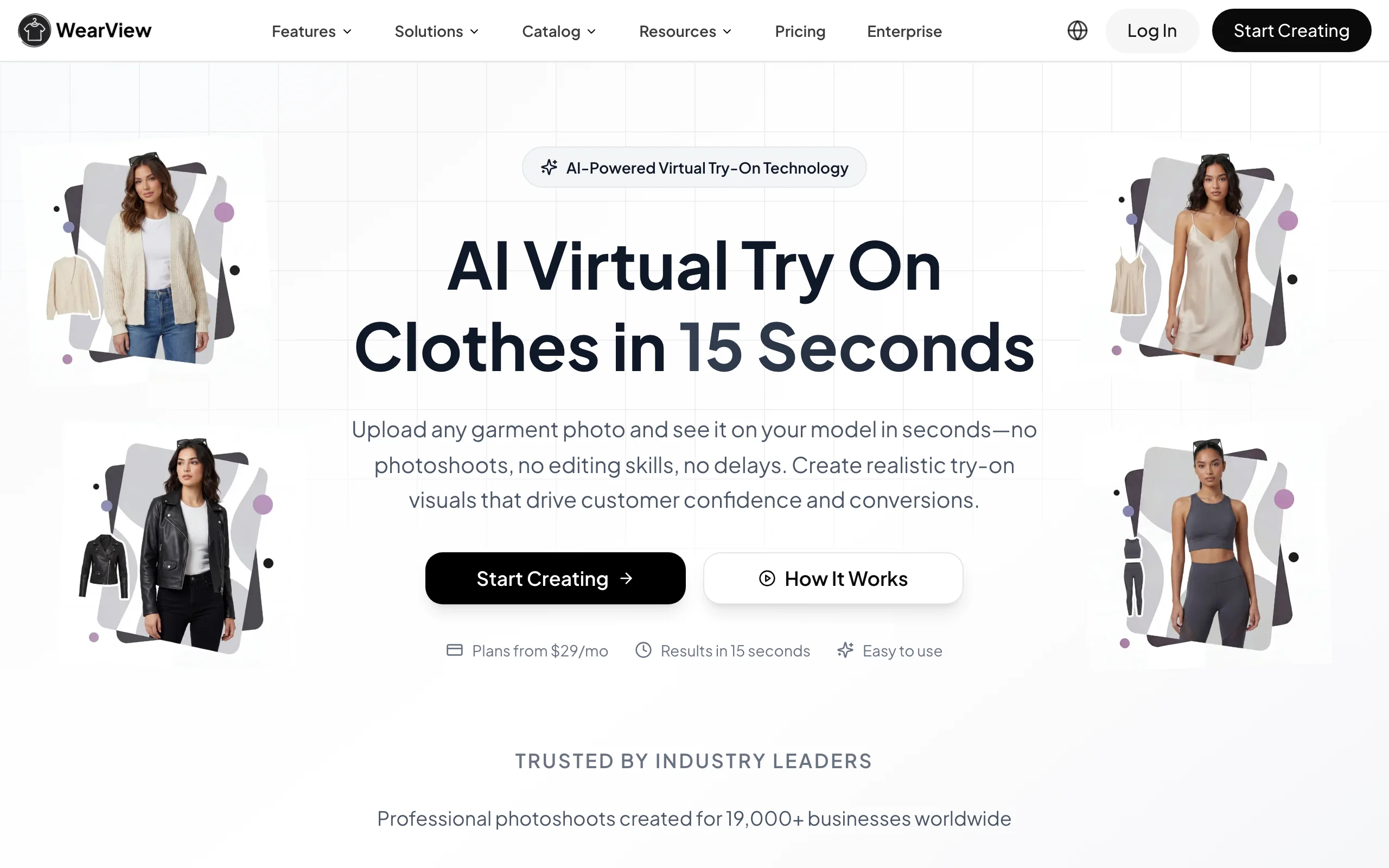
AI Tools for Ecommerce with WearView
Key features
- Virtual try-on with garment detail preservation (prints, textures, logos, text)
- AI model creation from text prompts with 100+ pre-built diverse models
- Product-to-model conversion from flat-lay, ghost mannequin, and packshot images
- Consistent model personas across products and campaigns
- AI pose control with reference-based generation
- AI fashion video generation at 720p and 1080p
- HD, 2K, and 4K output with commercial usage rights
Best for
- Fashion and apparel brands that need studio-quality on-model product photos without traditional photoshoots
- Ecommerce sellers managing large catalogs across Shopify, Amazon, Etsy, and other marketplaces
- Teams that want try-on, model creation, and video in one platform without juggling multiple tools
Pricing
- Lite: $29/month (50 credits)
- Pro: $49/month (200 credits)
- Advanced: $99/month (500 credits)
- Add-on credit packs available for one-off top-ups
Pros
- Seven AI tools in one platform covers the full fashion photography pipeline
- Strong garment detail preservation across prints, textures, and logos
- Consistent model identity keeps brand visuals coherent across campaigns
- Multiple resolution options up to 4K for high-quality PDP imagery
Cons
- Fashion-focused, less useful for non-apparel product categories
- No native Shopify app or public API for automated workflows
- Credit-based pricing requires planning for high-volume catalog refreshes
2. HubSpot Breeze Customer Agent, best AI customer agent for connected ecommerce engagement
HubSpot Breeze Customer Agent is an AI-powered agent that helps businesses handle customer conversations across marketing, sales, and service. It can answer common questions, qualify potential buyers, resolve customer inquiries, and provide personalized responses using approved business content such as website pages, blogs, and knowledge base articles.
Because Customer Agent works within HubSpot's customer platform, it can use CRM data and conversation history to provide more relevant responses and keep customer interactions connected. It can also identify when human attention is needed and hand conversations over to the appropriate team, making it useful for ecommerce businesses that want to automate repetitive interactions without completely removing human support.
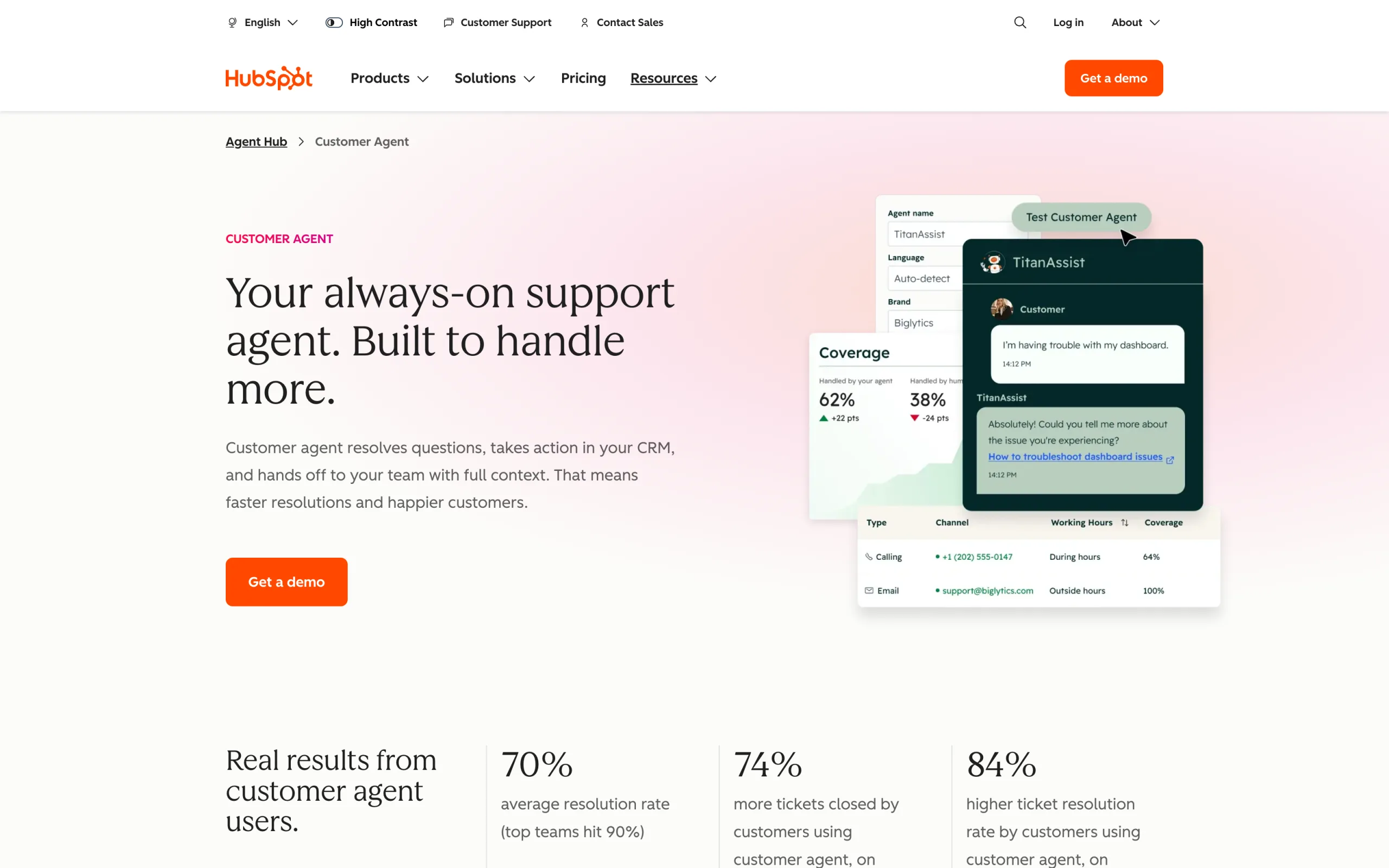
AI Customer Engagement with HubSpot Breeze Customer Agent
Key features
- 24/7 AI-powered customer conversations
- Answers grounded in approved website, blog, and knowledge base content
- AI-powered lead qualification and buyer assistance
- Automated resolution of common customer inquiries
- CRM and conversation context for more personalized responses
- Human handoff for conversations requiring additional support
Best for
- Ecommerce teams that want to automate repetitive customer and pre-sale questions
- Growing businesses that want AI support across marketing, sales, and customer service
- Teams using HubSpot that want AI conversations connected with their CRM and customer data
Pricing
- Available with eligible HubSpot Professional and Enterprise subscriptions
- Customer Agent usage requires HubSpot Credits
- Usage and credit requirements vary depending on the HubSpot subscription and level of Customer Agent activity
Pros
- Handles both customer service inquiries and pre-sale conversations
- Can qualify potential buyers in addition to answering customer questions
- Uses CRM and conversation history to provide additional context
- Works with existing business content rather than requiring responses to be built entirely from scratch
- Keeps AI-powered customer conversations connected to HubSpot's broader CRM
Cons
- Less ecommerce-specific than dedicated retail customer service platforms
- Does not provide Shopify-native store management features such as order editing or inventory management
- Best suited to businesses already using or considering the HubSpot ecosystem
- Higher Customer Agent usage may require additional HubSpot Credits
3. Shopify Magic, best free AI suite for Shopify merchants
If your store runs on Shopify, you already have a set of AI tools built into your admin at no extra cost. Shopify Magic generates product descriptions from a few keywords, writes email campaign copy with subject lines and CTAs, removes and replaces product image backgrounds, and suggests customer chat responses through Shopify Inbox. If you run a clothing store specifically, our best AI tools for Shopify clothing stores guide narrows the field further.
Sidekick, the conversational AI assistant, lets you manage store tasks through natural language. Ask it to create a discount code, analyze sales trends, or adjust your theme, and it handles the execution inside your Shopify admin. Shopify shipped over 150 AI-focused updates in its Winter 2026 Edition, including brand voice cloning from your past content, so generated copy matches your store's tone.
AI Tools for Ecommerce with Shopify Magic
Key features
- AI product description generation with customizable tone and length
- Email campaign copy with AI-generated subject lines and CTAs
- Background removal and scene generation for product images
- Sidekick AI assistant for store management via natural language
- Brand voice cloning from past content for consistent copy
- Shopify Inbox AI-suggested customer chat responses
Best for
- Shopify merchants who want AI capabilities without adding another tool to their stack
- Small stores and solopreneurs who need quick product descriptions and email copy
- Merchants already paying for Shopify who want to maximize their existing subscription
Pricing
- Free with any Shopify plan (Basic Shopify starts at $39/month)
- No additional cost for AI features
- Included on all plan tiers: Basic, Shopify, Advanced, and Plus
Pros
- Completely free for existing Shopify merchants
- Deeply integrated into the store admin, no context switching needed
- Sidekick handles operational tasks through natural language
- Covers multiple AI use cases: copy, images, chat, and store management
Cons
- Only available to Shopify merchants, not platform-agnostic
- Image editing is basic compared to dedicated tools like WearView or Canva
- Product descriptions can be generic without careful prompt engineering
- No fashion-specific features like virtual try-on or on-model generation
4. Klaviyo, best for AI-powered email and SMS marketing
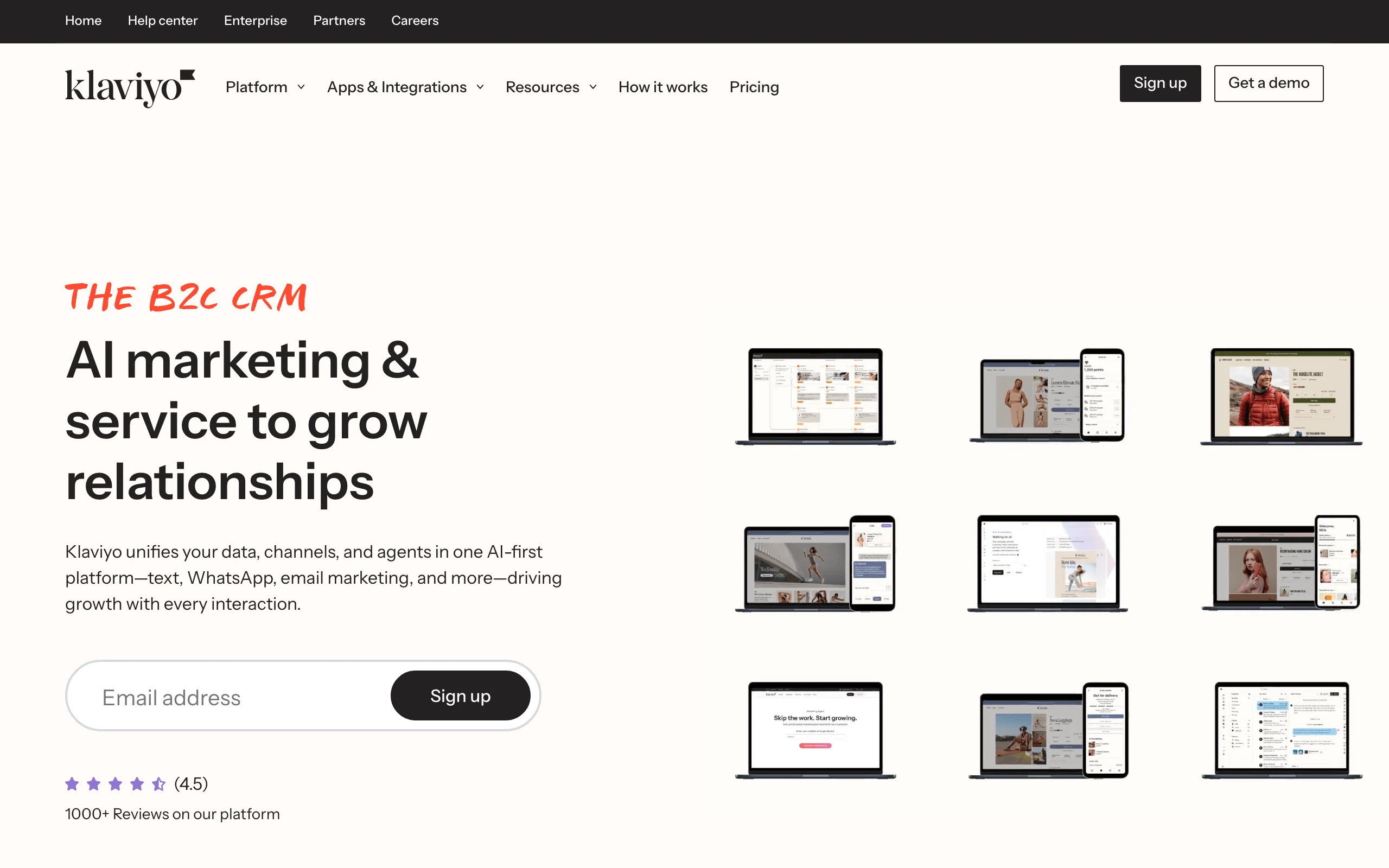
Klaviyo is the dominant email and SMS marketing platform for ecommerce, and its AI features have matured significantly. The platform pulls in purchase history, browsing behavior, and customer lifecycle data from your store, then uses that data to power automated flows: abandoned cart recovery, post-purchase sequences, winback campaigns, and personalized product recommendations.
The K:AI Marketing Agent creates campaign content automatically, from subject lines to full email body copy. Smart Send Time optimization delivers emails when each individual subscriber is most likely to engage. The platform's predictive analytics forecast customer lifetime value and churn risk, so you can segment and target accordingly. With 350+ pre-built integrations (Shopify, WooCommerce, BigCommerce, and more), Klaviyo fits into nearly any ecommerce stack.
AI Tools for Ecommerce with Klaviyo
Key features
- K:AI Marketing Agent for automated content creation
- Smart Send Time optimization per subscriber
- Predictive analytics for CLV and churn risk
- AI subject line and SMS copy generation
- Advanced segmentation with behavioral and purchase data
- 350+ pre-built integrations with ecommerce platforms and tools
- Automated flows: abandoned cart, post-purchase, winback, welcome series
Best for
- DTC brands and ecommerce stores that rely on email and SMS as primary revenue channels
- Merchants on Shopify, WooCommerce, or BigCommerce who want deep data-driven marketing
- Growing brands that need predictive analytics to segment and target high-value customers
Pricing
- Free plan: up to 250 active profiles, 500 email sends/month
- Email plans start from $20/month (251-500 profiles)
- Pricing scales with contact list size
- SMS and MMS add variable costs
Pros
- Deep ecommerce platform integrations with real purchase and browsing data
- Predictive analytics for CLV and churn are genuinely actionable
- Free tier is generous enough for early-stage stores to start
- Automated flows cover the full customer lifecycle out of the box
Cons
- Gets expensive as your contact list grows past 10,000+ profiles
- SMS costs add up quickly and are billed separately
- Steep learning curve for advanced segmentation and flow building
- Template editor can feel clunky compared to dedicated design tools
5. Jasper AI, best for AI copywriting at scale
Writing product descriptions for hundreds of SKUs, seasonal ad copy across channels, and weekly email campaigns is a content bottleneck for most ecommerce teams. Jasper AI tackles this with brand voice training: feed it your existing copy, style guides, and tone preferences, and it generates new content that sounds like your brand, not like generic AI output.
The platform includes 50+ content templates covering product descriptions, Google Ads, Facebook ad copy, email subject lines, blog posts, and social captions. Pro plans add AI image generation, so you can create ad creative alongside the copy. Multi-language support handles localization for international stores. Jasper's Workflows feature chains multiple generation steps together, so you can go from product spec to full listing copy in one automated sequence.
AI Tools for Ecommerce with Jasper AI
Key features
- Brand Voice training that analyzes your existing content tone and style
- 50+ content templates for product descriptions, ads, emails, and social
- AI image generation included in Pro plans
- Multi-language content generation for international stores
- Workflows for multi-step automated content creation
- Google Docs, WordPress, and browser extension integrations
- Team collaboration with shared brand assets and templates
Best for
- Ecommerce teams writing product descriptions for large catalogs (100+ SKUs)
- Marketing teams producing ad copy across Google, Meta, and social channels
- Brands selling internationally that need content in multiple languages
Pricing
- Pro: $59/month (billed annually) or $69/month
- Business: custom pricing
- 7-day free trial on the Pro plan
- The entry-level Creator plan ($39/month) was retired in 2026, so Pro is now the cheapest way in
Pros
- Brand Voice training produces noticeably more consistent output than generic AI
- Template library covers the full ecommerce content spectrum
- Workflows automate multi-step content creation (spec to listing in one pass)
- Image generation on Pro eliminates the need for a separate design tool for ads
Cons
- Expensive for solo sellers or small stores ($59/month minimum since the Creator plan was retired)
- Output quality varies by template and requires editing for nuance
- Brand Voice setup takes time to train properly
- Primarily text-focused: for fashion product imagery, a dedicated tool like WearView covers more ground
6. Canva, best for affordable all-in-one design and product visuals
Canva is the go-to all-in-one design tool for ecommerce sellers who want to handle product visuals, listing graphics, and social creatives in one affordable app. Its AI suite, Magic Studio, includes a one-click Background Remover that cleanly cuts products out of busy photos, plus Magic Media and Magic Background for generating fresh backdrops and scenes from a text prompt, no physical studio required. You can then polish shots with Magic Edit, Magic Eraser, and Magic Expand.
Canva runs on the web, iOS, Android, and desktop, so you can edit product photos on your phone right after shooting them. A genuinely useful free tier lets you test templates and basic design before upgrading, and a library of 1.6M+ templates covers marketplace listings, ads, and social posts. For specialized, high-volume product photography, such as batch background removal or fashion on-model generation, you'll want a dedicated platform like WearView, but for affordable, everyday design and light product-photo editing across all categories, Canva is hard to beat on value.
AI Tools for Ecommerce with Canva
Key features
- One-click Background Remover for clean product cutouts (Canva Pro)
- Magic Media text-to-image and Magic Background for AI-generated backdrops and scenes
- Magic Edit, Magic Eraser, and Magic Expand for photo touch-ups
- 1.6M+ templates for listings, ads, and social posts
- Magic Write for on-brand product copy and captions
- Bulk Create for data-driven design at scale
- Available on web, iOS, Android, and desktop
Best for
- Marketplace sellers (Amazon, eBay, Etsy) who need clean product images plus listing and ad graphics in one tool
- Mobile-first sellers who edit product photos on their phone right after shooting
- Multi-category stores and solo sellers who want affordable, general-purpose design, not a fashion-specific engine
Pricing
- Free: generous forever-free plan with limited monthly AI uses
- Pro: ~$15/month or $120/year (unlocks Background Remover and 500 AI credits/month)
- Business: $20/user/month or $200/user/year for teams
- Enterprise: custom pricing for larger organizations
Pros
- Free tier plus an affordable ~$15/month Pro plan make it low-cost to start
- Genuinely all-in-one: background removal, AI backgrounds, design, and copy in one app
- Mobile and desktop apps make on-the-go editing easy
- Massive template library speeds up listings, ads, and social content
Cons
- Background Remover and most AI features require the paid Pro plan
- No native batch processing or API for high-volume product photography workflows
- A general design tool, not a specialized product-photography engine, so AI backdrops are less refined than dedicated tools
- No fashion-specific features like virtual try-on or on-model generation, for which you need a dedicated AI fashion model generator
7. Gorgias, best for AI-powered customer service
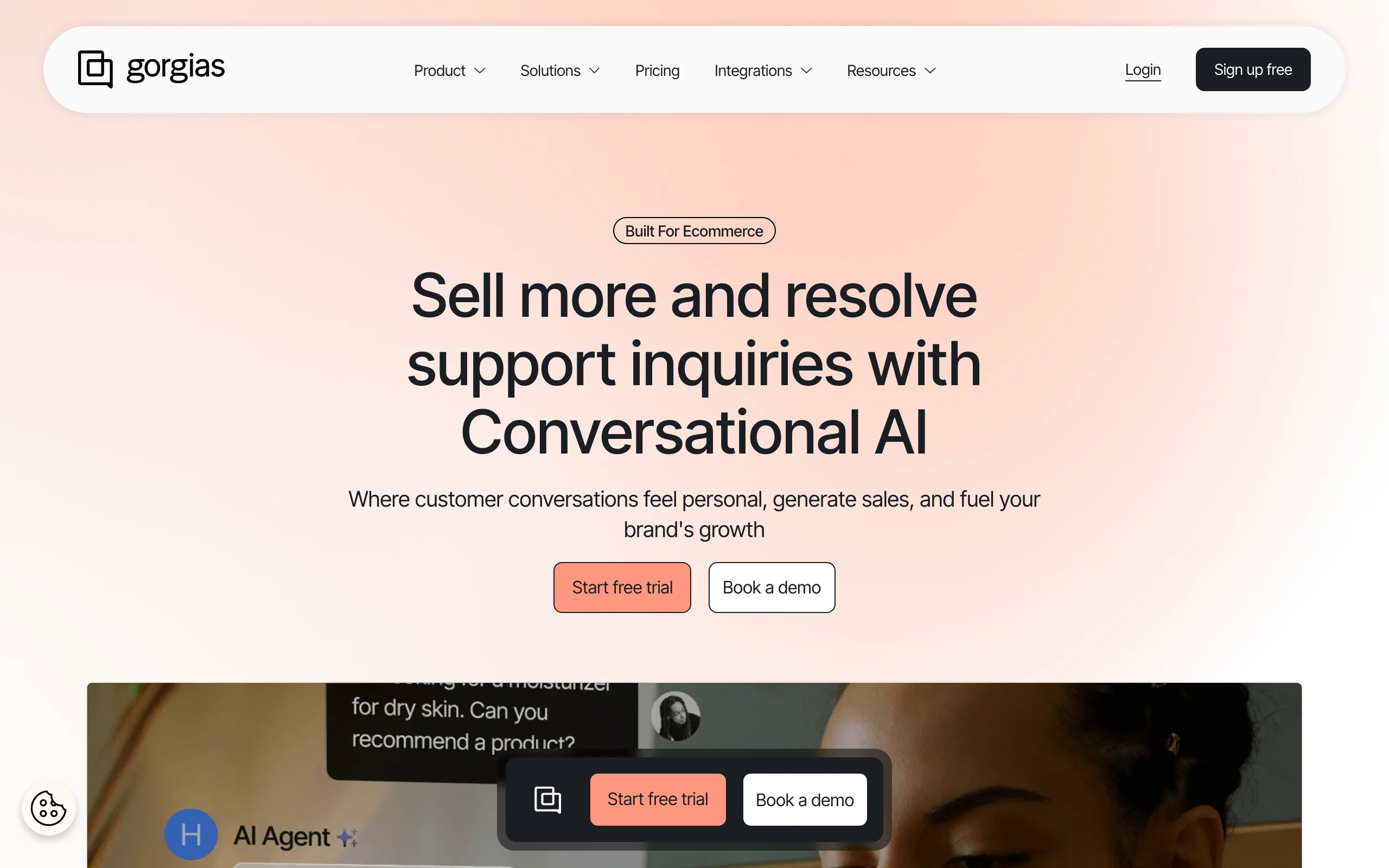
Customer service directly impacts conversion and retention in ecommerce, and Gorgias is built specifically for this use case. Unlike generic helpdesks, Gorgias connects deeply with Shopify, WooCommerce, and BigCommerce to pull order data, shipping status, and customer history directly into the support interface. Agents (human or AI) can process refunds, update orders, and apply discounts without leaving the helpdesk.
Gorgias runs two AI agents: the Shopping Assistant handles pre-sale questions (product recommendations, sizing, availability) and proactively engages visitors browsing your store, while the Support Agent resolves post-purchase issues (order tracking, returns, exchanges). The AI Agent pricing is pay-per-resolution ($1.00 per conversation resolved on monthly billing, $0.90 on annual), so you only pay when the AI actually solves a problem. Multi-channel coverage includes email, live chat, social media DMs, and voice.
AI Tools for Ecommerce with Gorgias
Key features
- Two AI agents: Shopping Assistant (pre-sale) and Support Agent (post-purchase)
- Proactive engagement: AI initiates conversations with browsing visitors
- Deep Shopify/WooCommerce/BigCommerce integration with in-helpdesk order management
- Pay-per-resolution AI pricing ($1.00 per resolved conversation, $0.90 on annual billing)
- Multi-channel: email, live chat, social media, and voice
- Automation templates and intelligent ticket routing
- Revenue attribution tracking for support interactions
Best for
- Ecommerce brands handling 300+ support tickets per month that need to scale without hiring
- Shopify and WooCommerce stores that want AI support agents with full order management access
- Brands that want their support team to drive revenue through proactive pre-sale engagement
Pricing
- Starter: $10/month (50 tickets)
- Basic: $50/month (300 tickets)
- Pro: $360/month (2,000 tickets)
- Advanced: $900/month (5,000 tickets)
- AI Agent: $0.90 per resolved conversation (separate from helpdesk)
Pros
- Purpose-built for ecommerce with native order management inside the helpdesk
- Pay-per-resolution AI pricing means you only pay when problems are actually solved
- Proactive Shopping Assistant can convert browsers into buyers
- Revenue attribution shows the ROI of each support interaction
Cons
- Per-ticket pricing gets expensive at high volume (1,000+ tickets/month)
- AI Agent cost is separate from the helpdesk subscription
- Primarily ecommerce-focused: limited utility outside retail
- Setup and automation configuration takes time to dial in
8. Surfer SEO, best for AI-driven ecommerce SEO
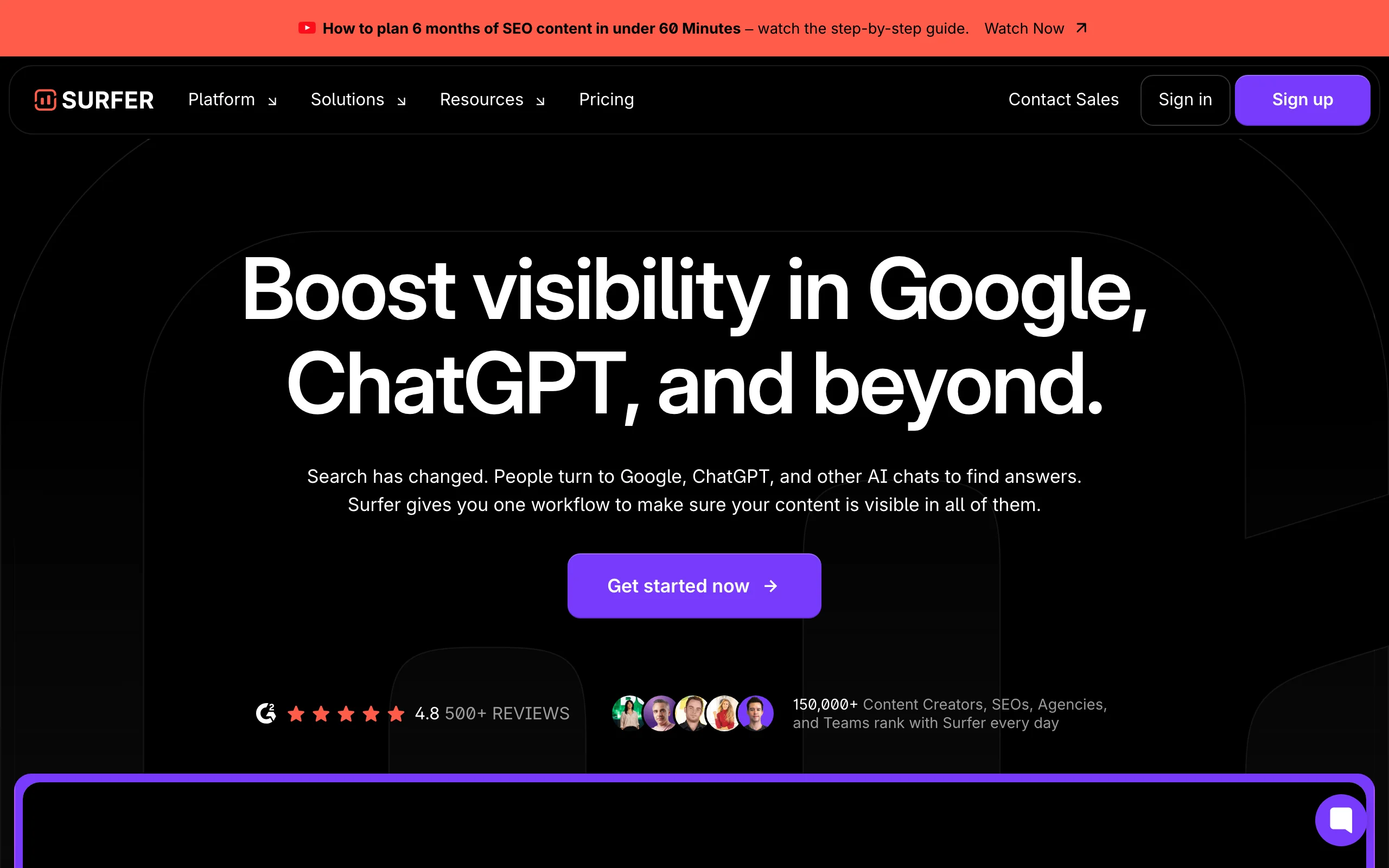
Organic search drives a significant share of ecommerce traffic, and Surfer SEO helps you create content that ranks. The Content Editor assigns a real-time Content Score (0-100) as you write, analyzing your content against the top-ranking pages for your target keyword. It tells you exactly which terms to include, how many times, and how to structure your headings.
Content Audit is Surfer's fix-it engine: it scans your existing pages, flags the weak ones, and tells you which gaps to close, while Topical Map surfaces the content angles worth covering next. The newer AI Tracker shows how your brand appears inside tools like ChatGPT, which matters as more product research starts there. For ecommerce, this is valuable for optimizing category pages, product descriptions, and blog content that drives top-of-funnel traffic. The tool integrates with Google Docs and WordPress for seamless editing workflows.
AI Tools for Ecommerce with Surfer SEO
Key features
- Content Editor with real-time Content Score (0-100) and NLP term suggestions
- Content Audit to spot weak pages and close content gaps
- AI Tracker to monitor how your brand appears in tools like ChatGPT
- SERP Analyzer for understanding ranking factors per keyword
- Keyword research with 100 searches/day
- Google Docs and WordPress integrations
- Rank Tracker for monitoring keyword positions
- Competitor content analysis and gap identification
Best for
- Ecommerce content marketers writing category pages, buying guides, and blog posts
- SEO teams optimizing product descriptions and landing pages for organic traffic
- Brands investing in content marketing as a customer acquisition channel
Pricing
- Discovery: $49/month (billed annually) or $59/month
- Standard: $99/month (billed annually) or $119/month
- Pro: $182/month (billed annually) or $219/month
- Peace of Mind: $299/month (billed annually) or $359/month
- Enterprise: from $999/month
- 7-day free trial on the Pro plan
Pros
- Real-time Content Score is the most actionable on-page optimization tool available
- Content Audit and Topical Map make it clear which pages to fix and what to write next
- Strong integrations with Google Docs and WordPress streamline the editing workflow
- Keyword research and SERP analysis help identify high-intent ecommerce terms
Cons
- No free trial: $79/month minimum commitment
- AI article generation costs extra ($29 per article)
- Focused purely on content SEO, does not cover technical SEO audits
- Learning curve for interpreting Content Score recommendations effectively
9. Nosto, best for AI personalization and product discovery
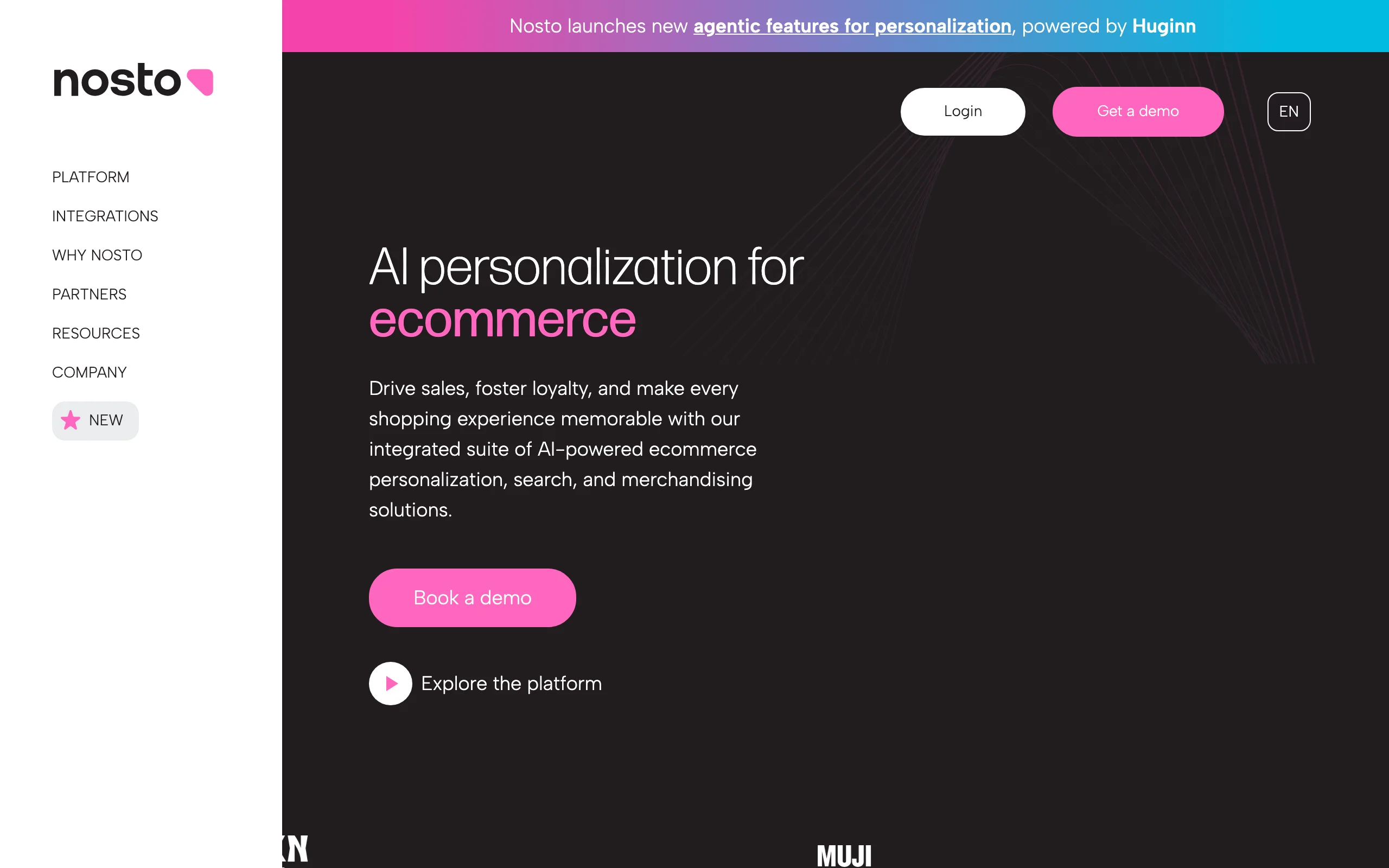
Generic product pages leave money on the table. Nosto uses AI to personalize the entire shopping experience: product recommendations based on browsing behavior, dynamic "shop-the-look" bundles, personalized banners by segment and device, and AI-powered site search that understands shopper intent, not just keyword matching.
Trusted by 1,500+ brands (including Kylie Cosmetics, Marc Jacobs, and Muji), Nosto's Commerce Experience Platform covers every touchpoint where personalization drives revenue. Its visual AI analyzes user-generated content and product imagery to surface relevant recommendations. The performance-based pricing model means you pay based on conversions driven, not flat monthly fees, which aligns the tool's cost with actual ROI.
AI Tools for Ecommerce with Nosto
Key features
- AI-powered product recommendations based on real-time browsing behavior
- Dynamic "shop-the-look" bundles and outfit recommendations
- Personalized banners, popups, and content by segment, location, and device
- Semantic AI search that understands shopper intent
- Visual AI for analyzing UGC and product imagery
- A/B testing and performance analytics across all personalization touchpoints
- Cross-device personalization with unified customer profiles
Best for
- Mid-market to enterprise fashion and lifestyle brands with 10,000+ monthly visitors
- Multi-channel retailers that want AI-driven product discovery across web and mobile
- Brands with large catalogs where manual merchandising can't keep up with customer behavior
Pricing
- Performance-based pricing tied to conversions driven
- Custom quotes based on store traffic and feature set
- No published starting price: reach out for a demo
- Enterprise-level investment (estimated $1,000+/month for mid-market)
Pros
- Performance-based pricing aligns cost with actual conversion impact
- Comprehensive personalization across every customer touchpoint
- Proven at scale with 1,500+ brands including major fashion retailers
- Visual AI and semantic search go beyond basic recommendation engines
Cons
- Custom pricing lacks transparency: hard to budget without a sales conversation
- Complex implementation requires developer resources for full setup
- Overkill for small stores with limited traffic or simple catalogs
- Enterprise-level investment may not fit early-stage ecommerce brands
10. YesPlz AI, best for AI fashion search optimization
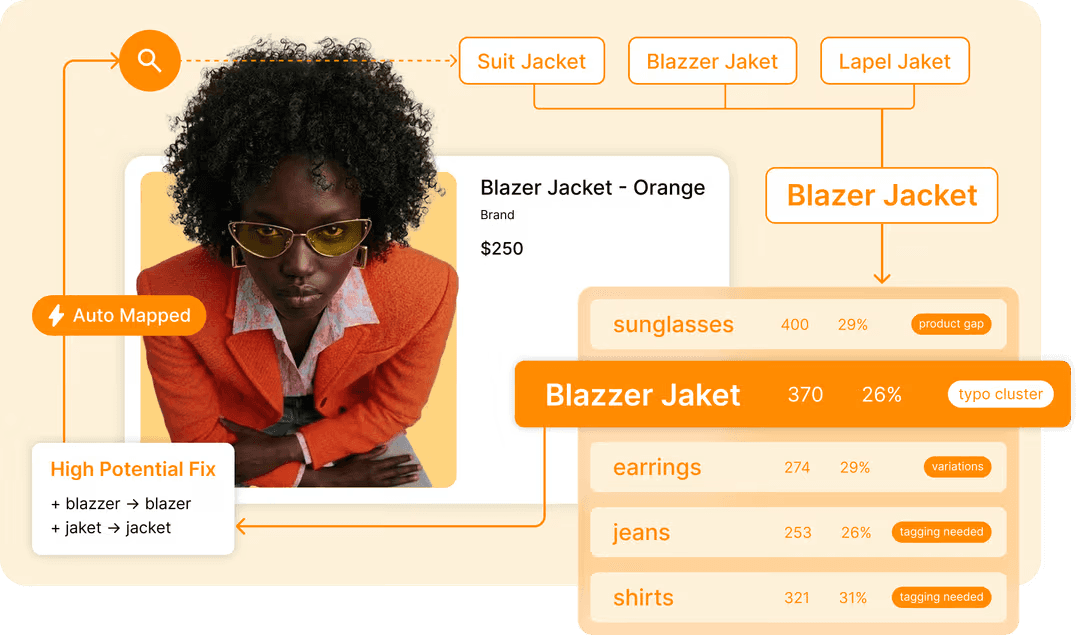
Your search bar is one of the most valuable tools in your eCommerce store, yet most retailers never touch it after setup. The problem is that shoppers don't always search for products in the way they are titled and described. Shoppers might misspell brand names or use different keywords for the same item. YesPlz AI Search Tune Agent runs in the background 24/7, watching every search query of your online fashion store.
It spots the keywords shoppers use most but click on least, figures out why results are failing, and applies the fix automatically.
AI Tools for Ecommerce with YesPlz AI
Key features
- Autonomous 24/7 search monitoring across all queries
- Typo detection and automatic synonym mapping
- Tagging gap identification for trend-driven and informal search terms
- Covers typos, synonyms, ranking issues, and product tagging gaps in one agent
- Full dashboard visibility into every change and its impact
- Per-fix CTR and conversion tracking
Best for
- Fashion and apparel stores where shoppers search in dozens of different ways for the same product
- Multi-brand retailers dealing with brand name misspellings and catalog inconsistencies
- Ecommerce teams that want better search results without hiring a dedicated search analyst
Pricing
- Monthly subscription based on SKU size
Pros
- Fully autonomous — detects, fixes, and tracks improvements without manual input
- Handles multiple problem types in one agent: typos, synonyms, tagging, and ranking
- Dashboard keeps you informed without pulling you into the weeds
- Real client results: one fashion retailer saw CTR jump from 25% to 61.69% after a single fix
Cons
- Best suited for fashion — less relevant for general merchandise stores
- Custom pricing requires a sales conversation before you know the cost
- No self-serve free trial — demo is the main way to evaluate the tool
- Needs sufficient search volume to detect patterns and make meaningful fixes
How to choose the best AI tool for your ecommerce store
1) Start with your biggest bottleneck
AI tools for ecommerce span seven distinct categories, so start by identifying where you're losing the most time or money:
- If product photography is your bottleneck (especially fashion): WearView covers the full pipeline from flat-lay to on-model to video. For general product categories, Canva offers affordable background removal and AI backdrops alongside broader design tools.
- If content creation slows down your listing velocity: Jasper AI generates product descriptions, ad copy, and email content with brand voice consistency. Shopify merchants can start with Shopify Magic for free.
- If customer support is eating into margins: Gorgias automates resolution with AI agents that understand order context.
2) Match the tool to your platform
Platform compatibility matters more than feature lists:
- Shopify merchants get the most value from Shopify Magic (free), Gorgias (deep integration), and Klaviyo (native connector).
- Multi-platform sellers (Amazon, Etsy, WooCommerce) should prioritize platform-agnostic tools: WearView, Canva, Jasper AI, and Surfer SEO work regardless of your storefront.
- Enterprise brands with complex personalization needs should evaluate Nosto's performance-based pricing model.
3) Calculate the unit economics
Credit-based and per-ticket pricing models can surprise you at scale:
- For WearView, calculate your monthly image needs. If you're refreshing 200 product listings per quarter, the Pro plan (200 credits/month) covers it. For larger catalogs, the Advanced plan or credit packs provide flexibility.
- For Gorgias, estimate your monthly ticket volume. The AI Agent at $1.00/resolved conversation ($0.90 annually) is cost-effective up to a point, then the per-ticket helpdesk pricing starts to compound. Note that a fully automated resolution bills as both a ticket and a resolution.
- For Klaviyo, pricing scales with your contact list. Map out your 12-month growth trajectory to avoid sticker shock as you scale past 5,000, 10,000, or 25,000 contacts.
4) Test before you commit
Most tools on this list offer free tiers or trials:
- Klaviyo's free plan (250 contacts) lets you build and test your first automated flows.
- Canva's free plan is enough to test templates and basic design before upgrading.
- YesPlz AI offers a demo to evaluate the Search Tune Agent on your store data.
- Jasper AI offers a 7-day free trial on Pro.
- Shopify Magic is free for all Shopify merchants.
- Surfer SEO offers a 7-day free trial of its Pro plan.
- For tools without free tiers (WearView, Nosto), test with a small batch of your hardest products. If the AI handles your most complex SKUs well, it will handle the rest.
FAQ
What are AI tools for ecommerce? AI tools for ecommerce are software platforms that use artificial intelligence to automate or improve specific parts of running an online store. This includes product photography, copywriting, email marketing, customer service, SEO, personalization, and inventory management. Each tool typically specializes in one category, though some platforms like Shopify Magic and WearView cover multiple functions.
Which AI tool is best for product photography? It depends on what you sell. For fashion and apparel, WearView offers the most complete pipeline: virtual try on clothes on AI models, product-to-model conversion, consistent model identity, and video generation. For general product categories, Canva is a versatile, affordable option with one-click background removal and AI-generated backdrops, plus design tools for listings and ads.
Is Shopify Magic free? Yes. Shopify Magic is included at no additional cost with any Shopify subscription (Basic, Shopify, Advanced, or Plus). It covers AI product descriptions, email campaign copy, background removal, and the Sidekick AI assistant. The underlying Shopify plan starts at $39/month for Basic.
Can AI tools replace professional product photography? For many ecommerce use cases, yes. Tools like WearView generate studio-quality on-model fashion photos from flat-lay images in about 90 seconds. For general products, tools like Canva create clean, marketplace-ready images from phone photos by removing backgrounds and generating new backdrops. That said, QA is still important: review AI-generated images for accuracy before publishing, especially for complex garments or products with fine details.
What is the best AI tool for writing product descriptions? Jasper AI is the strongest dedicated option, with brand voice training that makes output sound like your brand rather than generic AI copy. For Shopify merchants, Shopify Magic handles basic product descriptions for free. For teams that need SEO-optimized product content, pairing Jasper with Surfer SEO ensures descriptions rank well in addition to converting.
Which AI tool is best for ecommerce email marketing? Klaviyo dominates ecommerce email marketing with deep platform integrations and AI-powered automation. Its free plan (250 contacts, 500 sends/month) is enough for early-stage stores, and the AI features (Smart Send Time, subject line generation, predictive analytics) are included on all paid plans. For stores already on Shopify, the native Klaviyo-Shopify connector provides the deepest data integration.
How much do AI tools for ecommerce cost? Costs range widely. Shopify Magic is free. Canva has a free plan, with Pro from ~$15/month. WearView plans start at $29/month. Klaviyo's free plan covers 250 contacts, with paid plans from $20/month. Jasper AI starts at $59/month. Gorgias starts at $10/month plus $1.00 per AI-resolved conversation ($0.90 on annual billing). HubSpot Breeze Customer Agent comes with eligible HubSpot Professional and Enterprise subscriptions and runs on HubSpot Credits. Surfer SEO starts at $49/month. Nosto uses custom performance-based pricing. YesPlz AI uses monthly subscription pricing based on SKU size.
Do I need multiple AI tools or one all-in-one platform? Most ecommerce teams use 3-5 specialized AI tools rather than one platform. No single tool covers product imagery, copywriting, email marketing, customer service, and inventory well. The exception is Shopify Magic, which covers basic versions of several categories for free, but specialized tools outperform it in each individual area. Start with the tool that addresses your biggest bottleneck, then add others as needed.

WearView Team
WearView Content & Research Team
WearView Team is a group of fashion technology specialists focused on AI fashion models, virtual try-on, and AI product photography for e-commerce brands. We publish in-depth guides, case studies, and practical insights to help fashion businesses improve conversion rates and scale faster using AI.