July 9, 2026•4 min read
From AI Design to Sellable Apparel: Turning Your WearView Designs into Real Products
A design on a screen is not a business yet. Here is how to turn AI-generated apparel designs into real, sellable products with print-on-demand, and why a vertical factory that makes and prints its own garments beats the middleman model.
Picture of From AI Design to Sellable Apparel article
AI has removed the hardest part of starting an apparel brand: the design. With WearView, you can turn an idea into a polished, on-model garment design in minutes — no illustrator, no sampling studio, no creative bottleneck. But a design on a screen is not a business yet. At some point the file has to become a physical product that someone can buy, wear, and reorder. The question is how you produce it.
Print-on-demand: the natural path from design to product
For a creator, the simplest way to sell a design without a warehouse full of stock is print-on-demand (POD). Instead of ordering hundreds of units up front, you connect a design to an online store, and each garment is printed and shipped only after a customer buys it. No minimums, no inventory risk, no cash tied up in boxes of unsold shirts.
That model is a perfect match for AI design. You can test many concepts, launch a small drop, and scale only what sells — the same fast, low-risk loop WearView already gives you on the design side. POD simply extends it to the physical product.
The catch: most POD is a middleman model
Here is where a lot of AI-designed apparel loses its edge. Most POD platforms are middlemen: they route your order to whichever third-party print shop is cheapest and decorate generic, off-the-shelf blanks. You do not control the garment, the print size is capped at a small chest box, and the blank is the same one thousands of other stores are using. A striking design ends up flattened onto commodity merch — and customers can feel the difference in weight, fit, and finish.
If you are building a brand rather than a novelty store, the production model matters as much as the design. The way to escape the middleman ceiling is to work with a supplier that actually manufactures the product itself.
The vertical factory advantage: making the garment and printing it in-house
PODpartner is built the opposite way from a print network. It owns both a garment manufacturing factory and a printing factory, so the whole process — from making the blank to decorating it — happens under one roof, with nothing outsourced. That end-to-end control is exactly why its feature set is so complete and its products are genuinely unique:
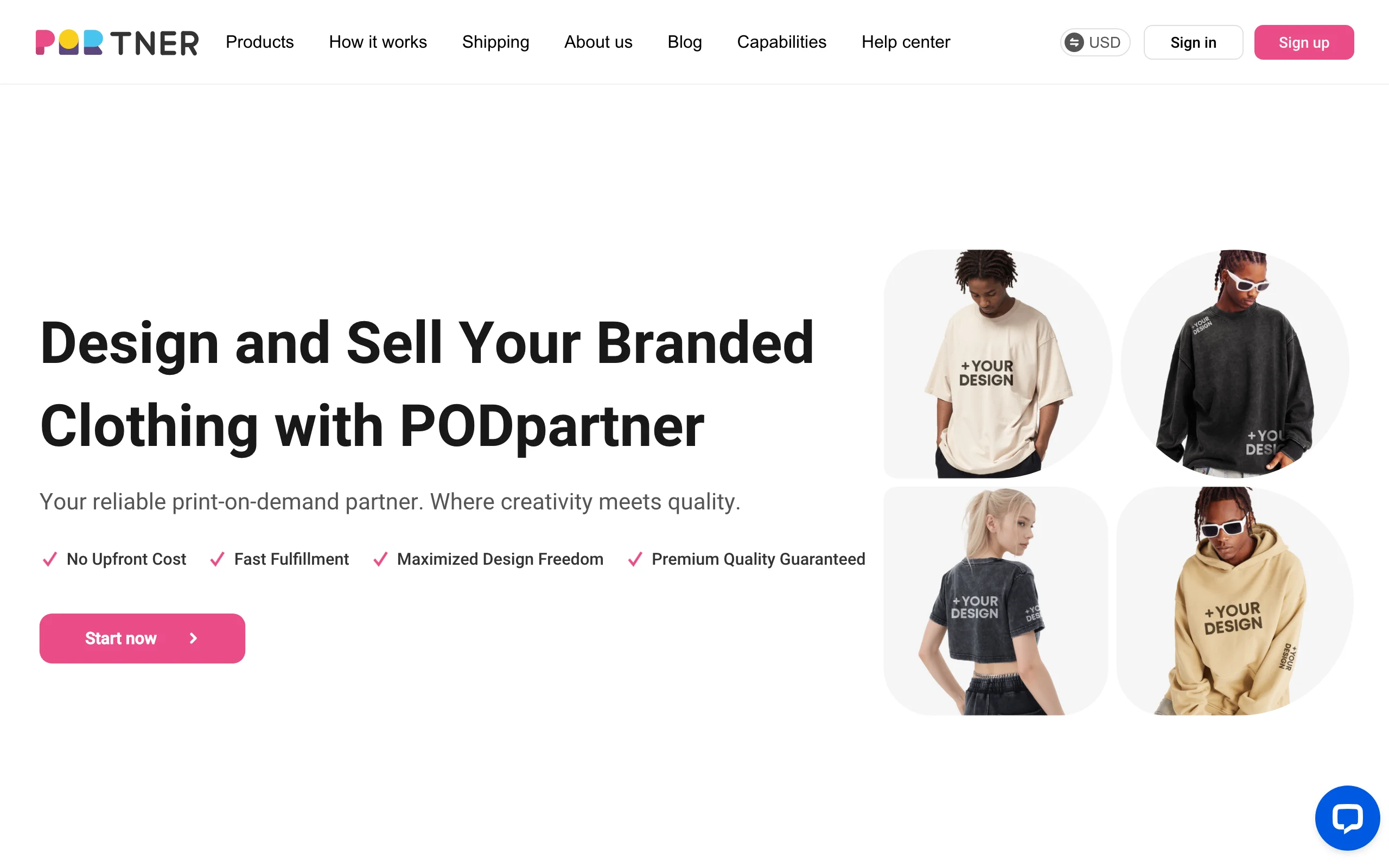
PODpartner homepage, a print-on-demand supplier that manufactures and prints its garments in-house
- Because it manufactures the garments itself, it offers heavyweight, retail-grade blanks (up to 440GSM hoodies and 425GSM oversized tees) and streetwear-leaning cuts that are hard to find on generic POD networks.
- Because it runs its own print floor, it supports 21+ print areas per garment, Jumbo DTG up to 24" x 24", and hybrid decoration — DTG, embroidery (DST files, up to 15 colors), and HTV combined on a single garment in one pass.
- Because it is all one pipeline, print quality, color, and hand-feel stay consistent from the first sample to the 500th reorder.
What that means for your AI design
AI tools love bold, oversized, edge-to-edge graphics — the kind of composition standard POD cannot print. With 21+ print areas and 24" x 24" Jumbo DTG, a big WearView design can land at full scale across the front, back, sleeves, or neck-to-hem, on a blank heavy enough to feel premium. The result reads as a designed product, not a graphic slapped on a thin tee.
From WearView to a finished product in four steps
- Design in WearView. Generate and refine your garment design and mockup until it looks the way you want it to sell.
- Send it to production. Move the design into PODpartner and pick a blank — silhouette, weight, and fit (tee, long sleeve, hoodie, sweatshirt, and more). Map the print areas and, if needed, add embroidery or HTV.
- Order a sample. Because production is made-to-order with no minimums, you can order a single physical sample to confirm print registration, color, and hand-feel before you launch.
- Sell it. Connect your store and publish. PODpartner integrates with Shopify, Etsy, Wix, WooCommerce, and Squarespace, and orders are produced in-house with QC in around two days.
Make it feel like a brand, not a print job
The difference between a one-off tee and a brand is in the details, and that starts with your logo: if you are still working on yours, our beginner guide on how to design a logo for a fashion brand covers that step. Because branding is produced in the same factory, PODpartner makes custom neck labels, hang tags, and branded packaging on demand, so the unboxing matches the product. For Shopify sellers, free Personalization lets customers add their own text or details on the product page — a simple way to charge more for made-to-order pieces and turn a single AI design into a customizable product line.
Why this matters for WearView designers
AI removes the design barrier; a real vertical factory — one that makes the garment and prints it — removes the manufacturing barrier. Together they let a solo creator go from concept to a premium, sellable apparel line without inventory risk or a factory of their own. Design it in WearView, produce it with PODpartner, and sell it anywhere your customers are.
Ready to bring your designs to life? Explore PODpartner to see the blanks, print areas, and branding options.
WearView Team
WearView Content & Research Team
WearView Team is a group of fashion technology specialists focused on AI fashion models, virtual try-on, and AI product photography for e-commerce brands. We publish in-depth guides, case studies, and practical insights to help fashion businesses improve conversion rates and scale faster using AI.