July 29, 2026•23 min read
AI Image Statistics 2026: The Numbers That Survive a Fact-Check
We tried to verify the most-cited AI image statistics of 2026. Most of them evaporated: a daily-volume figure inflated 2.35x and redated three years, an energy claim describing the worst model ever tested, and a marketing quote that became a McKinsey fact via one footnote. Here is what survived, and what did not.
Picture of AI Image Statistics 2026 article
We set out to write a normal statistics roundup. Gather the figures everyone cites about AI image generation, check them, publish the list.
Most of them did not survive.
Not "were slightly out of date." Did not survive. The most-quoted volume figure in the category turned out to be a real number from August 2023, inflated by 2.35x and restamped with this year. The most-quoted energy figure describes the least efficient model in a 2023 study, measured against a constant its own authors have since corrected. And the most authoritative-sounding claim in fashion AI, the one attributed to McKinsey, resolves through a single footnote to a company's own vice president talking to a reporter.
So this is a different kind of roundup. Below are the AI image statistics that survive tracing to a primary source, with their methodology and their limits. Then the ones that do not, with the receipts. If you only take one thing from this page: a citation is not a source. Almost every bad number here has a link that "checks out."
How we checked
The rule was simple. Follow every number to the document that first published it, read that document, and look at what it actually measured.
That is it. It is not a sophisticated technique, and it is why the errors below are so easy to find. Almost nobody does it, because the second-hand version always says what you want it to say.
Three failure patterns account for nearly everything:
- Freezing. A real estimate with a real date gets cited forever without its date, long after it stopped being true.
- Scope drift. A number about one narrow thing (editorial images, the worst model tested, lifestyle photos) gets restated as a number about a broad thing.
- Laundering. A company's marketing claim gets quoted by a journalist, then cited by an institution, and the institution's name replaces the company's as the source.
The volume numbers: nobody knows, and the popular answer is three years old
What you will read: "80 million AI images are created every day." It is often cited to Everypixel Journal, dated 2026.
What Everypixel actually says, on a page published 15 August 2023 and never updated: "people are creating an average of 34 million images per day."
The real figure is 34 million, not 80 million, and it is from August 2023. The claim inflates it by 2.35x and moves it forward three years, while linking to the genuine page, so a reader who checks the link finds a real source that appears to confirm it. That is what makes this the template for everything else on this page.
Everypixel deserves credit rather than blame here. Its methodology is stated openly, it flags its own limits ("obtaining accurate and up-to-date AI image statistics remains a challenge"), and it carries a published correction. The problem is not the source. The problem is what the internet did to it.
The same page is the origin of the famous 15 billion AI images total. Worth knowing how that was built: Stable Diffusion accounts for 12.59 billion of it, roughly 81%, derived by applying Midjourney's usage patterns to download counts. Only the Adobe Firefly component came from a company's own disclosure. The majority of the most-cited number in AI imagery is extrapolation, honestly labelled as such by the people who did it.
What is actually true now comes from the vendors, and they are the only ones counting:
| Claim | Source | Date |
|---|---|---|
| "more than 50 billion images have been generated with our Nano Banana image generation models" | Google (Sundar Pichai) | 19 May 2026 |
| "with more than 5 billion images generated to date" | 13 Oct 2025 | |
| "over 130 million users around the world created more than 700 million images in just the first week" | OpenAI | 23 Apr 2025 |
| "more than 22 billion assets globally, including images and videos" | Adobe Firefly | 24 Apr 2025 |
Sit with the first row. Google reports 50 billion images from one model family, which is more than three times the "15 billion images ever generated" figure that pages still print as a current total. And OpenAI's launch week alone works out to roughly 100 million images a day on a single platform, about three times the "34 million a day across all platforms" number now being passed off as 2026 data.
Two cautions. These are first-party counts with no methodology and no audit, so they are "Google says," not fact. And Adobe's 22 billion is assets, including videos, not images. The version you will see quoting "24 billion Firefly images" is wrong twice over.
The honest summary: nobody knows how many AI images exist. No independent body counts them. You can say the old numbers are dead without inventing a replacement.
Who actually uses AI image tools
This is the only rigorous adoption number in the category, and it comes from Pew Research Center: n=5,119 US adults, fielded 17 to 23 February 2026, American Trends Panel, margin of error ±1.6 points.
Asked whether they use AI chatbots "to create or edit images or videos":
- 24% of all US adults say yes
- 48% of chatbot users say yes
- 49% of US adults use AI chatbots at all; 44% have used ChatGPT
Both denominators are published, which means you should always say which one you mean. "24% of Americans" and "48% of users" are both true and describe different things.
Two limits Pew's own question imposes, which nearly every citation drops: it measures "images or videos" together, so it is not an image-only statistic, and it asks only about chatbots, so it misses anyone using Midjourney or Firefly outside a chat interface.
For retail specifically, here is the finding that should be a statistic and is not: no primary survey exists measuring what share of brands use AI-generated product imagery. We looked hard. Every figure in circulation is either invented (see the graveyard below) or comes from a vendor polling its own AI-interested mailing list. The most-cited adoption number in this industry does not exist.
What an AI image costs
Verified against vendor pricing pages in July 2026. These are list prices, and they move.
| Model | Cost per image |
|---|---|
| GPT Image 2 (1024px, low / medium / high) | $0.006 / $0.053 / $0.211 |
Nano Banana Pro (gemini-3-pro-image), 1K/2K | $0.134 |
Nano Banana 2 (gemini-3.1-flash-image), 1K | $0.067 |
| Nano Banana 2 Lite, 1K | $0.034 |
| FLUX.2 [pro] first megapixel | $0.03 |
| Ideogram 4.0 (Turbo / Default / Quality) | $0.03 / $0.06 / $0.10 |
| Seedream 5.0 Pro | $0.045 |
| Grok Imagine | $0.02 |
Note what that table does to the "AI images are basically free" framing. The spread between the cheapest and the most expensive tier here is roughly 35x, and quality tiers inside a single model span the same range.
The more interesting relationship is cost against speed. On Artificial Analysis's median trailing figures, the model at the top of the quality leaderboard is also the slowest and the priciest on the board: GPT-Image-2 at about 180 seconds and $211 per thousand images, against FLUX.1 [schnell] at 0.55 seconds and $2 per thousand. That is roughly 327 times slower and 105 times more expensive. Their per-thousand figure reconciles exactly with OpenAI's own published $0.211, which is a useful cross-check that the leaderboard is reading reality.
Two things people get wrong here. Midjourney has no per-image price, it is a subscription ($10 to $120/month), so any "Midjourney costs $X per image" is someone's arithmetic. And Adobe publishes no credit-to-dollar rate, so the widely quoted "$0.05 per Firefly image" is derived, not Adobe's number.
For what a photograph costs in the physical world, and how the two compare on a real catalog, we did that math separately in our breakdown of the real ROI of AI models on photoshoots. The cost of the software further upstream, from sketching to 3D, is its own verified table in our guide to designing clothes digitally.
What an AI image costs the planet
The claim: "generating one AI image uses as much energy as fully charging your smartphone."
This one is interesting because the source is excellent and the reporting was accurate at the time. The paper is Power Hungry Processing: Watts Driving the Cost of AI Deployment? by Alexandra Sasha Luccioni, Yacine Jernite and Emma Strubell, peer-reviewed at ACM FAccT '24. It measured 88 models across 10 tasks, 1,000 inferences each, repeated ten times.
Here is what it actually says, verbatim:
"the least efficient image generation model uses as much energy as 522 smartphone charges (11.49 kWh), or around half a charge per image generation"
Three things went wrong on the way to the headline.
It describes the worst model, not a typical one. The paper's median image generation model uses 1.35 kWh per 1,000 inferences. That is 1.35 Wh per image.
The constant changed. The paper defines a smartphone charge as 0.022 kWh. The famous headline was written against the EPA's older estimate of 0.012 kWh, which the authors flag themselves in footnote 5: "Before January 2024, the EPA website estimated a smartphone charge to consume 0.012 kWh of energy, which was the number used for comparisons in an earlier version of this study."
The headline was written on the preprint, in December 2023, and said so at the time. The peer-reviewed version downgraded the claim to "around half a charge," for the worst model tested.
So do the arithmetic the citations skip. Against the paper's own 22 Wh charge:
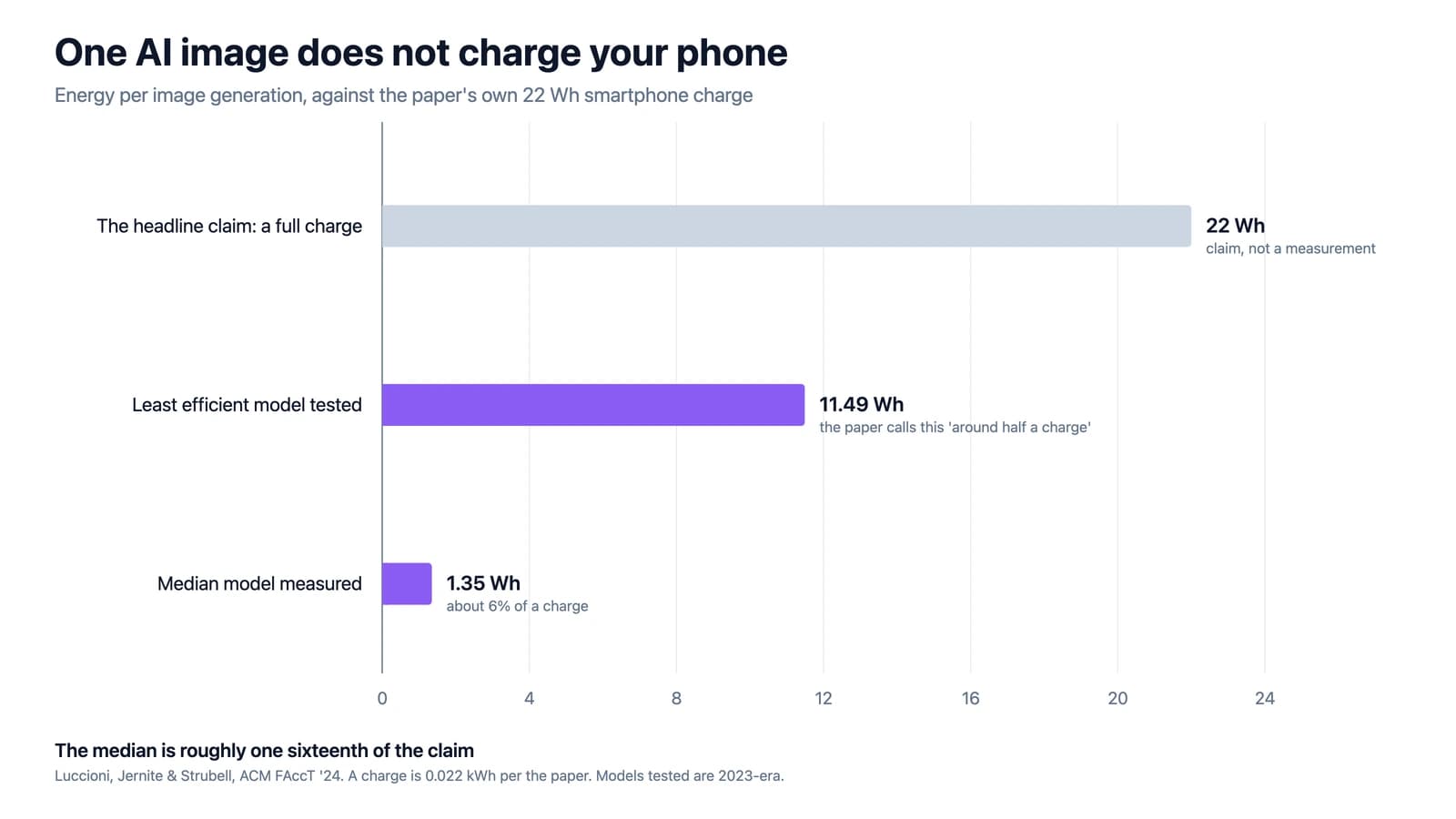
Bar chart comparing the claimed full phone charge of 22 Wh against the least efficient model at 11.49 Wh and the median measured model at 1.35 Wh per AI image
- Median model: 1.35 Wh, about 6% of a phone charge. Roughly one sixteenth of the claim.
- Least efficient model: 11.49 Wh, about 52%. Which is "half a charge," exactly as the paper says.
And every model in that study is from 2023. The measurements were also run sequentially, un-batched, while production APIs batch, so real per-image energy today is lower still. The environmental cost of AI images is a legitimate subject. This particular number is not evidence for it.
Can anyone actually tell?
Two peer-reviewed findings, pointing in an uncomfortable direction.
Humans cannot, and are confidently wrong. Miller et al., Psychological Science, November 2023 (experiments with n=124 and n=610) found AI faces were judged human 65.9% of the time against 51.1% for actual human faces. AI faces read as more human than real people, while real faces performed at chance. Participants' confidence was inversely related to their accuracy.
That result carries a caveat you must never drop: it holds for White faces only. The authors are explicit that the effect did not appear for other faces, and explain why: "Algorithms are trained disproportionately on White faces." The hyperrealism is an artifact of a skewed training distribution, which is a finding about the datasets as much as about human perception.
Machines cannot either, once they leave the lab. The Chameleon benchmark (ICLR 2025) tested nine detectors on AI images that had already passed human Turing tests. The result: "almost all models classify AI-generated images as real ones." Several scored near 100% accuracy on real images and near 0% on fakes, which is another way of saying they answer "real" to everything. The authors' conclusion: "detecting AI-generated images is far from being solved."
Set that against the regulation. EU AI Act Article 50(2) requires providers to mark synthetic output "in a machine-readable format and detectable as artificially generated," and it applies from 2 August 2026. Article 50(4) puts a disclosure duty on deployers of deepfakes. The obligation is real and dated. The detection technology, per the literature above, is not there. Both things are true at once, and any 2026 statistics page that reports the mandate without the detection failure is telling you half the story. If you generate synthetic media of people, the practical consequences of Article 50 are worth reading in full; we covered them alongside the platform rules in our guide to making an AI video of a person wearing a specific outfit.
One number that does not exist and should: nobody has measured what share of images online carry C2PA provenance data. The "600 of the 900,000 images processed each year" figure in circulation invents its denominator. And "C2PA is now an ISO standard" is false: it is a draft (ISO 22144). The tell is that people write it as "ISO/IEC" when it is ISO-only.
What it did to the jobs
The best labour statistics here are American, federal, and have no commercial interest in the answer. They also disagree with the narrative in a specific and useful way.
| Occupation | 2024 jobs | Projected 2024 to 2034 | Does BLS blame AI? |
|---|---|---|---|
| Models | 6,700 | decline 1% | Yes, explicitly |
| Photographers | 151,200 | grow 2% | No mention of AI |
The BLS names the mechanism for models, verbatim: "Technology, including artificial intelligence (AI) that allows companies to reuse images of products and models, may also limit demand for these workers." Median pay for models was $89,990 a year as of May 2024.
The photographers page, by contrast, does not mention AI at all. It attributes softness in the field to smartphones and online stock services.
So the US government's position is that AI is expected to reduce demand for models, but not for photographers. That is the opposite of how the story is usually told, and it comes from the one source in this article with nothing to sell. One caveat: the 6,700 figure is BLS's narrow occupational count and undercounts freelance and self-employed models, so read it as a trend, not as the size of the industry.
The stock photo business tells a similarly awkward story. Getty Images' FY2025 revenue was $981.3M, up 4.5%, which its own release calls "the highest reported revenue in the Company's 30-year history." But its AI-exposed Creative segment was effectively flat at +0.7%, while Editorial grew 6.9%, and the company posted a $206.2M net loss. Shutterstock's FY2025 revenue rose 6% to $989.9M, but Q4 fell 12% year over year. Record top line, flat creative, heavy loss. That is more interesting than either "AI killed stock photography" or "stock photography is fine," and it is why you should be suspicious of anyone telling you a clean version.
Two 2026 developments most roundups have not caught up with. The Getty and Shutterstock merger was terminated on 30 June 2026, after the UK's competition regulator conditioned clearance on selling Shutterstock's editorial business. And Getty's June 2026 partnership with OpenAI is display only: its content can appear inside ChatGPT, with no training rights. If you read "Getty licensed its library to OpenAI for training," that is wrong, and the distinction is the entire point of the deal.
The lawsuits have not resolved anything
Every "reckoning" headline implies a verdict. There isn't one.
Getty v Stability AI (UK), judgment 4 November 2025: Getty abandoned its primary copyright and database claims before closing submissions, accepting it could not show training happened in the UK. The court held that Stable Diffusion is not an "infringing copy," because model weights are trained parameters rather than stored copies. Getty won only a limited, historic trade mark point about watermarks, and was granted leave to appeal in December 2025.
Andersen v Stability AI (US) is three and a half years old and still in the pleadings. Third amended complaint February 2026, answers March 2026. No class certified. No trial date. The DMCA claims were dismissed with prejudice in 2024; core copyright claims survived to discovery.
The publishable statistic here is zero. No final ruling has established whether training on copyrighted images is infringement.
The market-size numbers are not estimates of anything
Here is the same market ("AI in fashion"), the same base year (2025), sized by seven research firms:
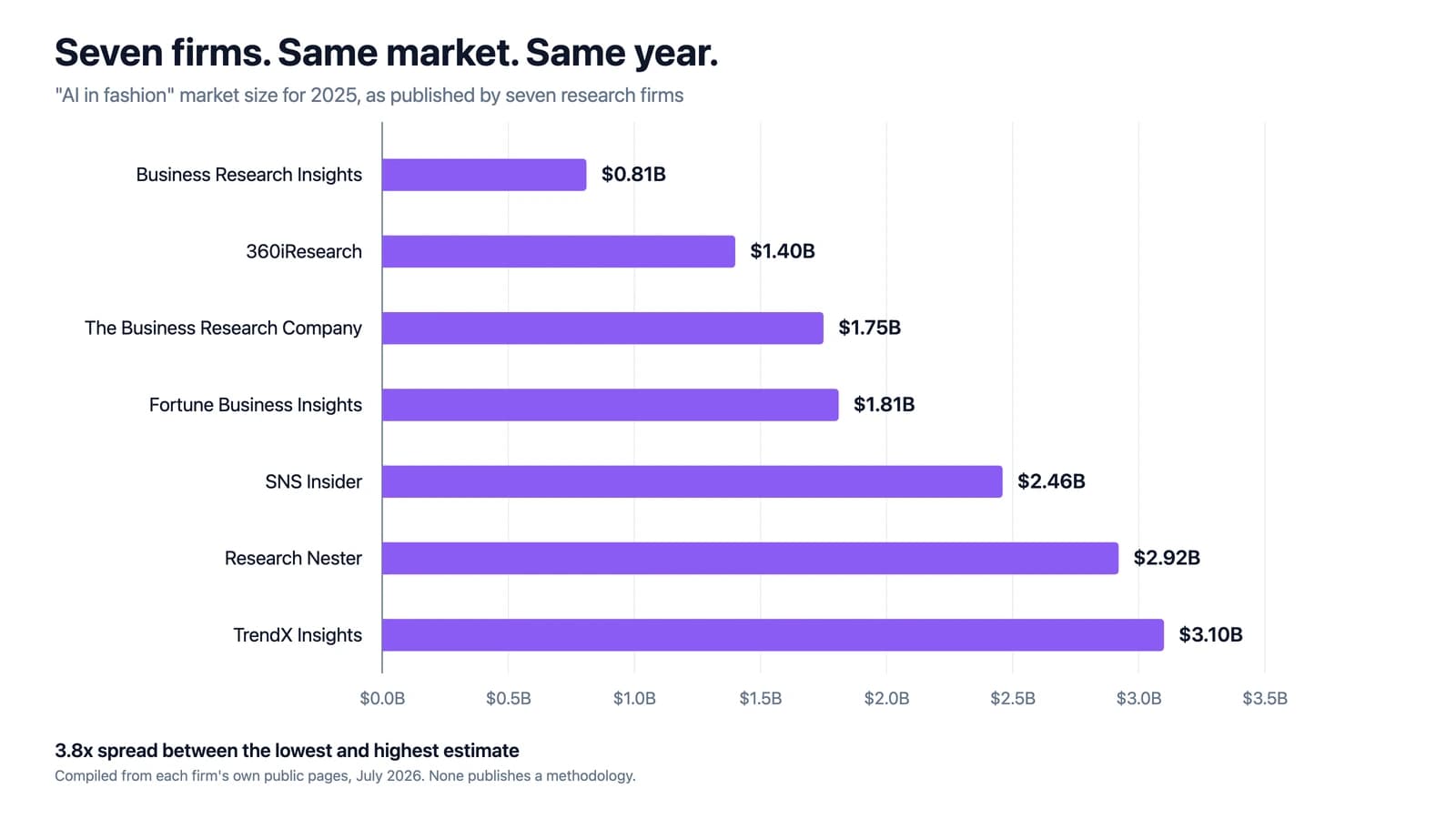
Bar chart of AI in fashion market size estimates for 2025 from seven research firms, ranging from $0.81B to $3.10B
| Firm | 2025 market size | CAGR |
|---|---|---|
| Business Research Insights | $0.81B | 19.39% |
| 360iResearch | $1.40B | 6.78% |
| The Business Research Company | $1.75B | 39.8% |
| Fortune Business Insights | $1.81B | 41.39% |
| SNS Insider | $2.46B | 40.30% |
| Research Nester | $2.92B | 40.8% |
| TrendX Insights | $3.10B | 29.50% |
A 3.8x spread on the present and a 6x spread on the growth rate. On the forecasts they diverge by more than 18x. None publishes a methodology; all are paywalled lead-generation reports distributed by press release.
The broader AI image generator market is no better. Market Research Future sizes it at $0.4956B for 2025; Research and Markets sizes it at $11.65B for the same year. That is a 23x spread, like for like. Push out to 2030 and Grand View says $1.08B while MarkNtel says $63.29B, a 59x spread on the same end year.
A note on how we did that, since it is the whole point of this page. It would have been easy to make those gaps look bigger by quietly comparing one firm's 2024 base against another's 2025, or by sliding in a firm that is actually sizing a broader market under a similar name. We caught ourselves doing exactly that in a draft. The numbers above are same-year, same-market, and they are damning enough without help.
These figures do not disagree at the edges. They refute each other. They are not estimates; they are marketing collateral for reports.
Specific corrections worth having, because these get cited by name. In each case we fetched the firm's own page and the cited figure was not on it:
- "$12.4B in 2026, per MarketsandMarkets": not in MarketsandMarkets' published work, and its own figures imply roughly $16.6B.
- "32.8% CAGR, per Grand View Research": Grand View publishes 17.7%.
- "$45B by 2030, per Precedence Research": we could find no Precedence report by that market name.
- Statista publishes no market size for AI image generators. And its generative AI sizes are, in its own words, "generated by the funding amount of Generative Artificial Intelligence companies", which is modelled from venture funding, not measured revenue.
All three of those phantom figures trace back to a single AI content farm, each with a confident clickable link to a real firm whose page does not contain the number. That is the laundering mechanism again, in the wild, in one place.
How a marketing claim becomes a McKinsey fact
This is the clearest example we found of the whole problem, and it is worth walking through slowly because the mechanism is invisible from the outside.
Step one. On 7 May 2025, Reuters journalist Helen Reid publishes an interview. Matthias Haase, "vice president of content solutions at Zalando", says generative AI "reduces costs by 90%" and cuts imagery production "to around three to four days from six to eight weeks." Around 70% of Zalando's editorial campaign images were AI-generated in Q4 2024. Reuters reports this accurately. Note that the 90% is not even in direct quotes; it is reported speech from a company executive about his own department.
Step two. McKinsey's State of Fashion 2026, page 32, states: "At Zalando, generative AI has reduced image production costs by 90 percent." It carries footnote 4.
Step three. Turn to the endnotes. Footnote 4 reads, in full: "Helen Reid, 'Zalando uses AI to speed up marketing campaigns, cut costs', Reuters, May 7, 2025." That is the entire evidentiary basis. It is the interview from step one.
Step four. The internet now writes "McKinsey found that Zalando reduced image production costs by 90%."
Nobody lied. Every link is real, and you can click every one. But an unaudited claim by a company about itself, with no baseline, no methodology and no third-party verification, acquired the authority of the world's most-cited consulting firm by passing through one footnote. And the scope quietly widened on the way: "editorial campaign imagery" became "image production," and headlines took it further still, to "content costs" and even "marketing costs." Zalando's catalog and product photography, which is the overwhelming majority of its imagery, was never part of the claim.
The same report contains a second trap. It says "92 percent of organisations say they will increase investments in generative AI, but only 1 percent describe their rollouts as 'mature.'" Note the word: organisations, not fashion companies. That figure is footnoted to McKinsey's Superagency in the workplace, an all-industry report from January 2025, and the footnote closes with McKinsey's own concession: "(retail specific survey data not published)." It is not a fashion statistic. It gets cited as one constantly, usually with "organisations" quietly swapped for "fashion brands."
And the McKinsey figure that is fashion-specific deserves care too: "More than 35 percent of executives report already using it in areas such as online customer service, image creation, copywriting, consumer search or product discovery." That is a combined bucket of five use cases. It does not mean 35% of fashion executives generate images. McKinsey also publishes no sample size for that survey.

Create your own AI fashion models
Generate diverse, brand-consistent models from a simple prompt and reuse them across every campaign.
The graveyard
Every claim below circulates in AI image statistics pages right now. Every one is either fabricated or attributed to a source that does not contain it. We checked each against the named source.
- "67% of ecommerce brands plan to integrate AI image generation by end of 2026, per Jungle Scout." We checked Jungle Scout's published reports and the figure is in none of them.
- "eMarketer projects 78% of ecommerce product imagery will involve AI by 2027." We could find no such forecast, and eMarketer's published work does not contain it.
- "A 2024 Etsy seller benchmark study found close-ups increase jewelry conversion 80%+." Etsy does publish seller research (its 2021 Global Etsy Seller Census ran through Ipsos with a sample of 6,407). It contains nothing about photo style or conversion. The study being cited does not exist.
- "Sephora found high-res texture close-ups had 58% higher engagement." Untraceable to any Sephora source.
- "Zalando's AI imagery is 38% of new product listing images." No source, and it contradicts Zalando's actual claim.
- "Stores using AI product images see a 35% conversion increase." No source.
- "AI on-model photos increase conversion 30 to 40% and cut returns 20 to 40%." No source.
- "Pew: only 12% feel confident they could tell AI content apart." Pew's actual figure is 53% are not confident. The 12% is not in the report.
- "Baymard: only 21% of apparel sites neglect human model images." The body of Baymard's human model page contains no percentages at all, and no 21%.
- "McKinsey: gen AI could add $150 to $275 billion to apparel operating profits" attributed to State of Fashion 2026. Neither figure appears in that report.
One entry deserves its own mention, because it is the format's reductio. A site called rewarx.com publishes ecommerce photography advice with literal unfilled template variables left in the text. Its comparison of AR and AI product photography contains the sentence: "Creating a single 3D model for AR typically costs between a controlled budget and a controlled budget." The generator never substituted the numbers, so the page tells you a cost is between one placeholder and the same placeholder. It ranks anyway.
Amazon's "click-through rates are more than 40% higher" is a subtler case, because it is real. Amazon published it in 2023, footnoted to its own unattributed internal data. But it compares lifestyle images against plain white-background images. It is not a claim that AI images outperform human-shot images, and it is cited that way constantly.
The two studies that argue against our own product
We build AI fashion imagery. So the fair test of a page like this is whether it publishes the research that cuts against us. Here it is.
AI models reduce purchase intention. A 2026 paper in the Journal of Retailing and Consumer Services (2x2 between-subjects, n=875 US participants) found that fashion ads using AI models raised advertising skepticism, which in turn reduced brand advocacy, word-of-mouth intention and purchase intention. Participants' open responses raised job displacement and ethics.
Baymard would rather you used a real person. Baymard Institute's guidance is direct: "mannequins or virtually rendered 'models' should be considered only as a last resort, with real human models used whenever possible." One fair caveat, stated rather than hidden: that page is dated December 2020, so "virtually rendered models" then meant CGI and mannequins, not generative AI. It is still the closest thing to independent guidance that exists, and it does not favour us.
There is a counterweight, and it is worth knowing how weak it is. Yahoo and Publicis Media published research showing AI disclosure lifting ad trust by 73%. Both companies sell AI-assisted advertising, the fieldwork was in late 2023, and the lift only applies to disclosures that respondents noticed, which is a self-selected subgroup rather than a randomised effect.
Our honest position: AI fashion imagery and product to model are the right tools when the alternative is a flat-lay and no shoot at all, which is the situation most small brands are actually in. They are not the right tools when you can afford a real photographer and a real model. Anyone who tells you the data says otherwise has not read the data.
What nobody has measured
The most useful section of any statistics page is the one nobody writes. As of July 2026, there is no credible figure for any of these:
- What share of brands or retailers use AI-generated product imagery
- What share of images online carry provenance metadata
- How many AI images are generated per day, across platforms
- Whether AI product imagery raises or lowers conversion, measured independently
- Whether AI imagery affects return rates
If you see a number for any of them, it was invented. That is not cynicism. We went looking, and there is nothing there.
How to check a statistic in about a minute
- Click the link, then read the page. Not the linking page. The one it points at. Most fabrications die here, because the source says something else or does not exist.
- Find the date on the source, not the article. "2026 statistics" pages routinely cite 2023 documents. If the source has no date, treat it as no source.
- Ask who profits from the number. A vendor measuring its own product is marketing, not research. It can still be true; it is not evidence.
- Check the denominator. "24% of adults" and "48% of users" are the same survey. "Assets" is not "images." "Editorial campaign images" is not "images."
- Watch for the footnote hop. If an institution states a number about a company, check whether the institution measured it or just cited a press interview.
Key takeaways
- The famous volume number is dead. 34 million images a day is real, and it is from August 2023. Google alone now reports 50 billion images from one model family. Anyone printing "80 million a day, 2026" has copied a number that was inflated and redated.
- The energy claim is off by roughly 16x for a typical model. The median measured 1.35 Wh, about 6% of a phone charge. The "full charge" headline described the least efficient model in the study, against a constant its authors have since corrected.
- Detection does not work, and the law arrives anyway. Machine detectors called almost everything real in the Chameleon test; humans rate AI faces as more human than real ones. EU AI Act Article 50 applies from 2 August 2026 regardless.
- Ignore market-size figures entirely. Seven firms sized the same fashion AI market in the same year across a 3.8x range. They are not estimates.
- A citation is not a source. The Zalando 90% is a company VP in a press interview. It reads as a McKinsey finding because of one footnote. That single move explains most of what is wrong with this genre.
- The most honest statistic on this page is an absence. Nobody has measured how many brands use AI product imagery. The industry's favourite adoption number does not exist.
FAQ
How many AI images are generated per day in 2026? Nobody knows, and any specific figure you see is unreliable. The widely-cited "34 million per day" comes from Everypixel Journal and dates to August 2023; the "80 million per day" version inflates that figure and restamps it with a current year. For scale, OpenAI reported 700 million images in one launch week in April 2025, which is roughly 100 million per day on a single platform.
How many AI images have been created in total? The "15 billion" figure everyone cites is from August 2023, and about 81% of it is extrapolated from download counts rather than counted. It is now clearly obsolete: Google alone reported more than 50 billion images from its Nano Banana models in May 2026. There is no independent total.
What percentage of people use AI to create images? Per Pew Research (n=5,119 US adults, February 2026), 24% of US adults and 48% of AI chatbot users say they use chatbots to create or edit images or videos. Note the question combines images and videos, and only covers chatbot use, so it misses standalone tools like Midjourney.
Does generating an AI image really use as much energy as charging a phone? No, not for a typical model. The peer-reviewed study behind that claim measured a median of 1.35 Wh per image, roughly 6% of a phone charge. The "full charge" framing came from a December 2023 article written on the preprint, describing the least efficient model tested and using an older EPA constant. The paper's own published wording is "around half a charge" for that worst-case model.
Can AI-generated images be detected? Not reliably. The Chameleon benchmark (ICLR 2025) found that nine detectors classified almost all AI images as real. Humans do no better: a 2023 Psychological Science study found AI faces were judged human 65.9% of the time versus 51.1% for real faces, though that result holds only for White faces because of training-data skew.
How much does an AI-generated image cost? Roughly $0.006 to $0.21 per image on current APIs, depending on model and quality tier. GPT Image 2 spans $0.006 to $0.211; Google's Nano Banana Pro is about $0.134; FLUX.2 [pro] starts around $0.03. Midjourney is subscription-only ($10 to $120/month) and has no per-image price.
Is the AI fashion market really worth $2.9 billion? Treat every figure in that genre as unusable. Seven research firms sized the same market in the same base year at anywhere from $0.81B to $3.10B, with growth rates from 6.78% to 41.39%. None publishes a methodology, and they are sold as lead-generation reports.
Do shoppers trust AI-generated product images? The evidence is not favourable. Pew found 76% of US adults say it is important to be able to tell whether an image is AI-made, while 53% are not confident they could. A 2026 study in the Journal of Retailing and Consumer Services (n=875) found fashion ads with AI models increased advertising skepticism and reduced purchase intention.

WearView Team
WearView Content & Research Team
WearView Team is a group of fashion technology specialists focused on AI fashion models, virtual try-on, and AI product photography for e-commerce brands. We publish in-depth guides, case studies, and practical insights to help fashion businesses improve conversion rates and scale faster using AI.