
More than just a display piece, a mannequin for fashion design is an essential collaborator in any studio. It's the silent partner that helps translate a two-dimensional sketch into a tangible, three-dimensional garment, making it indispensable for achieving professional-level fit, drape, and proportion.
Your Silent Partner in The Design Studio
In fashion, precision is everything. A brilliant sketch is just the beginning; the real magic happens when fabric meets form. This is where a mannequin—specifically, a dress form—becomes one of the most important tools in a designer's arsenal. It's not just some static object, but a physical stand-in for the human body, letting creators sculpt, pin, and perfect their visions.
Think of a dress form as the bridge connecting your imagination to the final product. A "display mannequin" in a store window is built to sell a finished garment. A designer's dress form, on the other hand, is built for the messy, hands-on work of creation itself. It’s the studio workhorse that helps answer all the critical questions during the design process.
The Role of The Dress Form
A dress form serves several fundamental purposes, each vital to bringing a concept to life. Without one, designers would essentially be working in the dark, guessing how fabric will fall or how a seam will curve on a real body.
- Translating 2D to 3D: It provides a physical canvas to transform a flat pattern or a simple piece of fabric into a structured garment that has real shape and volume.
- Perfecting the Fit: A dress form allows for constant adjustments and fittings, ensuring every dart, seam, and contour aligns perfectly with the body's natural shape.
- Mastering the Drape: It's the only way to truly see how a specific fabric will hang, fold, and move—crucial for creating everything from fluid dresses to sharply tailored jackets.
Its enduring importance is clear even in market trends. The global mannequin market continues to grow, with projections showing a steady expansion at a compound annual growth rate of 4.28% through 2032. As detailed in a market analysis from Fortune Business Insights, this demonstrates a consistent demand for these crucial tools in both design and retail.
A dress form isn't just a stand-in for a model; it's a standardized tool that guarantees consistency. It ensures that a size 8 pattern created today will fit the same as one created next month, providing a reliable baseline for an entire collection.
Ultimately, the dress form is more than just equipment. For photographers and marketers, mastering techniques like the invisible mannequin effect is key to creating compelling product shots. For designers, however, the form is where artistry meets engineering. It’s where a simple idea is given structure, where fabric is coaxed into its final form, and where a creative vision is meticulously built, one pin at a time.
Choosing The Right Type Of Dress Form
Picking the right mannequin for fashion design is one of those foundational decisions that can make or break your entire workflow. This isn’t just about getting a body-shaped object for your studio; it's about selecting a precise tool that actually helps you achieve your creative vision. Different forms are built for completely different jobs, from draping a new idea to showcasing the final product.
Think of it this way: the world of mannequins is split into two big camps—those for display and those for design. A display mannequin is like a picture frame; its whole purpose is to present the finished art beautifully. But a dress form? That’s the canvas itself, built to take the pins, pulls, and constant adjustments of the creative process.
This quick decision tree helps visualize where to start. Are you creating something from scratch, or just showing it off?
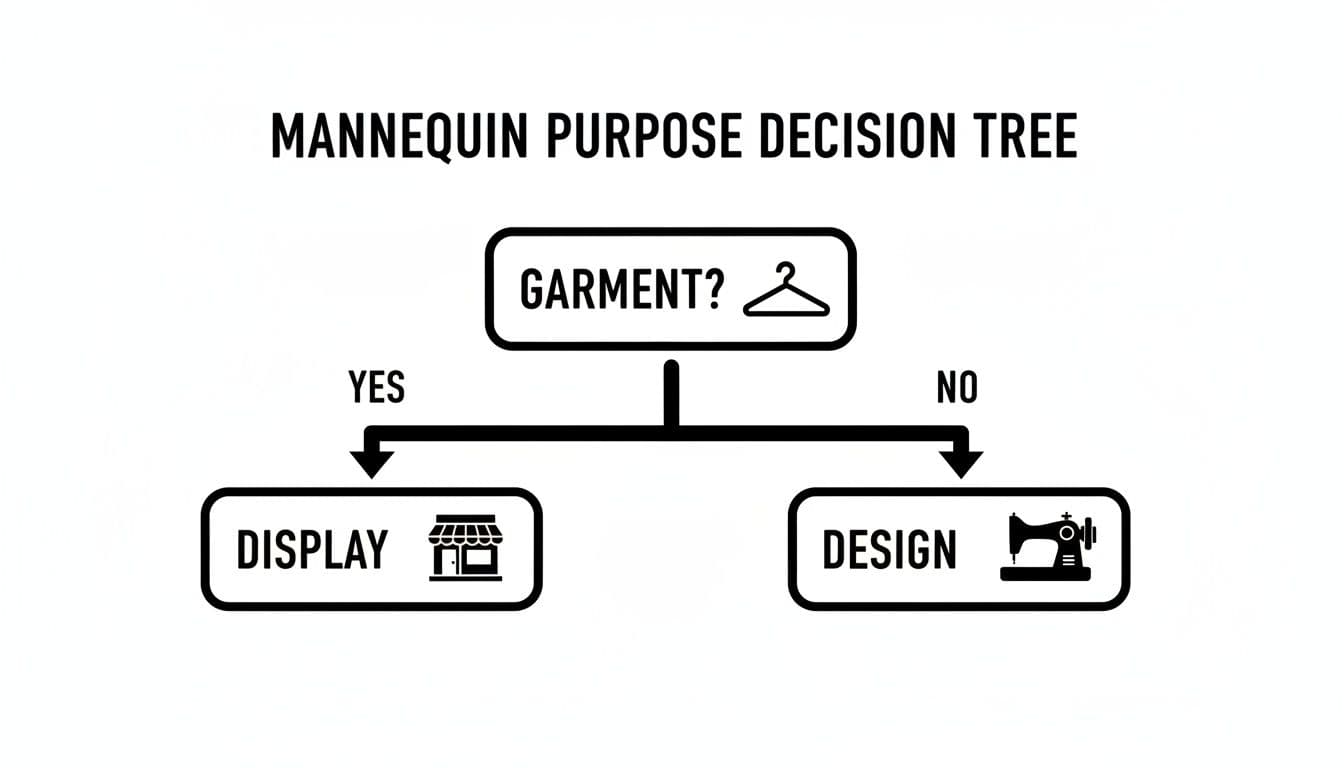
A mannequin purpose decision tree chart showing if a garment is for display or design.
As you can see, the path forks immediately. One side leads to the functional tools needed for design work, while the other leads to the static forms used for retail and photography.
Display Mannequins: The Final Showcase
When your garment is finished and ready for its close-up, a display mannequin is what you need. These are the polished, often headless figures you see gracing store windows and popping up in e-commerce lookbooks. Their job is to sell a vision. They’re usually made from hard materials like fiberglass or plastic and come in a couple of distinct styles.
- Realistic Mannequins: These have fully sculpted faces, hair, and lifelike poses. They’re great for helping a customer imagine themselves in the clothes, making them a powerful tool in a retail setting.
- Abstract Mannequins: These are much more stylized, with simplified (or no) facial features and usually a single finish, like matte white or glossy black. By stripping away the personality, they put all the focus right where it belongs: on the garment.
While they’re essential for sales, their hard surfaces and fixed poses make them completely impractical for patternmaking or draping. Trying to pin fabric onto fiberglass is a recipe for frustration.
Professional Dress Forms: The Designer's Workhorse
This is where the real work happens. For the hands-on process of creating a garment, a professional dress form is absolutely non-negotiable. These are technical tools, engineered to act as a stand-in for the human body during the entire design and construction phase. They’re almost always covered with a layer of foam and linen or canvas, which is key.
That soft, fabric-covered surface makes it a pinnable dress form, the undisputed champion for draping. It lets you anchor fabric directly onto the form, sculpting pleats, shaping seams, and bringing a design to life in three dimensions. It’s a tactile, intuitive process that’s simply impossible on a hard display mannequin.
Even within this category, you have options tailored to specific tasks:
- Adjustable Dress Forms: These clever forms have dials that let you expand or shrink the bust, waist, and hip measurements. This makes them incredibly versatile for designers who work with multiple sizes or create bespoke pieces for clients. The only downside is that the gaps between the adjustable panels can sometimes interrupt the flow of a perfectly smooth drape.
- Bifurcated Dress Forms: Also known as full-body or pant forms, these include legs—an absolute game-changer for designing trousers, shorts, swimwear, or bodysuits. They are the only way to accurately check the fit of an inseam or crotch curve.
While an adjustable form offers flexibility, a fixed professional form provides unmatched stability and a perfectly smooth, uninterrupted surface. This solid foundation is why they remain the top choice for high-end designers and couture houses that rely on absolute precision for draping and tailoring.
To help clarify the options, this table breaks down the main types of forms designers use, highlighting what they do best.
Comparing Dress Forms For Fashion Design
| Mannequin Type | Primary Use | Key Features | Ideal For |
|---|---|---|---|
| Display Mannequin | Retail & E-commerce | Fiberglass/plastic, realistic or abstract poses, non-pinnable. | Showcasing finished garments, visual merchandising, product photography. |
| Adjustable Dress Form | Custom & Multi-Size Design | Pinnable surface, adjustable dials for bust/waist/hips. | Home sewers, custom clothiers, designers working across a size range. |
| Bifurcated Dress Form | Pant & Swimwear Design | Includes legs (full or partial), pinnable surface. | Designing trousers, shorts, lingerie, swimwear, and activewear. |
| Fit Mannequin | Professional Fit & QC | Industry-standard sizing, based on anthropometric data. | Brands needing consistent fit, quality control, production sampling. |
Each form serves a distinct purpose in the journey from a sketch to a final product, so choosing the right one for your specific stage is crucial.
Fit Mannequins: The Industry Standard
At the very top of the pyramid, you’ll find the fit mannequin (or fit model form). These aren't just generic body shapes; they are the result of extensive research and data. Brands invest a ton of money into developing proprietary fit forms based on anthropometric studies of their actual target customers.
This is all about consistency. By using a standardized fit mannequin, a brand ensures that a size 8 from this season’s collection fits exactly like a size 8 from the next. It removes all the guesswork and provides a reliable, unchanging baseline for quality control.
While they represent a serious investment, a good fit form is an invaluable asset for any brand that’s serious about creating a perfect, consistent fit. It turns the abstract idea of "fit" into something measurable, repeatable, and reliable.
How To Master Sizing And Measurements
A brilliant design can fall completely flat if the fit is wrong. It’s a hard truth every designer learns. The secret to a perfect fit starts with perfect measurements, and your mannequin for fashion design is where that process begins. Mastering its dimensions isn't just a good idea—it's the skill that separates amateur guesswork from professional precision.
First, let's talk about standard sizing. A "standard" size, like a US 8, isn't a universal constant. These sizes are born from historical data about human body shapes, but every brand tweaks them to match their ideal customer. That’s why a size 8 from one label fits differently than a size 8 from another. Each one is built around a slightly different body.
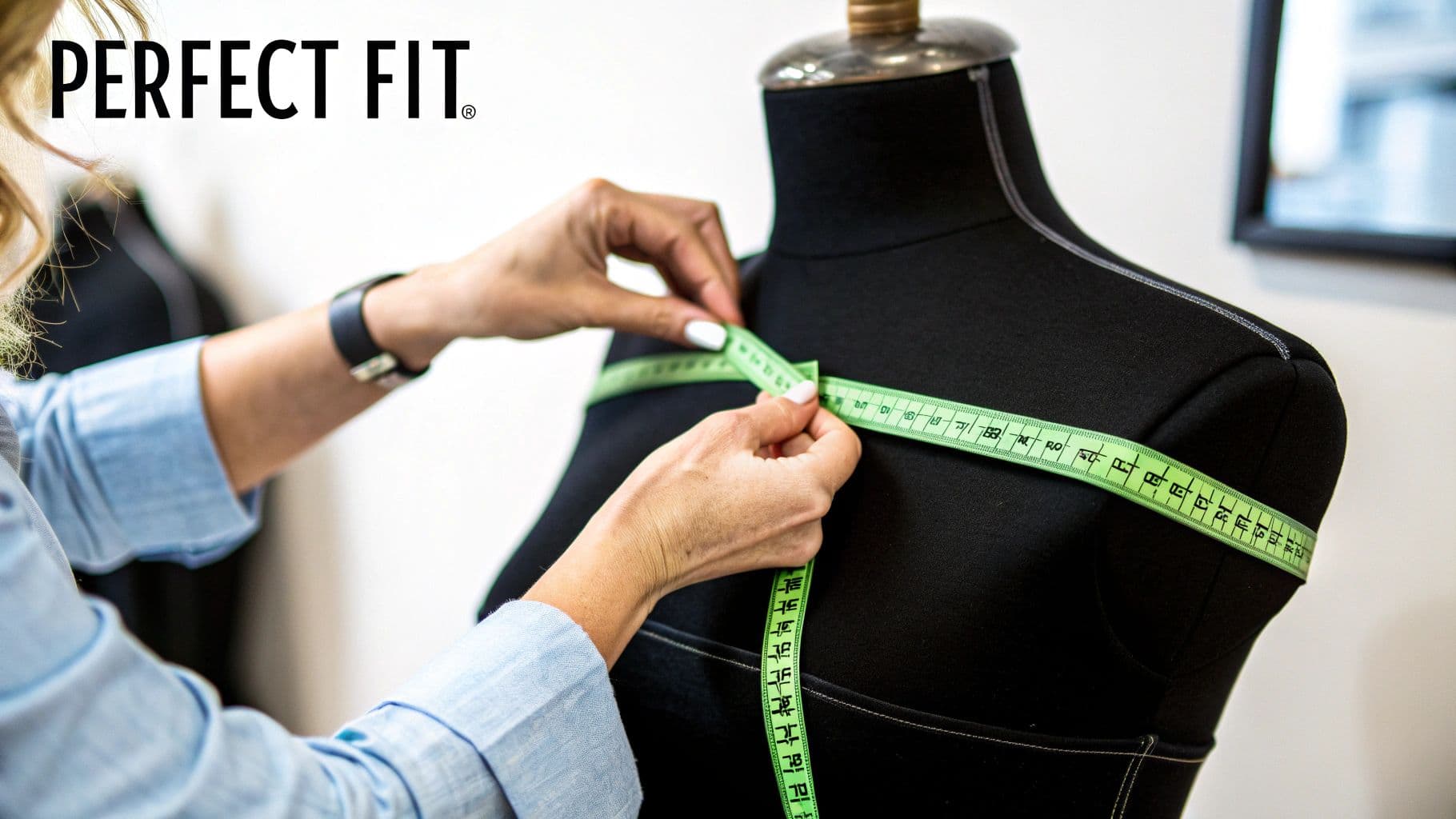
A person's hands measure a black mannequin with a green tape, focusing on tailoring.
This is precisely why you have to know your own form’s measurements like the back of your hand. Think of your dress form as your silent, perfectly still fit model. Its dimensions are your ground zero, your single source of truth for every garment you create.
Taking Core Measurements Correctly
Before a single pin hits the fabric, you need to measure your form. It’s a simple process, but it’s the foundation for everything that follows. Grab a soft measuring tape and let’s lock in these three key numbers:
- Bust: Wrap the tape around the absolute fullest part of the bust. The most common mistake here is letting the tape sag in the back—keep it perfectly parallel to the floor all the way around.
- Waist: Find the smallest part of the torso. This is the natural waistline, and most professional forms have a ribbon or twill tape marking the exact spot.
- Hips: Measure around the widest point of the hips, which is usually about 7-9 inches below the waist. Just like with the bust, keeping the tape level is critical.
These are the big three, but don't stop there. One often-overlooked measurement that can make or break a bodice or jacket is the back-waist length. You measure this from the most prominent bone at the base of the neck down to the natural waistline. Nailing this ensures your garments are balanced and don't pull or sag.
It's no surprise that the global mannequin market is booming, with projections expecting it to reach USD 4.2 billion by 2030. And while a huge chunk of that is for store displays, detailed mannequin market research shows that demand for specialized dress forms for designers is growing even faster. We need tools that actually work.
Transforming Your Form With Padding
So, what happens when your dress form’s measurements don’t line up with your fit model or target customer? You don’t buy a new form—you customize the one you have. This is where padding kits become your best friend.
Padding lets you build up specific areas—a fuller bust, wider hips, a rounded tummy—to create a true body double. It's a bit of an art form, but it's how you turn a generic shape into a specific one.
Think of a standard dress form as a blank canvas. Padding is the technique you use to sculpt it into a masterpiece that mirrors your unique fit model, accounting for every curve and proportion that makes them unique.
To get started, you'll need a detailed measurement chart from your fit model. Then, using foam pads from a specialized kit, you can start sculpting.
- Bust and Shoulders: Add pads to adjust the cup size, create broader shoulders, or even mimic a slight stoop.
- Waist and Hips: Build out the waist for a less defined hourglass or add to the hips and thighs to create a curvier lower body.
- Posture Adjustments: Small pads are brilliant for mimicking common fit challenges like a sway back or a fuller abdomen, ensuring your garments hang correctly on real bodies.
Once all the pads are in place, you pull a fitted cover over the entire form. This smooths everything out, holds the padding securely, and gives you a clean, pinnable surface to work on. Your newly customized form now closes the gap between your design vision and the reality of a flawless fit.
Applying Core Design And Draping Techniques
Once your dress form is padded out and ready, it stops being a static object and becomes your creative partner. This is where sketches and ideas finally meet fabric, and a designer’s vision starts to take real shape. Your mannequin for fashion design is the central hub for the most critical, hands-on stages of making a garment.
Now, we’ll get into the core techniques that bring a garment to life on the form, starting with the art of draping and moving through pattern making and final styling. Every single step relies on the form as a stable, accurate stand-in for the human body.
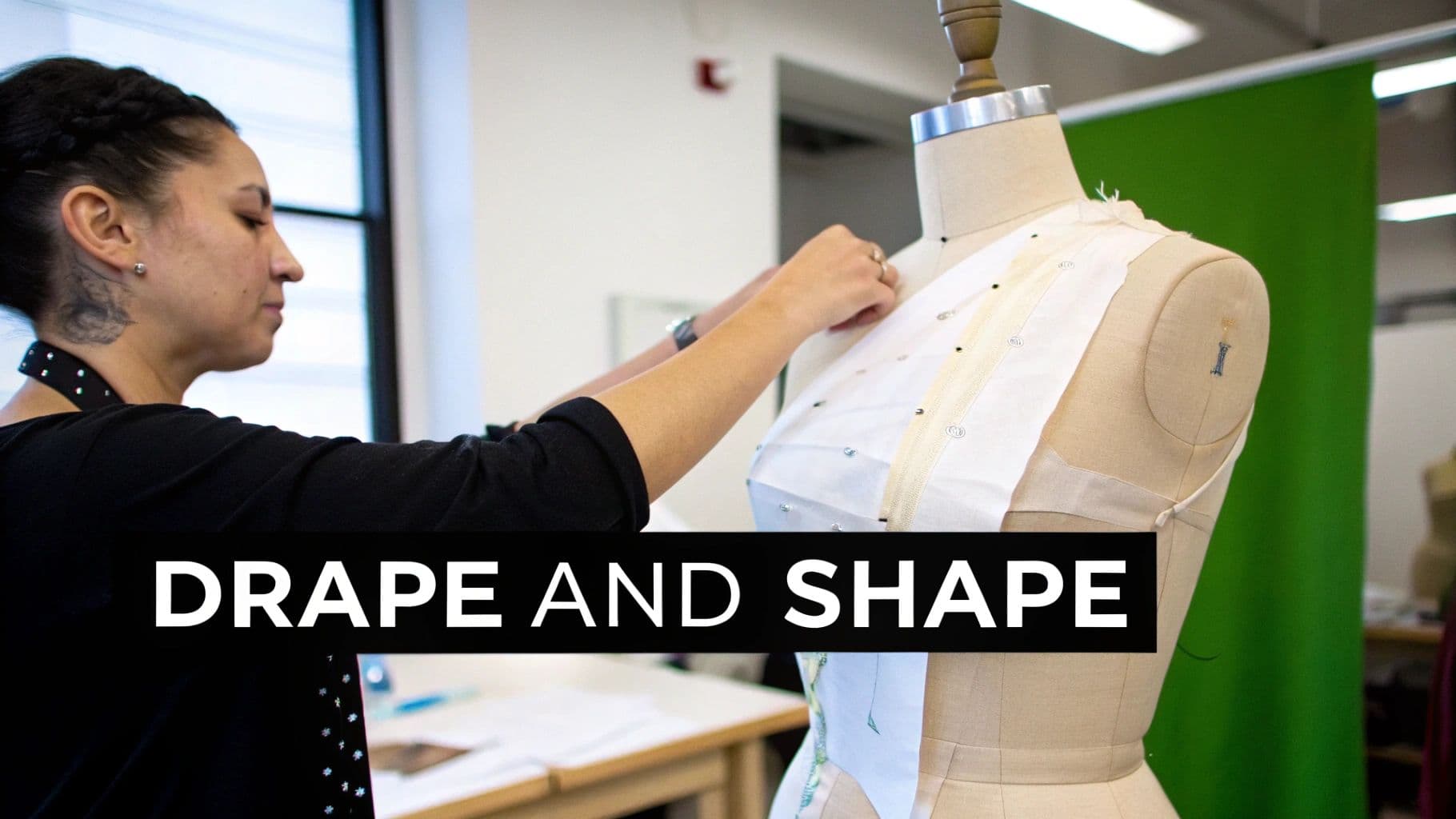
A fashion designer with braids and a neck tattoo drapes white fabric onto a mannequin, shaping a new garment.
Draping Fabric To Sculpt Your Vision
Draping is easily the most artistic and intuitive way to design. Instead of sketching out a flat paper pattern, you work directly with the fabric, sculpting it onto the dress form. This process lets the material’s own weight, texture, and personality guide the design. Of course, a pinnable surface isn't just nice to have here—it's essential.
Think of it like sculpting, but with cloth. You pin muslin or your final fabric to the form, smoothing, pleating, and folding it until the silhouette you want emerges. This 3D approach is fantastic for discovering unexpected shapes and truly understanding how a specific fabric wants to behave.
A dress form allows you to see how gravity interacts with your fabric in real-time. It’s the difference between guessing how a bias-cut skirt will hang and knowing how it will fall, giving you complete control over the final look.
This technique is a game-changer for creating garments with complex, organic shapes that are nearly impossible to map out in a two-dimensional sketch. It perfectly bridges the gap between imagination and reality, which is why it's a cornerstone skill in couture and bespoke design. If this hands-on approach sparks your interest, exploring different methods for drawing fashion illustrations can add another powerful layer to your creative process.
Perfecting Patterns And Prototypes
After you’ve draped a design in muslin, the next move is to translate that three-dimensional shape back into a flat pattern. You'll carefully mark your seam lines, darts, and notches directly onto the draped fabric before unpinning it from the form. This marked-up muslin becomes the blueprint for your paper pattern.
Once you’ve got a paper pattern, the dress form becomes your testing ground again. You’ll create a sample garment, often called a toile, and fit it onto the form to hunt for any issues. This is where you catch problems before they make it to your expensive final fabric.
You can spot common fitting problems right away on a form, like:
- Pulling or Strain: Are there weird tension lines in the fabric? That means an area is too tight.
- Gaping or Sagging: If you see excess fabric pooling, especially at necklines or armholes, the pattern needs an adjustment.
- Improper Balance: The form helps you see if the garment hangs evenly and whether the side seams are perfectly vertical.
The dress form gives you an objective, standardized body for this crucial quality control step. It lets you tweak your pattern with precision until the fit is absolutely flawless, ensuring every single piece you make from that pattern is consistent.
Styling For Lookbooks And Product Shots
While a dress form is a workshop tool, the clothes perfected on it are ultimately meant for the spotlight. After all the designing, patternmaking, and sewing are done, the final piece is ready to be styled for its debut.
This is where the display mannequin circles back into the picture. A finished garment, which owes its perfect fit to the meticulous work done on a professional dress form, can be transferred to an abstract or realistic mannequin for photography. The beautiful structure and shape you achieved in the studio will ensure it looks just as stunning on the display form.
This workflow highlights the distinct but complementary roles of these tools:
- The dress form is for the process—the creative work of draping, fitting, and perfecting.
- The display mannequin is for the presentation—showcasing the polished, finished product for lookbooks, e-commerce sites, and retail floors.
By mastering these core techniques on a quality dress form, you build a workflow that guarantees a higher level of polish and a more accurate version of your creative vision, from the very first pin to the final photograph.
The Evolution To Virtual Mannequins
For centuries, the dress form has been the silent partner in every design studio. But today, it’s got a digital counterpart. While a physical mannequin for fashion design is still non-negotiable for getting that hands-on feel for fabric and fit, the industry is leaning heavily into virtual mannequins and 3D avatars to crack modern problems—especially in the unforgiving world of e-commerce.
Let’s be clear: this isn't about replacing the artistry of draping a physical garment. It’s about adding a powerful digital layer that closes the gap between the design table and the online checkout cart. For growing brands, virtual models are a game-changer, letting them show off designs on a huge range of body types without the logistical nightmare and steep costs of a traditional photoshoot.
The Rise of AI-Powered Model Imagery
Picture this: you generate stunning, on-model photos for your entire new collection in the time it takes to brew a pot of coffee. No cameras. No lights. No human models. That’s the new reality AI platforms are delivering. This tech can take a simple photo of your garment on a hanger and instantly wrap it around a photorealistic virtual model.
This simple process wipes out huge chunks of time and money from your budget. Just think about what goes into a standard photoshoot:
- Hiring models, photographers, and stylists
- Renting out studio space and expensive equipment
- Dealing with the logistics of shipping samples and juggling everyone's schedules
AI-powered visualization just sidesteps all of that, putting high-quality product photography within reach for any brand, no matter the size. It drastically shortens the time it takes to get from design to market, getting products in front of customers faster than ever. This digital shift is happening alongside continued growth in the physical world; the fashion mannequins market is still projected to hit over US$ 1.4 billion by 2032, proving both tools are in high demand. You can dig into the numbers in this market growth analysis.
Promoting Inclusivity and Consistency
One of the biggest wins for virtual mannequins is the ability to finally deliver on the promise of inclusivity. For decades, the mannequin industry has been stuck on a single, standardized, often Eurocentric body type. Virtual tech completely shatters that mold.
With AI, a brand can showcase a single garment on an endless variety of models, representing different ethnicities, sizes, and ages. This isn't just a feature—it's a fundamental shift that allows every customer to see themselves reflected in the brand.
On top of that, AI platforms let you generate consistent brand models. This means you can create a unique virtual model who becomes the recognizable face of your brand, showing up across every product page and marketing campaign. It’s a powerful way to build a cohesive brand identity that connects with your audience. You can see how this tech is changing the game in our guide to the future of virtual dressing room experiences.
Ultimately, the journey from the physical dress form to the virtual avatar isn't about replacing old with new. It’s about combining the best of both worlds. Designers get the tactile feedback they need from a physical form while using AI to launch their creations into the world with more speed, diversity, and creative control than ever before.
Common Questions About Fashion Design Mannequins
Even when you think you have all the right gear, questions pop up. It doesn't matter if you're a first-year student or a seasoned pro tweaking your process—getting straight answers saves you time, money, and a whole lot of headaches. This section tackles the most common questions we hear about choosing and using a mannequin for fashion design.
Think of this as your studio cheat sheet. The goal is to cut through the jargon and help you make this essential piece of equipment work for you.
What Is The Difference Between A Mannequin And A Dress Form?
This is a big one. People throw these terms around interchangeably, but in the design world, they’re two completely different tools for two completely different jobs. It’s like confusing a paintbrush with a picture frame—one is for creating the art, the other is for showing it off.
A mannequin is what you see in a shop window. Its whole purpose is to display a finished garment for retail, whether in a physical store or on an e-commerce site. They’re usually made from hard materials like fiberglass, come in stylized or realistic poses, and you definitely can't stick pins in them.
A dress form, on the other hand, is the workhorse of the design studio. It's a technical tool covered in pinnable fabric and built to precise industry measurements. This is where you do the real work: draping fabric, making patterns, and fitting your prototypes. You create on a dress form; you sell on a mannequin.
What Size Dress Form Should A Beginner Buy?
This question comes up all the time with emerging designers, and the answer really has two parts. First, if you’re just starting to build a portfolio or a sample collection, you can't go wrong with an industry-standard size like a US 6 or 8. These sizes are a versatile, solid foundation for most womenswear development.
But here’s the more important part: you should buy a size that actually reflects your target customer. If your brand is all about plus-size fashion, menswear, or petite fits, you absolutely need to invest in a form that matches those specific measurements from day one. An adjustable form might seem like a flexible option, but for serious draping, nothing beats the stability and dead-on accuracy of a professional fixed-size form.
How Do I Pad A Dress Form To Custom Measurements?
A standard dress form is a fantastic starting point, but it's rare that one size perfectly matches a fit model or a specific customer. That’s where padding comes in—it’s how you turn your generic form into a precise body double.
Here’s the basic process:
- Take Meticulous Measurements: Start with a super detailed measurement chart of your fit model. Don't just get the bust, waist, and hips. You need everything: back-waist length, shoulder width, thigh circumference, the works.
- Add Pads Strategically: Use a foam padding kit to build up the areas that need more volume. Pin the pads in place and add layers slowly to sculpt the shape.
- Measure and Sculpt Constantly: As you add padding, keep measuring. You need to constantly compare the form's new dimensions to your target numbers. Don’t be afraid to trim or even sand the pads to create smooth, natural-looking curves.
- Finish with a Fitted Cover: Once you've nailed the dimensions, pull a snug-fitting cover over the entire padded form. This is crucial—it creates a smooth, unified, and pinnable surface that’s ready for work.
Can Virtual Mannequins Replace Physical Dress Forms?
This isn't an either/or situation. Virtual and physical mannequins aren't competitors; they're collaborators that shine at different stages of the fashion lifecycle. A physical dress form is still absolutely essential for the hands-on, tactile work of actually making a garment. You just can't fake the feel of how a specific fabric drapes or the immediate feedback you get from fitting a real-life prototype.
A physical dress form is for the creation process—the intuitive art of sculpting with fabric. A virtual mannequin is for the communication process—visualizing the final product for marketing and sales.
A modern, efficient workflow uses both. A designer uses their physical form to perfect a garment's fit, feel, and structure. Then, they use virtual mannequins to generate endless on-model images for their online store and marketing campaigns, skipping the high costs and long lead times of traditional photoshoots. One tool makes the product, the other helps sell it.
Historically, the lack of diversity in physical mannequins has been a major blind spot, with most based on Eurocentric body standards. The Victoria & Albert Museum even had to commission a special mannequin based on South Sudanese model Adhel Bol for their Africa Fashion exhibition, a story that highlights why representation in fashion display matters. This is exactly the kind of problem virtual model technology solves instantly by offering limitless diversity with just a click.
Ready to skip the photoshoots and create stunning, on-model imagery in seconds? At WearView, we empower fashion brands to generate studio-quality visuals using AI. Simply upload your garment photos and watch as our platform transforms them into photorealistic images on a diverse range of models, saving you up to 90% on production costs and getting your products to market faster.
Discover how WearView can transform your product photography and start creating today.
Tags:
WearView Team
WearView Content & Research Team
WearView Team is a group of fashion technology specialists focused on AI fashion models, virtual try-on, and AI product photography for e-commerce brands. We publish in-depth guides, case studies, and practical insights to help fashion businesses improve conversion rates and scale faster using AI.