January 30, 2026•22 min read
Improving ecommerce conversion rates: 7 proven techniques to boost sales
Discover practical steps for improving ecommerce conversion rates with diagnostics, visuals optimization, and a streamlined checkout to boost sales.
Improving ecommerce conversion rates: 7 proven techniques to boost sales
Boosting your conversion rates isn't about guesswork. It's a systematic hunt for the friction points in your sales funnel, followed by targeted experiments to smooth them out. You have to start by digging into your data to figure out where and why shoppers are leaving, then make smart changes to your visuals, user experience, and trust signals to get more people from "just looking" to "just bought."
Finding the Leaks in Your Sales Funnel
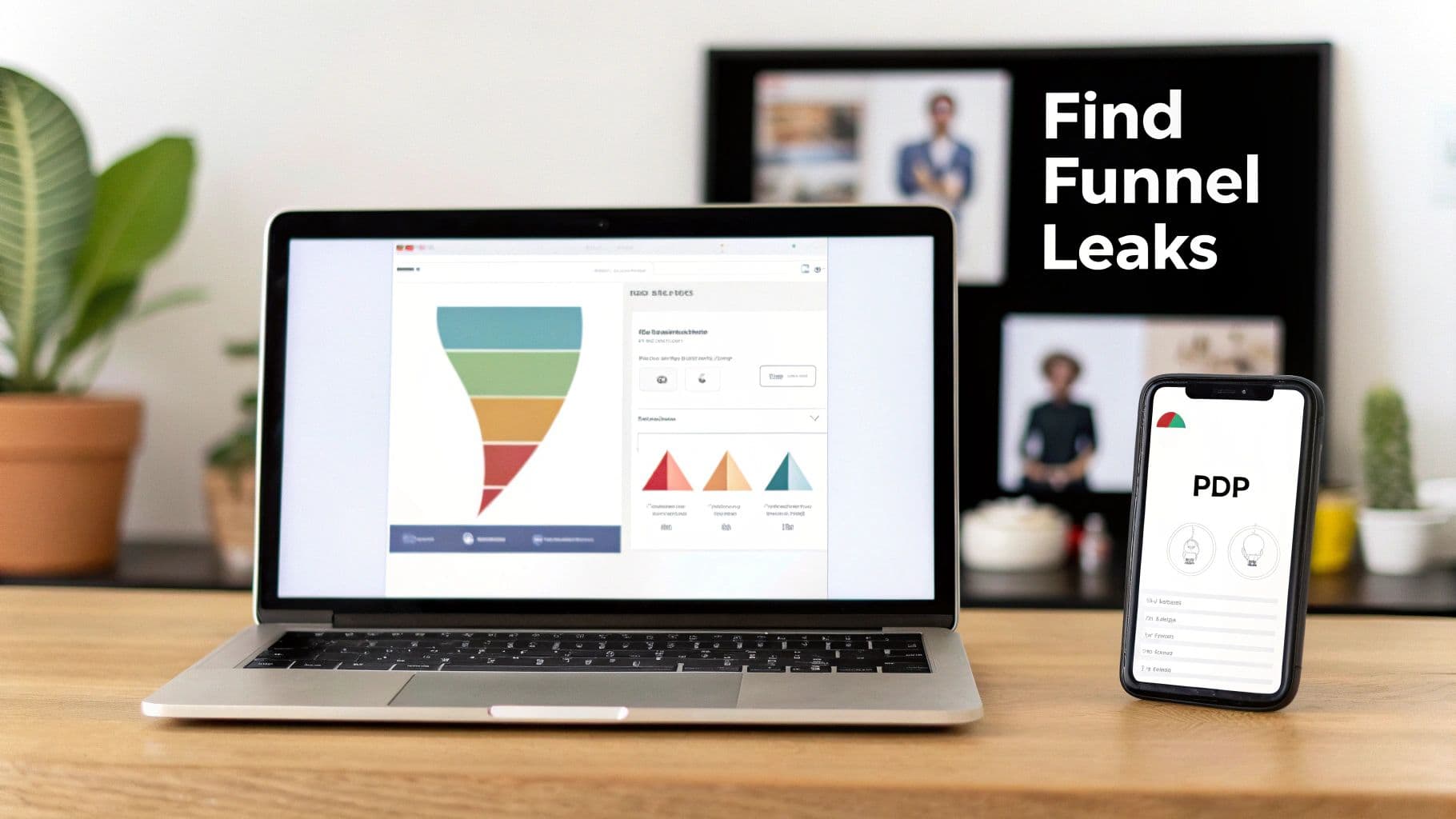
Digital marketing workspace showing e-commerce funnel analysis on a laptop and product page on a smartphone.
Before you can start optimizing, you need to play detective. A solid conversion rate optimization (CRO) strategy isn't built on gut feelings; it's grounded in a crystal-clear understanding of where your sales funnel is springing leaks.
For fashion brands, this means going way beyond surface-level stats like total traffic. You need to get into the weeds and look at the specific actions customers take—or, more importantly, don't take—on their way to making a purchase. The goal here is simple: find the exact moments where potential customers get bored, confused, or just give up. This initial diagnosis is your treasure map, guiding every decision you make from here on out.
Identifying Critical Drop-Off Points
Your first job is to trace your customers' steps using data. Tools like Google Analytics are the obvious starting point, but the real magic is in knowing which reports to pull. Don't just glance at your overall bounce rate; break it down by page, traffic source, and device to find the real culprits.
Here are the key stages to investigate:
- Homepage to Product Page: If you see a massive drop-off here, it’s a big red flag. It could mean your navigation is a mess or the products you're featuring just aren't grabbing anyone's attention.
- Product Detail Page (PDP) to Cart: This is a huge one. Lots of views but no "add to cart" clicks? The problem is almost always on the PDP itself. Think poor product photos, confusing sizing charts, or a lack of social proof like customer reviews.
- Cart to Checkout: When people add items to their cart but never even start the checkout process, it often comes down to sticker shock. Hidden shipping costs are a classic conversion killer, as is forcing people to create an account instead of offering a guest checkout.
Analyzing User Behavior with Visual Tools
Numbers tell you the what, but visual tools tell you the why. To really get inside your customers' heads, you need to see your site through their eyes. This is where user behavior analytics tools are worth their weight in gold.
Heatmaps, for instance, show you exactly where people are clicking, where their mouse hovers, and how far down the page they actually scroll. You might find out everyone is trying to click on a lifestyle image that isn't actually a link—a clear sign of a design flaw. Session recordings take it a step further, letting you watch anonymized videos of real user sessions. It's like looking over their shoulder as they get frustrated or confused.
A critical step in improving ecommerce conversion rates is analyzing not just what users do, but what they don't do. A heatmap might reveal that 90% of visitors never scroll down to see your shipping policy, leading them to abandon their cart later when they see the final cost.
This kind of qualitative insight gives you the context that raw numbers can't. When you combine the quantitative and the qualitative, you can form powerful, evidence-based hypotheses about what to fix first. For more AI-driven strategies and a deep dive into actionable CRO tactics, this guide on how to improve ecommerce conversion rates is a fantastic resource.
Segmenting Your Audience for Deeper Insights
Treating all your visitors the same is a recipe for mediocre results. A one-size-fits-all analysis will mask the specific problems affecting different customer groups. For fashion e-commerce, segmenting your data is absolutely essential.
Try breaking down your funnel performance by:
- Device Type: Are mobile users abandoning carts at a higher rate? Your mobile checkout probably feels clunky and frustrating.
- Traffic Source: Are visitors from your Instagram ads bouncing off product pages immediately? It could be a mismatch between your ad creative and the landing page experience.
- New vs. Returning Visitors: If new visitors aren't converting, your site might be missing the key trust signals needed to convince a first-time buyer to pull out their credit card.
By pinpointing these leaks with precision, you build a data-driven foundation for your entire CRO strategy. This diagnostic work ensures you’re not just making random changes; you’re solving the right problems. It's the same kind of focused analysis brands use with tools like a virtual dressing room to see exactly how new features impact user engagement and, ultimately, sales.
Mastering Visuals to Boost Buyer Confidence
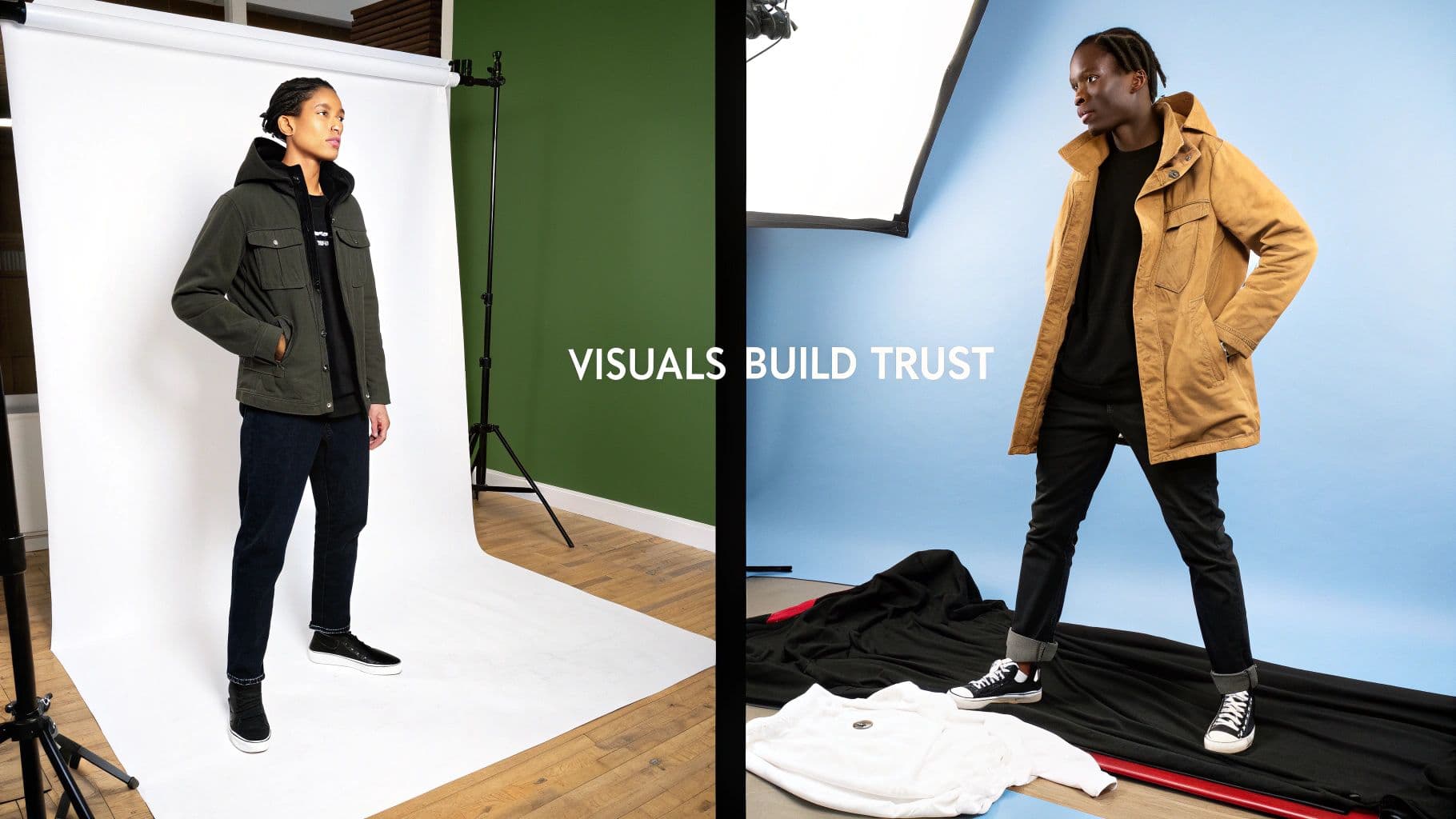
Two models showcase casual clothing in a photo studio, highlighting visual trust for e-commerce.
In fashion ecommerce, your product images are your best salespeople. Period. They're doing the heavy lifting, convincing a shopper to stop scrolling, click through, and actually buy. High-quality, engaging visuals are the absolute cornerstone of improving ecommerce conversion rates because they close the gap between staring at a screen and the real-world desire to try something on.
When a customer can't touch the fabric or see how a dress hangs, your photos have to answer every unspoken question and erase any doubt. This is where so many brands miss the mark. A product page filled with inconsistent model shots, lifeless flat lays, or sad-looking hanger photos just screams uncertainty. Shoppers are left wondering, "How will that actually look on a person? On me?" That hesitation is a silent conversion killer.
The Undeniable Power of On-Model Imagery
Let's be honest, the single biggest question in a fashion shopper’s mind is all about fit and style. A static photo of a sweater lying flat on a white background just doesn't cut it. It shows the product, sure, but it doesn't sell the look or the feeling. This is precisely why on-model photography consistently blows other visual formats out of the water.
Seeing clothing on a human body provides immediate, crucial context. It helps customers instantly understand:
- Drape and Fit: How does the fabric fall? Is it a slim fit or more relaxed?
- Proportion and Scale: How long is that shirt, really? Where does the skirt hem actually hit?
- Styling Potential: Oh, I could wear it with those jeans! It gives them ideas.
This clarity builds instant buyer confidence and dramatically lowers the perceived risk of making a bad purchase. In the hyper-competitive fashion world—where benchmarks show the average conversion rate for apparel hovers just over a meager 3%—powerful visuals are what separate the top players from everyone else. In fact, we’ve seen websites using high-resolution, on-model lifestyle images achieve conversion lifts of up to 30% compared to those stuck with flat lays.
The AI Shortcut: Turning Garment Photos into Conversion Drivers
For years, getting high-quality on-model shots for every single product was a logistical and financial nightmare. The costs of models, photographers, and studios—not to mention the sheer time involved—was a massive barrier. This forced many brands to launch new arrivals with subpar photos, knowingly sacrificing sales just to get products live.
AI-powered tools have completely flipped the script. Now, you can take a simple photo of a garment on a hanger or mannequin and instantly generate a photorealistic on-model image. This isn't just about saving a ton of money; it's about fundamentally upgrading your entire visual merchandising strategy.
Think of it this way: every product page without a compelling on-model photo is a leaky bucket. You're forcing customers to use their imagination, and when they can't quite picture it, they bounce. AI plugs that leak.
If you want to go deeper on how this works, check out our guide on AI product photography and how it transforms basic shots into professional assets.
To put the impact into perspective, consider the shift from standard flat-lay photography to AI-powered on-model visuals. The difference isn't just aesthetic; it's measurable across key performance indicators.
Visual Content Impact on Fashion Ecommerce KPIs
This table shows the measurable impact of switching from standard product photography to advanced, AI-powered on-model visuals across key ecommerce metrics.
| Metric | Impact of Standard Visuals (Flat Lays) | Impact of Advanced Visuals (AI On-Model) |
|---|---|---|
| Conversion Rate | Baseline performance, often below industry average. | +15-30% lift by reducing purchase anxiety. |
| Add-to-Cart Rate | Moderate; relies on product appeal alone. | +20-50% increase as shoppers can visualize the item. |
| Return Rate | High, often 20-30% due to poor fit expectation. | -5-15% reduction as fit and drape are clearer. |
| Time on Page | Lower, as shoppers quickly decide they lack info. | +40-60% increase in engagement as they explore visuals. |
| Ad CTR | Standard performance, struggles to stand out in feeds. | +30-70% higher CTR due to relatable, engaging imagery. |
The data makes it clear: better visuals aren't a "nice-to-have." They are a direct lever for growth, impacting everything from initial ad engagement to post-purchase satisfaction.
Showcasing Diversity and Building Real Connection
Today’s shoppers don’t just want to see products; they want to see themselves. Generic, one-size-fits-all model imagery can easily alienate a huge chunk of your audience. If a shopper can't find a model who reflects her body type or ethnicity, it becomes ten times harder for her to visualize wearing your product.
This is another area where AI is a game-changer. Instead of being constrained by the models you can hire for a shoot, you can generate visuals featuring a massive range of ethnicities, body types, and ages.
Imagine a customer landing on your product page for a new jacket. With a click, she can see that jacket on a model who shares her skin tone and body shape. That kind of personalized experience creates a powerful, immediate connection and validates her decision to buy. It sends a clear message that your brand is inclusive and understands its audience—a critical factor in building the trust that leads to long-term loyalty.
Optimizing the Path From Product Page to Purchase

Hand holding smartphone with shopping cart icon at a digital streamline checkout display in a store.
Getting a shopper to your product page with great visuals is only half the battle. Now you have to make the journey from "I want this" to "I bought this" completely frictionless. Any doubt, any confusion, any unnecessary click is an open invitation for them to leave.
This is where you bridge the gap between the emotional pull of your products and the simple, logical steps needed to actually buy them. It's a two-front war: first, arm your Product Detail Pages (PDPs) with everything a shopper needs to feel confident, and second, ruthlessly cut the fat from your checkout flow.
Fortifying Your Product Detail Pages
Beyond the powerful on-model shots we've already covered, your PDPs need to be layered with compelling copy and social proof. These elements work in tandem to convince a customer that clicking "Add to Cart" is the right move.
Your product descriptions need to do more than list specs. They have to sell an experience. Instead of just "Cotton-blend fabric," try something like, "A soft, breathable cotton blend that feels amazing, perfect for all-day comfort." That small tweak helps the shopper imagine themselves wearing it.
Just as crucial is hearing from other customers. We know that 61% of shoppers read online reviews before they even think about buying. When you put customer reviews and star ratings right on the PDP, you provide instant, unbiased validation that your marketing copy never could.
A product page without customer reviews is like a restaurant with an empty dining room—it just makes people nervous. Showcasing real feedback, even the occasional four-star review, builds far more credibility and trust than a wall of perfect marketing copy.
Finally, you have to be radically transparent about your policies. Surprise shipping fees are the number one killer of conversions. Put your shipping costs, delivery windows, and return policy right out in the open. It stops nasty surprises at checkout and shows you respect your customers, a key part of improving ecommerce conversion rates.
Streamlining the Checkout Funnel
Once that item hits the cart, the clock starts ticking. The goal is a checkout process so simple a customer could do it on autopilot. Every extra field, every unnecessary page load, every confusing instruction drastically increases the odds they'll just give up.
One of the absolute biggest conversion killers? Forcing users to create an account. For a first-time buyer, this is a huge, annoying barrier. You must offer a big, obvious guest checkout option to get them through the door with as little friction as possible.
Here are a few high-impact optimizations you can make right away:
- One-Page Checkout: Ditch the multi-step process. Put everything on a single, clean page so users can see the entire finish line at once. This is especially critical on mobile, where clicking through multiple pages feels like a chore.
- More Ways to Pay: Shoppers now expect flexibility. Go beyond credit cards and offer digital wallets like Apple Pay, Google Pay, and PayPal. These often bypass manual address entry entirely, letting customers pay with a fingerprint or face scan.
- Mobile-First Everything: With most of your traffic coming from phones, your checkout must be designed for thumbs. That means big, easy-to-tap buttons and form fields that don't require pinching and zooming. It has to feel natural on a small screen.
Think about a common scenario: a shopper sees a dress they love on Instagram and clicks through on their phone. They add it to their cart, but the checkout is a tiny, multi-page form that demands they create an account. They get frustrated, close the tab, and the sale is lost.
Now, imagine that same shopper clicks through to a one-page, mobile-friendly checkout with an Apple Pay button. The entire purchase could be done in less than 30 seconds. That’s how you turn casual browsers into repeat customers.
Using AI Personalization to Create Custom Shopping Experiences
Today's shoppers have come to expect more than just a grid of products. They want a shopping journey that feels like it was made just for them. Let's face it, generic storefronts with one-size-fits-all messaging are on their way out. The real secret to improving ecommerce conversion rates now is using AI to create personal, relevant experiences that make every customer feel understood.
This isn't just about a "you might also like" carousel at the bottom of the page. We're talking about truly dynamic content. Imagine your website intelligently swapping out on-model images based on a user's browsing history, their location, or even the specific Instagram ad they clicked to get to your site. That's the level of detail we're aiming for.
Moving Beyond Basic Recommendations
While classic recommendation engines still have their place, modern AI tools unlock a much deeper level of interaction. Features like Virtual Try-On are shifting the online shopping experience from a passive scroll into an active, engaging session.
Instead of guessing how a dress might hang, a shopper can instantly see it on a model that reflects their own body type, height, and skin tone. This simple interaction is incredibly powerful for two reasons:
- It builds massive confidence. Seeing a realistic preview of how the product will actually look on someone like them cuts through purchase anxiety like nothing else.
- It creates a memorable connection. This level of personalization makes the experience feel special and unique, forging a much stronger bond with your brand.
This kind of tech directly tackles the single biggest hurdle in online fashion: the inability to try things on before you buy.
Here’s a perfect example of how a brand can use AI to showcase a single garment on a diverse range of models, making the product instantly more relatable to a wider audience.
The image shows how one piece of clothing can be realistically rendered on models with different ethnicities and body types, creating a more inclusive and personal visual experience for shoppers.
Powering Hyper-Targeted Ad Campaigns
Personalization isn't just a website tool; it's a game-changer for your paid advertising, especially on visual-heavy platforms like Instagram and TikTok. Running a generic ad with a single model shot is a huge missed opportunity. With AI, you can spin up dozens of ad variations with almost no extra effort.
Let's say you're launching a new jacket. Instead of one ad, you could run multiple campaigns at the same time, each targeting a specific audience segment with a unique on-model visual that speaks directly to them. A younger, trend-focused crowd might see the jacket styled for a music festival, while a more professional segment sees it paired with workwear.
By tailoring your ad creative to specific audience segments, you stop hoping for clicks and start attracting high-quality traffic. When a user clicks an ad that truly reflects their style and lands on a product page that continues that personalized journey, the chance of a conversion skyrockets.
This targeted approach delivers tangible results:
- Higher Click-Through Rates (CTR): Ads that feel personal and relevant simply get more attention in a crowded feed.
- Lower Cost Per Acquisition (CPA): When you drive more qualified traffic, you stop wasting ad spend on people who were never going to buy anyway.
- Improved Ad Performance: The ad platforms reward engaging creative, which leads to better campaign results and a much higher return on your investment.
By integrating AI, you create a seamless, personalized loop from that first ad impression all the way to the final checkout click. If you're looking to dig deeper, our overview of the best AI tools for ecommerce breaks down the platforms that make this possible. This level of customization isn't a luxury anymore—it's a core part of any modern conversion strategy.
Running Conversion Experiments That Actually Work
Improving your conversion rate isn't a "set it and forget it" task. It’s a constant cycle of testing, learning, and refining your approach. The difference between a stagnant brand and a high-growth one often comes down to moving from guesswork to data-backed decisions. This means adopting a structured way to experiment, where every change you make is a calculated move designed to teach you something valuable about your customers.
This process gives you the freedom to test bold ideas without betting the entire business. It cuts through the noise to show you what really drives sales, helping you build a playbook of proven tactics that consistently grow your bottom line.
Formulating a Strong Hypothesis
Every good experiment starts with a strong, testable hypothesis. This isn't just a vague idea like, "Let's try some new photos." It's a specific, measurable statement that predicts a clear outcome.
A solid hypothesis needs three things: the change you're proposing, the result you expect, and the reason you expect it. For a fashion brand, a powerful hypothesis might sound like this:
"By replacing our standard flat-lay photos on product pages with AI-generated on-model imagery, we will increase our Add to Cart rate by 15% because shoppers will be able to better visualize the fit and style, reducing purchase uncertainty."
See how clear that is? It's measurable (a 15% lift), specific (Add to Cart rate), and it explains the "why." This framework turns a random thought into a scientific test, guaranteeing you learn something useful, whether the test wins or loses.
Prioritizing Your Experiments
You're probably buzzing with a dozen ideas for tests, but you can't run them all at once. The trick is to prioritize them using a simple framework based on potential impact and how easy they are to implement.
For each idea, ask yourself:
- Potential Impact: How much could this realistically move the needle on your main KPI? A test on your product page visuals will almost certainly have a bigger impact than changing the color of a link in your footer.
- Implementation Ease: How much time and how many resources will this test demand? Swapping out images is pretty straightforward, but a complete checkout redesign is a massive project.
- Traffic Volume: The page you’re testing needs enough traffic to get a statistically significant result in a decent amount of time. Focus your efforts on your highest-traffic product categories to get faster, more reliable data.
Always start with the high-impact, low-effort experiments. These are your "quick wins" that build momentum and deliver immediate value, which can help fund your more ambitious projects later on.
Choosing the Right Testing Method
For most e-commerce brands, the gold standard for testing is the A/B test (or split test). The concept is simple: you show two versions of a page—the control (Version A) and the variation (Version B)—to different segments of your audience at the same time to see which one performs better.
It’s a clean, direct way to measure the impact of a single change. For instance, you could test your original product page against a version that includes a Virtual Try-On feature to see which one drives more conversions. Simple as that.
What's crucial, though, is tracking the right Key Performance Indicators (KPIs). The goal isn't just to get more clicks; it's to drive meaningful business outcomes. An imagery test on a product detail page (PDP) should track the Add to Cart Rate and the overall Conversion Rate. A checkout optimization test should focus on the Checkout Completion Rate and Average Order Value. Matching the right metric to the right test ensures you're actually measuring what matters.
Mobile optimization is a huge area for experimentation. This flow shows how AI can personalize the mobile experience—a critical step in lifting conversion.
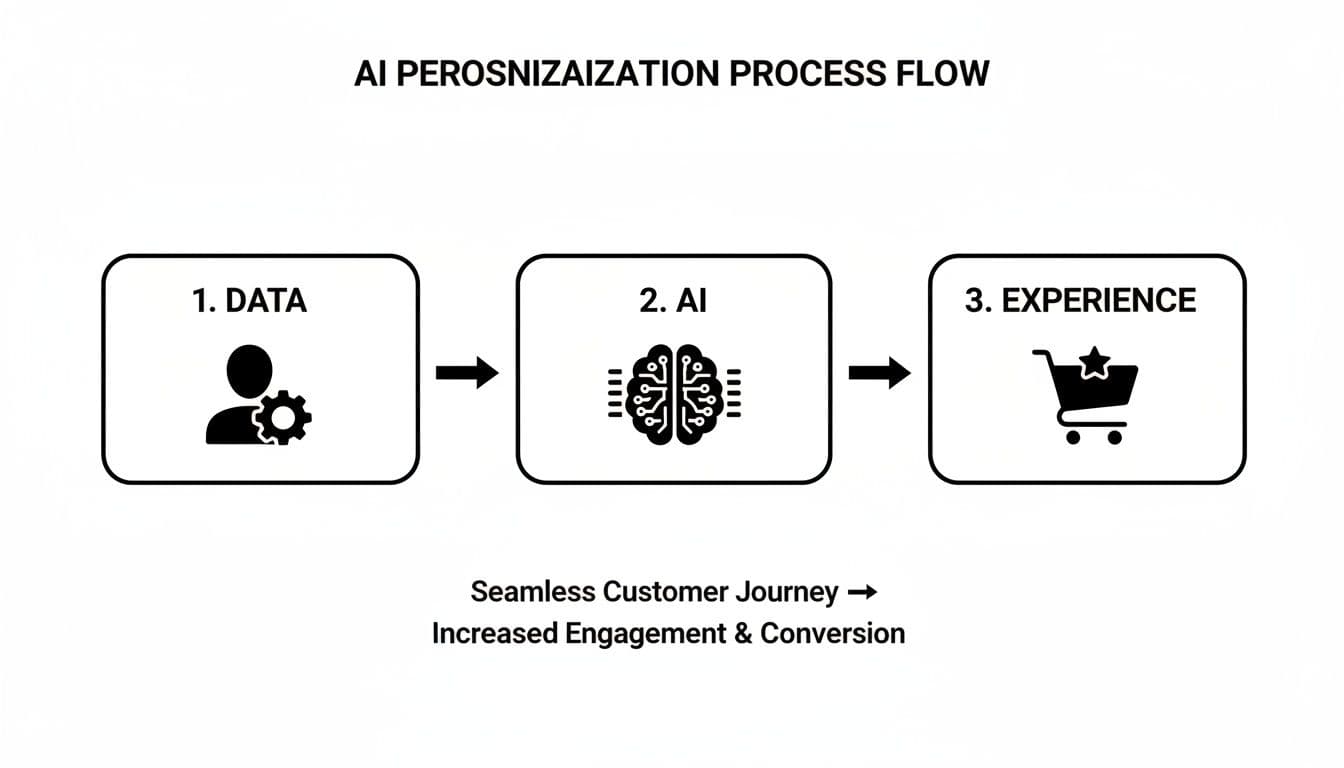
AI personalization process flow showing data, AI, and improved customer experience leading to conversion.
This process highlights how user data can be fed into an AI engine to create a personalized shopping experience, which directly impacts purchase decisions. As mobile shopping continues to dominate, getting this flow right is essential. By Q3 2025, smartphones drove over 75% of global retail site visits, yet mobile conversion rates still lag far behind desktop. This gap represents a massive opportunity for brands that nail the mobile testing experience. You can find more benchmark data on device performance to see where you stand.
Your Ecommerce Conversion Questions Answered
Diving into conversion optimization always brings up a few key questions. Let's tackle some of the most common ones we hear from fashion brands so you can move forward with a clear plan.
What Is a Good Conversion Rate for a Fashion Store?
You’ll see industry benchmarks floating around the 2-4% mark, but honestly, chasing a universal number is a trap. A "good" conversion rate is completely relative. It depends on your niche, your price point, and your average order value. A luxury brand selling $2,000 coats will have a very different baseline than a fast-fashion store selling $20 tops.
Forget industry averages. The only benchmark that matters is your own.
A much healthier approach is to focus on improving against your own historical data. A realistic and powerful goal is aiming for consistent, quarter-over-quarter growth. If you can get a 10-20% lift from where you are now, that’s a fantastic starting point for any optimization push.
How Can I Improve My Mobile Conversion Rate?
With most of your traffic probably coming from smartphones, your mobile experience isn't just a feature—it's your entire store for most customers. If it’s clunky, you're losing money. Period.
Start with speed. Use performance tools to find out what's slowing you down and be ruthless about cutting it. A couple of seconds of lag is all it takes for a potential customer to bounce.
Next, think about ergonomics. Is your site truly thumb-friendly? Buttons need to be big and easy to tap, and navigation has to be dead simple. Streamline the checkout by adding one-click payment options like Apple Pay and Google Pay. Nobody wants to fill out a tiny form on a phone screen. Finally, use lightweight but powerful features like a Virtual Try-On that give a rich experience without killing performance.
For a deeper dive into the fundamental concepts, explore what conversion rate means in marketing and how to effectively master it for your business. This foundational knowledge is key to building a successful CRO strategy that lasts.
Which CRO Experiment Should I Run First?
For almost every fashion brand I've worked with, the biggest wins come from product imagery. It's the lowest-hanging fruit with the highest impact.
Your first A/B test should be simple: pit your existing product photos (especially flat lays or hanger shots) against new, professionally generated on-model visuals. It’s a direct and powerful test.
Here’s a simple way to structure it:
- Hypothesis: Swapping flat lays for on-model images will boost the "Add to Cart" rate.
- Primary Metric: Track the percentage of visitors adding the item to their cart.
- Secondary Metric: Keep an eye on the overall conversion rate for that specific product.
Why does this work so well? Because it answers the single most important question a shopper has: "How will this actually look on a person?" You're tackling purchase anxiety right at the point of decision, which makes this one of the most powerful first moves you can make.
Ready to transform your product visuals and boost your conversion rates? With WearView, you can generate studio-quality, on-model photography in seconds, not weeks. Ditch the expensive photoshoots and see how AI can drive real results for your brand. Create your first on-model images for free.

WearView Team
WearView Content & Research Team
WearView Team is a group of fashion technology specialists focused on AI fashion models, virtual try-on, and AI product photography for e-commerce brands. We publish in-depth guides, case studies, and practical insights to help fashion businesses improve conversion rates and scale faster using AI.