April 21, 2026•21 min read
The Ultimate Guide to the Virtual Dressing Room
Discover how a virtual dressing room can slash returns, boost sales, and elevate your brand. Explore the technology, business impact, and implementation steps.
The Ultimate Guide to the Virtual Dressing Room
Ever tried to buy a shirt online, only to hesitate because you have no idea how it will actually look on you? That’s the exact problem a virtual dressing room solves. Think of it as a smart mirror for your online store, letting shoppers digitally "try on" clothes before they even think about clicking the buy button.
Why Online Shopping Needs a Digital Makeover
A hand holds a smartphone showing a woman using a virtual try-on app for clothes, with 'TRY BEFORE YOU BUY' text.
Fashion e-commerce has a big problem: the "imagination gap." Customers see gorgeous product photos on perfect-looking models, but they're left guessing how that dress or pair of jeans will fit their own, unique body. It’s a huge point of friction.
This isn't just a minor inconvenience; it has real costs. The uncertainty leads directly to abandoned carts and sky-high return rates. When a customer can't confidently picture themselves in an item, they either don't buy it, or they buy it, hate it, and send it back.
Closing the Confidence Gap
A virtual dressing room is the bridge across that imagination gap. It's more than a cool feature—it’s a powerful sales tool that gives shoppers the visual proof they need to buy with confidence. Seeing how a shirt actually drapes on a body similar to theirs removes the guesswork.
This tech tackles the biggest anxieties of buying clothes online head-on:
- Fit and Sizing: Customers get a much better feel for how an item will look on their frame.
- Style and Appearance: Shoppers can see a realistic preview of the garment's texture, drape, and overall vibe.
- Purchase Confidence: By eliminating doubt, you empower customers to make faster, more informed decisions.
The Growing Market for Virtual Solutions
The demand for these tools is exploding. The virtual dressing room market is on track to hit USD 24.30 billion by 2032. Why? Because brands are desperate to fight back against online apparel return rates that often soar past 30%.
Adopting this technology isn't just about customer experience—it can lead to 90% lower production costs and get your products to market way faster. To really make an impact, these tools need to be part of broader personalization strategies that make the entire shopping experience feel more individual.
What was once complex, expensive tech is now accessible for brands of all sizes, turning static product photos into interactive, high-converting assets. It's a huge leap forward, driven by major advances in AI. We dive deeper into this topic in our article on how AI is revolutionizing fashion content creation.
How Virtual Dressing Room Technology Works
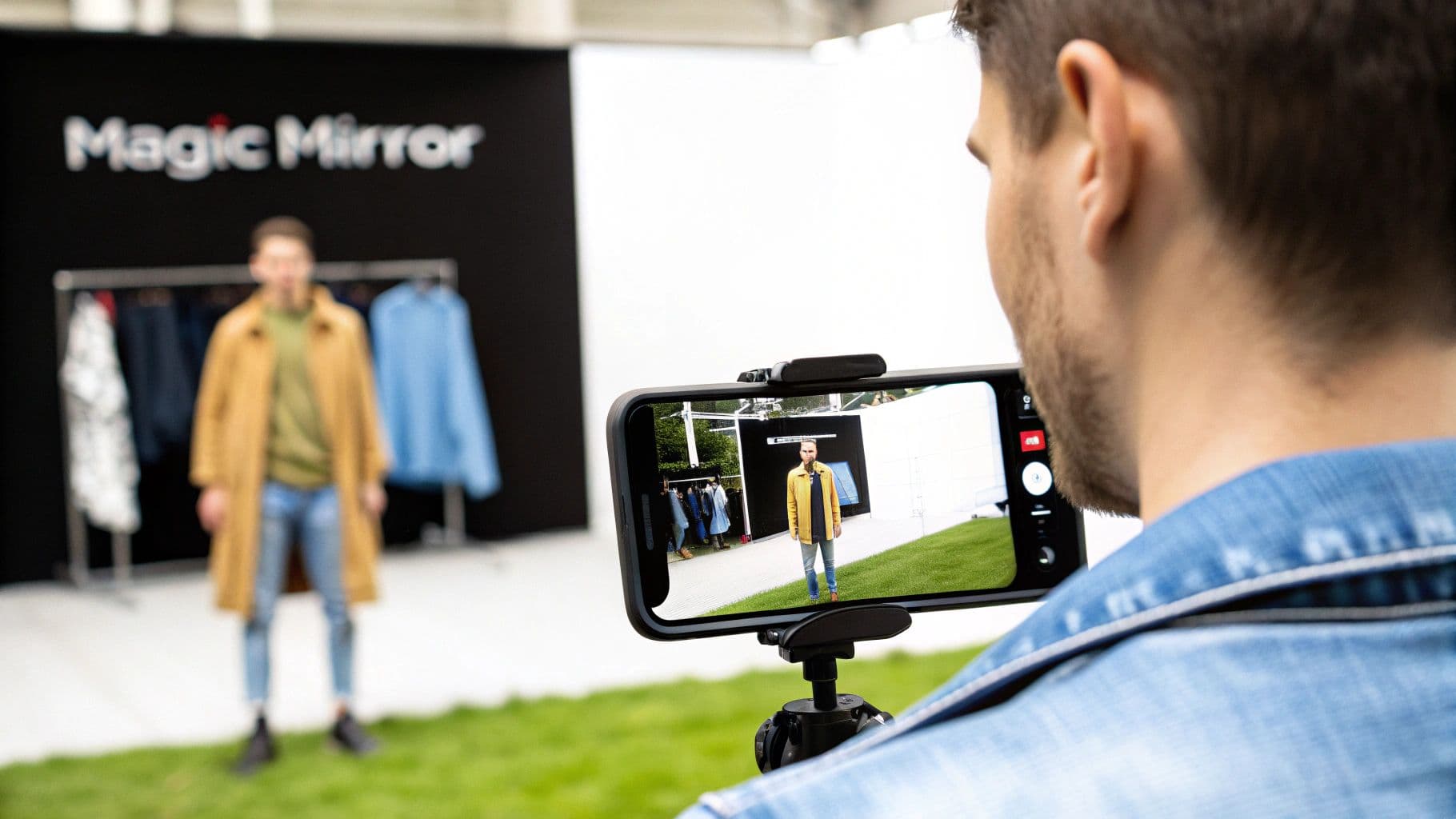
A person films another person trying on virtual clothes using a smartphone and tripod at a 'Magic Mirror' event.
At its core, a virtual dressing room isn't a single piece of software. Think of it more like an orchestra of powerful technologies playing in harmony to create that seamless digital try-on experience you see on screen. The two lead performers are Augmented Reality (AR) and Artificial Intelligence (AI).
AR acts as the "magic mirror." It takes what your phone's camera sees—the real world—and layers digital information on top. In this case, it superimposes a digital garment onto your body, creating the illusion you're actually wearing it.
But if AR is the mirror, AI is the master tailor. It's the brain behind the operation, analyzing both the clothing and the person's body to make sure the final image looks believable. AI is what understands that a silk blouse should drape softly, while a denim jacket needs to look more structured.
Core Technological Approaches
Not all virtual dressing rooms are built the same. They use different methods, each with its own set of pros and cons. To really get a handle on the mechanics, it helps to understand where this tech fits in the bigger picture. For a deeper dive, this resource explains what is Extended Reality and how it works, which is the family of immersive technologies that virtual try-on belongs to.
Here are the main approaches you'll run into:
2D Overlays: This is the most basic version. It essentially takes a flat picture of a garment and sticks it on top of a photo of a person. It’s simple, but it can give a rough idea of color and style.
3D Visualization: This is a big step up. It uses a full 3D model of the clothing, letting you see it from different angles. This gives a much more realistic feel for the garment's shape, texture, and how it might actually fit.
To achieve true photorealism, brands are increasingly turning to TG3D Studio to digitize physical garments. By combining high-precision fabric scanning with advanced 3D design tools, brands can create 'digital twins' that mirror the exact texture and drape of real-world materials. This infrastructure allows for the creation of lifelike on-model imagery directly from 3D designs, ensuring virtual try-on experiences are both visually stunning and physically accurate.
AI-Generated Imagery: This is the newest and most scalable method, and it’s a total game-changer. Instead of just pasting an image on top of you, AI generates a brand-new, photorealistic image of a model wearing the clothes, all from a standard product photo.
This software-first approach is taking over the industry. In fact, the software component of the virtual dressing room market now holds a massive 48.3% revenue share. This makes perfect sense when you consider that 60% of global fashion sales are expected to happen online soon. Brands using these tools are already seeing 20-40% higher social media engagement.
The Power of AI Model Generation
The biggest leap forward is coming from platforms that use AI to generate on-model imagery from a simple product shot. This completely changes the game for fashion brands by getting rid of the need for expensive, time-consuming photoshoots.
Traditionally, creating a 3D model for every single item in a collection was a huge hurdle, demanding specialized skills and a serious budget. Now, a brand can just upload a flat-lay or hanger photo of a new dress. The AI analyzes it, understands the fabric and cut, and creates a high-quality image of a model wearing it—in any pose, with any background. Our guide on AI model creation breaks down how this tech is making professional fashion content accessible to everyone.
This process essentially democratizes high-end fashion photography. It lets brands showcase their entire catalog on a diverse range of models that actually look like their customers, boosting relatability without the logistical nightmare of a real-world shoot. The result? A faster, cheaper, and infinitely more flexible way to create compelling visuals that actually sell clothes.
The Real Business Impact of Virtual Try-On
While the tech behind a virtual dressing room is cool, its real value is what it does for your bottom line. Forget the "how" for a second and let's focus on the "why"—the specific, measurable ways this tool can completely change an e-commerce business. This isn't just a gimmick; it’s a direct solution to some of the biggest problems in online fashion.
This technology goes straight for the financial jugular, targeting the biggest money pits and growth blockers that plague online apparel stores. By closing the gap between a flat product photo and a customer's real-world body, it systematically improves the numbers that matter across your entire sales funnel.
Slashing Costly Return Rates
Returns are the silent killer of profit in e-commerce. Every time a customer buys an item, tries it on, and sends it back, it kicks off a chain reaction of costs—shipping, restocking, and even potential damage to the garment. A virtual dressing room stops this problem before it even starts by setting the right expectations from the get-go.
When a shopper can see exactly how a dress will drape on a model with a similar body type, or how a jacket fits over a sweater they might own, they get a much clearer, more honest picture of the final look. This visual confirmation is everything. It dramatically reduces the chance of that dreaded "fit surprise" when the package arrives, which is the number one reason for returns.
The numbers don't lie. Brands that bring in this technology see a 25-40% reduction in apparel returns, which is massive when you consider the industry average hovers between 20-40%. On top of that, AR-powered fitting experiences can drive a 30% increase in conversion rates and a 20% lift in overall sales. The social buzz is just as strong, with users sharing their virtual outfits and creating 15-25% more engagement on Instagram and TikTok. You can explore the full market analysis on virtual dressing rooms to dig deeper into these stats.
Boosting Conversion and Average Order Value
Think about every abandoned cart. Each one represents a moment of doubt. Was it the price? The shipping cost? Or was it that nagging uncertainty: “Will this actually look good on me?” A virtual dressing room gives shoppers the confidence they need to push past that final hesitation.
By letting people visualize themselves in an outfit, you remove the biggest point of friction in the entire online buying journey. This simple shift from guessing to knowing has a direct, powerful impact on the "Add to Cart" and "Complete Purchase" buttons.
A virtual dressing room turns passive browsing into an active, engaging experience. This hands-on process doesn't just build confidence; it encourages people to play and experiment, making it easier for them to discover—and fall in love with—new styles.
This newfound confidence also makes people buy more. When a customer can easily mix and match a top with a few different pairs of pants to see what works, they’re far more likely to build a full outfit instead of just buying one thing. This naturally pushes up your Average Order Value (AOV) because shoppers feel much more secure about their larger purchases.
The table below breaks down the typical performance boost brands see after integrating virtual try-on technology.
KPI Improvements From Virtual Dressing Room Integration
This table quantifies the typical business impact of adopting virtual try-on technology across key e-commerce metrics.
| Key Performance Indicator (KPI) | Industry Average (Without VDR) | Reported Improvement (With VDR) | Business Impact |
|---|---|---|---|
| Return Rate | 20-40% | 25-40% Reduction | Slashes reverse logistics costs, reduces wasted inventory, and boosts profit margins. |
| Conversion Rate | 1-3% | 30% Increase | Turns more browsers into buyers by eliminating fit uncertainty at the point of decision. |
| Sales Uplift | N/A | 20% Increase | Drives higher overall revenue by making the entire collection more accessible and desirable. |
| Average Order Value (AOV) | Varies by brand | 10-15% Increase | Encourages customers to buy complete outfits, increasing the value of each transaction. |
| Customer Engagement | Varies by brand | 15-25% Increase | Increases time spent on site and social sharing, building brand affinity and organic reach. |
As the data shows, the impact is felt across the board, moving metrics that directly contribute to healthier revenue and stronger customer relationships.
Deepening Customer Engagement and Brand Loyalty
Finally, the benefits go way beyond a single sale. When you offer a more personal and inclusive shopping experience, you build a much stronger bond with your audience. Customers who see products on models that actually reflect their own body type, ethnicity, and personal style feel seen and understood.
That kind of representation is incredibly powerful for building loyalty. You stop being just another faceless online store and become a trusted style partner. This creates a feedback loop that keeps on giving:
- Increased Dwell Time: Shoppers hang around on your product pages longer, interacting with your clothes and exploring more of your collection.
- Enhanced Brand Perception: You’re seen as a modern, innovative brand that genuinely gets what its customers want and need.
- Valuable Data Insights: You start to see which styles and combinations are resonating most with different types of customers, giving you priceless data for future designs and marketing.
Ultimately, this changes the whole game. What used to be a static, high-cost product photoshoot becomes a dynamic, revenue-generating engine. You’re not just showing a product anymore—you’re creating an experience that drives sales, cuts costs, and builds a community that will stick with you for the long haul.
Bringing a Virtual Dressing Room to Your Brand
Integrating a virtual dressing room sounds like a massive, expensive tech project, right? For a long time, it was. You needed a dedicated dev team and a six-figure budget. Thankfully, those days are over. Fashion brands can also follow our virtual dress room guide for a brand-focused walkthrough. Today, it’s about picking the right tool and knowing what you want to achieve.
First things first: you need to define your primary goal. Is your return rate a nightmare that needs taming? Or is your main objective to create a ton of diverse marketing assets without the cost and hassle of photoshoots? Maybe it’s a bit of both.
Knowing your “why” is the most critical step. It guides every decision, from the software you choose to how you’ll know if it's actually working. A brand bleeding money on returns needs a tool that nails the visual fit. A brand trying to scale its content needs a platform that can churn out high-quality, on-brand images in a flash.
Getting Started with Implementation
Once you've got a clear goal, the practical steps are surprisingly simple. For most e-commerce brands, especially if you’re on a platform like Shopify or WooCommerce, the process is about finding a SaaS (Software as a Service) provider that fits your needs.
These modern tools are built for easy integration. The workflow is incredibly straightforward and powerful:
- Upload Your Product Photos: Start with the standard flat lays or hanger shots you already have. No 3D modeling or fancy photography is required.
- Select Your AI Model: Pick from a library of diverse models or even create custom ones that perfectly match your brand’s look and feel.
- Generate and Download: The AI does the heavy lifting, creating brand new, photorealistic images of your chosen model wearing the clothes. They’re instantly ready for your product pages, social media, and ad campaigns.
This process puts powerful virtual try-on tech in the hands of brands of any size, not just the big players with deep pockets.
The proof is in the numbers. This is the kind of direct return on investment brands see after putting this technology to work—slashing returns while boosting conversions and sales.
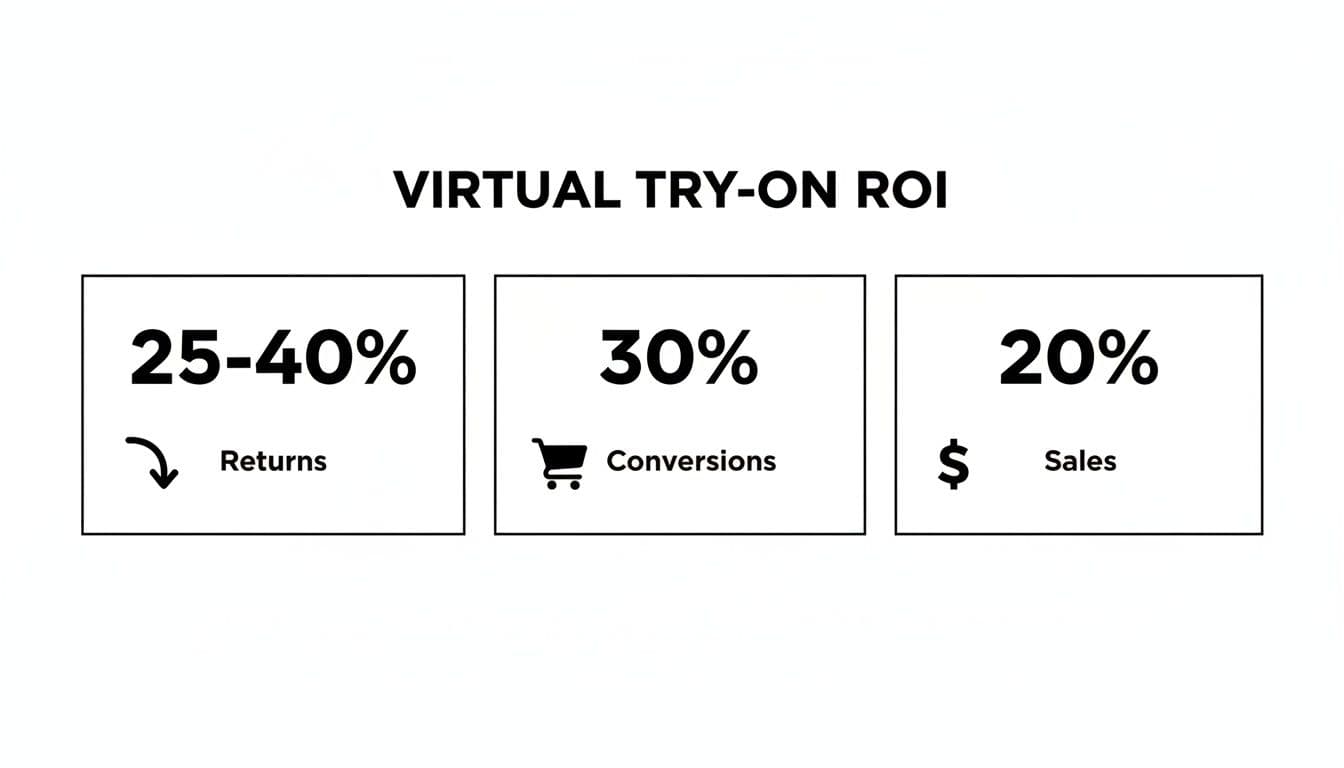
Virtual try-on ROI infographic showing 25-40% reduced returns, 30% conversions, and 20% sales increase.
These aren't just vanity metrics. They show how giving customers more confidence directly impacts your bottom line.
Choosing the Right Solution for You
Let's be clear: not all virtual dressing room tools are created equal. As you shop around, keep these key factors in mind to make sure you’re making a smart investment.
The key is to find a solution that not only meets your immediate goals but can also grow with your business. Look for a partner that offers flexibility, high-quality output, and a clear path to generating a positive ROI.
Here’s what to look for:
- Image Quality: The realism of the final image is everything. A cheap, unnatural-looking result can backfire, eroding customer trust instead of building it. You want shoppers to think, "That looks real."
- Ease of Use: Your team should be able to jump in and use the platform without a computer science degree. If it’s not intuitive, it won’t get used.
- Integration and Scalability: How well does it play with your current e-commerce setup? More importantly, can it handle your entire product catalog as you grow?
- Model Diversity and Customization: Modern shoppers expect to see themselves reflected in your brand. A good platform offers a wide range of diverse models and lets you maintain a consistent brand aesthetic.
The journey from a simple product photo to a fully modeled image has never been faster. To see this in action, you can explore the entire product-to-model AI transformation process and understand how it completely sidesteps the old-school photography bottlenecks. This is a fundamental shift in how fashion brands create and use visual content online.
Best Practices for a Successful Launch
Getting a virtual dressing room is just step one. Making it a massive success—that’s where the real growth happens. A great launch isn’t about just flipping a switch; it's a full-blown strategy to make sure customers don't just find the tool, but absolutely love using it.
The goal is to weave this feature so deeply into your shopping experience that people can't imagine buying without it. Treat it like a major product release, paying close attention to everything from the quality of your images to the way you tell your customers about it.
Start with High-Quality Inputs
You’ve heard the old saying, "garbage in, garbage out." Well, for AI-powered visual tools, it's gospel. The realism of your virtual dressing room depends entirely on the quality of the product images you feed it. To get those jaw-dropping, realistic results, you need clean, clear, and consistent photos.
Think of your product photo as the DNA for every image the AI creates. If you start with low-resolution shots, bad lighting, or wrinkled clothes, you're going to get unconvincing, sloppy outputs. That doesn't build trust; it erodes it.
Your virtual try-on tool should be a confidence booster, not a source of doubt. High-quality imagery ensures the technology accurately represents your products, leading to a more informed and satisfying customer journey.
A strong foundation guarantees every generated image reflects the quality your brand stands for.
Promote the Feature Actively
Don't just stick your shiny new tool on a product page and hope for the best. A successful launch needs a real marketing push across every channel you own. You have to tell people about this awesome new feature and show them exactly why it makes their lives easier.
Here are a few ways to get the word out:
- Website Banners: Slap a can't-miss banner right on your homepage announcing the launch.
- Email Campaigns: Send a dedicated email to your entire list, walking them through the benefits of virtual try-on.
- Social Media: Create fun, engaging posts and short videos showing the tool in action. Think TikToks, Reels, and Stories.
- Paid Ads: Run targeted ad campaigns that scream "try it before you buy it!" to pull in new shoppers.
By shouting about it from the rooftops, you position the virtual dressing room as a core reason to shop with you and not your competitors.
Embrace and Showcase Diversity
One of the most powerful things about modern virtual try-on is its ability to represent all your customers. People want to see clothes on models who look like them. It’s that simple. Using a diverse range of AI-generated models isn't just a nice-to-have; it's essential for connecting with your audience.
This goes way beyond just ticking an inclusivity box. When customers see themselves in your marketing, they feel seen, they feel understood, and that's how you build fierce brand loyalty. It shows you value them as individuals, not just as numbers on a spreadsheet.
For instance, WearView lets you choose from a huge library of models—or even create custom ones—that perfectly match your target demographics. This makes sure your product pages and marketing campaigns hit home, building a stronger community around your brand.
The Future of Digital Fashion Is On-Demand
As we’ve seen, the virtual dressing room isn’t just a gimmick. It’s a powerful solution to some of the oldest headaches in e-commerce, directly tackling the confidence gap for shoppers and the costly, wasteful cycle of returns. It breathes life into a static product grid, turning a passive store into an interactive fitting room.
When customers can see how clothes will actually look and fit on a body that feels like their own, the friction in the buying process disappears. That fundamental shift—from guessing to knowing—is what builds trust, empowers shoppers, and gets them to click “buy now” with certainty.
The Rise of Hyper-Personalization
So, where is this all headed? The next frontier is hyper-personalization, where the experience isn't just relatable—it's one-of-a-kind. Imagine a customer uploading their own photo and instantly seeing a photorealistic AI model that looks exactly like them, trying on your entire collection in seconds.
This isn’t about finding a model that looks like you anymore; it’s about seeing the clothes on you. That level of connection promises to push customer confidence and conversion rates to a whole new level.
The message is clear: virtual try-on isn't a passing trend. It's a strategic move toward a more sustainable, personal, and efficient future for the entire retail industry.
Embracing an On-Demand Visual Strategy
For brands, this signals a massive shift away from the old, expensive ways of creating content. Forget planning photoshoots months in advance. With an AI platform like WearView, you can generate studio-quality visuals on-demand for any product, on any model, at any time.
This on-demand power is a game-changer. It means you can react instantly to market trends, test new styles with almost zero risk, and churn out a limitless stream of fresh content for social media and ads. This isn't just about keeping up; it's about leading the charge in a new era of digital fashion where speed, personalization, and efficiency are everything.
Frequently Asked Questions
Jumping into virtual dressing room tech can bring up a few questions. As brands start exploring this powerful tool, a few common concerns always seem to pop up: "How much is this going to cost me?", "Do I need a 3D designer?", and "But how accurate is it, really?" Let's clear the air on these.
How Much Does a Virtual Dressing Room Cost?
The words "virtual dressing room" might make you think of a massive, enterprise-level price tag. That used to be the case. Early versions were custom-built behemoths that required a huge upfront investment, shutting out everyone but the biggest players in the industry.
Thankfully, that model is dead. Today's market is all about affordable Software as a Service (SaaS) subscriptions. This means you can get access to incredibly powerful virtual try-on features for a simple monthly fee, completely wiping out those scary initial costs. It’s a game-changer that makes this tech accessible to everyone from scrappy DTC startups to established retailers.
Do I Need 3D Models of My Clothes?
This is easily one of the most common—and most important—questions we get. The short answer? A clear and resounding no. While some older or more specialized systems might force you down the complicated path of 3D modeling, modern AI-powered platforms are built to work with what you already have.
The best solutions today can take your standard 2D product photos—yep, even simple flat lays or hanger shots—and use AI to generate stunning, photorealistic images that have a true three-dimensional feel. This is a massive breakthrough. It completely removes the bottleneck of needing specialized 3D skills or paying for expensive asset creation, making the whole process ridiculously simple.
The real magic of a modern virtual dressing room is its ability to turn your existing, simple assets into powerful sales tools—without adding a single ounce of technical complexity to your workflow.
This simplicity is what makes the technology so easy to adopt and scale.
How Accurate Is the Sizing and Fit?
It's crucial to understand what "accuracy" really means here. Some niche tools are all about hyper-precise body scanning to spit out technical measurements, which has its place. But for most fashion brands, the real goal is visual accuracy.
The power of a top-tier virtual try-on isn't about giving a customer their exact inseam. It's about giving them a highly realistic visual of a garment's drape, texture, and overall vibe on different body types. It answers the one question that matters most to a shopper: "How will this actually look on me?"
That visual confirmation is what builds the confidence to click "buy." By showing exactly how a fabric falls or how a silhouette looks on a model they can relate to, you're making sure the item meets their expectations. That’s the key to slashing returns and keeping customers happy.
Ready to see how an AI-powered virtual dressing room can cut your return rates and lift your conversions? With WearView, you can generate instant, studio-quality visuals from your existing product photos—no expensive shoots or 3D models required. Start creating your on-brand model imagery today.

WearView Team
WearView Content & Research Team
WearView Team is a group of fashion technology specialists focused on AI fashion models, virtual try-on, and AI product photography for e-commerce brands. We publish in-depth guides, case studies, and practical insights to help fashion businesses improve conversion rates and scale faster using AI.