March 4, 2026•22 min read
10 Futuristic Clothes Ideas Shaping Fashion in 2026
Discover 10 revolutionary futuristic clothes ideas, from smart fabrics to 3D-printed fashion. Get actionable tips for brands to visualize these concepts.
10 Futuristic Clothes Ideas Shaping Fashion in 2026
Fashion is no longer just about aesthetics; it's about integration, intelligence, and sustainability. The line between technology and textiles is blurring, giving rise to revolutionary concepts that are redefining what we wear and how we wear it. This listicle explores groundbreaking futuristic clothes ideas that are moving from the lab to our closets, providing a clear roadmap for brands looking to innovate. We'll move beyond abstract concepts to offer actionable insights on bringing these designs to life visually, from campaign styling to creating stunning product imagery.
This guide is designed for direct application. For each concept, we detail how to produce visuals and style outfits for campaigns, including notes on leveraging AI fashion-photography tools. These platforms allow brands to showcase innovative designs on diverse models without the high costs of traditional photoshoots, instantly demonstrating both functionality and style. Understanding how to present these innovations is crucial. For a deeper dive into how innovative presentations might shape the next era of apparel, explore cutting-edge concepts for future fashion shows. Let's dive into the ideas shaping the next frontier of fashion.
1. Smart Fabrics with Embedded Sensors
Smart fabrics are intelligent textiles embedded with microelectronics and IoT sensors that monitor biometric data and environmental conditions. This futuristic clothes idea moves beyond aesthetics, transforming garments into functional tools for health, wellness, and connectivity. These fabrics can track heart rate, body temperature, and movement, adjusting their properties in real-time for optimal comfort or performance.
Imagine a jacket that warms up as the temperature drops or a shirt that changes color to alert you to high UV exposure. Early proof points included Ralph Lauren's PoloTech shirt, which tracked biometric data, and the Google and Levi's Jacquard jacket, which let wearers control a phone with a gesture on the cuff. Google retired Jacquard in April 2023, and the jackets lost their connected features once the companion app went offline, a reminder that a smart garment lives or dies by long-term software support. The category still ships today, just with sharper use cases: Hexoskin, for example, sells clinically validated smart shirts that continuously track ECG, respiration, and activity. These examples showcase how fashion can merge with wearable technology, and what it takes to make that merger last.
How to Implement and Visualize
- Marketing Focus: Position these garments as premium, high-tech performance wear. Develop clear marketing copy that explains the tangible benefits of the embedded technology, such as improved athletic performance or real-time health monitoring. Emphasize durability and simple maintenance to address consumer concerns about washing advanced textiles.
- Visual Campaign Strategy: Use AI fashion photography tools like WearView to create dynamic visuals. Its AI Video Generator can produce compelling animations showing the fabric’s responsive features, like color-changing capabilities or a heads-up display of health metrics. Lifestyle imagery should depict the clothing in action-scenarios, such as a runner checking their heart rate on a connected app.
Key Insight: The success of smart fabrics lies in demonstrating their practical value. Consumers will invest in these futuristic clothes ideas when they understand how the technology enhances their daily lives, whether through improved safety, fitness tracking, or personalized comfort.
2. Self-Cleaning and Adaptive Garments
Self-cleaning and adaptive garments are engineered with nanotechnology and advanced material science to repel stains, odors, and bacteria. This futuristic clothes idea leverages photocatalytic processes or hydrophobic coatings to actively break down dirt and moisture, significantly reducing the need for traditional laundering. These innovative textiles not only promote sustainability by conserving water and energy but also offer unparalleled convenience for the modern consumer.
Brands are already exploring this frontier. For example, PANGAIA’s collection incorporates peppermint oil treatment for its anti-odor properties, while companies utilizing technologies like Schoeller’s NanoSphere create fabrics that mimic the self-cleaning effect of a lotus leaf. These garments maintain a pristine appearance for longer, making them ideal for travel, athletic wear, and everyday use where durability and low maintenance are paramount.
How to Implement and Visualize
- Marketing Focus: Emphasize the dual benefits of convenience and sustainability. Position these garments as a smart investment that saves time, resources, and money on cleaning. Create detailed product descriptions that explain the underlying nano-coating technology in simple, accessible terms to build consumer trust.
- Visual Campaign Strategy: Use AI tools like WearView to generate compelling before-and-after imagery demonstrating the fabric's stain-repellent qualities. Its Product-to-Model feature can create lifestyle scenes showing the clothing looking fresh during high-activity scenarios, like traveling or exercising, to underscore its resilience and low-maintenance appeal.
Key Insight: The value proposition for self-cleaning garments is rooted in effortless upkeep and longevity. Brands can win over consumers by clearly demonstrating how this technology simplifies daily routines and contributes to a more sustainable lifestyle, making it one of the most practical futuristic clothes ideas.
3. 3D-Printed Customizable Fashion
3D printing transforms clothing production by enabling mass personalization, complex geometric designs, and zero-waste manufacturing. This futuristic clothes idea allows customers to customize fit, color, texture, and structure at the point of sale, creating truly bespoke garments. The technology eliminates traditional cutting and sewing constraints, supporting on-demand production that reduces inventory risk and environmental impact.
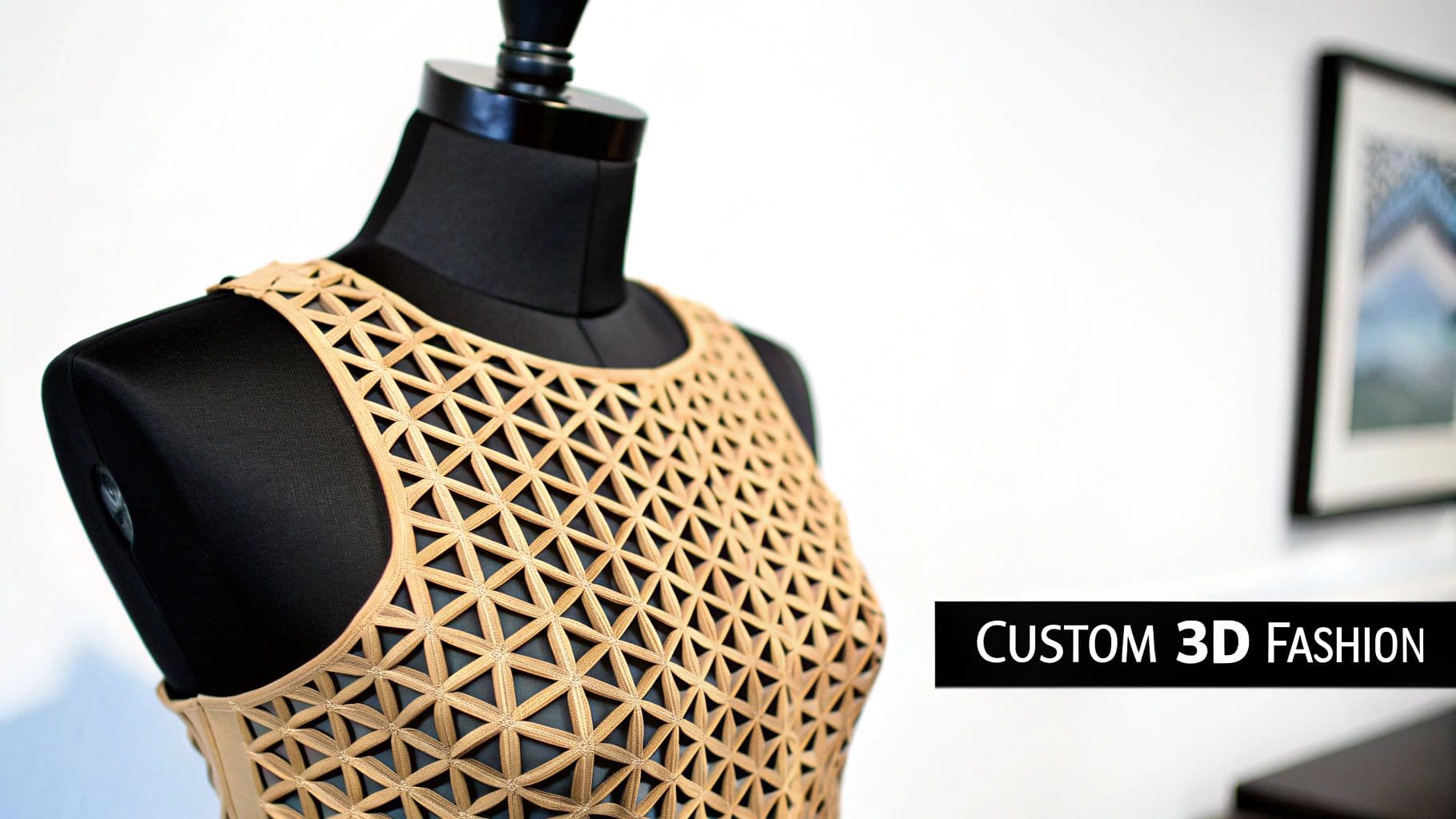
A beige 3D-printed top with a geometric triangular pattern displayed on a black mannequin, highlighting custom fashion.
This concept is already being explored by pioneers like Iris van Herpen in haute couture, who uses 3D printing to create architectural masterpieces, and Danit Peleg, who offers entirely 3D-printed fashion collections. Similarly, Adidas's partnership with Carbon for customized shoe midsoles demonstrates the technology's commercial viability. These examples prove that 3D printing is moving from niche experimentation to a scalable solution for personalized fashion.
How to Implement and Visualize
- Marketing Focus: Emphasize the exclusivity and sustainability of bespoke, zero-waste production. Frame each garment as a piece of wearable art, co-created by the consumer. Use clear messaging to explain the customization process, making it seem simple and accessible.
- Visual Campaign Strategy: Use AI tools like WearView to generate lifestyle imagery of customized pieces before physical production, saving time and resources. Its AI Model Creation feature can showcase countless design variations on diverse body types. Leverage the Virtual Try-On tool to help customers visualize their personalized fit, reducing returns and building purchase confidence.
Key Insight: The power of 3D printing lies in its ability to offer radical customization and sustainability. Brands can succeed by positioning this technology not just as a manufacturing method but as an interactive experience where consumers become designers of their own unique, futuristic clothes.
4. Holographic and LED-Integrated Clothing
Holographic and LED-integrated clothing incorporates dynamic light displays and electroluminescent fibers to create stunning visual effects. This futuristic clothes idea turns garments into canvases for digital art, allowing colors and patterns to shift based on movement, environmental light, or programmed sequences. This technology merges fashion with performance, offering wearers the ability to customize their look in real-time via connected mobile apps.
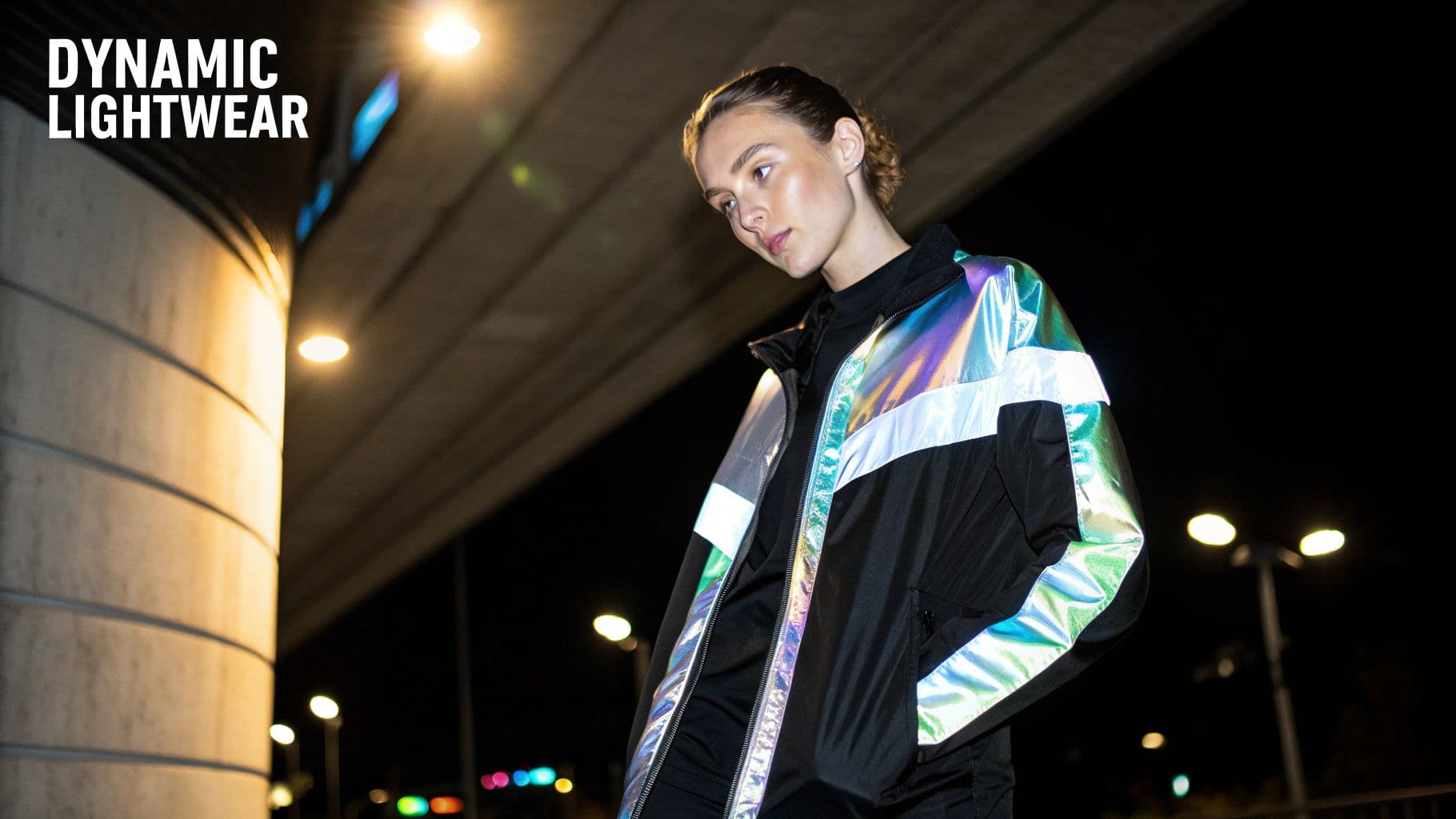
A woman wears a black jacket with reflective iridescent stripes at night under an overpass.
Pioneers like Hussein Chalayan have famously integrated LEDs into runway pieces, while brands such as Willy Chavarria and SoKind have brought holographic materials into ready-to-wear collections. These garments are not just for avant-garde fashion; they represent a new frontier in self-expression, similar to how an augmented reality shirt overlays digital information onto a physical item. The technology offers a powerful tool for performers, festival-goers, and anyone looking to make a bold visual statement.
How to Implement and Visualize
- Marketing Focus: Position this clothing as expressive, high-impact statement wear perfect for nightlife, concerts, and creative events. Highlight the customization features, such as app-controlled patterns and color changes, as a primary selling point. Emphasize the durability of the electronic components and provide clear care instructions.
- Visual Campaign Strategy: Use WearView’s AI Video Generator to produce dynamic videos showcasing the holographic and light-up effects in motion, as static images cannot capture their full impact. Create lifestyle content set in low-light or performance environments like concerts or cityscapes at night to show the garments at their most brilliant. Partnering with DJs, dancers, and performers can provide authentic, engaging demonstrations.
Key Insight: The appeal of holographic and LED clothing is its power to transform the wearer into a moving spectacle. Success hinges on creating visually compelling marketing that demonstrates the dynamic and interactive nature of these futuristic clothes ideas, inspiring consumers to embrace fashion as a form of performance art.
5. Modular and Transformable Clothing Systems
Modular and transformable clothing systems are garments designed with interchangeable components like magnetic closures, snap attachments, and zippers. This approach allows wearers to reconfigure a single base piece into multiple outfits by adding, removing, or swapping elements like sleeves, hoods, and panels. This futuristic clothes idea champions versatility and sustainability, enabling users to adapt their clothing to different seasons and occasions, thereby reducing textile waste and promoting a minimalist wardrobe.
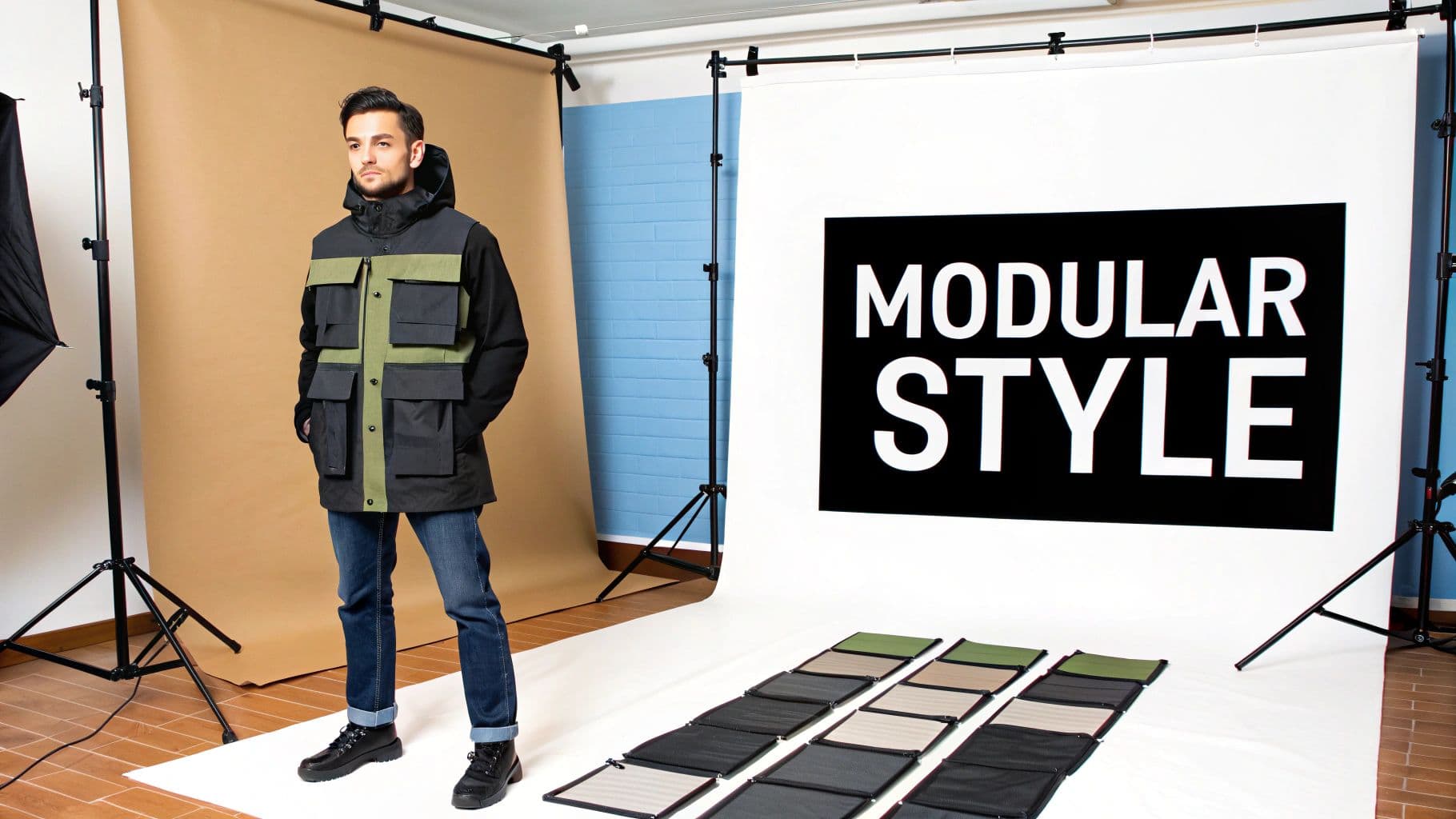
Man modeling a black and olive green modular jacket with multiple pockets in a studio.
This concept is gaining traction with innovative brands. For instance, PANGAIA offers jackets with detachable components that adapt to changing weather, while ABLE JEANS has explored convertible clothing systems. These examples demonstrate a shift toward fashion as a functional, long-lasting system rather than a collection of disposable items, empowering consumers with creative control over their style.
How to Implement and Visualize
- Marketing Focus: Emphasize the garment’s versatility, cost-effectiveness, and sustainability. Position it as a smart investment that offers multiple looks in one. Create instructional guides and styling videos to help customers understand the full range of possibilities and how to use the attachments.
- Visual Campaign Strategy: Use AI tools like WearView to generate a series of images showcasing the same model transforming the garment. Its Pose Control and variation features can efficiently create a visual narrative of a single piece becoming a jacket, then a vest, then a cropped coat. Lifestyle shots should depict the clothing in diverse scenarios, highlighting its adaptability from a morning commute to an evening event.
Key Insight: The appeal of modular clothing lies in its blend of personalization and practicality. Success requires not only innovative design but also clear communication that educates consumers on how to maximize the garment's potential, turning a single purchase into a long-term, adaptable wardrobe staple.
6. Bioengineered and Lab-Grown Textiles
Bioengineered and lab-grown textiles are fabrics created through biotechnology, offering sustainable alternatives to traditional materials. This includes lab-grown leather from cell cultures, mushroom mycelium leather, and spider silk proteins cultivated via fermentation. These futuristic clothes ideas aim to replicate or surpass the qualities of conventional textiles while significantly reducing environmental impact, water consumption, and animal welfare issues, defining the next wave of sustainable luxury fashion.
Leading the charge today is Japan's Spiber with its Brewed Protein fiber, a fermentation-grown, silk-like material already used in commercial garments by Goldwin, The North Face, and nanamica, and featured in Stella McCartney's Winter 2026 runway collection. Modern Meadow has likewise moved past its early Zoa leather to INNOVERA (formerly BIO-VERA), a plant-protein and biopolymer material aimed at footwear and accessories. The category is not risk-free: Bolt Threads abandoned Microsilk, paused its Mylo mushroom leather in 2023, and has since ceased operating, while MycoWorks ended production of its Reishi mycelium leather in late 2025. Scaling a biomaterial is proving as hard as inventing one. Still, the survivors show that science can deliver both premium quality and ethical production, moving fashion beyond its reliance on resource-intensive agriculture and animal farming.
How to Implement and Visualize
- Marketing Focus: Position these textiles as the pinnacle of sustainable luxury. Develop educational content that explains the biotechnology behind the materials in simple, compelling terms. Highlight the superior quality, durability, and unique textures to justify a premium price point. Emphasize the positive environmental and ethical story.
- Visual Campaign Strategy: Use high-resolution, macro photography to showcase the intricate textures and flawless quality of the materials. Lifestyle imagery should depict the textiles in sophisticated, everyday scenarios to demonstrate their wearability and elegance. With AI tools like WearView, brands can generate detailed product shots on diverse models, ensuring the material’s drape and finish are presented perfectly across various body types and styles.
Key Insight: The appeal of bioengineered textiles is rooted in their dual promise of luxury and responsibility. Brands must communicate both aspects effectively, educating consumers on the innovative science while showcasing the material's aesthetic and functional excellence to drive adoption.
7. Shape-Memory and Temperature-Responsive Garments
Shape-memory and temperature-responsive garments are crafted from advanced materials that adapt their form and function based on environmental triggers. Utilizing shape-memory alloys and phase-change materials, these futuristic clothes ideas can change fit, structure, or even color in response to temperature fluctuations. Imagine a jacket whose sleeves automatically shorten in the heat or a shirt that compresses for easy packing and expands to a perfect fit when worn.
This technology creates intelligent clothing systems that prioritize adaptive comfort and functionality. Pioneering examples include Outlast's temperature-regulating technology, originally developed for NASA, which absorbs, stores, and releases heat for optimal thermal comfort. Similarly, researchers are developing smart garments that can adjust their structure, offering a glimpse into a future where clothing dynamically responds to both the wearer’s body and their surroundings.
How to Implement and Visualize
- Marketing Focus: Highlight the practical benefits of adaptive comfort and convenience. Frame these garments as intelligent solutions for travelers, athletes, and anyone living in a variable climate. Use technical specifications and data to build credibility and explain the science behind the materials in simple, benefit-driven language.
- Visual Campaign Strategy: Leverage AI tools like WearView to create compelling visuals that demonstrate the garment’s transformative properties. Its AI Video Generator can produce animations showing a jacket’s sleeves adjusting or a fabric changing color with temperature shifts. Use before-and-after imagery to showcase a garment’s compressed state for packing versus its expanded, wearable form.
Key Insight: The appeal of shape-memory garments is their seamless blend of high-tech innovation and everyday practicality. Brands can succeed by showcasing how this technology offers a tangible upgrade in comfort and convenience, making the clothing feel less like a gadget and more like an intuitive extension of the wearer.
8. Digital-Only Fashion and Metaverse Clothing
Digital-only fashion consists of garments and accessories designed exclusively for virtual environments like social media, gaming platforms, and the metaverse. These futuristic clothes ideas exist as digital files, often secured as NFTs, allowing users to express their style through avatars without any physical production. This model opens up a low-cost, high-margin revenue stream for brands, focusing on community-building and cultural relevance in digital worlds.
Major brands are already pioneering this space. Gucci's collaboration with Roblox and Balenciaga's partnership with Fortnite introduced exclusive digital items to massive gaming audiences. Similarly, brands like The Fabricant operate entirely in the digital realm, crafting haute couture for metaverse platforms. These examples demonstrate the growing market for virtual self-expression and the creative freedom that digital-only design affords. The emergence of these digital marketplaces relies on evolving commerce infrastructure; understanding the broader trends in the future of B2B e-commerce can offer insights into the foundational systems supporting such innovations.
How to Implement and Visualize
- Marketing Focus: Target digitally native audiences by framing virtual garments as exclusive, collectible assets. Develop educational content that explains NFT ownership and metaverse use cases. Partner with platform influencers and streamers for authentic promotion, showcasing the clothing on their avatars during live events. Brands can leverage this concept, similar to a virtual dressing room, to allow risk-free style experimentation.
- Visual Campaign Strategy: Use WearView's AI Model Creation to generate diverse and stylized avatars that align with your brand's aesthetic. Its AI tools can produce high-fidelity visuals of the digital garments in dynamic metaverse-inspired settings. Create a consistent visual language across digital and physical collections to strengthen brand identity in both realms.
Key Insight: Digital-only fashion thrives on creativity and community. Success in this space depends on treating virtual items not just as products, but as cultural artifacts that empower users to build and express their identities in the burgeoning digital landscape.
9. Programmable and AI-Designed Fashion
Programmable and AI-designed fashion leverages artificial intelligence to generate unique patterns, silhouettes, and color palettes based on vast datasets of trend information and consumer preferences. This futuristic clothes idea shifts design from a purely human-driven process to a collaborative one between creator and machine. AI algorithms can create endless personalized variations, optimize designs for manufacturing, and adapt collections to market demands in real time, enabling true mass customization.
This concept is already making an impact, with companies like Stitch Fix using AI for personalized styling and H&M partnering with AI platforms for trend forecasting. Research from institutions like the Institut Français de la Mode (IFM) and platforms such as Lalaland.ai, which creates AI-generated models and designs, demonstrate how AI can accelerate and diversify the creative process. This approach moves fashion toward a more efficient and data-informed future.
How to Implement and Visualize
- Marketing Focus: Develop transparent marketing that highlights the innovative AI design process. Frame it as a blend of human creativity and technological precision, offering customers unique, data-driven styles. Create educational content that explains the benefits of generative design, such as reduced waste and personalized options.
- Visual Campaign Strategy: Use a tool like WearView to rapidly visualize thousands of AI-generated design variations on virtual models. Its Consistent Models feature can maintain brand coherence by showing different algorithmic outputs on the same set of brand-aligned avatars. This allows for diverse and expansive campaign imagery without the cost of physical sampling.
Key Insight: The power of AI-designed fashion lies in its ability to offer limitless personalization at scale. Success depends on framing the technology not as a replacement for human designers but as a powerful tool that augments creativity and responds directly to consumer desires.
10. Kinetic and Movement-Responsive Fashion
Kinetic fashion features garments engineered to respond dynamically to the wearer’s movements. This futuristic clothes idea uses flexible panels, articulated joints, and innovative seam construction that adapts fit and structure during motion. By combining fashion with biomechanics, these clothes are designed to enhance rather than restrict the human body, allowing materials to shift, expand, and contract in harmony with natural movement patterns.
This concept is actively explored in performance wear. Brands like Arc'teryx with its articulated fit technology and Lululemon’s Motion Lab research showcase how seams and fabric panels can be placed to mirror the body’s mechanics. These designs offer unparalleled comfort and freedom, making them ideal for athletic and everyday activities where mobility is key. The focus is on creating clothing that feels like a second skin, moving as one with the wearer.
How to Implement and Visualize
- Marketing Focus: Position these garments as an intersection of engineering and apparel. Create marketing materials that include technical specification graphics explaining the articulated design and biomechanical benefits. Highlight how the clothing optimizes performance and comfort for specific activities, from yoga to urban commuting.
- Visual Campaign Strategy: Use WearView’s AI Video Generator to produce slow-motion videos that showcase the garment’s flexibility and adaptive fit during movement. Action-based lifestyle imagery is crucial, depicting models running, stretching, or jumping. Feature a diverse range of body types to demonstrate how the kinetic design provides a superior fit for everyone.
Key Insight: The value of kinetic fashion is experienced, not just seen. Marketing must effectively communicate the feeling of unrestricted movement through dynamic visuals and authentic testimonials, bridging the gap between technical design and tangible user benefit.
10-Point Comparison of Futuristic Clothing Ideas
| Technology | 🔄 Implementation Complexity | ⚡ Resource Requirements | 📊 Expected Outcomes | ⭐ Key Advantages | 💡 Ideal Use Cases |
|---|---|---|---|---|---|
| Smart Fabrics with Embedded Sensors | High — integrates sensors, power, connectivity, washability | High — electronics R&D, battery, testing, specialized manufacturing | Real-time biometrics & environmental data; dynamic thermal/color response | Functional garments; premium differentiation; health monitoring | Premium activewear, medical wearables, performance garments |
| Self-Cleaning and Adaptive Garments | Medium-high — nano-coatings and adaptive materials require validation | Moderate — coating processes, durability testing, regulatory checks | Fewer washes; longer garment life; sustainability claims | Strong eco-message; lower maintenance; extended lifecycle | Travel clothing, outdoor wear, sustainable/luxury lines |
| 3D-Printed Customizable Fashion | Medium-high — digital workflows, printing integration, post-processing | High — capital equipment, materials development, slower production speed | True mass-customization; zero-waste on-demand production; unique forms | Bespoke fit; inventory reduction; complex geometry possible | DTC couture, accessories, rapid prototyping, made-to-order |
| Holographic and LED-Integrated Clothing | High — electronics, app control, power and washability engineering | Moderate-high — LEDs, controllers, batteries, specialized assembly | High visual impact; programmable patterns; strong social reach | Viral/performative appeal; expressive branding; shareable content | Stage wear, festivals, influencer pieces, performance costumes |
| Modular and Transformable Clothing Systems | Medium — modular design, attachment engineering, UX considerations | Moderate — multiple components, inventory complexity, durable connectors | Multiple outfits from one base piece; upsell modular add-ons | Versatility; sustainability alignment; higher perceived value | Travel wardrobes, minimalist customers, seasonally adaptable collections |
| Bioengineered and Lab-Grown Textiles | Very high — biotech processes, scale-up, regulatory compliance | Very high — lab facilities, specialized suppliers, slow scaling | Animal-free materials; lower environmental footprint; premium positioning | Authentic sustainability; novel luxury materials; investor/media interest | Ethical luxury brands, high-end accessories, sustainability showcases |
| Shape-Memory and Temperature-Responsive Garments | High — advanced materials, supplier specialization, thorough testing | High — phase-change/shape-memory materials, R&D, quality control | Adaptive fit/thermal regulation; packable/expandable garments | Improved comfort/performance; innovative storytelling; travel convenience | Performance wear, travel gear, temperature-variable climates |
| Digital-Only Fashion and Metaverse Clothing | Low–Medium — 3D design, platform standards, NFT integration | Low — primarily design and platform fees; no physical supply chain | Scalable digital drops; community engagement; rapid experimentation | Zero inventory costs; high margins; fast time-to-market | Metaverse drops, collaborations, digital collectibles and marketing |
| Programmable and AI-Designed Fashion | Medium — AI models, data pipelines, integration with production | Moderate — compute, data labeling, design ops, tooling | Rapid design iteration; personalized variations; fewer failed SKUs | Infinite variations; trend responsiveness; design efficiency | Fast-fashion, personalized DTC, trend-driven capsule lines |
| Kinetic and Movement-Responsive Fashion | Medium-high — biomechanical patterning, articulated construction | Moderate-high — advanced materials, precision manufacturing, testing | Better fit during motion; performance and comfort gains; fewer returns | Enhanced mobility; athlete appeal; technical differentiation | Activewear, sportswear, movement-focused lifestyle brands |
Weaving Tomorrow's Wardrobe Today
The journey through these futuristic clothes ideas, from self-cleaning fabrics to programmable, AI-designed garments, reveals a clear and exciting trajectory for the fashion industry. The wardrobe of tomorrow is not merely an aesthetic choice; it is an active, intelligent, and highly personalized extension of our lives. We've seen how smart textiles can monitor our health, how modular systems can offer unparalleled versatility, and how bioengineered materials can pave the way for a truly sustainable future.
The common thread weaving these concepts together is a move away from passive apparel towards dynamic, responsive, and purpose-driven design. This paradigm shift presents both a challenge and an immense opportunity for fashion brands. The value of a temperature-responsive jacket or a holographic dress cannot be fully captured in a static product shot. Communicating these innovations effectively is the new frontier for fashion marketing.
From Concept to Commerce: The Visualization Imperative
For brands aiming to lead in this new era, the key is not just to embrace these futuristic clothes ideas but to master the art of presenting them. How do you showcase a garment that changes shape, color, or function without costly and complex video production? How do you visualize a 3D-printed custom piece on a thousand different body types instantly?
This is where the power of advanced visualization tools becomes non-negotiable. Traditional photoshoots are too slow, too expensive, and too limited to keep pace with the speed of digital fashion and rapid prototyping. To truly connect with consumers, brands must create compelling, dynamic, and diverse visual narratives that bring these complex ideas to life.
Key Takeaway: The success of futuristic fashion relies as much on innovative visualization as it does on innovative design. Brands that can effectively demonstrate the value and magic of these new concepts will capture the market.
Actionable Next Steps for Forward-Thinking Brands
To begin weaving these concepts into your brand's DNA, focus on the following strategic actions:
- Prioritize a "Hero" Concept: Instead of trying to implement everything, select one or two futuristic ideas that align most closely with your brand's core identity. A brand focused on sustainability might explore bio-textiles, while a tech-forward label could pioneer LED integrations.
- Invest in Digital Prototyping: Leverage digital design and AI visualization to experiment with these ideas without the overhead of physical samples. This allows for rapid iteration and creative exploration, helping you refine concepts before committing to production.
- Build a Narrative-Driven Campaign: Your marketing should tell the story behind the innovation. Explain how the technology works and why it benefits the customer. Use high-quality, AI-generated visuals to create scenarios that place your futuristic garments in real-world contexts, making the abstract feel tangible and desirable.
Embracing these futuristic clothes ideas is about more than just staying relevant; it is about defining what comes next. By integrating these innovations and adopting the tools to visualize them, you are not just selling a product. You are selling a vision of the future, positioning your brand as a leader in a more intelligent, sustainable, and personalized world of fashion.
Ready to bring your most ambitious fashion concepts to life? With WearView, you can generate thousands of on-model, studio-quality images in minutes, showcasing your futuristic clothes ideas with stunning realism and endless creative freedom. Explore how our advanced AI fashion-photography tool can help you visualize the future of your brand today.

WearView Team
WearView Content & Research Team
WearView Team is a group of fashion technology specialists focused on AI fashion models, virtual try-on, and AI product photography for e-commerce brands. We publish in-depth guides, case studies, and practical insights to help fashion businesses improve conversion rates and scale faster using AI.