May 15, 2026•18 min read
6 best AI tools for on-model photography in 2026
On-model photography moves catalog conversion more than any other product visual, but real shoots take weeks and cost thousands. AI tools now generate the same on-model imagery in seconds. Here are the six best AI tools for on-model photography in 2026, with verified pricing and ratings.
Picture of 6 best AI tools for on-model photography in 2026 article
On-model photography is the visual that moves catalog conversion more than any other product image: a person wearing the garment, in a setting, in a pose. Real on-model shoots take weeks to coordinate and cost thousands per session, which is why most brands still under-shoot their catalogs. AI on-model photography tools collapse that workflow: upload a flat-lay or packshot, pick or describe an AI model, and the platform generates a finished on-model image in seconds.
In this guide, we compare the 6 best AI tools for on-model photography in 2026. We cover pricing, key strengths, ideal user profiles, fact-checked review scores, and a practical decision framework so you can pick the right tool for your catalog and brand.
Best AI on-model photography tools: a brief overview
- WearView: Best overall for fashion brands: a complete AI fashion photography platform with product-to-model, virtual try-on, ghost mannequin, pose control, and AI fashion video in one workspace.
- Pebblely: Best for budget-friendly product staging that pairs with on-model imagery: 100+ scene templates for flat-lay backgrounds at the lowest entry price on this list.
- Flair.ai: Best for branded compositions plus an on-model feature: drag-and-drop canvas with a permanent free plan, recently expanded to include on-model fashion generation.
- Adobe Firefly: Best for multi-purpose generative editing and product scenes: Adobe's commercially-safe generative AI with text-to-image, generative fill, expand, and background tools, plus a Firefly Services API for automation.
- VModel.ai: Best for API-first developer workflows: pay-as-you-go API platform with multiple AI model and face swap endpoints for custom pipelines.
- Canva: Best for finishing on-model photos into marketing assets: design platform with Magic Studio AI features used by most ecommerce brands for social, ad, and email creative built around AI on-model imagery.
| Tool | Key strength | Pricing | Platforms |
|---|---|---|---|
| WearView | Fashion-tuned full platform with on-model, ghost mannequin, video | From $29/month | Web |
| Pebblely | 100+ scene templates with low entry price | From $9/month; no free tier | Web |
| Flair.ai | Drag-and-drop canvas plus new on-model fashion feature | Free plan; Pro from $8/month | Web |
| Adobe Firefly | Generative fill, expand, and product scenes with an API | Free tier; Standard from $9.99/month | Web, API |
| VModel.ai | Pay-as-you-go API with face swap and AI models | $10 free credits; pay-per-use | Web, API |
| Canva | Magic Studio AI inside the most-used design platform | Free; Pro from $15/month | Web, iOS, Android |
1. WearView, best overall for AI on-model photography
WearView is a complete AI fashion photography platform built around on-model imagery as the core output. The dedicated flat-lay to model tool turns a flat-lay, ghost mannequin, packshot, hanged garment, or existing on-model image into a new on-model photo in under 15 seconds. You upload the source, choose an AI model from a library covering different ethnicities, body types, and age groups, and describe the background or setting you want.
WearView lets you build full on-model campaigns from studio shots to lifestyle imagery. Each model can be customized with specific poses through reference images via the AI pose changer, and you can describe any pose and setting via text. Beyond product-to-model, the platform includes AI virtual try-on, AI fashion model creation from text prompts, ghost mannequin generation, and AI fashion video that animates products into short clips for ads and social, all in one workspace.
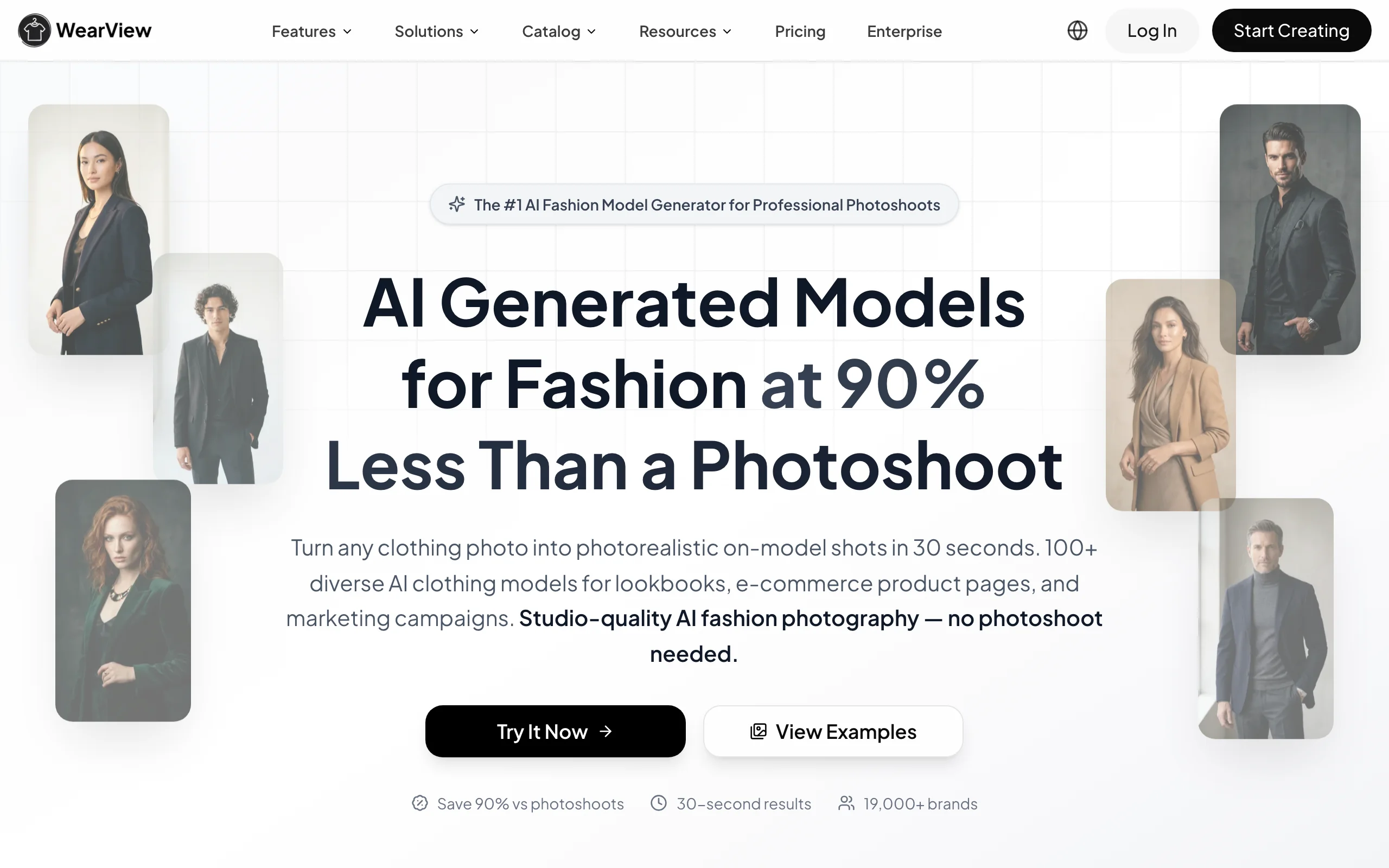
On Model Photography with WearView
Key features
- Product to Model: turn flat-lays, mannequin shots, or packshots into on-model photos in under 15 seconds
- Diverse AI model library with control over ethnicity, body type, age, and pose
- AI pose control via reference images for multiple angles per SKU
- Ghost mannequin generation from flat product shots
- AI fashion video at 720p (Pro) and 1080p (Advanced) from product photos
- HD, 2K, and 4K output with full commercial usage rights
Best for
- Fashion brands replacing studio on-model shoots with AI-generated images from existing flat-lays
- Ecommerce teams managing full catalogs across PDP, hero, lifestyle, and video formats
- Agencies producing on-model content for several fashion clients simultaneously
Pricing
- Lite: $29/month (50 credits) — standard AI engine, virtual try-on, product-to-model
- Pro: $49/month (200 credits) — premium AI engine, AI Fashion Video at 720p, ghost mannequin, up to 5 team members, priority support
- Advanced: $99/month (500 credits) — credit rollover, AI Fashion Video at 1080p, up to 15 team members, VIP support
- Enterprise: custom pricing with API and dedicated success manager
- Annual billing saves 2 months free (up to $198/year on Advanced)
Pros
- Most complete on-model feature set on this list (product-to-model, virtual try-on, pose control, ghost mannequin, AI video) in one platform
- Garment fidelity preserves prints, textures, and fabric drape across the full catalog
- 4K output with full commercial rights, suitable for PDPs, paid ads, and print
- Team collaboration with up to 15 members on the Advanced plan
Cons
- Credit-based pricing means very high-volume users may need the Advanced plan or top-ups
- No native Shopify app, and API access is limited to the Enterprise plan rather than a self-serve tier
2. Pebblely, best for budget-friendly staging alongside on-model work
Pebblely doesn't generate on-model imagery directly. What it does well is the other half of the catalog: turning flat-lays and packshots into styled scenes for product detail pages, social posts, and email banners. Upload your clothing image, pick from 100+ scene templates, and Pebblely generates a styled background in seconds. You can also describe custom scenes via text prompts.
For fashion brands, Pebblely is the cheapest credible companion to a fashion-AI tool: use WearView or another on-model platform for the model shots, and Pebblely for the flat-lay variants and lifestyle staging. Note that Pebblely does not currently offer a free tier, and the previous Shopify app listing is not currently available on the Shopify App Store.
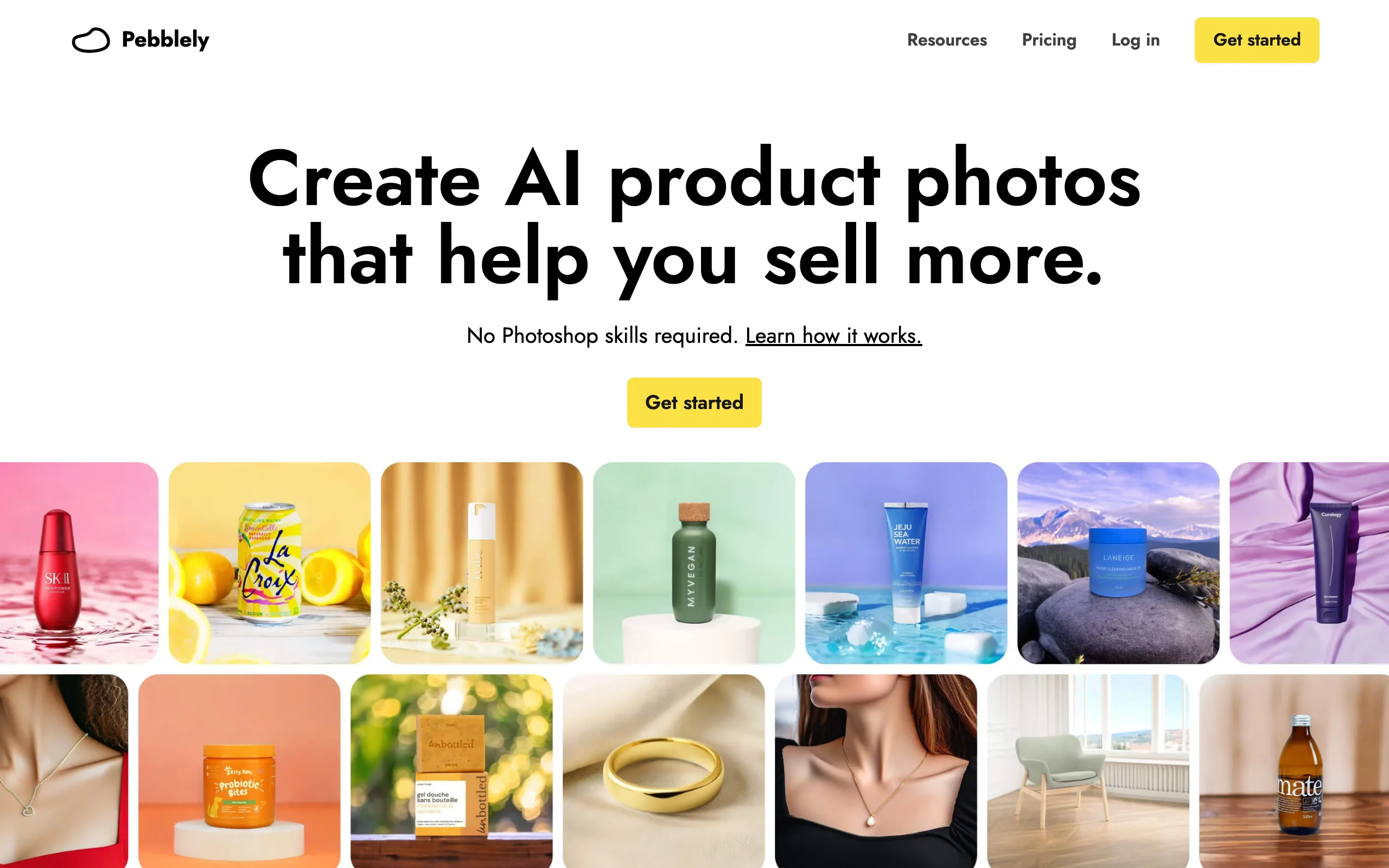
On Model Photography with Pebblely
Key features
- 100+ scene templates spanning lifestyle, studio, seasonal, and minimalist looks
- Custom scene generation via text prompts
- Built-in background removal before scene generation
- Bulk generation for processing multiple products at once
- Yearly plans include 2+ months free
Best for
- Small ecommerce sellers running flat-lay catalogs on Etsy, Poshmark, or Depop
- Fashion brands that pair on-model imagery (from another tool) with styled flat-lays
- Sellers who want low-cost staging before committing to a fashion-AI platform
Pricing
- Lite: $9/month (30 images, custom prompts)
- Basic: $19/month (200 images, bulk generate)
- Pro: $39/month (500 images, marked "Best value")
- No free tier currently displayed on the pricing page; a free trial may be available
- Yearly billing offers 2+ months free
Pros
- Lowest paid entry tier on this list ($9/month)
- 100+ templates make scene selection fast and intuitive
- Bulk generation works well for catalogs of 30-500 products
Cons
- No on-model generation: only handles flat-lay and packshot styling, not garments on models
- No free tier and Shopify app currently unavailable
- Limited customization compared to canvas-based tools like Flair.ai
3. Flair.ai, best for branded compositions plus on-model fashion
Flair.ai started as a canvas-based AI design tool: drag your product onto a workspace, position it where you want, add AI-generated props and surfaces, and Flair generates a styled composition. The platform recently added a dedicated on-model feature ("Fit your clothing and jewelry onto AI generated models with patterns and logos preserved") that turns it into a hybrid: you can produce styled flat-lay imagery and on-model shots from the same workspace.
For fashion brands building lookbooks, editorial flat-lays, and on-model imagery without juggling multiple tools, Flair covers a wider range than purpose-built fashion AI platforms. The permanent free plan makes it easy to test before committing, and Pro+ unlocks commercial licensing.

On Model Photography with Flair.ai
Key features
- On-model fashion generation that preserves garment patterns and logos
- Drag-and-drop canvas for precise composition control on flat-lay and styled work
- AI-generated props, surfaces, and styling elements
- Custom Models (training your own model on a dataset)
- Image and video generation in the same workflow
- Commercial licensing on Pro+ and higher tiers
Best for
- Brand marketing teams producing both styled lookbook content and on-model imagery
- Fashion brands that want one workspace for composition design and on-model fashion
- Creative agencies pairing branded flat-lay assets with model shots
Pricing
- Free: $0 — 1 Custom Model, 5 generated images, 1 video generation
- Pro: $8/month — faster rendering, image upscales and variations, 2 video generations
- Pro+: $26/month — up to 8 standard or 2 fast Custom Models, 80 images, 3 videos, priority rendering, commercial licensing
- Scale Tier 1: $38/month — up to 15 standard or 4 fast Custom Models, 150 images, 5 videos, API early access
- Enterprise: custom — unlimited API, SAML SSO, dedicated success manager
Pros
- Permanent free plan to test before paying
- Canvas interface gives precise control over flat-lay arrangement that prompt-only tools can't match
- Custom Model training is unusual at this price point
- Recently added on-model feature broadens the use case beyond styled compositions
Cons
- On-model output is newer and less specialized than fashion-only platforms
- Canvas workflow takes more time than one-click generators for simple on-model jobs
- Free and Pro tiers do not include commercial licensing (Pro+ required)
4. Adobe Firefly, best for multi-purpose generative editing and product scenes
Adobe Firefly is one of the broadest generative AI tools on this list. It doesn't do fashion on-model generation, but it covers the surrounding work: text-to-image generation across 30+ models, Generative Fill and Generative Expand for editing and extending shots, one-click background removal, and compositing a product photo into a generated scene with matching lighting and shadows. Because Firefly is trained on licensed Adobe Stock content, its output is designed to be commercially safe.
For fashion brands, Firefly is the general-purpose companion to a dedicated on-model tool: generate the on-model photo in WearView, then use Firefly to build seasonal backgrounds, expand a shot to a new aspect ratio, clean up distractions, or composite a flat-lay into a styled scene. It's available as a standalone web app and inside Photoshop, Lightroom, and Express, and Adobe's Firefly Services API lets developer teams automate generative fill, expand, and product compositing at scale.
On Model Photography with Adobe Firefly
Key features
- Text-to-image generation across 30+ models, including partner models
- Generative Fill and Generative Expand for editing and extending shots
- Composite product photos into generated scenes with matched lighting and shadows
- One-click background removal
- Commercially-safe output trained on licensed Adobe Stock content
- Firefly Services API for automating generation and edits at scale
Best for
- Fashion brands generating backgrounds and scenes around on-model photos from another tool
- Creative teams already working inside Photoshop, Lightroom, or Express
- Developers automating generative fill, expand, and compositing through the Firefly Services API
Pricing
- Free: limited generations to try, no credit card required
- Standard: $9.99/month — 2,000 generative credits
- Pro: $19.99/month — 4,000 generative credits
- Premium: $199.99/month — 50,000 generative credits
- Firefly Services API billed by usage; generative features are also bundled in Adobe Creative Cloud plans
Pros
- Big-brand tooling with commercially-safe generation
- Generative Fill and Expand are best-in-class for editing and extending product shots
- Works both standalone and inside the Adobe apps most creative teams already use
- Firefly Services API supports automation at scale
Cons
- No fashion on-model or virtual try-on generation: it's a general creative tool
- Credits are consumed by premium features and can run out on heavy use
- Best value comes bundled with a broader Adobe Creative Cloud subscription
5. VModel.ai, best for API-first developer workflows
VModel.ai is a unified AI model API platform that hosts multiple AI model and face swap endpoints (and many other AI tools: image upscaling, style transfer, fashion model generation). The pricing model is pay-as-you-go credits with no monthly subscriptions, which fits developer teams building custom on-model pipelines, agencies running variable-volume projects, and brands that don't generate enough volume to justify a SaaS subscription.
For on-model photography specifically, individual models are priced per use (e.g., Photo Face Swap Pro at $0.004 per use, or 250 uses for $1). $10 free credits cover hundreds of photo operations.
On Model Photography with VModel.ai
Key features
- Unified REST API for many AI models including AI fashion model and face swap variants
- Pay-as-you-go credit model with no subscription requirement
- Credits don't expire
- Each model priced individually (per use or per second)
- Web interface for non-technical team members
Best for
- Developers building custom on-model photography pipelines
- Agencies running one-off on-model projects with variable volume
- Brands that want on-model AI without monthly subscription overhead
Pricing
- $10 free credits to start
- Photo Face Swap Pro: $0.004 per use (250 uses for $1)
- Photo Multiple Face Swap: $0.008 per use
- Video Face Swap Pro: $0.008 per second (125 seconds for $1)
- Video Multiple Face Swap: $0.016 per second
- Universal credit system across the entire library
- No monthly subscription
Pros
- No subscription lock-in: pay only for what you use
- Strong API documentation for developer integration
- Universal credits work across the entire model library
Cons
- Less polished web interface than dedicated subscription tools
- Output quality varies by underlying model (the platform aggregates many)
- Limited brand consistency features
6. Canva, best for finishing on-model photos into marketing assets
Canva is not built for on-model generation, but most ecommerce and DTC brands already use it for everything that comes after the on-model shot. The Magic Studio AI suite (Magic Edit, Magic Eraser, Magic Expand, Dream Lab image generation, Magic Write) lets you take an AI-generated on-model photo from another tool on this list and turn it into finished marketing assets: Instagram posts, Pinterest pins, Facebook ads, email banners, lookbook PDFs.
For fashion brands, the practical use is the second step of the workflow: generate the on-model photo in WearView (or VModel.ai), then bring it into Canva to add typography, brand kit elements, and platform-specific resizing. The Background Remover and Magic Edit features can also handle light edits to the underlying photo without leaving the Canva canvas.
On Model Photography with Canva
Key features
- Magic Studio AI suite: Magic Edit, Magic Eraser, Magic Expand, Dream Lab AI image generation, Magic Write
- Brand Kit for consistent fonts, colors, and logos across assets
- Background Remover built into the canvas
- Platform-specific resizing for Instagram, Pinterest, Facebook, TikTok, email
- Templates for social posts, ad creative, lookbooks, presentations
- Real-time team collaboration on Pro and Business plans
Best for
- Fashion brands turning AI-generated on-model photos into finished social, ad, and email assets
- DTC teams who need design and AI image work in one tool
- Small brands without a dedicated designer
Pricing
- Free: limited templates, basic editing
- Pro: $15/month or $120/year — 500 monthly AI credits across Magic Studio, Brand Kit, 1 TB storage, premium templates
- Business: $20/user/month or $200/user/year, no seat minimum, multiple Brand Kits, admin controls, and Canva Grow Insights (Business replaced Teams for new sign-ups)
- Enterprise: custom pricing
- Pricing varies by region
Pros
- Most widely used design tool in this list, so brand teams already know the interface
- Magic Studio gives basic AI photo edits without a separate subscription
- Brand Kit ensures every asset stays on-brand
- Free tier is genuinely usable for testing
Cons
- Not built for on-model generation: AI image gen is general-purpose, not fashion-specialized
- 500 AI credits/month on Pro caps heavy AI users
- For dedicated on-model fashion imagery, you still need one of the fashion-AI tools above
How to choose the best AI on-model photography tool
1) Do you need on-model imagery, flat-lay staging, or both?
If your work is primarily on-model (the traditional fashion catalog output), you want a tool with dedicated on-model generation. WearView covers this with the most complete feature set, including pose control and ghost mannequin generation, and the platform is built around on-model photography for every product listing. VModel.ai exposes on-model and face swap models through a pay-per-use API for custom workflows.
If you also need styled flat-lays, ghost mannequin shots, or product-in-scene imagery (common for editorial brands and many marketplace sellers), Pebblely and Flair.ai cover those use cases, and Adobe Firefly adds generative backgrounds, fill, and expand for editing around your on-model shots. For a deeper look at on-model conversion specifically, see our guide to the best flatlay-to-model AI tools.
2) How important is garment fidelity?
For fashion brands, the AI must preserve garment details (prints, textures, fit, fabric drape) without distortion during the on-model generation. WearView is the only fashion-tuned tool on this list, built specifically to keep prints, textures, and drape intact during on-model generation. General tools like Adobe Firefly aren't built to keep garment details intact on a model — they handle the scenes, backgrounds, and edits around the shot.
If fidelity matters less and you just need varied imagery for testing or low-volume work, VModel.ai's per-use API and Pebblely or Flair.ai for the staging side of the catalog are good lower-cost options.
3) What's your volume and pricing profile?
Run the unit economics. For variable or low-volume use, VModel.ai's pay-as-you-go API ($0.004-$0.008 per face swap) means you only pay for what you generate. For under 30 on-model images a month, the cheapest credible entry to dedicated fashion AI is WearView Lite at $29/month (50 credits). Pebblely's $9/month Lite tier, Flair.ai's free or $8/month Pro tier, and Adobe Firefly's $9.99/month Standard tier are the cheapest options for the flat-lay and editing side of the catalog, though none generate on-model imagery.
For 50-200 on-model images a month, WearView Pro ($49/month, 200 credits) is well-priced for the output quality. For 500+ images a month, WearView Advanced ($99/month, 500 credits) or VModel.ai bulk credit usage scale better.
4) What platform do you sell on?
If you run a Shopify store, WearView, Adobe Firefly, Pebblely, and Flair.ai all work through manual or batch upload (none of the tools in this list have native Shopify apps). For developer-built stacks with custom PIM or DAM systems, Adobe's Firefly Services API and VModel.ai's API are the most flexible options. WearView is the simplest path for fashion-specific output across any storefront.
FAQ
What is AI on-model photography? AI on-model photography uses generative AI to produce images of clothing or accessories worn by a virtual model, replacing the studio shoot, professional photographer, and human model traditionally needed for catalog and campaign imagery. You upload a flat-lay or packshot, choose or describe an AI model, and the platform generates a finished on-model photo in seconds.
Are AI on-model photos good enough for product pages and ads? For most use cases, yes. Tools like WearView produce up to 4K output with full commercial usage rights. Brands have used AI-generated on-model imagery on PDPs, paid social, Google Shopping, and even print catalogs. The key is testing with your hardest SKUs (complex prints, layered outfits, reflective fabrics) before rolling out at scale.
Can AI on-model tools replace a real fashion photoshoot completely? For most catalog and ecommerce work, yes. Brands like Mansour have replaced full studio shoots with AI workflows, dropping production costs by up to 90%. Editorial campaigns and high-fashion editorial work still benefit from human direction, but day-to-day catalog refresh, ad creative, and PDP imagery are well within AI's reach today.
What input produces the best AI on-model photos? Clean, well-lit flat-lay or ghost mannequin shots on a neutral background give the AI the cleanest starting point for on-model generation. Avoid cluttered backgrounds, low resolution, or extreme angles. For face swap or model swap workflows, an existing on-model photo with good lighting and a clear face shot works best.
Is there a free AI on-model photography tool? Flair.ai offers a permanent free plan (1 Custom Model, 5 generated images) and does generate on-model imagery, though commercial licensing is gated behind its Pro+ tier. Adobe Firefly also has a free plan with limited generations, though it handles generative editing and scenes rather than on-model shots. VModel.ai gives $10 in free credits to test on-model and face swap models. WearView and Pebblely do not have permanent free tiers but start at $29/month and $9/month respectively.
Can I use AI on-model photos for Meta and Google ads? Yes, on paid plans. AI-generated on-model photos are particularly useful for paid social because you can generate dozens of variants quickly and A/B test poses, models, and backgrounds without booking another shoot. Note that some tools (like Flair.ai) gate commercial licensing behind their Pro+ tier, so check the licensing terms on your plan.
Which AI on-model photography tool is best for Shopify? None of the tools in this list have a native Shopify app at the moment. WearView works well with Shopify catalogs through manual or batch upload of your product images. For developer-built integrations, VModel.ai's API and Adobe's Firefly Services API are the most flexible options for automated pipelines.
How long does AI on-model generation take? Most tools deliver an on-model image in 10-30 seconds. WearView's Product to Model averages under 15 seconds. Pay-as-you-go tools like VModel.ai can vary depending on queue load. Compared to a real studio shoot (typically 1-3 weeks from booking to delivery), every option here is dramatically faster.
WearView Team
WearView Content & Research Team
WearView Team is a group of fashion technology specialists focused on AI fashion models, virtual try-on, and AI product photography for e-commerce brands. We publish in-depth guides, case studies, and practical insights to help fashion businesses improve conversion rates and scale faster using AI.