February 28, 2026•17 min read
Photography fashion model (photography fashion model): Master the Shoot Workflow
Discover photography fashion model shoots from planning to post-production, and see how AI reshapes fashion visuals.
Photography fashion model (photography fashion model): Master the Shoot Workflow
Model photography is the lifeblood of e-commerce fashion. It’s what takes a simple garment hanging on a rack and turns it into something desirable—an aspirational piece that shoppers can actually see themselves wearing.
This isn’t just about snapping pretty pictures. It's about creating an emotional connection that bridges the gap between the screen and the customer's closet, giving them the confidence to click "buy."
Why High-Impact Model Imagery Matters
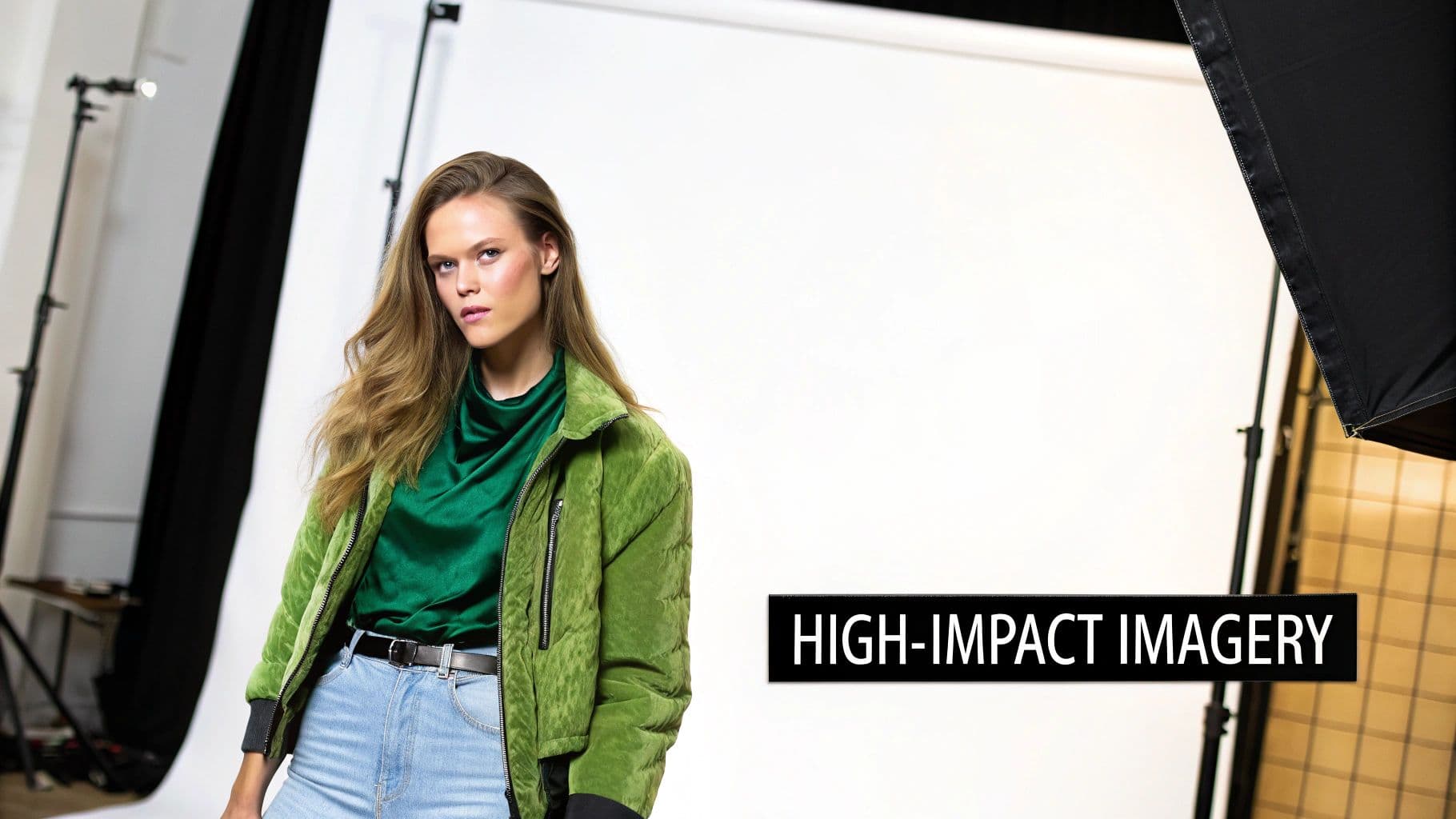
Female model in a green jacket and blue jeans in a professional photography studio.
In the crowded world of online retail, killer visuals are what separate the brands that thrive from those that just survive. Think about it. A flat-lay photo on a stark white background shows you the what—the shape, the color. But put that same item on a model who nails your brand’s vibe, and suddenly it has a story. It has context. It has personality.
That transformation is everything because online shoppers can't touch the fabric or feel the fit. Your model photography has to do all the heavy lifting, answering questions your customer hasn't even thought to ask yet. It shows them how the fabric drapes, how the piece moves, and how it really fits on a human body.
Building Brand Identity and Trust
Great model photography does more than just sell a product; it sells your entire brand. Every choice—from the model you cast to the styling, the location, and the mood—screams volumes about who you are. Are you edgy and urban? Classic and refined? The right imagery makes that crystal clear in a split second.
When you get this right consistently, you build a powerful, recognizable brand identity. Customers start to see a reflection of themselves, or who they want to be, in your models. That builds a deep sense of trust and loyalty that turns first-time buyers into lifelong fans. A great shoot delivers a feeling, not just a folder of JPEGs.
A photography fashion model shoot is the crucial link between a static product and a customer’s lifestyle. It’s where a piece of clothing becomes part of a narrative, allowing shoppers to see themselves not just wearing the item, but living in it.
Driving Conversions and Reducing Returns
At the end of the day, this is all about driving sales. And nothing drives conversions in fashion quite like effective model imagery. When a customer feels confident about how an item will look and fit, that hesitation to click "Add to Cart" melts away.
This clarity has a huge secondary benefit: it slashes your return rate. One of the biggest reasons for returns is the gap between expectation and reality. By giving customers an accurate, detailed, and appealing look at your product on a real person, you close that gap. They know exactly what they’re getting, which means happier customers and fewer costly returns eating into your bottom line.
The Pillars of a Traditional Fashion Shoot
A great fashion shoot doesn't just happen. It's a carefully planned production built on four core pillars. Get these right, and you'll create visuals that don't just look good—they sell your product. Each element has to work with the others, turning a simple idea into a compelling story for your brand.
First up is posing and direction. This is all about the conversation between the photographer and the model. It’s where a static image becomes a story. You’re not just telling someone where to put their hands; you're guiding them to channel an attitude that perfectly matches your brand's vibe.
Good direction is laser-focused on showing off the garment. How does the fabric move? What's the best angle for that silhouette? How can we highlight that intricate cuff detail? Trying out a wide range of poses is essential to discovering what makes the product—and the story—shine. We break down exactly how to guide models in our detailed article on photo shoot modelling.
Mastering Light and Mood
Next, we have lighting techniques. Lighting is everything. It single-handedly sets the mood and defines the texture of a photograph. This isn't just about making things visible; it's about sculpting the entire scene. The choice between hard light, which creates crisp, dramatic shadows, and soft light, which gives a gentle, flattering glow, is a foundational decision.
An experienced photographer knows how to use light to pull the eye toward key details, create a sense of depth, and get the right emotional reaction from the viewer. A bright, airy setup might be perfect for a new line of summer dresses, while a moody, low-key lighting scheme could be exactly what a luxury coat brand needs.
The ultimate goal of a fashion shoot is to create a visual roadmap for the customer. From the model's expression to the styling and lighting, every element should work together to help them envision the product in their own life, answering questions before they’re even asked.
The Importance of Styling and Shot Lists
The third pillar is styling and wardrobe. This goes way beyond just putting clothes on someone. It's the meticulous prep work: ensuring every garment is perfectly steamed, fits just right, and is paired with accessories that tell the complete story. A stylist on set is invaluable for keeping everything looking perfect and making quick adjustments on the fly.
Finally, the whole operation is held together by the shot list and creative brief. Think of this as the shoot's blueprint. It details every single photo you need, from standard full-body e-commerce shots to detailed close-ups and creative lifestyle compositions. It's common for high-end fashion brands to feature an average of eight images per product, and over 91% use a mix of photography styles to show items from every angle imaginable. This multi-shot strategy is now the standard for a great online shopping experience. A solid shot list ensures you don't miss a thing and makes the entire day run smoothly.
Mapping the E-commerce Production Workflow
Getting a garment from a designer's sketch to a live product page is a serious logistical dance. It's a journey powered by a detailed production workflow that demands a ton of planning, coordination, and cash for any traditional photography fashion model shoot. This entire operation really boils down to three core phases: pre-production, the shoot itself, and post-production.
The real work begins long before anyone ever steps on set. Pre-production is the strategic heart of the whole operation, where the creative vision gets locked in and all the logistical puzzle pieces are put into place. This is where brands spend most of their time, because solid planning is the only way to guarantee a smooth shoot day.
Pre-Production Groundwork
This first phase is a waterfall of critical decisions. It all starts with casting the right models who actually look and feel like your brand, and scouting locations that match the campaign's vibe. At the same time, the crew comes together—photographers, stylists, hair and makeup artists, and production assistants.
Key pre-production tasks usually include:
- Creative Direction: Nailing down the concept, mood board, and the overall visual game plan.
- Team Assembly: Hiring all the creative and technical pros needed to make the magic happen.
- Logistics Management: Booking studio time, arranging travel, and sorting out all the equipment rentals.
- Wardrobe Preparation: Sourcing, styling, and meticulously prepping every single garment that's going in front of the camera.
This infographic breaks down the four creative pillars—posing, lighting, styling, and the brief—that really guide the entire process.
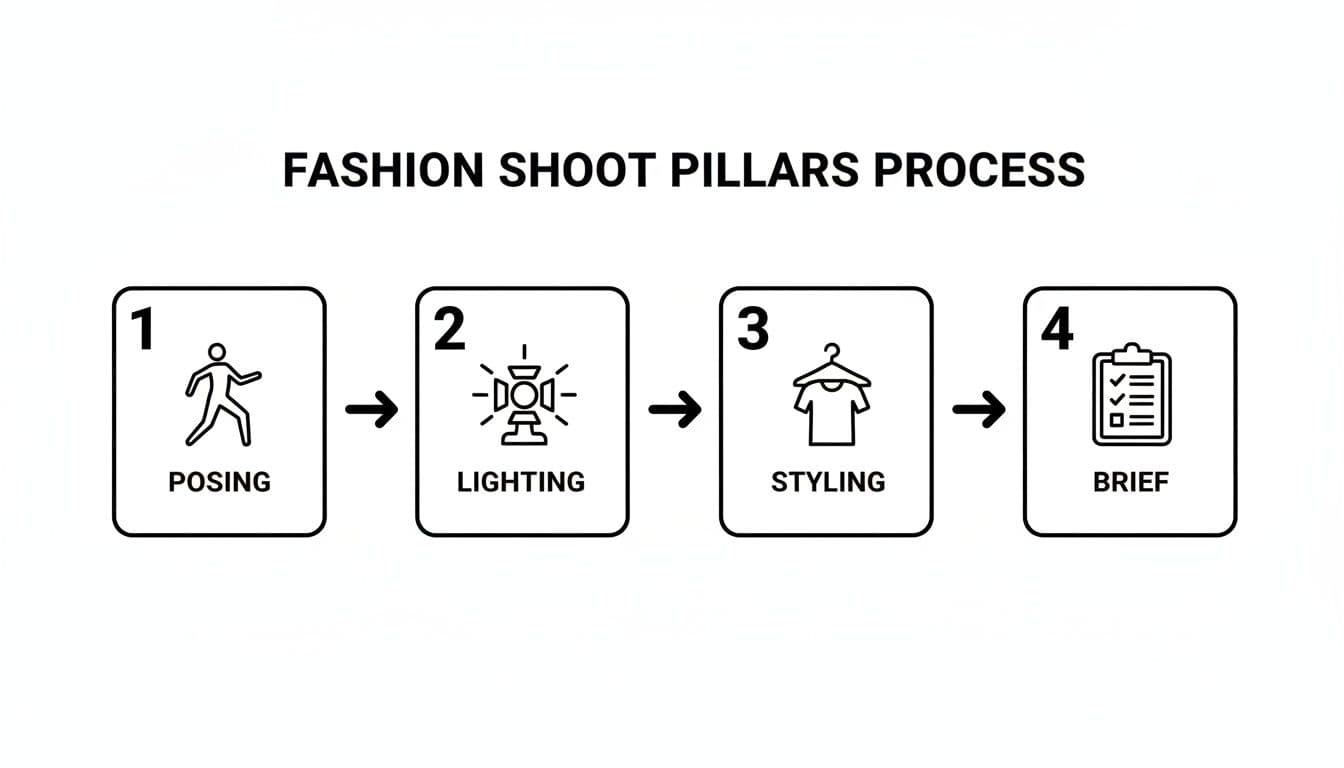
A four-step process infographic detailing fashion shoot pillars: posing, lighting, styling, and brief.
Think of these elements as the blueprint for shoot day. They ensure every decision, big or small, supports a cohesive look that’s perfectly on-brand.
The table below breaks down just how much time and money this traditional approach can consume. It’s a sobering look at the resources required before you even get to the post-production stage.
Traditional Photoshoot Costs and Timelines
| Phase | Key Activities | Estimated Cost Range | Typical Timeline |
|---|---|---|---|
| Pre-Production | Concept development, model casting, location scouting, crew hiring, wardrobe styling, logistics coordination. | $2,000 - $15,000+ | 2-6 weeks |
| Shoot Day | Studio rental, photographer fees, model fees, stylist fees, hair & makeup, catering, equipment rental. | $1,500 - $10,000+ per day | 1-3 days |
| Post-Production | Image selection (culling), professional retouching, color correction, formatting, final delivery. | $500 - $5,000+ | 1-2 weeks |
As you can see, the costs and timelines add up quickly, making it a significant investment for brands of any size.
Execution and Post-Production
Shoot day is where all that meticulous planning pays off. It's a high-energy, fast-paced environment focused on checking off every look on the shot list. The photographer guides the model through poses while the rest of the team keeps a close eye on lighting, styling, and makeup to make sure everything stays perfect from one shot to the next. Every minute counts, as studio and crew time are the biggest money drains.
Once the cameras are finally put away, the post-production phase kicks in. This is where raw images are transformed into polished, web-ready assets that actually drive sales.
The goal of post-production isn't just to fix imperfections; it's to ensure every image is consistent, accurately represents the product, and aligns perfectly with the brand’s digital storefront aesthetic.
This final stage involves a few more painstaking steps:
- Culling: The photographer or an editor has the fun job of sifting through thousands of images to pick the absolute best shots for each look.
- Retouching: Those chosen few are then professionally retouched to correct colors, smooth out any blemishes, and make sure the product details pop.
- Formatting: Finally, the edited photos are resized, cropped, and optimized for fast load times on Shopify, WooCommerce, or whatever e-commerce platform you’re using.
The Unstoppable Demand for E-commerce Visuals
The boom in online shopping has completely rewired how brands and customers interact. With no fitting rooms and no way to feel the fabric, high-quality images have become the single most important tool in a brand's sales arsenal. What was once a simple product shot against a white background is now a full-blown storytelling moment—and the right photography fashion model is the star of that story.
These visuals do far more than just show off a product. They build an immediate sense of trust and give shoppers the confidence they need to click "buy." When customers can see exactly how a garment fits, moves, and drapes on a real person, their biggest questions are answered before they even have to ask. That clarity translates directly to more sales and, just as crucially, fewer costly returns.
The Scale of the Visual Economy
This hunger for great content isn't just a passing trend; it's a massive, accelerating economic force. As more and more brands flood the online space, the need for fresh, diverse, and compelling model photography has exploded, carving out a specialized and booming niche in the industry. Great visuals are no longer a "nice-to-have"—they're table stakes for competing online.
In the digital marketplace, visual content is the new currency. Brands that invest in a robust and scalable visual strategy are not just selling clothes; they are building an immersive brand experience that keeps customers coming back.
The numbers back this up. The e-commerce product photography market is on track to hit US$275.4 million by 2030, growing at a blistering 11.6% CAGR that dwarfs the broader commercial photography world. This niche alone already makes up about 45% of the entire global commercial photography market, proving its dominant role in modern retail. You can dive deeper into the data with these product photography statistics to see just how big this shift is.
A Strategic Imperative for Brands
This relentless demand creates a huge operational headache. Churning out a constant stream of high-quality images using traditional photoshoots is expensive, slow, and nearly impossible to scale effectively. Brands are under constant pressure to create visuals for new collections, social media campaigns, and targeted ads, all while keeping their brand look and feel consistent.
The business case is crystal clear: a powerful visual strategy is essential for survival and growth. As a result, brands are being forced to find smarter, more efficient ways to produce content. This pressure has opened the door for new solutions that can deliver the quality and volume needed to compete, but without the logistical nightmares of old-school photoshoots—creating a compelling reason to explore tech-driven alternatives.
How AI Is Redefining Fashion Photography
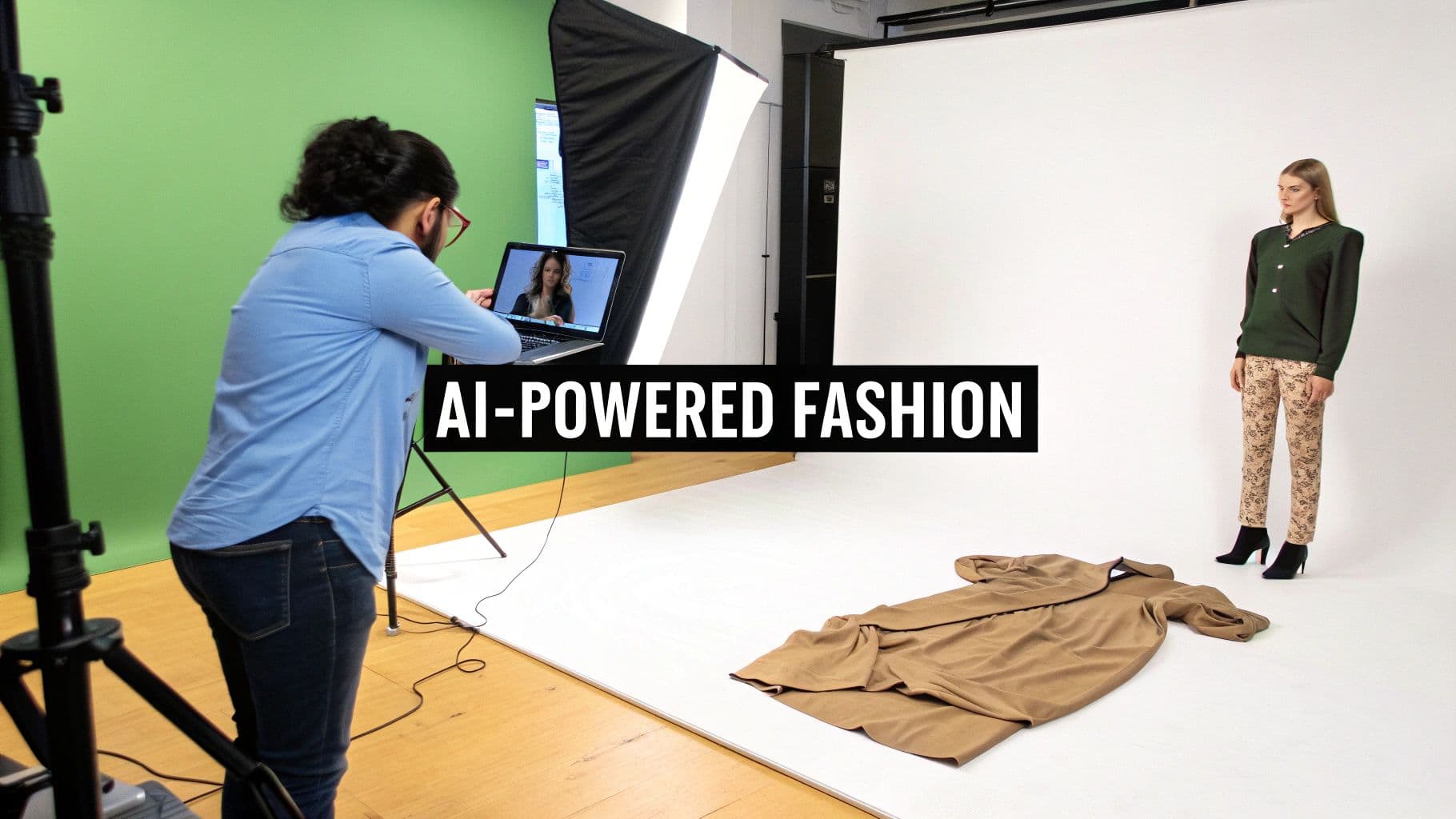
A man photographs a fashion model and a brown coat in a studio, with 'AI-POWERED FASHION' text.
The classic fashion photoshoot—with its high costs, complex logistics, and long turnaround times—is starting to show its age. The relentless demand for fresh content has pushed brands to a breaking point. It's simply not sustainable.
Enter Artificial Intelligence. AI is offering a smarter, more agile way to create stunning on-model visuals without the massive operational headache of a physical shoot.
Instead of booking studios and flying in models, brands can now generate professional-grade imagery from a single, simple photo of a garment. This tech bridges the gap between your physical product and a digital model, completely sidestepping the need for cameras, crews, and on-set chaos.
From Garment to Model in Seconds
The idea is surprisingly straightforward. You start with a basic picture of your product—it can be on a hanger, laid flat, or even on a mannequin. AI algorithms then get to work, analyzing the garment’s texture, shape, and how it drapes, before digitally fitting it onto a virtual model with startling realism.
This process takes a production timeline that used to span weeks and crushes it down to mere moments.
What makes this a true game-changer is the sheer efficiency and control it hands back to the brand. You can churn out an endless stream of visual assets for every single product, perfectly tailored to different marketing channels, all while maintaining absolute brand consistency.
Here are a few of the biggest wins:
- Speed to Market: Get new collections live with full model imagery almost instantly. No more waiting weeks for photos while the initial sales buzz fades.
- Creative Freedom: Experiment with countless model types, diverse backgrounds, and new poses without spending an extra dime on production.
- Unmatched Scalability: Generating thousands of on-model images is now as simple as uploading product photos. The content bottleneck is officially broken.
The financial upside is just as compelling. In fact, 73% of fashion brands are already experimenting with AI to create their visuals. The best AI-generated imagery is now virtually indistinguishable from traditional photos, allowing brands to slash production costs by up to 90% while boosting their creative output by as much as 500%.
The Rise of the Virtual Model
This new wave of digital creation goes way beyond just putting clothes on an avatar. Modern AI platforms that allow for AI model creation let brands build their own custom AI fashion model from the ground up—one that perfectly embodies their unique aesthetic.
You get to define every detail, from facial features and hairstyles to specific body types and signature poses. The result? Every single image feels cohesive and completely on-brand.
By replacing the logistical chaos of traditional shoots with a streamlined digital workflow, AI allows fashion brands to refocus their resources on creativity and growth rather than production management.
We're even seeing the emergence of hyper-realistic AI-generated models that challenge the very idea of a traditional photography fashion model. This gives brands a level of consistency that's nearly impossible to achieve with human models, whose availability and look can change over time.
For brands, this means no more casting calls, scheduling conflicts, or last-minute cancellations. It’s about building a roster of digital talent that is always available, ready to showcase your next collection with flawless consistency. This isn't just about saving money; it’s about unlocking a new level of creative agility and control over your brand's most valuable asset: its visual identity.
Frequently Asked questions
It's natural to have questions, especially when new technology is changing how brands create visuals. Whether you're weighing a traditional studio shoot against AI-driven tools, here are straight answers to the most common questions we hear from e-commerce managers and brand owners.
What Does a Typical Fashion Model Photoshoot Cost?
A traditional fashion model photoshoot can be a serious investment, easily running anywhere from a few thousand to tens of thousands of dollars. That number covers everything from the photographer and model’s day rates to studio rental, a professional stylist, and all the post-production work like retouching and color grading. Every piece adds up.
In contrast, AI photography platforms can slash those costs—often by as much as 90%. Instead of a massive upfront production expense, you get predictable subscription or per-image pricing. You’re swapping the logistical and financial headache of a physical shoot for a simple, digital workflow.
What Is the Most Important Element for E-commerce Success?
Beyond just a pretty picture, the single most important element is giving a customer the confidence to click "buy." Your images have to tell the whole story. They need to show off the product's fit, the feel of the fabric, and all the key details from every angle, on a model your audience connects with.
Think of it this way: great e-commerce photos answer a customer’s questions before they even think to ask them. This builds a ton of trust and removes the hesitation that kills conversion rates. Get the visuals right, and you'll see a direct impact on your sales.
Can AI-Generated Model Images Replace Real Photoshoots?
For the bread and butter of e-commerce—product detail pages, social media posts, and digital ads—the answer is a definite yes. Today’s AI can generate photorealistic model images that are often impossible to tell apart from traditional photos.
AI gives you incredible speed, scale, and consistency for the bulk of your content needs. While a highly conceptual, artistic brand campaign might still benefit from a live shoot, AI is more than capable of handling the day-to-day visual demands of running a modern e-commerce business.
How Do I Maintain Brand Consistency with AI Models?
This is one area where AI actually makes things easier. Top-tier platforms let you create and reuse your own unique AI models across your entire product line, locking in a cohesive look that’s true to your brand.
You can dial in specific facial features, body types, signature poses, and even branded backgrounds to make sure every single image feels like it came from the same world. It’s often more consistent than trying to book the same human model for shoots that are months apart.
This level of control ensures your brand’s visual story is told the same way, every time.
Ready to create stunning, on-brand model photography without the cost and complexity of traditional shoots? WearView is an AI-powered platform that transforms your flat product shots into studio-quality visuals in seconds. Explore how WearView can revolutionize your content creation.
WearView Team
WearView Content & Research Team
WearView Team is a group of fashion technology specialists focused on AI fashion models, virtual try-on, and AI product photography for e-commerce brands. We publish in-depth guides, case studies, and practical insights to help fashion businesses improve conversion rates and scale faster using AI.