March 6, 2026•18 min read
Modern Dresses Design Ideas for Today's Fashion Brands
Discover commercially successful dresses design ideas. This guide covers inspiration, silhouettes, fabrics, and using AI to visualize your collection.
Modern Dresses Design Ideas for Today's Fashion Brands
Feeling that familiar panic staring at a blank mood board? We’ve all been there. The secret to creating truly standout dresses design ideas isn't just about raw creativity—it's about channeling that artistry into a smart, strategic process. A beautiful sketch is just the start; the real magic happens when you turn that spark of inspiration into a dress that sells.
The Modern Dress Design Journey From Concept to Customer
Getting a dress from a concept in your head to a customer's closet has completely changed. The old, slow, step-by-step method just doesn't cut it anymore. Today's market is all about speed and efficiency. To keep up, designers are embracing a much more fluid and connected approach, using new tools to bring their vision to life faster than ever.
It really boils down to three main stages: inspiration, design, and marketing. But instead of being separate, siloed steps, they now flow directly into one another.
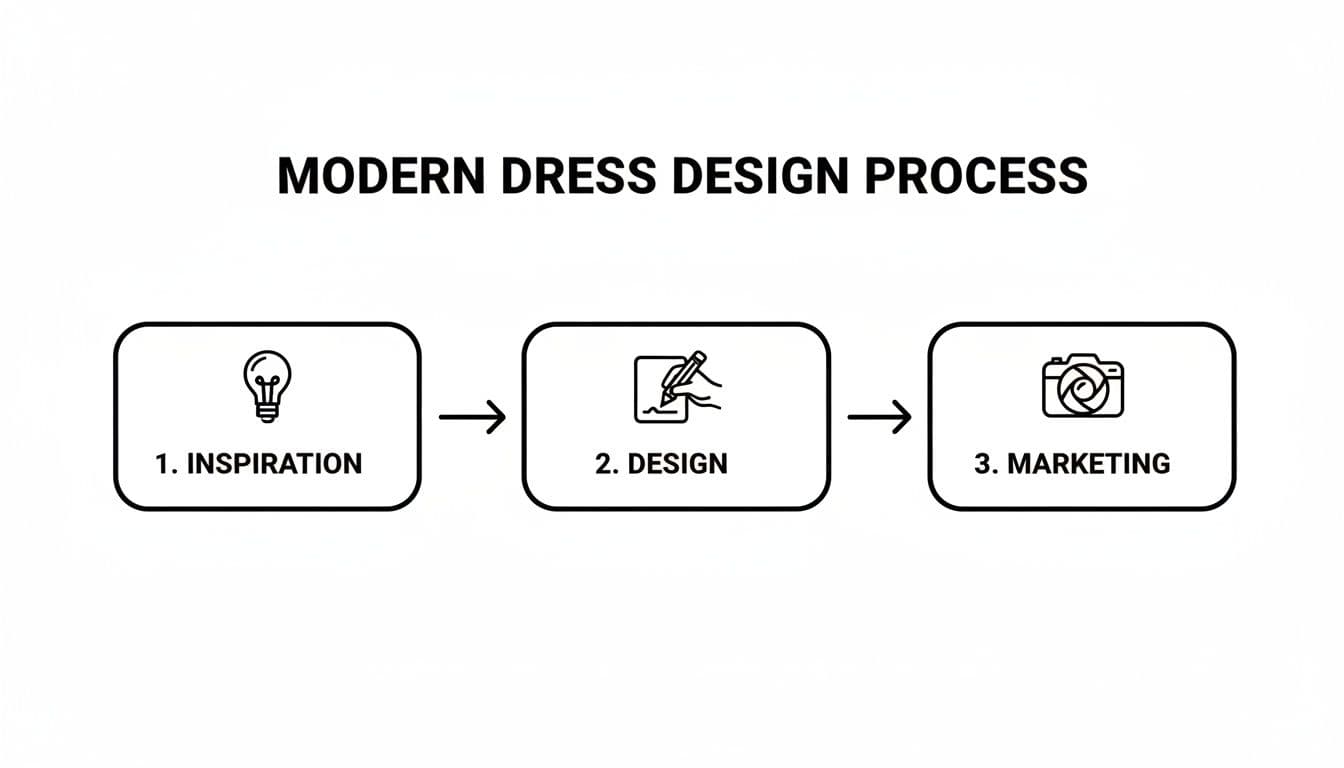
A diagram illustrates the three steps of a modern dress design process: inspiration, design, and marketing.
This connected path creates a straight line from your initial creative idea to the final marketing images, which can shave weeks or even months off your development timeline.
From Sketch to Sale
The whole process kicks off with gathering inspiration, but it has to move quickly into tangible design and, crucially, visualization. Knowing how to navigate this path is what makes or breaks a collection, especially when you're working with complex details like bespoke dress tailoring. Every step you take should build on the last, making sure the final garment is exactly what you envisioned.
A modern, successful dress design strategy rests on a few essential pillars. These elements work together to bridge the gap between creative vision and commercial success, ensuring your designs resonate with customers and align with your brand's goals.
Core Pillars of Modern Dress Design
| Pillar | Description | Key Focus Area |
|---|---|---|
| Market Awareness | Having a deep understanding of current trends, customer desires, and where the market is headed next. | Trend forecasting, competitor analysis, customer feedback loops. |
| Material Innovation | Selecting fabrics that not only enhance the design but also reflect your brand's values, such as sustainability or performance. | Sourcing sustainable textiles, exploring new fabric technologies, print development. |
| Efficient Prototyping | Finding faster, more cost-effective ways to test and refine your ideas without relying solely on expensive physical samples. | 3D rendering, virtual fit sessions, rapid digital visualization. |
Embracing these pillars helps you move from simply designing clothes to building a forward-thinking, resilient fashion brand that can adapt to a fast-paced industry.
Thriving in a Growing Market
And the opportunity out there is huge. The global dress market is on track to hit a staggering $378.4 billion in 2026, driven by fresh design and cultural shifts. For the thousands of fashion businesses in the US, this boom brings a major challenge: how do you design, produce, and market new dresses faster and more affordably to grab a piece of that pie?
By reframing dress design as a strategic system, brands can move from being reactive to proactive, capturing market trends instead of just chasing them. This shift is critical for building a lasting and profitable brand.
This is exactly where tools like WearView come in. They’re designed for this new, faster reality. Instead of waiting for traditional photoshoots, you can instantly create photorealistic images of your designs on models. It completely changes the game for creating marketing assets and getting your collection to market.
In this guide, we'll break down each stage with practical advice to help you generate, develop, and visualize your next dress collection.
Sourcing Inspiration for Truly Unique Dress Designs
Anyone can scroll through Pinterest, but truly unique dress designs are born from a deeper, more intentional search for inspiration. The real work begins when you step away from the screen and start training your eye to find design cues in the world around you.
It’s about building a rich visual library in your mind. This is how you develop a distinct point of view that makes your work instantly recognizable and separates you from the noise.
Look Beyond the Runway
Great ideas rarely come from looking where everyone else is. To create something that feels genuinely new, you need to become a master of making unexpected connections. It's about finding the thread that ties completely different worlds together.
- Architectural Forms: Take a walk and just look at the buildings around you. The stark, powerful lines of a brutalist structure could be the blueprint for a minimalist, sculpted dress. In contrast, the fluid, organic shapes of a Zaha Hadid building might spark an idea for a gown with dramatic, cascading drapes.
- Historical Archives: Go deeper than just vintage clothing trends. Spend an afternoon diving into online museum archives. Look at how garments were actually put together centuries ago—the clever construction of a 1940s work uniform or the ridiculously intricate embroidery on an 18th-century court dress can be a goldmine.
- Biomimicry in Nature: Nature is the ultimate designer, and its solutions are endlessly inspiring. The iridescent sheen on a beetle's wing could become a new textile finish. A deep-sea creature’s color gradient could inform a unique dyeing process, or the delicate veins of a leaf could inspire a new embroidery pattern.
The key isn’t to copy these sources directly. It’s to pull out the essence—a line, a texture, a color story—and filter it through your own creative lens. This act of translation is where originality truly comes to life.
Weave a Narrative with Your Mood Board
Once you’ve collected all this raw material, it's time to give it a voice. A great mood board is far more than a collage of pretty images; it’s a strategic tool that tells the story of your collection. It should feel focused and purposeful, acting as your north star for every design choice that follows.
Think of your mood board as the first scene in a film—it needs to set the mood, the place, and the character immediately. Don't just pin things. Ask yourself why you chose that image of a rusty gate. Is it the crumbling texture? The burnt-orange color? The feeling of beautiful decay?
For instance, a compelling board might weave together:
- Photos of ancient Roman sculptures that define a draped, toga-like silhouette.
- Close-ups of cracked desert earth to lock in a color palette of terracotta, sand, and stone.
- Images of modern, minimalist pottery that will guide the choice of clean, unadorned accessories.
This is how you turn a random pile of images into a sharp, coherent concept. You’re no longer working with scattered dress design ideas, but with a focused vision that gives you a rock-solid foundation before you ever start to sketch.
Choosing Silhouettes and Fabrics That Tell Your Story
Now that you have your core story, it's time to bring it to life through shape and texture. Think of silhouette and fabric as the building blocks of your dress. They're what turn an abstract idea into a real, wearable garment that moves, feels, and communicates a specific message.
Getting this combination right is where the magic happens. The silhouette provides the fundamental structure, while the fabric gives it emotion and personality. This isn't just about picking what looks good; it’s about making sure your choices support the story you want to tell.
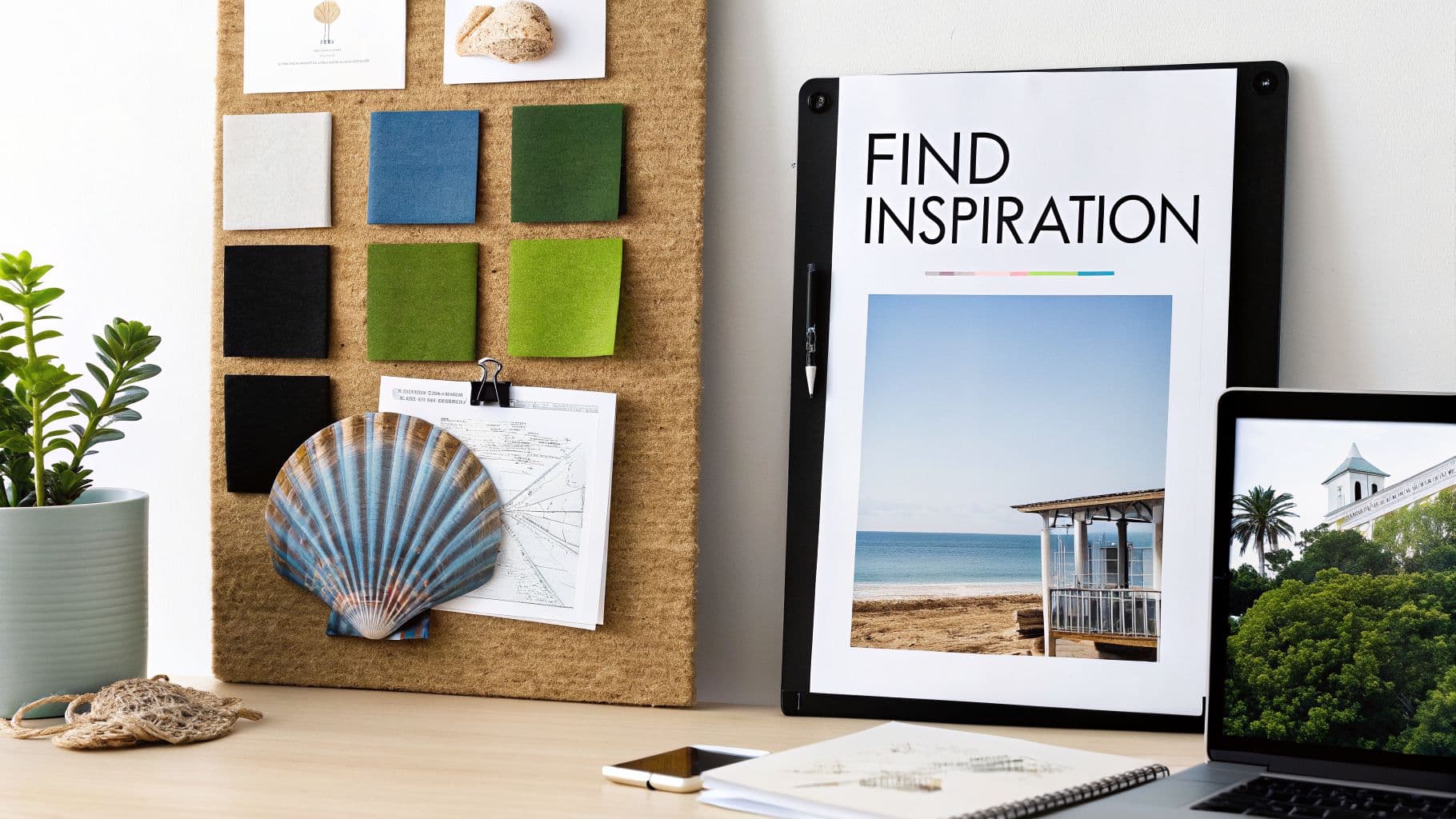
A designer's desk with a cork board, fabric swatches, inspiration print, laptop, and a green plant.
Modernizing Classic Silhouettes
Every great designer knows the classics. These foundational dress shapes have survived for a reason—they just work. But the real fun starts when you put your own spin on them.
- The A-Line: It’s a go-to for a reason, flattering on nearly everyone as it flows from a fitted top to a wider hem. To make it feel fresh, try playing with an asymmetrical hemline or adding an unexpected slit.
- The Sheath: This straight, close-fitting silhouette is a beautiful blank slate. Use that simplicity to your advantage by featuring a bold, graphic print or adding architectural elements like dramatic, oversized pockets.
- The Ball Gown: Known for its tight bodice and massive, full skirt, this silhouette is all about drama. For a modern take, imagine crafting it from something totally unexpected, like structured denim or a high-tech nylon, instead of traditional silk or tulle.
Don't be afraid to mix and match. What happens when you add voluminous, romantic sleeves to a sharp, minimal sheath dress? That kind of contrast is what creates truly memorable designs.
Fabric as the Soul of the Design
This is where your design gets its personality. The fabric choice dictates everything—how the dress hangs, how it feels against the skin, and the overall mood it projects. A dress pattern made in heavy wool will look and feel completely different from the same one cut in a breezy rayon.
The right fabric does more than just look good; it communicates feeling. A crisp linen feels casual and effortless, while a heavy satin speaks to formality and luxury. The choice of material is your design's first impression.
Sustainability is also a huge driver of innovation in fabric right now. With the second-hand market growing faster than traditional retail, consumers are actively looking for brands that think about a garment's entire lifecycle. This has opened the door to incredible new textiles, from plant-based leathers made from mycelium to fabrics spun from algae.
As the high-end fashion market is projected to reach $378.4 billion by 2026, these eco-conscious materials are becoming more accessible and are something every designer should be exploring. You can dive deeper into these shifts by reading the complete market analysis to better understand the trends.
Think practically, too. A solid color in a quality crepe can beautifully highlight the clean lines of a minimalist dress, making it perfect for the office. That same dress in a lightweight printed cotton, on the other hand, suddenly becomes an easy, everyday piece with a totally different vibe.
Creating Clear Sketches and Effective Tech Packs
This is where the rubber meets the road. All those abstract ideas for your dress now have to become a concrete plan that a factory can actually use. Moving from a creative concept to a precise technical specification is arguably the most important communication you'll do in the entire design process. It’s less about artistic flair and all about crystal-clear instruction.
I can’t stress this enough: a vague sketch or an incomplete tech pack is the number one cause of production headaches. We're talking wasted materials, costly errors, and major delays. The goal is to create a document so thorough that a manufacturer on the other side of the world could make your dress exactly as you see it in your head, without ever needing to pick up the phone.
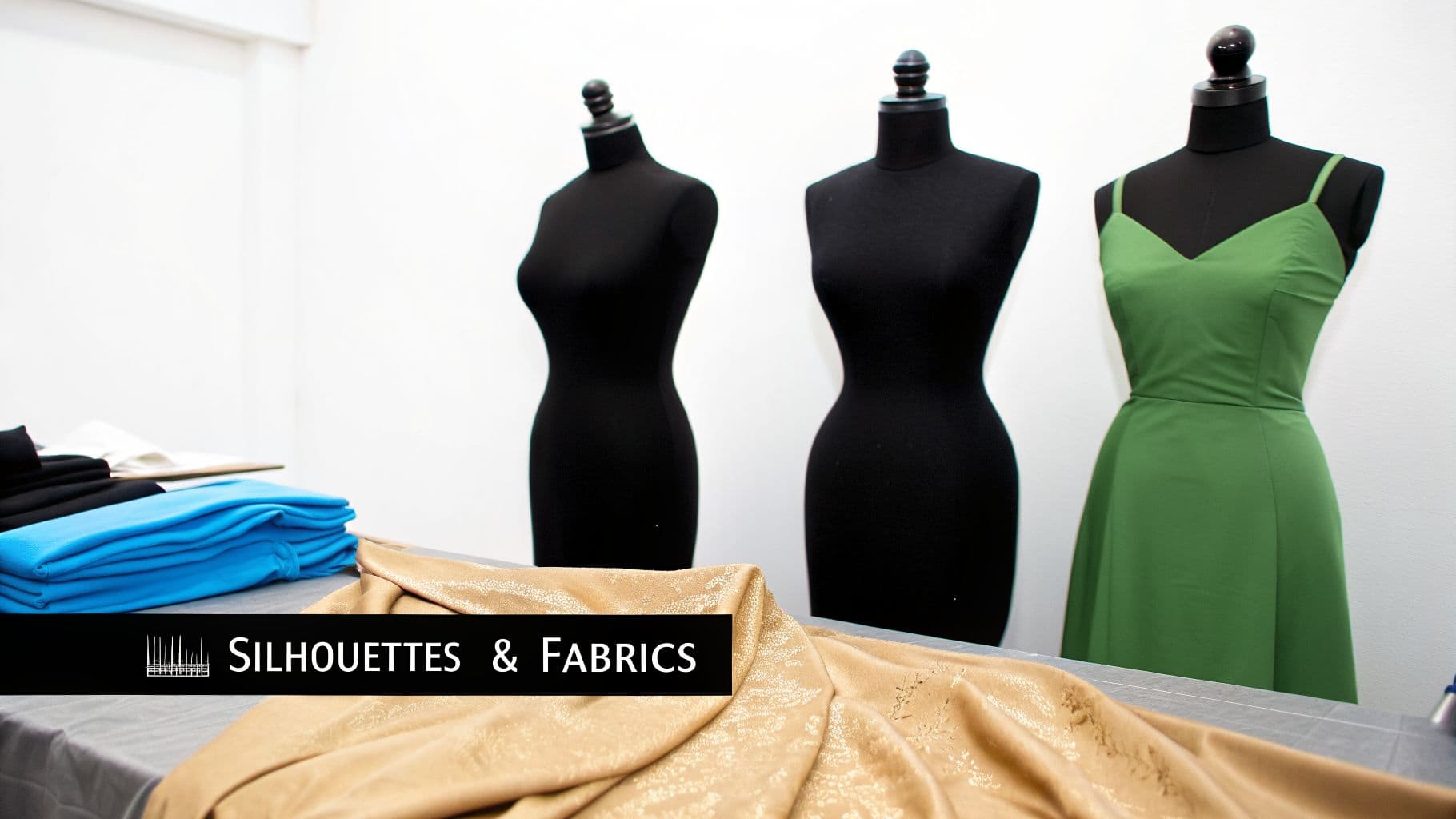
Three mannequins, two black and one with a green dress, stand near various fabrics in a design studio.
What Is a Tech Pack, Really?
Put simply, a tech pack is the complete instruction manual for your dress. It’s got every single detail needed to build the garment from scratch. They might look intimidating at first, but a solid tech pack is built on just a few core components that anyone can master.
For instance, if your design includes custom logos or patterns, knowing the ins and outs of processes like embroidery digitizing is a huge advantage. This kind of knowledge helps you communicate those complex details clearly in your tech pack, avoiding any misinterpretation.
Here are the non-negotiables you'll need to include:
- Flat Sketches: These are simple, 2D line drawings of the front and back of your dress. They need to show every seam, dart, and style line clearly, but without any artistic shading or dimension.
- Construction Details: Think of these as close-up shots. Use callouts or separate drawings to highlight specific features, like how a unique collar is constructed, where a pocket should be placed, or the technique for a tricky pleat.
- Bill of Materials (BOM): This is your master shopping list. It needs to account for every single component, from the main fabric down to the last button, zipper, label, and even the thread.
- Size Grading: This is the chart specifying the key measurements for every size you plan to sell. A good grade rule ensures the fit is consistent across your entire size range.
A well-executed tech pack is your best insurance policy against production mistakes. Investing time in getting the details right upfront will save you thousands of dollars and weeks of time in the long run.
Let’s take that pleated midi dress as a real-world example. Your tech pack would start with a flat sketch showing the bodice, waistband, and pleated skirt. You'd then add callouts specifying the exact width of each pleat, the type of zipper (e.g., "YKK invisible zipper, color-matched"), and the stitching method for the hem. By spelling out every detail, you leave zero room for guesswork.
For a deeper dive, check out this practical tech pack example that breaks it down step-by-step. It really shows how you can turn a creative vision into a precise manufacturing guide.
2. Visualizing Your Designs Instantly with AI
Your tech pack is finalized, the specs are perfect, but now you hit the industry’s classic bottleneck. How do you actually start selling your new dress without waiting weeks for a physical sample and then sinking a small fortune into a photoshoot?
This is where AI-driven visualization completely changes the game. Forget the logistical headache of booking photographers, models, and studios. You can now take a simple flat-lay photo of your garment, place it on a model that fits your brand’s vibe, and generate an entire set of photorealistic marketing images in minutes. It’s a way to bring your dress designs to life long before the final piece is even stitched.
Rethinking the Photoshoot
Let's be clear: this isn't about replacing creativity. It's about giving you the freedom to explore it without the usual constraints of time and money. You can experiment with countless styling concepts and see how your dress looks on a truly diverse range of body types—something that’s often logistically impossible with traditional shoots.
The impact on your bottom line is staggering. We've seen brands slash their photoshoot costs by as much as 90%. That’s capital you can pour back into better materials, design development, or marketing. You get to build hype and even start taking pre-orders before the first sample shipment lands.
In an industry that produces over 100 billion garments a year, this kind of efficiency isn't just a nice-to-have. As detailed in the latest State of Fashion report, fashion leaders are actively seeking tools that cut costs and get products to market faster to navigate economic and supply chain uncertainty.
How It Works: From a Flat Lay to a Full Campaign
So, what does this actually look like day-to-day? The process is refreshingly simple and designed to keep you focused on creativity, not technical hurdles.
Get Your Garment Photo: First, just snap a picture of your dress. A clean flat lay on the floor or a shot on a hanger or mannequin works perfectly. This image is your starting point.
Choose Your Model: Next, you pick a model who embodies your brand's look. Tools like WearView offer a library of options, and you can even work with them to create custom ai generated models for a look that’s 100% unique to your brand.
Generate Your Shots: With your garment and model selected, you simply click to generate your images. You can direct the poses, swap out backgrounds, and fine-tune the styling to build a complete asset library for e-commerce, social media, and ads.
This is so much more than creating one good photo. It’s about generating an entire visual toolkit—from clean PDP shots to aspirational lifestyle content—all from a single garment picture. For brands of any size, the ability to instantly visualize and market your dress design ideas this way is a true game-changer.
Frequently Asked Questions About Modern Dress Design
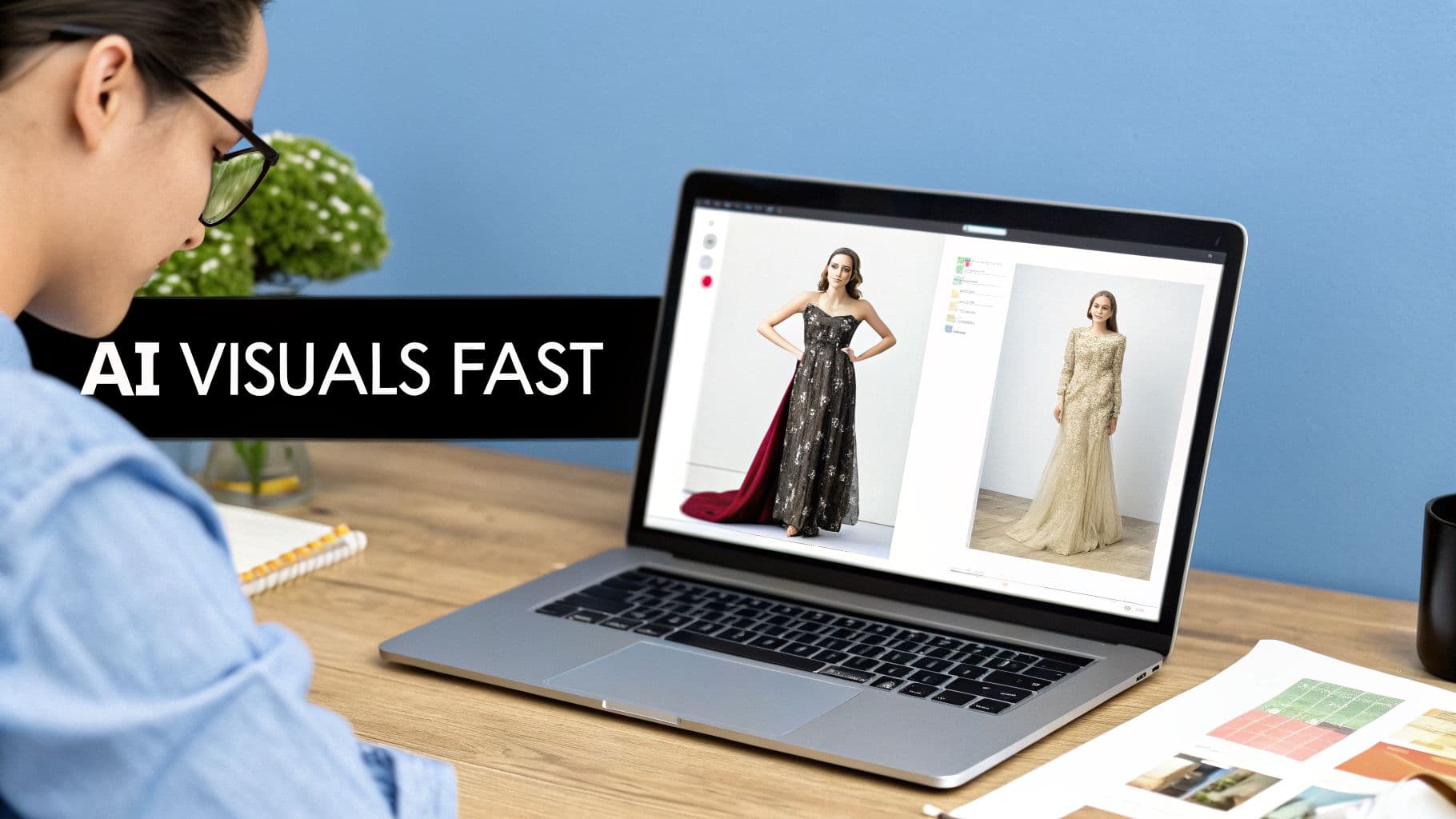
A person wearing glasses reviews various fashion dress designs displayed on a laptop screen, with 'AI VISUALS FAST' overlay.
As you get deeper into dress design, a lot of practical questions come up, especially when trying to balance creative vision with the realities of running a business. Whether you're curious about sustainable fabrics or new digital tools, here are some straight answers to the questions I hear most often from design teams.
How Can Small Brands Afford to Use Sustainable Fabrics?
This is probably the number one hurdle for emerging brands, but it's definitely not impossible. The trick is to get strategic with where and how you source your materials.
A great starting point for many smaller labels is working with suppliers who offer deadstock fabrics. These are high-quality, leftover materials from larger fashion houses. You can buy them in smaller runs, which means you get amazing textiles without having to meet huge minimum order quantities.
Another smart move is to design with mono-materials. A dress made from 100% organic cotton or 100% Tencel is much simpler to recycle later on. It’s also often cheaper to source than a complex, custom-blended fabric.
A lot of designers worry that "sustainable" means sacrificing on the look or feel. But in my experience, materials like linen, organic cotton, and unique deadstock can actually give a collection a more premium, thoughtful quality that tells a great brand story.
What Is the Best Way to Start a Tech Pack with No Experience?
First off, don't let the term "tech pack" scare you. Your initial one doesn't have to be a masterpiece. It just needs to be clear enough for a manufacturer to understand your vision.
The simplest way to dive in is by grabbing a free template online. This gives you a professional framework, so all you have to do is fill in the blanks with the essential details of your dress.
For your first one, just focus on these key pieces:
- Simple Flat Sketches: Just clean, clear drawings of the front and back. This isn't an art contest; it's about communication.
- Key Measurements: List the most important measurements for a single sample size. This gives your factory a starting point to grade from.
- Material List: Be specific about every single component—the main fabric, lining, zippers, buttons, and even the thread.
A pro tip: Take photos of similar details on garments you already own and include them as a visual reference. This can clear up a ton of confusion and make sure your manufacturer gets exactly what you’re picturing.
How Does AI Imagery Ensure Brand Consistency?
This is a totally valid concern for established brands. The good news is that modern AI photography tools are designed specifically with brand consistency in mind. It's all about setting up your visual DNA and locking it in.
For instance, many platforms let you create and reuse the same AI-generated model across all of your product photos. Right away, this gives your entire collection and e-commerce site a unified, recognizable feel.
You can also go a step further and define specific brand rules for backgrounds, lighting, and even model poses. Think of it as creating a digital style guide right inside the tool. This ensures that every single image, from one campaign to the next, feels like it came from your brand.
Can I Use AI Visualization for Vintage or One-Of-A-Kind Dresses?
Yes, and honestly, it’s a game-changer for this exact scenario. If you're a vintage reseller or create one-off pieces, you know that a traditional photoshoot for a single item is just too expensive to make sense.
With AI, the workflow is incredibly simple. Just take a clean shot of the dress—either on a hanger or laid flat—and upload it to the platform.
In just a few minutes, you can have a whole set of on-model images showing how the garment actually fits and moves. It lets you display that special item on different body types, which makes it infinitely more appealing to someone shopping online. It solves a huge marketing headache for anyone selling unique inventory.
Ready to stop waiting and start visualizing? See how WearView can transform your flat lays into stunning, on-model photoshoots in minutes and get your dresses design ideas to market faster than ever. Start creating with WearView today.
WearView Team
WearView Content & Research Team
WearView Team is a group of fashion technology specialists focused on AI fashion models, virtual try-on, and AI product photography for e-commerce brands. We publish in-depth guides, case studies, and practical insights to help fashion businesses improve conversion rates and scale faster using AI.