February 8, 2026•24 min read
A Brand's Guide to Virtual Fitting Rooms
Discover how virtual fitting rooms are reshaping fashion e-commerce. This guide explains the tech, benefits, and implementation steps for your brand.
A Brand's Guide to Virtual Fitting Rooms
Virtual fitting rooms, or VFRs, are exactly what they sound like: digital tools that let shoppers “try on” clothes without ever touching them. Think of it as a smart, personal mirror built right into your product page. Some brands call it a virtual changing room; the technology is the same. It’s the tech that finally bridges the gap between seeing an item online and knowing how it will actually look on your body.
At its core, the technology uses a sophisticated mix of AI, 3D modeling, and augmented reality to simulate the in-store try-on experience, giving customers the confidence they need to hit “buy.”
How Do Virtual Fitting Rooms Actually Work?
Picture this: a customer lands on your site and finds a dress they love. But the dreaded size chart leaves them guessing. Instead of abandoning their cart, they click a “Try It On” button. Suddenly, a static product page becomes an interactive, personalized experience.
That’s the magic. This one feature cuts through the biggest hesitation point in online fashion—the uncertainty of fit. It’s a powerful example of modern website personalization, creating a shopping journey that feels custom-built for each user and directly boosts your bottom line. This isn't just a fun gimmick; it's a serious sales tool.
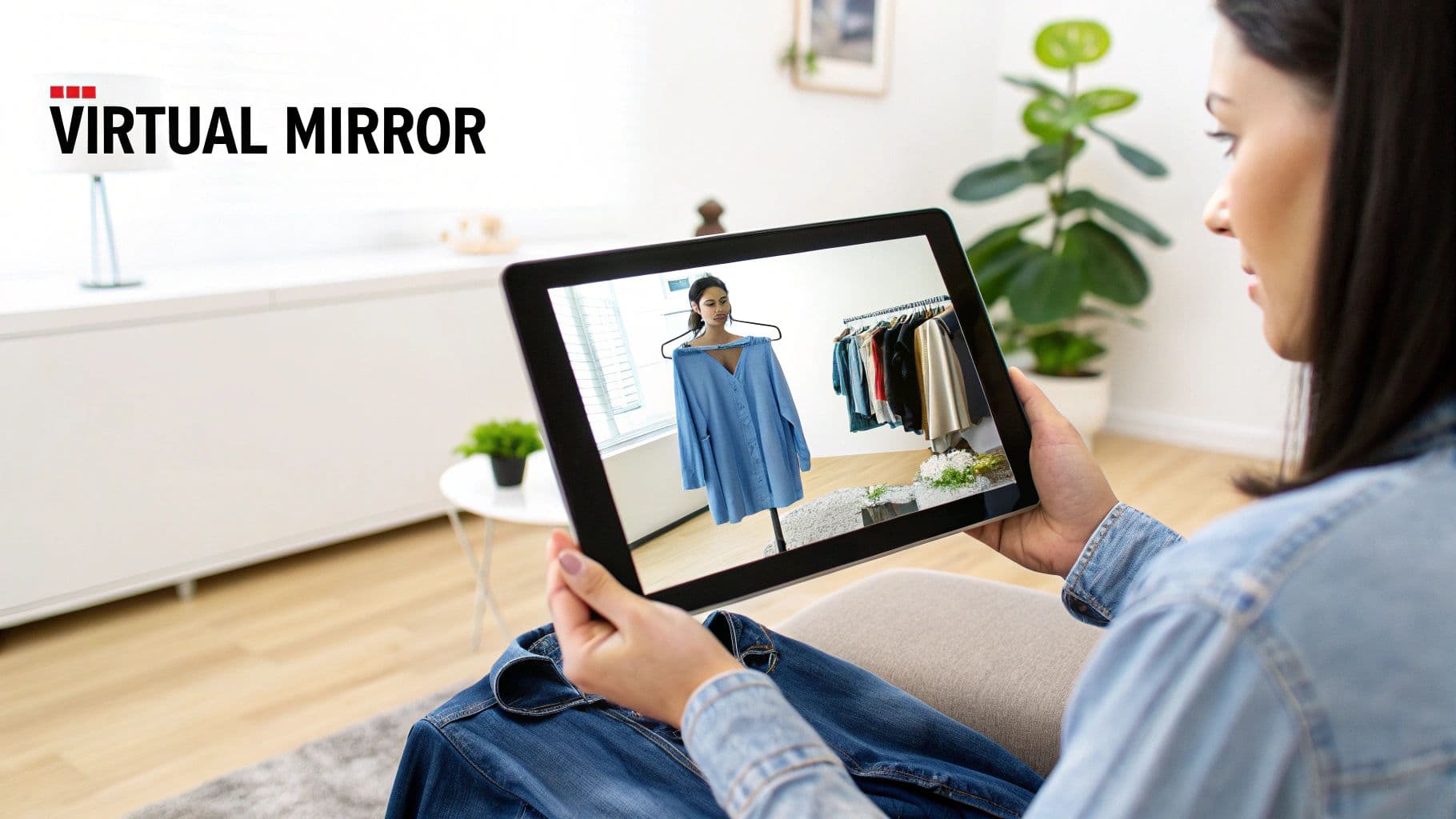
A woman uses a tablet displaying a virtual mirror showing clothes on a digital model.
The Typical Customer Journey
For the shopper, the whole process is designed to feel effortless and intuitive. While the exact tech varies between providers, the user’s path is almost always a simple, helpful one.
Here’s a quick breakdown of the steps they’ll take:
- Select a Product: The journey starts on any standard product page for a shirt, dress, or pair of pants.
- Activate the VFR: They click a "Virtual Try-On" button, launching the experience without ever leaving the page.
- Provide Input: This is where they personalize it. They might upload a photo, quickly enter a few key measurements, or select a pre-made digital model that mirrors their body type.
- Visualize the Fit: In seconds, the tech generates a realistic 3D render or an image overlay showing exactly how the garment hangs and fits on their body. They can spin the model around, check the drape from different angles, and even compare sizes side-by-side.
This simple interaction transforms a passive scroll into an active, engaging decision, giving customers all the visual proof they need to add the item to their cart without a second thought.
To get a clearer picture, let's break down the core components of virtual fitting rooms into a simple table.
Virtual Fitting Rooms at a Glance
| Concept | Primary Technology | Key Benefit for Customers | Key Benefit for Brands |
|---|---|---|---|
| Virtual Try-On | Augmented Reality (AR) | See clothes on your live camera feed | Engaging, interactive experience |
| Digital Avatars | 3D Body Scanning & AI | Create a precise digital twin for accurate fit | Highly personalized recommendations |
| Size Recommendation | AI & Machine Learning | Get the right size based on measurements | Drastically reduced return rates |
| Virtual Mirror | In-Store Smart Displays | Try on multiple outfits instantly in-store | Bridges physical and digital retail |
This table shows how different technologies come together to solve the core challenges of online fashion shopping for both the customer and the business.
Bridging the Digital Divide
At the end of the day, the goal of a virtual try on is to replicate the confidence-building moment that happens in a physical fitting room. By giving shoppers a clear, visual answer to the question, "Will this fit me?", these tools tackle the main reasons for abandoned carts and expensive returns head-on.
And the market is booming because it works. The virtual fitting room market, valued at USD 6.24 billion recently, is on track to explode to USD 21.45 billion by 2032. This isn’t just hype; it's driven by real results. With over 70% of fashion retailers now prioritizing digital tools, brands are seeing a 35% jump in user satisfaction after implementation.
The Tech Behind Modern Virtual Try-Ons
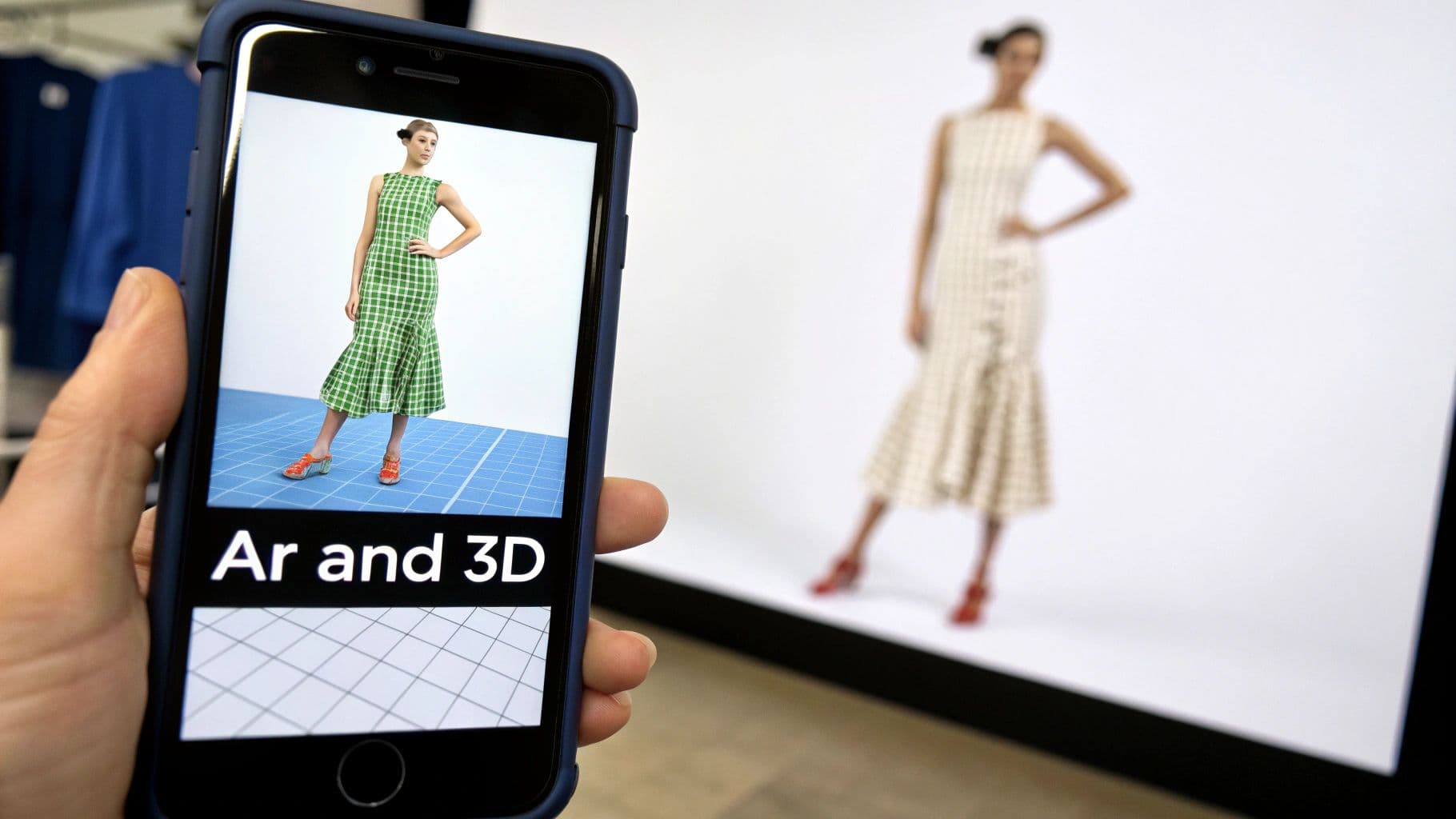
A hand holds a smartphone displaying a 3D model of a woman in a green dress, illustrating augmented reality fashion.
So, how does a virtual fitting room actually work? It’s not just one single piece of tech. Think of it as a high-performance engine with three critical components working in perfect sync: Augmented Reality, 3D Modeling, and Artificial Intelligence.
Each one tackles a different part of the puzzle. Together, they create a seamless and surprisingly realistic try-on experience that turns a static product image into something a shopper can actually interact with and trust.
Augmented Reality: The Interactive Overlay
Augmented Reality, or AR, is what brings the experience to life. It’s the magic that merges a digital garment with your real-world view through a phone camera. When you point your phone at yourself and see a t-shirt instantly appear on your body in the live video, that’s AR at work.
This is the most direct and engaging part of the technology. It provides immediate visual feedback, transforming a customer’s screen into a "magic mirror" where the digital and physical worlds collide. Instead of just guessing, they get a dynamic preview. It’s fun, it’s intuitive, and it instantly removes a huge layer of uncertainty.
3D Modeling: Creating the Digital Twin
While AR handles the interactive overlay, 3D modeling is what gives the digital garment its substance and realism. This is where a flat, 2D product photo gets transformed into a lifelike, three-dimensional "digital twin" of the actual piece of clothing.
Skilled artists create a digital model that understands the garment’s true shape, size, and structure. The most advanced systems can even simulate how different fabrics will behave. A silk blouse will drape and flow very differently from a structured denim jacket, and 3D modeling captures that nuance.
It’s this technology that answers the most important fit questions: "How will it hang on my hips?" or "Will it be too tight across my shoulders?"
By creating a true-to-life digital version of the item, 3D modeling gives the virtual try-on the accuracy it needs to be more than just a gimmick. It’s what builds the confidence a shopper needs to click "buy" without ever touching the fabric.
Artificial Intelligence: The Smart Brain of the Operation
If AR is the visual interface and 3D modeling is the digital product, then Artificial Intelligence (AI) is the powerful brain that makes the whole thing work. AI is the virtual tailor and personal stylist, running all the complex calculations behind the scenes to deliver a personalized and accurate fit. The most sophisticated machine learning business applications are at the heart of making these try-ons look shockingly real.
AI plays several crucial roles here:
- Size Recommendations: AI algorithms are brilliant at this. They can take a customer's measurements (or even just analyze their shape from a photo) and instantly cross-reference them with a garment's specific dimensions to suggest the perfect size. This alone can slash size-related returns.
- Photorealistic Rendering: This is where things get really impressive. Advanced AI can take a simple 2D product image and generate a realistic photo of how that item would look on a real person, correctly simulating fabric drape and accounting for body curves.
- Personalized Avatars: AI is the engine that creates digital avatars that accurately reflect a user’s unique body shape and size. This allows for a truly personalized fitting, far beyond just overlaying a flat image. It’s also the core technology behind the diverse and realistic AI models that are changing e-commerce photography.
Ultimately, AI provides the predictive power that turns a cool visual trick into a genuinely smart, helpful, and convincing shopping tool.
The Real-World Payoff: Why Virtual Fitting Rooms Matter for Your Brand
Sure, the tech is cool. But what really matters is the impact on your bottom line. Adding a virtual fitting room isn't about chasing the next shiny object; it’s a strategic play that hits the biggest pain points in online fashion head-on. It turns guesswork into sales and casual browsers into repeat buyers.
The benefits aren’t isolated, either. They create a positive ripple effect across your entire business, from boosting conversions on day one to cutting operational headaches long after the checkout is complete.
Drive More Sales and Higher Conversions
The biggest hurdle for any online fashion store is the "imagination gap." A customer sees a dress on a model, but they can't picture how it will actually look and fit on their own body. Virtual fitting rooms slam that gap shut. When a shopper can see how a shirt fits their shoulders or how a dress drapes on their frame, their confidence to buy goes through the roof.
That newfound confidence translates directly into higher conversion rates. Shoppers stop abandoning their carts because of size anxiety and start clicking "buy." Brands that get this right often see a noticeable lift in sales because they’ve removed the single biggest point of friction in the digital shopping journey.
A confident customer is a paying customer. You're not just showing them a product; you're giving them a clear, personalized preview that replaces doubt with a reason to complete the purchase.
Drastically Cut Down on Costly Returns
Let's be honest: returns are a profit-killer. The logistics of processing, restocking, and often marking down returned items can bleed a brand dry. And what’s the number one reason for fashion returns? The wrong fit. It's a tale as old as e-commerce itself.
Virtual fitting rooms attack this problem at the root. By helping customers nail the right size the first time, you can slash your return rates. This isn't a small tweak; it's a massive operational win that saves you money on reverse logistics, customer service hours, and dead inventory. For many brands, the savings from reduced returns alone pay for the entire VFR investment.
This isn't a niche trend, either. North America has become a hotbed for VFR adoption, with a market now valued at USD 2.64 billion. Retailers are deploying this tech specifically to fight high return rates, because a realistic preview is proven to work. For online brands, this means fewer returns, happier customers, and a healthier bottom line. You can dive deeper into the market analysis of these trends to see the full picture.
Enhance Customer Engagement and Loyalty
Beyond the immediate transaction, virtual fitting rooms create a stickier, more memorable shopping experience. You're transforming a passive scroll through product pages into an engaging, personalized interaction. Customers are no longer just looking at clothes; they’re actively styling and trying them on.
That kind of positive, genuinely helpful experience builds a real connection. Shoppers remember the brand that made it easy to find that perfect-fitting pair of jeans.
- Increased Time on Site: Interactive tools like VFRs keep people on your product pages longer, which is a great engagement signal for search engines.
- A Memorable Experience: A slick try-on feature is a powerful differentiator that makes you stand out from competitors who are still stuck with static size charts.
- Fueling Repeat Purchases: When a customer receives an item that fits exactly as they expected, they trust you. That trust is the foundation of long-term loyalty and future sales.
Champion Sustainability and Inclusivity
Finally, adopting VFRs signals that your brand is in tune with what modern consumers care about. By cutting down on returns, you automatically reduce your carbon footprint. Fewer back-and-forth shipments mean less fuel burned, less packaging wasted, and a more sustainable operation overall.
Even better, this technology is a powerful tool for inclusivity. It lets you showcase your clothing on a truly diverse range of body types, moving far beyond the single "standard" model. When customers can see themselves reflected in your products, it fosters a powerful sense of belonging and shows that your brand is committed to serving everyone.
Implementing a Virtual Fitting Room on Your Website
So, you're sold on the idea of a virtual fitting room. That's the easy part. The jump from knowing it’s a good idea to actually getting one live on your site can feel massive, but it’s more straightforward than you might think.
Think of it less like a scary, site-wide technical rebuild and more like a strategic upgrade. It’s no different than adding a new payment gateway or a live chat widget—a focused project designed to make your customers’ lives easier and your business healthier. Whether you grab an off-the-shelf solution or go for a custom build, the roadmap is pretty much the same.
Step 1: Define Your Strategic Goals
Before you even think about looking at vendors, you have to know what you’re trying to achieve. Why are you really doing this? Your answer to that question will steer every other decision.
Vague goals like "improving the customer experience" are useless here. You need hard, measurable targets.
What does success actually look like?
- Reduce return rates: "We want to slash returns due to bad fit by 20% in the first six months."
- Increase conversion rates: "Our goal is to bump up conversions on our core product pages by 15%."
- Boost customer engagement: "We need to get shoppers to spend an extra 30 seconds on our key product pages."
- Expand market reach: "We want to finally win over online shoppers who are too scared to buy because of fit anxiety."
With clear KPIs like these, you’re not just buying tech; you’re making a measurable investment. You'll have a benchmark to prove it's working.
Step 2: Choose the Right Technology Partner
Now that you have your goals, it's time to find a partner. This is a big deal—you're choosing the tech your customers will engage with every day. The market has everything from simple size-and-fit quizzes to mind-blowing AI that puts your clothes on a photorealistic model.
When you're talking to vendors, get straight to the point.
Crucial Questions for VFR Vendors
- What kind of product photos do you need? Can you use our existing flat lays, or are we talking about expensive 3D scans?
- How much is this going to slow down my website? Show me the data.
- How much can we customize this thing to match our brand's vibe?
- Can I see case studies from brands that are actually similar to mine?
Finding a partner whose tech slots into your current workflow is everything. For instance, the new wave of product to model ai solutions can take your existing catalog photos and magically turn them into dynamic try-on sessions. This completely skips the need for costly 3D modeling, making the whole process faster and way more affordable.
Step 3: Prepare Your Product Catalog
Okay, you've picked a partner. Now it's time to get your data in order. A virtual fitting room is only as smart as the information you feed it. That means your product catalog needs to be clean, organized, and packed with detail.
You'll probably need to get these things ready:
- High-Resolution Images: Sharp, well-lit photos of every piece, from multiple angles.
- Accurate Sizing Charts: Every single measurement for every size of every product. No shortcuts.
- Product Attributes: Details on fabric, how much it stretches, and the intended fit (e.g., slim, regular, oversized).
Honestly, this is a great excuse to finally do that product data audit you've been putting off. The more accurate the data you provide, the better the virtual try-on will be for your customers.
Here's a simple look at how a well-executed VFR pays off:
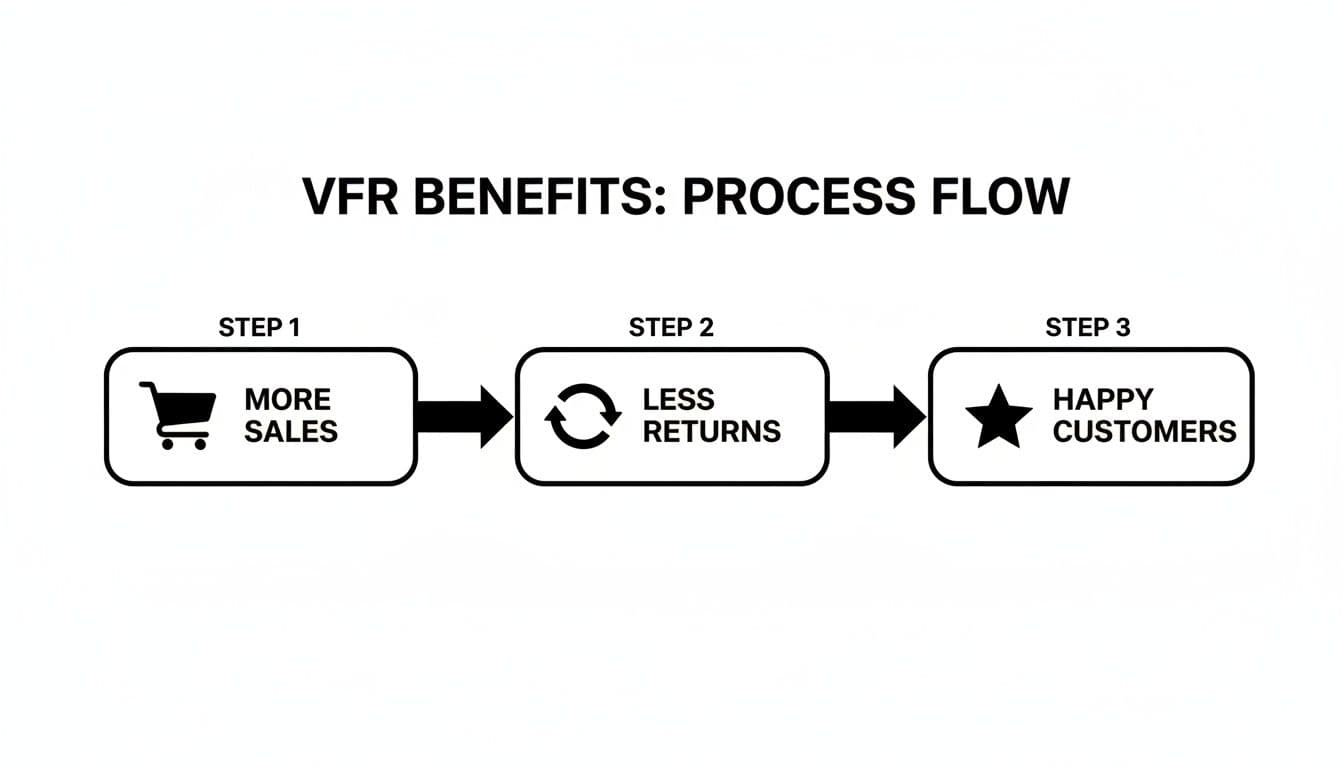
A process flow diagram illustrating VFR benefits: more sales, less returns, leading to happy customers.
This just hammers home the point: a better customer journey directly connects to better business results. More sales and fewer returns lead straight to happy, loyal customers.
Step 4: Integrate and Test the VFR Tool
With your catalog prepped, your tech partner will handle the integration. Most good VFR solutions are built to play nice with major e-commerce platforms like Shopify, BigCommerce, or Magento. Usually, it's as simple as dropping a snippet of code onto your site.
But the next part is absolutely critical: testing. Treat this like the final dress rehearsal before opening night. Test it on every device you can find—desktop, tablet, and every kind of phone. Test it on Chrome, Safari, and Firefox.
Is the "Try It On" button obvious? Is the tool easy to figure out? Are the recommendations accurate? This is your last chance to find and fix any weird bugs before your customers do.
Step 5: Launch and Promote Your New Feature
It's time. But please, don't just quietly flick a switch and hope people notice. You just invested time and money into an awesome new feature—shout about it!
- Email Marketing: Blast your email list with an announcement. Show them how it works.
- Social Media: Create some slick videos or GIFs of the VFR in action for Instagram and TikTok.
- Website Banners: Slap a big, bold banner on your homepage that funnels people directly to the new experience.
When you treat implementation like a full-blown project—from setting goals to hyping the launch—your virtual fitting room stops being a gimmick and becomes a genuine powerhouse for your brand. It's a tool that drives sales, kills returns, and builds the kind of loyalty that lasts.
How to Measure the ROI of Your VFR Investment
Putting a new piece of tech on your site is one thing, but making sure it actually earns its keep is another. A virtual fitting room is only as good as the results it drives, and to justify the cost, you need a clear, data-backed way to see its impact on your bottom line.
Proving the value of your VFR isn’t just about saying "it works." It's about connecting the dots between the feature and your revenue. Luckily, you don't need a data science degree to do it. It all comes down to tracking a handful of key performance indicators (KPIs) that show exactly how customers are responding.
Key Metrics for Tracking VFR Performance
Before you can even think about ROI, you need to know what to measure. The right metrics will tell you the story of how your VFR is shaping shopper confidence and driving them to click "buy."
The most important step? Establish a baseline for these numbers before you launch. This gives you a clear "before and after" picture, making the impact undeniable.
Here’s what you need to keep a close eye on:
- Conversion Rate Lift: This is your north star. Compare the conversion rate of shoppers who use the virtual try-on against those who don't. A healthy lift in the VFR user group is the clearest sign that the tool is crushing purchase anxiety.
- Reduction in Return Rate: Returns are the silent killer of profit margins in fashion, and fit is the number one culprit. Track the return rate for items bought after a virtual try-on. A significant drop here is solid proof your VFR is helping people choose the right size the first time.
- Increase in Average Order Value (AOV): Confidence is a powerful sales driver. Does trying something on virtually give shoppers the green light to add more to their cart? Monitor if customers who use the VFR end up with a higher AOV than your site average.
- Engagement Rate: How many people are actually clicking the "try it on" button? This simple metric tells you if the feature is visible, easy to use, and genuinely helpful. Low engagement might mean you need to make the button more prominent or the experience more intuitive.
A Simple Formula for Calculating ROI
Once you’ve got your data, the math is refreshingly simple. You're just comparing the money the VFR made and saved you against what you paid for it.
Here’s a straightforward formula to get started:
ROI (%) = [ (Financial Gain from VFR - Cost of VFR) / Cost of VFR ] x 100
To figure out your "Financial Gain," you'll add up the value from your KPIs. This includes the extra revenue from higher conversions and AOV, plus the very real cash you saved by processing fewer returns. Pit that number against the cost of your VFR software, and you've got your return on investment.
Beyond the Numbers: The Qualitative Wins
Not every benefit fits neatly into a spreadsheet. While the hard data is crucial for any business case, don't ignore the "soft" wins that build long-term brand equity and customer loyalty. These are just as important for understanding the full picture.
Think about tracking these improvements, too:
- Customer Satisfaction: Send out a quick post-purchase survey. Ask shoppers directly about their experience with the virtual try-on. Glowing feedback is a powerful signal that you're making the shopping journey better.
- Social Media Mentions: A cool, helpful tool like a VFR gets people talking. Keep an eye on social channels for organic mentions, shares, and user-generated content. This is free marketing fueled by a great customer experience.
- Brand Perception: Offering a genuinely useful, modern tool positions your brand as a leader. It shows you care about the customer's experience, which attracts new shoppers and builds the kind of loyalty that lasts.
The Future of Digital Fashion and Virtual Try-Ons
The virtual fitting rooms we're using today? They're just the first draft. As the tech gets smarter and faster, the line between shopping on your screen and in a real store is going to get incredibly blurry, creating experiences that feel more intuitive, personal, and baked right into our digital lives.
The next big leap is the merger of virtual try-on with social commerce and the metaverse. Imagine scrolling through your social feed, seeing a jacket you love, and instantly trying it on your own avatar without ever leaving the app. Or think about attending a virtual concert and buying the digital outfit your favorite artist is wearing on stage—with the option to get the real thing shipped to your house.
This isn't just about convenience. It’s about transforming passive window shopping into an active, engaging experience. In this future, trying on clothes isn't something you do on a sterile product page; it’s a natural part of how you hang out online.
Hyper-Realism and Advanced AI
The realism of virtual try-ons is about to get a serious upgrade. The next wave of AI won't just slap a flat image of a garment onto you; it will simulate the actual physics of the fabric with mind-blowing accuracy. You won’t just see how a silk shirt looks—you'll see exactly how it drapes, ripples, and moves as you walk.
This is all thanks to huge strides in a few key areas:
- Hyper-Realistic Avatars: AI is getting incredibly good at creating digital twins that are nearly indistinguishable from reality. We're talking subtle details like body shape, posture, and even skin tone.
- Precise Fabric Simulation: The technology will be able to perfectly mimic the weight, stretch, and flow of different materials. It will know how denim holds its shape versus how chiffon catches the air, giving you a genuine preview of both fit and feel.
This level of detail will start to chip away at the last bit of hesitation in online shopping, making the virtual try-on as trustworthy as stepping into a physical fitting room.
Data as a Strategic Design Tool
But maybe the biggest game-changer isn't what the customer sees, but what the brand learns. Every single time a customer virtually tries on an item, they're creating a data point. Brands will suddenly know which styles are getting the most love from specific body types, which colors people can't get enough of, and where a fit is consistently off.
This data is pure gold. It stops being a simple sales metric and becomes a core part of the design and production pipeline. Brands can finally make smarter, proactive decisions, creating clothes they know their customers want and cutting down on the massive waste that comes from guessing wrong.
This isn't a far-off dream; it's already happening. Europe’s virtual fitting room market, for example, is already leading the pack, with fashion hubs in the UK, France, and Italy jumping in headfirst. Brands in the region have seen user satisfaction climb by 35% after implementing the tech. With 70% of retailers putting their digital projects on the fast track, the shift to a data-driven, virtual-first model is picking up serious speed. You can dig into more of the numbers in recent virtual fitting room market reports.
Unpacking the Fine Print: Your Virtual Fitting Room Questions Answered
When you start digging into virtual fitting rooms, the big-picture benefits are clear. But it's the practical, day-to-day questions about cost, workflow, and performance that really matter. Let's get straight to the point and tackle the most common questions brands ask before making a move.
Think of this as the no-fluff guide to understanding what it actually takes to get a VFR up and running, and how to make a smart choice for your business.
How Much Is This Going to Cost Me?
The price tag for a virtual fitting room can swing wildly, and it all comes down to the tech you choose and how many customers you have. On one end, you have subscription-based SaaS platforms that might run anywhere from a few hundred to several thousand dollars a month. On the other end, a completely custom-built solution is a serious upfront investment, easily running into the tens of thousands.
But focusing only on the price is the wrong way to look at it. The real question is about the return on investment (ROI). A system that reliably bumps up your conversion rate and slashes your return rate can pay for itself in no time. Newer AI solutions have really changed the game here, offering a much more accessible entry point by working with your existing product photos—completely sidestepping the need for pricey and slow 3D scanning.
What Kind of Product Photos Do I Need to Have?
This is one of the most important questions, and the answer hinges entirely on the vendor you pick. Some of the older or more complex 3D systems are pretty demanding, requiring you to create special 3D scans of every single garment. That's a massive operational headache and a non-starter for most brands.
Thankfully, the latest AI-powered fitting rooms are way more flexible. They’re built to work with the standard 2D product images you’re probably already shooting for your store, like:
- Flat-lay photos
- On-model images
- Simple shots on a hanger
The AI does all the heavy lifting, transforming those simple images into a surprisingly realistic try-on. No matter which system you go with, one rule always applies: start with high-resolution, well-lit photos. Great inputs always lead to great outputs, reinforcing your brand’s quality and giving your customers the best possible experience.
Will This Thing Slow Down My Website?
Every e-commerce manager lives in fear of a slow website, so this is a 100% valid concern. A slow site kills conversions. Period.
Any reputable VFR provider knows this and designs their software to have a minimal impact on your page speed. Most modern tools load asynchronously. In simple terms, this means the fitting room widget loads separately from the rest of your page. Your product details, images, and "Add to Cart" button all pop up instantly, while the VFR loads in the background without holding anything up.
A well-made virtual fitting room should feel like it was always part of your site—a smooth, integrated feature, not some clunky add-on that makes customers wait. When you’re talking to vendors, always ask to see live examples on other stores. Go there and test the speed yourself. It’s the only way to know for sure.
Ready to transform your fashion e-commerce experience with stunning, AI-generated visuals? WearView replaces costly photoshoots with instant, on-model imagery that boosts conversions and cuts costs. Discover how WearView can revolutionize your product photography.

WearView Team
WearView Content & Research Team
WearView Team is a group of fashion technology specialists focused on AI fashion models, virtual try-on, and AI product photography for e-commerce brands. We publish in-depth guides, case studies, and practical insights to help fashion businesses improve conversion rates and scale faster using AI.