February 4, 2026•23 min read
The Ultimate Guide to a Virtual Dress Room for Fashion Brands
Discover how a virtual dress room transforms e-commerce with AI try-ons. Learn to boost sales, reduce returns, and create immersive shopping experiences.
The Ultimate Guide to a Virtual Dress Room for Fashion Brands
A virtual dress room is the closest thing e-commerce has to a real-world fitting room. It’s a tool that lets online shoppers see exactly how a piece of clothing would look on a realistic model, all without ever leaving the product page. Using powerful AI, this tech creates photorealistic images that finally bridge the gap between browsing online and the confidence you get from an in-person try-on.
What Is a Virtual Dress Room
Think of your favorite clothing store's fitting room. Now, imagine having that same experience right on your phone or laptop. That’s the simple idea behind a virtual dress room. It's a technology built right into your product pages that lets customers see how clothes fit on different body types, finally answering that nagging question: "But how will this actually look on a person?"
This is way more than just slapping a flat image of a shirt onto a mannequin. Today's systems use sophisticated AI to analyze a garment’s specific fabric, cut, and texture. It then renders a true-to-life image showing how that item would naturally drape, fold, and even stretch on a human body. The result is a far more authentic and genuinely helpful shopping experience.
For years, the biggest roadblock for online fashion has been shopper uncertainty. People hesitate—and ultimately abandon their carts—because they just can't be sure about fit and style. This leads directly to lost sales and, even worse, expensive returns. A virtual dress room tackles this problem head-on.
The Power of Visualization
Seeing is believing, and that’s never been truer than in fashion. When a shopper can pick a model that mirrors their own body shape and instantly see how a dress hangs or a pair of jeans fits, it wipes away most of the guesswork. This builds immediate confidence and helps them make a much smarter, faster purchasing decision.
This technology transforms a boring, static product photo into a dynamic, interactive experience. Instead of just seeing a sweater on a hanger or a single studio model, shoppers can explore different looks and styles in a way that feels personal. The impact isn't just cosmetic; it completely changes how customers interact with your products.
A virtual dress room gives shoppers the visual proof they need to feel certain about their choices, effectively turning hesitation into a confident purchase.
Why It Matters for Modern Brands
In a ridiculously crowded e-commerce market, a killer customer experience is what makes a brand stand out. A virtual dress room isn't just a cool feature—it's a powerful differentiator that delivers real, measurable business results.
- Slash Return Rates: The number one reason for returns is bad fit. By giving customers a realistic preview of how an item will look, brands see a huge drop in return rates, which goes straight to protecting their bottom line.
- Boost Conversion Rates: Confidence sells. When a customer feels sure that a product is right for them, they are exponentially more likely to hit that "Add to Cart" button.
- Deepen Customer Engagement: Interactive tools like a virtual try on keep shoppers on your site for longer. This increased engagement doesn't just look good in analytics; it builds a stronger connection to your brand and encourages them to come back.
At the end of the day, this technology is more than a novelty. It's a strategic tool that solves some of the oldest and most frustrating challenges in online apparel while creating a more engaging and satisfying experience for today's shopper.
How Virtual Try-On Technology Actually Works
So, how does a flat photo of a t-shirt suddenly look like it’s being worn by a real person on your screen? It’s not magic, but it’s close. At the core, virtual dress rooms rely on a smart partnership between Artificial Intelligence (AI) and 3D rendering.
The process is surprisingly direct. You start with a simple, 2D picture of your product—maybe on a hanger or laid out on a table. The AI acts like a highly skilled digital tailor, instantly analyzing that image. It doesn't just see a shape; it understands the fabric's texture, its weight, and how it’s supposed to drape and fold in the real world.
Once the AI has done its homework on the garment, the 3D rendering engine takes over. Think of it as the virtual mannequin. It takes all that rich clothing data from the AI and drapes it perfectly onto a model’s body, accounting for lighting, shadows, and natural physics. This is what creates that stunningly photorealistic final image.
The Core Technological Components
Let's pull back the curtain a bit more. The whole system is built on a few key pieces of tech, each with a specific job. This isn't just about stretching an image over a body; it's about precision engineering that respects the garment's design.
The goal is to make sure the rugged texture of denim looks like denim and the subtle sheen on a silk blouse is captured perfectly. It all comes down to these three parts working together.
- Garment Analysis AI: This is the brains of the operation. The AI uses sophisticated neural networks to look at your 2D product photo and essentially reverse-engineer it into a 3D-ready format, mapping out its cut, texture, and material properties.
- 3D Rendering Engine: This is the artist. It takes the AI’s instructions and applies them to a virtual model. It’s responsible for calculating all the tiny details—like how light hits the fabric and where shadows should fall—to produce a final image that looks real.
- Model Generation: The best platforms now also let you create unique and on-brand ai generated models. This gives you total control over your brand’s look without the massive expense and hassle of traditional photoshoots.
This tech stack is designed to fit seamlessly into the way people already shop, creating a simple, intuitive flow from browsing to trying on to buying.
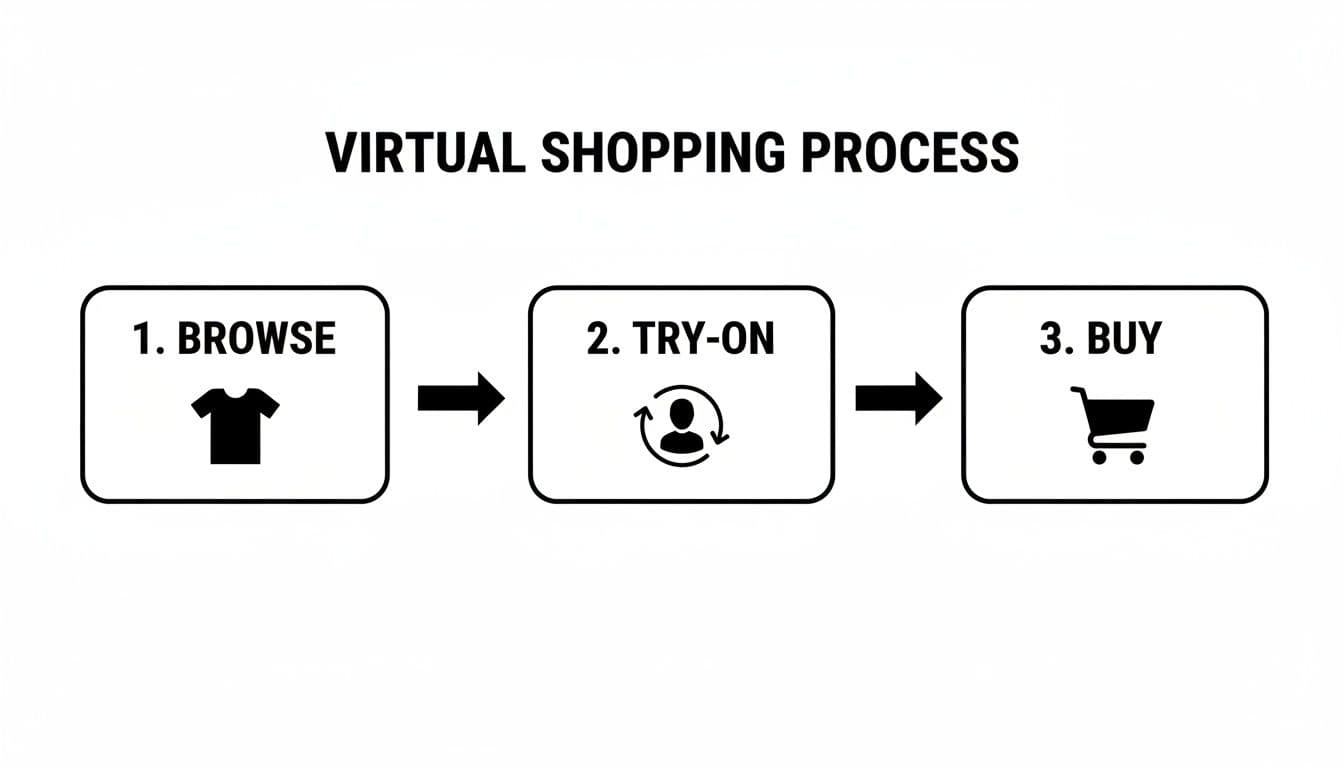
Diagram showing the virtual shopping process in three steps: browse, try-on, and buy with icons.
As you can see, the try-on step bridges the gap between seeing a product and feeling confident enough to purchase it, smoothing out one of the biggest friction points in online shopping.
From Photo Upload to Final Image
What does this actually look like for a brand manager or a store owner? The entire workflow is designed to be dead simple. You don't need a degree in 3D modeling or a background in computer science. You just need the product photos you already have.
The process is incredibly straightforward:
- Upload Garment Photos: Start by uploading your existing product shots. These can be flat lays, hanger photos, or even pictures on a mannequin. The AI is smart enough to handle different types of images.
- Select a Model: Pick a model from a diverse library or create a custom one that truly represents your target customer and brand vibe.
- Generate Try-On Images: Click a button, and the system does the rest. In seconds, you get high-resolution, studio-quality images of your model wearing the garment, ready for your product pages, ads, and social media.
By handling all the heavy technical lifting, virtual dress room technology frees up brands to do what they do best: focus on creativity, marketing, and connecting with their customers.
This simple workflow completely democratizes high-end fashion photography. What was once only possible for big retailers with deep pockets is now accessible to anyone, from small brands to solo entrepreneurs. It shifts the focus from expensive, time-consuming production to smart, effective visual merchandising.
The Business Impact of a Virtual Dress Room
Putting a virtual dress room on your site is more than just a cool feature; it’s a strategic move that hits your most important metrics right where it counts. By getting to the heart of what makes people hesitate when buying clothes online, this tech delivers real, measurable results that beef up your bottom line.

Folded clothing beside a laptop with business analytics and "REDUCE RETURNS" text.
The first thing you’ll notice is a serious jump in sales. When customers can actually see how a shirt will hang or a pair of jeans might fit them, their confidence to buy goes through the roof. That clarity is what turns a hesitant browser into a definite buyer, pushing your conversion rates up.
Of course, the success of the tool hinges on how well it's designed and integrated into your site. Knowing the principles behind web design to boost your conversion rates is key to getting the most bang for your buck from a virtual try-on. A polished storefront matters too; see our guide to fashion web design.
Drastically Lowering Return Rates
Returns are the silent profit killer in online fashion, and "it didn't fit" is almost always the reason. A virtual dress room tackles this problem head-on, helping shoppers pick the right size and style before they ever hit the "buy" button.
When a customer gets a realistic preview of how a dress drapes or a jacket sits on their shoulders, the odds of a return plummet. We're not talking about a tiny tweak here—brands often see a 30-40% reduction in returns. That’s a huge saving on reverse logistics, restocking, and writing off damaged goods.
By giving customers better visual information, a virtual dress room turns a hopeful guess into an informed choice. It fundamentally breaks the expensive cycle of buying and returning.
This shift does wonders for customer happiness, too. Shoppers love a reliable experience, and they’re far more likely to come back for more when their first purchase is a perfect fit.
Slashing Content Production Costs
Beyond the customer-facing wins, a virtual dress room completely changes the game for your internal content workflow. Let's be honest, traditional photoshoots are a massive drain on time and money. You've got models, photographers, studios, and endless editing to pay for.
This technology pretty much wipes those costs off the board. Instead of orchestrating a complicated shoot for every new collection, you can generate an entire catalog of high-quality, on-model images for a fraction of the cost and in a fraction of the time.
This new efficiency means:
- Faster Time-to-Market: Get new products live on your site in hours, not weeks.
- Reduced Overhead: Free up your content budget for things that actually grow the business, like marketing.
- Ultimate Creative Flexibility: Want to see that dress on a different model or against a new background? Done. No reshoots needed.
This kind of agility lets brands react to trends faster and keep their product pages looking fresh without emptying their bank accounts.
Meeting Modern Consumer Expectations
Today’s shoppers aren't just buying products; they're buying experiences. They expect online shopping to be interactive and personal, and that’s quickly becoming the standard, not the exception. Augmented reality isn't just for forward-thinking brands anymore—it's what customers want.
The demand is huge. Around 71% of consumers now say they'd shop more often if a brand offered AR features. North America is leading the charge, with the U.S. market alone projected to hit USD 7.55 billion by 2032. You can explore the complete market analysis to see just how big this trend is.
At this point, adding a virtual dress room isn't just about getting an edge; it's about staying in the game.
How to Get Your Virtual Dress Room Up and Running
Bringing a virtual dress room to your e-commerce store is a lot more straightforward than it sounds. You don’t need a small army of developers or a massive budget. Modern platforms are built for real brands, letting you get this powerful tech humming with just a few key steps.
It all starts not with code, but with a simple question: what are you trying to achieve? Before looking at any software, get clear on your goals. Are you laser-focused on slashing those pesky return rates? Is your main priority lifting conversion rates? Or maybe you just need a better way to create a ton of marketing content without breaking the bank.
Your answer to that question will be your north star, guiding every single decision you make from here on out. Nailing this down ensures you don’t just get a tool, you get the right tool for your brand.
Getting Your Assets in Order
With your goals set, it's time to get your assets ready. The good news? You probably have everything you need already. The one non-negotiable for any virtual dress room is your product photography—this is what the AI uses to work its magic.
And you don't need fancy, high-end studio shots on a live model. In fact, simpler is often way better.
- Flat Lays: Photos of your clothes laid out on a clean, neutral background are perfect. This gives the AI a clear, undistorted view of the item’s shape, cut, and details.
- Hanger Shots: A simple shot of the garment on a hanger works just as well. The AI can easily isolate the product and understand its structure.
- Mannequin Photos: If you're already using mannequins, those images are a great starting point. The system is smart enough to remove the mannequin and map the clothing onto a new model.
The key here is just clarity and consistency. Good lighting and sharp focus will always give you the most photorealistic and compelling results. Once your photos are organized, you’re ready to find the right partner to bring your vision to life. This is also a good time to explore other AI tools for fashion brands and see how a virtual dress room fits into your broader strategy.
To make things even easier, here's a quick checklist to walk you through the entire process.
Virtual Dress Room Implementation Checklist
This checklist breaks down the journey from initial idea to a live, sales-driving feature on your store. Follow these steps to ensure a smooth and successful launch.
| Phase | Key Action | Considerations and Best Practices |
|---|---|---|
| 1. Strategy & Planning | Define Your Primary Goal | Is it reducing returns, increasing conversions, or creating content? Pick one main KPI to focus on. |
| Set Success Metrics | How will you measure success? (e.g., "reduce returns by 15% in Q3" or "increase AOV by 5%"). | |
| Audit Your Existing Assets | Gather your flat lay, hanger, or mannequin product photos into a dedicated folder. | |
| 2. Preparation & Selection | Organize Product Photos | Ensure photos are high-resolution, well-lit, and on a clean background for best results. |
| Research Platforms | Look for ease of use, image quality, and model diversity. Test free trials (like WearView's). | |
| Choose a Partner | Select the platform that best aligns with your goals, budget, and workflow. | |
| 3. Integration & Launch | Generate Try-On Images | Upload your product photos to the platform and start creating your new on-model imagery. |
| Upload to Your Store | Download the high-res images and add them to your product pages, just like regular photos. | |
| Plan Your Launch Promotion | Draft social media posts, email newsletters, and maybe a blog post announcing the new feature. | |
| 4. Promotion & Optimization | Announce the Launch | Go live with your promotional content. Make a big deal out of it! |
| Gather Customer Feedback | Use surveys or social media polls to ask shoppers what they think of the new experience. | |
| Monitor Your KPIs | Track your key metrics weekly to measure impact and identify what's working best. |
By breaking it down into these manageable phases, you can tackle the implementation confidently and make sure no crucial steps are missed.
Choosing Your Platform and Going Live
This is the big one. Selecting the right platform will make or break your experience. Look for a solution that’s dead simple to use, produces stunningly realistic images, and offers a diverse library of models. A platform like WearView, for instance, is built to handle the entire workflow—from photo upload to final image download—in just a few clicks.
The best virtual dress room solutions act as a content engine, not just a try-on feature. They should empower you to create a wide range of marketing assets quickly and affordably.
Once you’ve picked your platform, the integration is usually the easiest part. For most brands, it means simply downloading the new on-model images and uploading them to your product pages on Shopify or Magento, or whatever platform you use. It’s no different than adding any other photo.
Finally, it's launch time. Don't just quietly flip a switch. Shout it from the rooftops! Announce it on social media, feature it in your email newsletters, and maybe even create a little landing page explaining how it helps shoppers. The more you show customers how this new tool makes their lives easier, the faster they’ll embrace it—and the sooner you’ll see the results in your sales and engagement numbers.
Creative Ways to Use Virtual Try-On Technology
A virtual dress room is so much more than just another feature on your product page. Think of it as a powerful, always-on content creation engine. While its main job is helping shoppers see how an item might fit, the real magic happens when you start using it across your marketing, advertising, and brand-building.
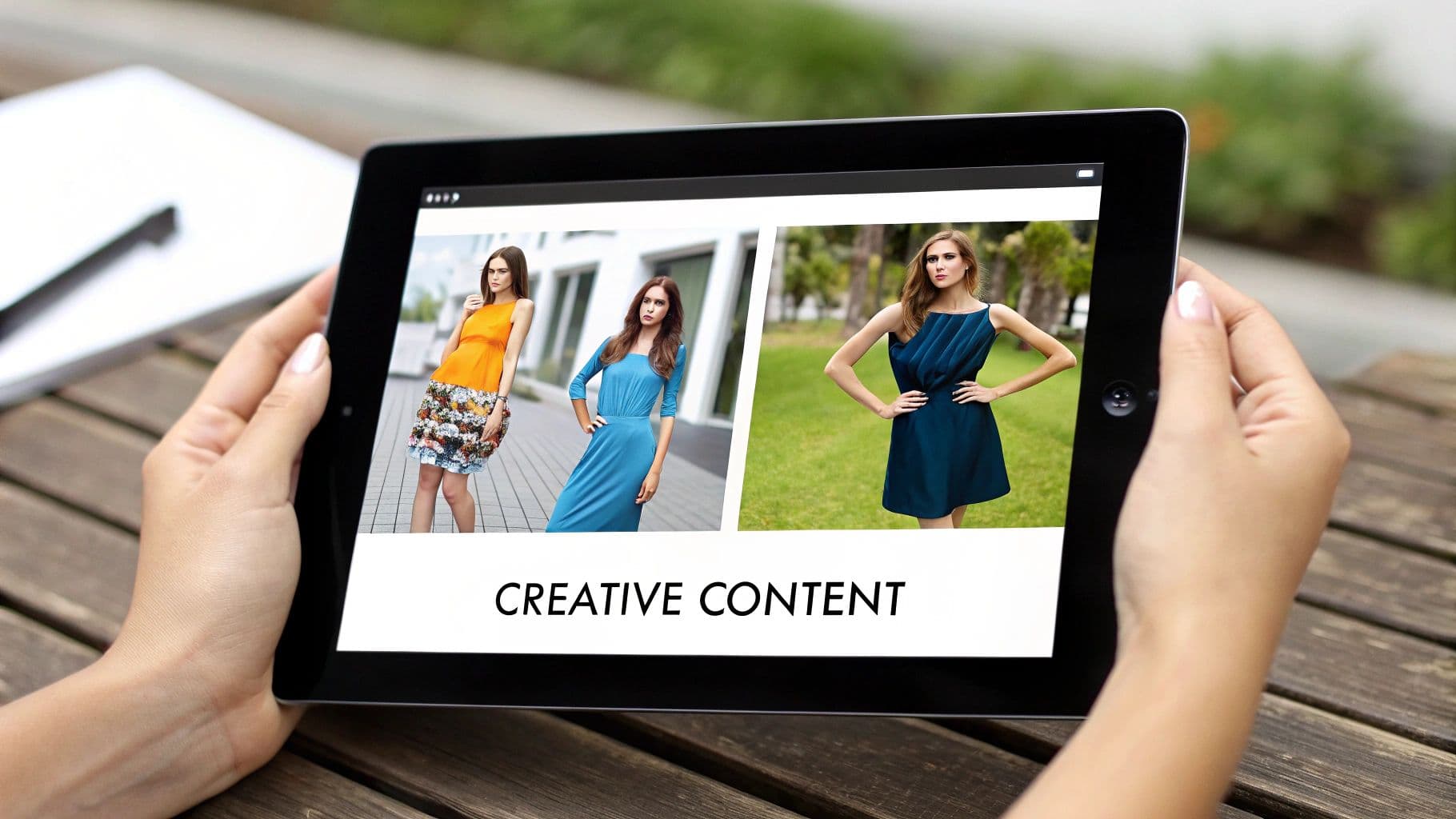
Close-up of hands holding a tablet displaying fashion images of women in dresses and 'CREATIVE CONTENT'.
Imagine being able to generate an endless stream of on-brand, studio-quality images without ever booking a photographer, a model, or a studio. This tech turns your entire product catalog into a dynamic asset, ready to be repurposed for any campaign at a moment's notice.
Build Radically Inclusive Campaigns
One of the most powerful applications is the ability to create marketing that is genuinely inclusive. Traditional photoshoots are expensive and logistically complicated, forcing you to pick just a handful of models to represent your entire diverse customer base. A virtual dress room shatters those limitations.
With AI-powered model generation, you can showcase your apparel on a virtually limitless range of body types, ethnicities, ages, and personal styles. This lets you:
- Truly Reflect Your Audience: Create campaigns where every single customer can see someone who looks like them. That builds a powerful sense of connection and belonging.
- Enter New Markets Smartly: Tailor ad creative for specific demographics in different regions without needing separate, expensive photoshoots for each one.
- Champion Body Positivity: Move beyond stale industry standards and celebrate a realistic, diverse spectrum of beauty. This isn't just good ethics; it builds incredible brand loyalty.
This level of representation used to be financially and logistically out of reach for most brands. Now, it’s as simple as selecting a new model and clicking a button.
Supercharge Your Social Media and Ads
Let's be honest: static product shots get lost in the noise of a busy social media feed. Virtual try-on tech gives you the tools to pump out a constant stream of fresh, engaging ad creative without the usual production headaches.
The real power of a virtual dress room lies in its ability to function as an agile content factory, turning a single garment photo into dozens of unique marketing assets.
You could, for example, instantly generate images of your new collection on different models for highly targeted ads on Instagram or Facebook. This opens the door to rapid A/B testing—find out which model or style resonates most with specific audiences and optimize your ad spend for maximum impact. You can even create short, animated clips showing different poses, adding a dynamic element that grabs attention and stops the scroll.
The business case for this is getting stronger every day. The market is projected to explode from USD 8.352 billion in 2026 to USD 29.545 billion by 2035. This growth is fueled by intense consumer demand for more visual and personalized shopping experiences. As you can learn from the latest market growth reports, this trend is already expanding beyond clothing into beauty and other categories, signaling a huge shift in how people shop.
By using a virtual dress room as a creative tool, you're not just improving your product pages. You're building a smarter, faster, and more effective marketing machine that can keep up with the demands of modern digital advertising, connecting your brand with customers in more meaningful—and profitable—ways.
Future Trends in Virtual Fashion
The world of virtual fashion is moving fast. We're quickly going beyond simple try-on features and heading toward a future that’s far more integrated and intelligent. The tech that powers a virtual dress room is getting stronger every day, promising experiences that aren't just realistic but deeply personal. This shift is set to completely change how brands and shoppers connect online.
One of the biggest changes coming is hyper-personalization. Imagine your customers uploading their own photos and instantly seeing how a dress or shirt looks on their exact body type, with stunning accuracy. This isn't science fiction. It’s the next step in removing that last bit of guesswork from online shopping, creating a real bond between a customer and a product before it even ships.
Tech giants are already pouring resources into custom image generation models. These aren't just slapping a product image onto a photo; they're learning the intricate physics of how different fabrics fold, stretch, and hang on unique bodies to make the final render look true to life.
The Rise of AI and Interactive Commerce
Artificial intelligence is the engine pushing all of this forward. The latest leaps in generative AI will soon make virtual try-on images completely indistinguishable from high-end studio photography. This blows the doors open for new kinds of shopping experiences that feel less like clicking through a static catalog and more like having a helpful conversation.
The innovation isn't just limited to clothing, either. We're seeing exciting developments across the board, like the emergence of AI jewelry, which acts as a smart styling assistant. It’s a clear sign of a wider trend where AI will guide shoppers through every part of their purchase.
The money is following the innovation. The global virtual fitting room market was valued at USD 5.57 billion in 2024 and is expected to explode to USD 20.65 billion by 2030. This massive growth, tracked in market analysis from Grand View Research, shows just how essential this technology is becoming for any brand that wants to stay in the game.
Integration with the Metaverse and Digital Wardrobes
Another huge trend on the horizon is the merging of e-commerce with digital worlds like the metaverse. Soon, customers won't just be trying on clothes for their physical life; they’ll be building out digital closets for their online avatars. A virtual dress room is the natural bridge between these two worlds.
Your brand's digital garments could become assets that customers own and use in virtual spaces, creating new revenue streams and opportunities for brand engagement that we're only just beginning to imagine.
This integration will empower brands to:
- Sell Digital Twins: Offer a digital copy of a physical garment that a customer can use in a game or virtual event.
- Create Virtual-Only Collections: Launch exclusive digital-only drops to generate hype and attract a new audience of digital collectors.
- Host Immersive Shopping Events: Build virtual showrooms where avatars can walk around, interact with products, and shop in a fully 3D space.
Bringing a virtual dress room into your strategy today is about more than just boosting this quarter’s sales or cutting return rates. It’s about laying the groundwork for the next chapter of retail—one that’s more immersive, more personal, and woven directly into the digital lives of your customers.
Frequently Asked Questions About Virtual Dress Rooms
As more brands start looking into this tech, a few practical questions always pop up. Getting a handle on the specifics helps you see exactly where a virtual dress room could fit into your workflow and what to really expect from it. We’ve pulled together the most common ones to give you clear, straight answers.
These cover everything from what kind of assets you need to how realistic the final images are, helping you make a much more informed call.
How Accurate Is a Virtual Dress Room?
Today's virtual try-on technology is surprisingly accurate. Using smart AI, these systems look at a simple 2D photo and analyze the garment’s texture, fabric weight, and specific cut. From there, the AI simulates how that material would realistically drape, fold, and stretch on an actual person.
While it's a simulation, the result is a far more honest picture of how a piece fits and looks than you could ever get from a static flat lay or hanger photo. It just feels more real.
What Kind of Photos Do I Need to Start?
You probably have everything you need already. The best part about modern virtual dress room platforms is that they’re designed to work with what you've got—no expensive, professional photoshoots required.
You can get started with simple, clear images of your clothes:
- Flat Lays: Photos of your apparel laid out flat on a clean background.
- Hanger Shots: Basic images of the clothing on a hanger.
- Mannequin Photos: Your existing product shots on a mannequin work perfectly, too.
The AI is built to grab the garment from these kinds of photos and get it ready for the try-on. All you need is decent lighting and a clear shot of the product itself.
The whole point of modern virtual dress rooms is to make them easy to use. By working with the product photos you already have, the tech removes a huge barrier to entry for brands of all sizes.
Can I Use Models That Match My Brand Identity?
Absolutely. Top-tier platforms come with huge libraries of diverse, ready-to-use models, so you can pick people who genuinely reflect your customer base.
Even better, many solutions now offer AI model creation tools. This is a game-changer. It lets you generate completely unique, on-brand models from scratch, giving you total creative control over your brand's look and feel without the crazy costs of casting and photoshoots. You can make sure every single product is shown on a model that fits your brand’s vibe perfectly.
Ready to see how a virtual dress room can change your content game and lift your sales? With WearView, you can generate unlimited studio-quality, on-model photos in seconds. Get started with WearView today and see the difference for yourself.

WearView Team
WearView Content & Research Team
WearView Team is a group of fashion technology specialists focused on AI fashion models, virtual try-on, and AI product photography for e-commerce brands. We publish in-depth guides, case studies, and practical insights to help fashion businesses improve conversion rates and scale faster using AI.