
When you hear "modeling for clothing brands," you're really talking about the lifeblood of your visual marketing. It’s how you use human or AI-generated models to show off your apparel online and in ads. This has always been a core part of selling clothes, but the game has completely changed. The old way—expensive, complicated photoshoots—is giving way to modern AI solutions that are faster, cheaper, and more flexible.
The Modern Challenge of Visual Merchandising
Creating killer model imagery used to mean a straightforward (but painful) process of hiring a photographer and a few models. Now, it's a major strategic crossroad: do you stick with the logistical nightmare of traditional shoots or embrace the efficiency of new tech?
For a growing number of brands, the old path is just no longer viable.
The costs alone are a huge barrier. In the hyper-competitive fashion world, modeling can easily eat up 20-30% of a brand's total marketing spend. A single professional photoshoot can set you back anywhere from $50,000 to $200,000. For a mid-sized brand launching a few collections a year, that can balloon to over $1 million annually. It’s no surprise, then, that brands switching to AI platforms are reporting cost reductions of up to 90%, a trend highlighted in recent fashion industry statistics.
This infographic really puts the staggering cost difference into perspective.
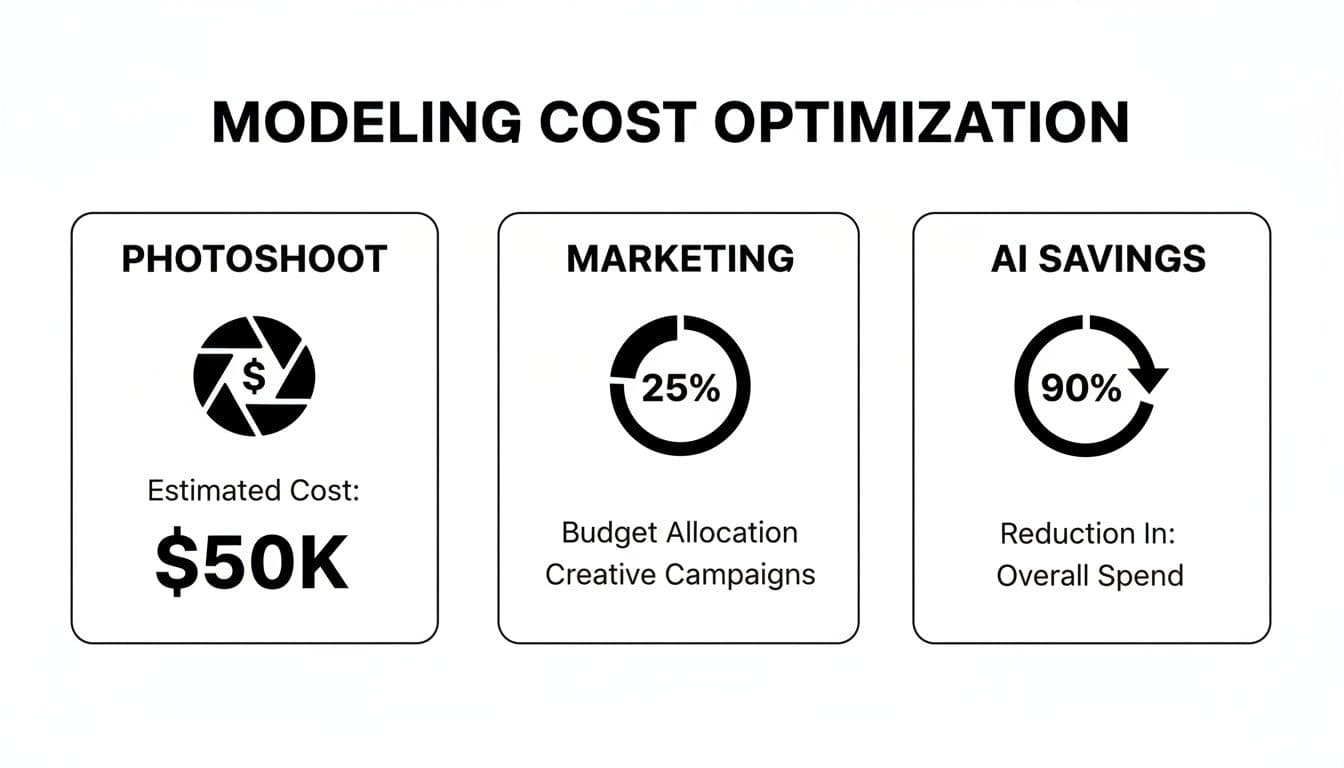
Infographic details modeling cost optimization showing $50K photoshoot, 25% marketing, and 90% AI savings.
The numbers don't lie. Shifting to AI can dramatically slash your production budget, freeing up cash for marketing efforts that actually move the needle.
Why a New Approach Is Necessary
It’s not just about the money. The old way of doing things is slow and riddled with headaches. Juggling schedules, scouting locations, and managing a whole crew on set is a massive time-suck that can seriously delay your product launch.
And then there's the diversity problem. Trying to achieve genuine, authentic representation with just a handful of models is nearly impossible. Today’s brands need to connect with a global customer base, which means showing a wide range of body types, ethnicities, and personal styles.
The goal is to shift from a reactive, project-by-project mindset to a scalable, data-driven visual strategy. It's about building a consistent and inclusive brand story that truly resonates with your customers.
This urgent need for a smarter, more agile workflow has opened the door for incredible innovation. The conversation has moved beyond just "taking pictures." Now, it's about creating a flexible and efficient system for producing on-brand, high-converting visual assets. It’s less about the photoshoot and all about smart merchandising that drives sales.
Traditional Photoshoots vs AI Modeling A Quick Comparison
To make the choice clearer, let's break down the key differences between the old-school approach and what AI brings to the table. This isn't just about cost; it's a fundamental shift in speed, flexibility, and creative control.
| Attribute | Traditional Photoshoots | AI Modeling Platforms |
|---|---|---|
| Cost | High upfront investment ($50K-$200K per shoot) | Low, predictable subscription costs (often <$100/mo) |
| Speed | Slow (weeks to months from planning to final assets) | Extremely fast (minutes to generate hundreds of images) |
| Diversity | Limited by model availability and casting budget | Unlimited diversity on demand (any ethnicity, age, body type) |
| Logistics | Complex (scheduling, locations, crew, travel) | Minimal (all done online from a laptop) |
| Scalability | Difficult and expensive to scale | Infinitely scalable; generate more assets as needed |
| Creative Control | Limited to the shots captured on the day | High; easily iterate on poses, backgrounds, and styles |
Ultimately, the choice depends on your brand's specific goals. While traditional photoshoots still have their place for high-concept campaigns, AI modeling offers an undeniable advantage for the day-to-day visual merchandising that powers modern e-commerce.
Defining Your Brand's Model Aesthetic
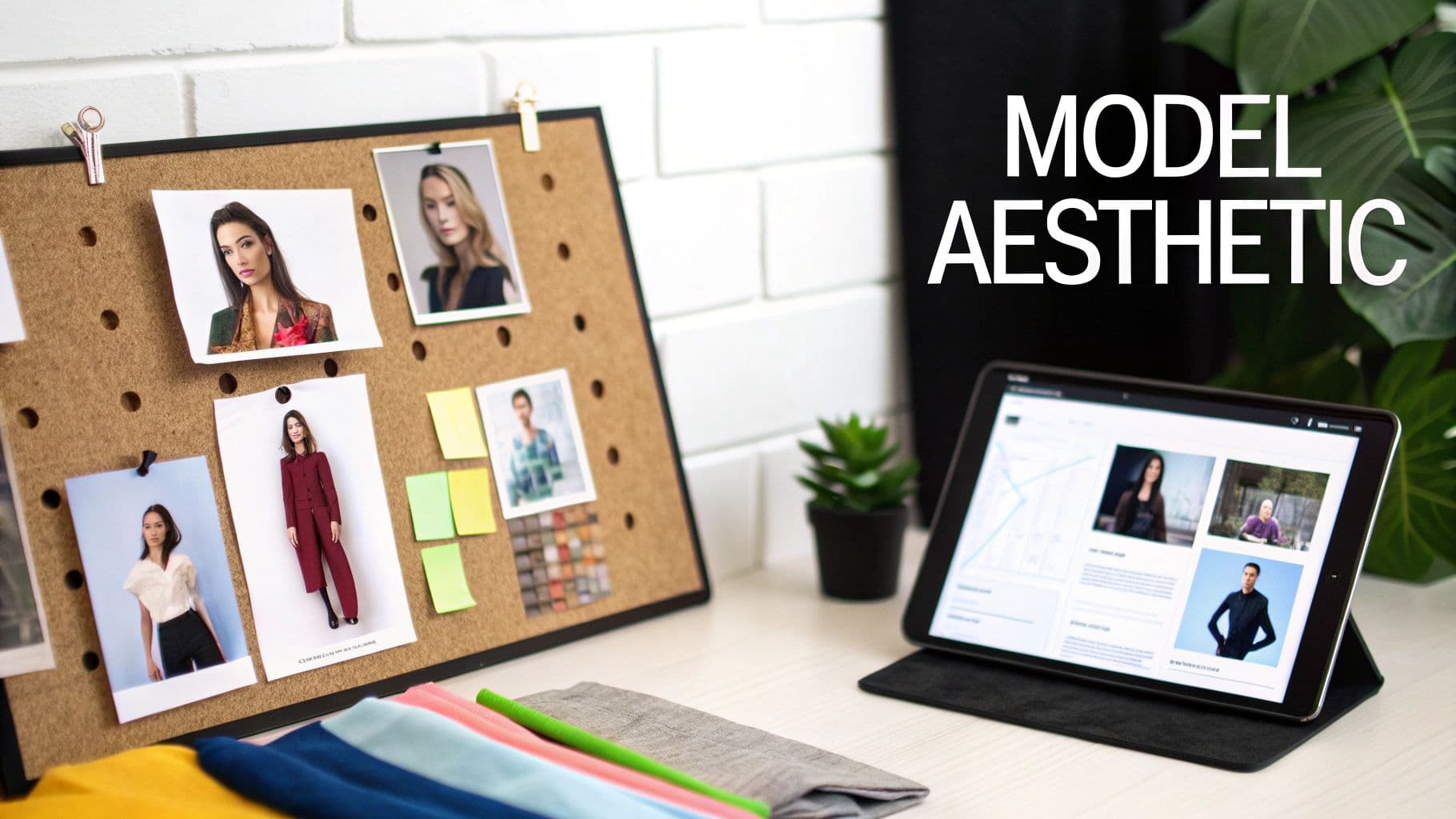
A fashion designer's desk with a mood board, model photos, tablet, and fabric swatches.
Before you even think about cameras or casting calls, your visual strategy boils down to one simple question: Who are you selling to? The answer to this is the bedrock of your entire model aesthetic. This isn't just about finding pretty faces; it's about building a visual language that speaks directly to your customer's identity and aspirations.
Think of your model aesthetic as the human element of your brand's story. It's the critical piece that lets a customer look at an image and think, "That could be me." To really nail this, it helps to look at the big picture of creative advertising. A great place to start is by studying what the pros are doing when it comes to Harnessing Fashion Advertising Creativity.
Building Your Customer Persona
Your ideal model is just a stand-in for your ideal customer. So, let's get specific. You need to move past basic demographics and build a persona that feels like a real person with a real life.
- Values and Beliefs: What's important to them? Are they focused on sustainability, climbing the career ladder, or raising a family?
- Hobbies and Interests: What do they do on a Saturday? Are they hiking a trail, visiting a new art exhibit, or trying the latest restaurant?
- Style Influences: Who's on their feed? Are they following big-name influencers or are they into more niche, micro-creators with a unique point of view?
- Vibe: What's their energy? Are they edgy and confident, or are they more warm and approachable?
When you have this level of detail, you can find models who don't just wear your clothes—they embody the spirit of your brand. A company selling rugged outdoor gear needs models who look like they've actually spent time outside, not like they just stepped off a high-fashion runway. The authenticity is what sells.
Why Diversity Is a Business Imperative
Let's be clear: in today's market, diversity isn't a "nice-to-have." It's a non-negotiable. Your customers expect to see themselves reflected in the brands they buy from, and they'll vote with their wallets if they don't. Research consistently shows that brands with diverse representation are seen as more authentic and trustworthy, which has a direct line to your bottom line.
An inclusive approach to modeling for clothing brands isn't just a social responsibility; it's a powerful business strategy that broadens your market appeal and builds genuine customer loyalty.
This means consciously showing a range of ethnicities, body types, ages, and abilities in your imagery. Take a brand like Levi's, for example. They've effectively used AI-generated models to display their jeans on a huge variety of body shapes, making it easier for more people to see how the product might look on them. Whether you're using real people or their digital twins, the goal is the same: create a visual world where everyone feels seen and welcome.
Crafting a Detailed Casting Brief
A casting brief is your roadmap for finding the right talent. This document gets everyone on the same page, from casting agents to photographers to the AI platforms you might be using. The more specific you are, the better your results will be.
A solid brief should always include:
- Physical Attributes: Provide clear ranges for height, key measurements, and general build.
- Ethnicity and Look: Be specific about the ethnic backgrounds you want to feature.
- Personality and Vibe: Use descriptive words. Are you looking for "serene," "energetic," "quirky," or "sophisticated"?
- Pose and Expression: Mood boards are your friend here. Include reference images that capture the feeling you're after. For digital shoots, advanced tools offering pose control can give you incredible precision.
This level of detail is your best tool for consistency. It ensures every single image, whether it comes from a physical photoshoot or an AI generator, perfectly reinforces the unique aesthetic you've worked so hard to define.
Mastering Your Photoshoots, With or Without a Camera
Once you've nailed down your model aesthetic, it's time for the fun part: bringing that vision to life. Whether you're wrangling a crew on set or guiding an algorithm from your laptop, the end goal is exactly the same—create stunning, professional images that convince people to buy your clothes.
Both paths demand a sharp eye for detail and a rock-solid plan. Let's break down how to execute each one.
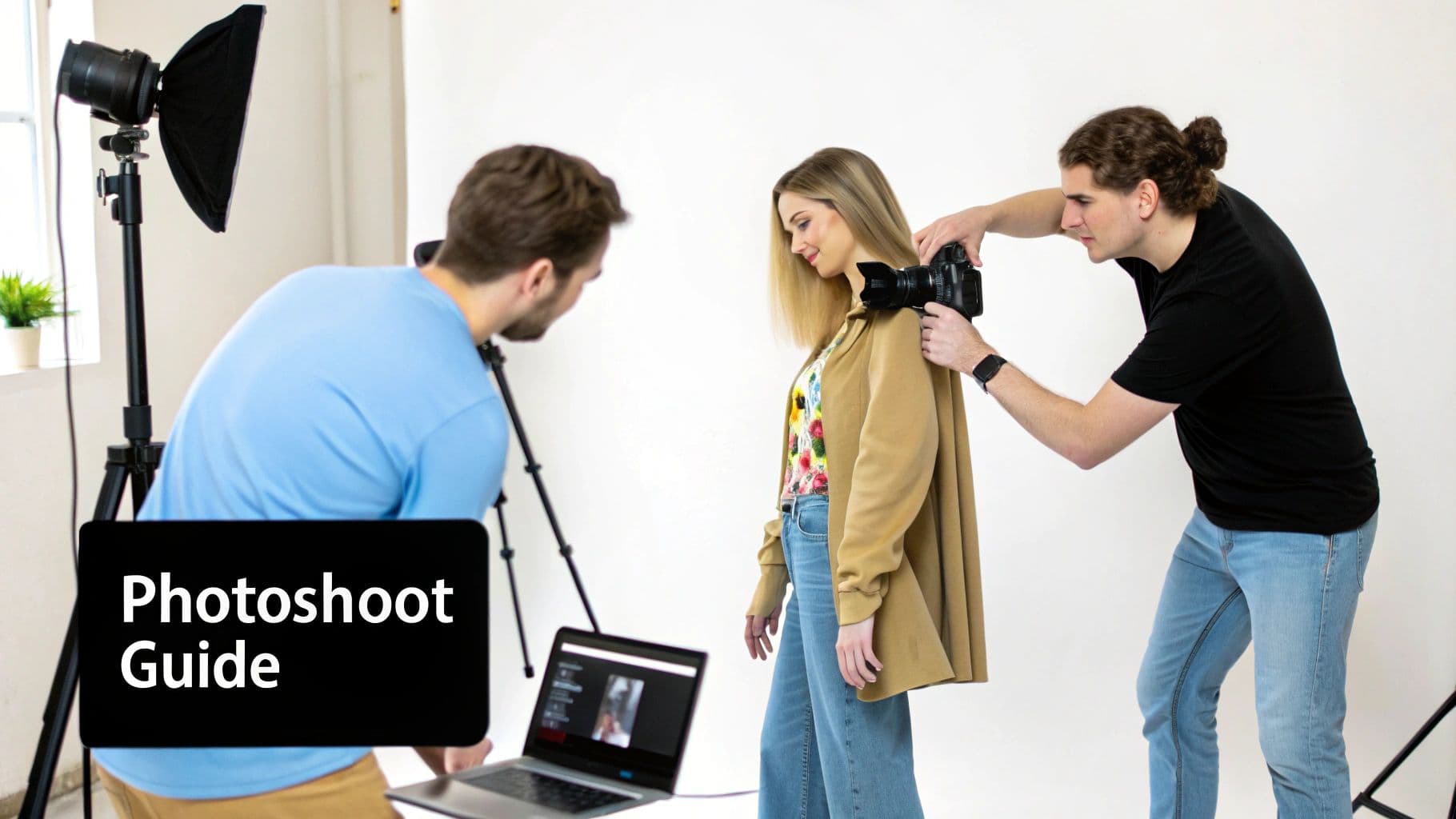
A professional studio photoshoot featuring a model, photographer, and assistant with lighting equipment and a laptop.
The Traditional Photoshoot Playbook
For brands going the traditional route, success is all about meticulous preparation. A great shoot doesn't just happen by accident. It's the direct result of crystal-clear communication and detailed documents that leave absolutely nothing to chance.
Think of this as translating your creative vision into a set of foolproof instructions for your entire team.
Here are the three essential documents you need to run a smooth on-set production:
- The Shot List: This is your photoshoot's blueprint. It needs to detail every single image you need, specifying the product, model, and angle. Don't just write "blue t-shirt." Be specific: "blue t-shirt, front view, full body" and "blue t-shirt, back detail, close-up."
- The Pose Guide: A visual mood board is non-negotiable here. Pull together reference images that show the exact poses, expressions, and energy you're after. This gives your models a tangible target to hit, ensuring the shots capture the right vibe, whether it's upbeat and playful or moody and sophisticated.
- The Styling Brief: This guide spells out precisely how each piece should be worn and paired. Get into the weeds—include notes on accessories, footwear, and even hair and makeup to guarantee a cohesive look that screams your brand's name.
The single biggest secret to a successful traditional photoshoot is over-communication. A well-prepared brief ensures every single person on set is aligned with your vision, which minimizes costly reshoots and maximizes every minute of your time.
Executing with AI-Powered Platforms
When you're working with technology, the "photoshoot" happens on a screen, but that need for a clear vision doesn't disappear. Instead of managing people, you're giving direct commands to intelligent software to generate your perfect images.
It's a fundamentally different workflow, but it can achieve the same professional results.
The product to model AI process, for example, lets you upload a simple flat-lay photo of your garment and instantly see a photorealistic image of it on a model. This completely sidesteps the need for physical samples and all the logistical headaches that come with a traditional shoot.
This digital-first approach also comes with some serious environmental street cred. The fashion industry is under a microscope for its sustainability practices, contributing up to 8% of global greenhouse gas emissions. AI modeling eliminates the waste and travel of physical shoots, offering a much more eco-conscious alternative.
With these tools, you can cycle through different models, styles, and backgrounds in seconds. You can select from a diverse library of digital talent, adjust poses with a click, and drop them into custom environments that tell your brand's story—all without the expense and chaos of a physical set. It’s how you produce a massive volume of high-quality, on-brand imagery at scale.
Deploying Your Images for Maximum Impact
A flatlay of a wooden desk with a tablet displaying 'MAXIMIZE IMPACT,' laptop, monitor, phone, and financial documents.
Creating a folder full of beautiful images is only half the battle. The real value—and the real work—begins when you start deploying those assets strategically across all your marketing channels.
A stunning product shot that works perfectly on your website will likely fall flat on Instagram. An image that kills it in a paid ad campaign might feel out of place on a product detail page. This is where so many brands miss the mark: they use a one-size-fits-all approach when every channel speaks its own visual language.
Tailoring Visuals for Every Channel
To get the most out of your imagery, you have to think like a user on each platform. What are they there to do? How are they consuming content? Answering these questions is the key to matching your visuals to the context.
Here’s a quick breakdown of how to think about your main channels:
- Website & Product Pages: Clarity is king here. Shoppers need high-resolution images showing multiple angles, close-ups of fabric and stitching, and a consistent, non-distracting background. The goal is to inform and build trust.
- Social Media: This is all about stopping the scroll. You need dynamic, attention-grabbing content. Think vibrant lifestyle shots, short ai fashion videos, and anything that feels authentic and engaging. Vertical formats are a must for platforms like Instagram Stories and TikTok.
- Digital Ads: Your ad creative has one job: earn the click. This often means using images with bold colors, a strong focal point, or an intriguing composition that sparks curiosity. This is the perfect place for aggressive A/B testing.
The Power of A/B Testing Your Model Imagery
You can't just guess which images will perform best—you have to test. A/B testing is the only way to get data-backed proof of what actually drives your audience to convert.
It's simpler than it sounds. Just run controlled tests on small variables to see what moves the needle. For instance, you could test:
- Different Models: Does a model with a certain look or body type result in a higher click-through rate?
- Poses & Expressions: Is an energetic action shot more effective than a classic studio pose?
- Settings & Backgrounds: Does a clean, minimalist background outperform a scenic lifestyle shot for a specific product?
By tracking metrics like click-through rates, conversion rates, and time on page, you’ll start to see clear patterns emerge. This creates a powerful feedback loop that informs your future photoshoots, ensuring your modeling for clothing brands strategy is always getting smarter.
The most successful brands don't just create beautiful imagery; they create a system for testing and learning. Every image is an opportunity to better understand your customer and refine your visual merchandising.
Navigating Usage Rights and Maximizing ROI
One of the biggest hidden costs in traditional photography is image licensing. Contracts are often tangled webs of restrictions based on time, region, or media type. Before you know it, you’re facing expensive renewal fees or, worse, legal trouble for using an image outside its licensed scope.
This is where AI modeling platforms offer a massive advantage.
Most AI tools, including ours, provide full commercial, royalty-free usage rights as part of your subscription. Once you generate an image, it’s yours. You can use it however you want, wherever you want, for as long as you want.
This simple, transparent approach completely eliminates the headache of licensing and ensures you can deploy your assets across every single marketing channel without a second thought. It’s about getting the absolute maximum return on every dollar you invest in your creative.
Measuring Performance and Scaling Your Visuals
Let's get down to what really matters: results. Your visual strategy is just a creative exercise until you can prove it moves the needle on sales. The whole point of hiring models or generating them with AI is to sell more clothes, so tracking performance isn't just a good idea—it's non-negotiable.
This is where you move beyond "I think this looks good" and start using hard data to understand what actually resonates with your customers. By setting up a data-driven feedback loop, every image you publish becomes a lesson that makes the next one even smarter.
Key Performance Indicators to Track
To get a real sense of what's working, you have to look at metrics across the entire sales funnel. Forget vanity metrics like "likes" and zero in on the numbers that directly impact your bank account.
Start by tracking these KPIs to measure the real-world impact of your model imagery:
- Conversion Rate on Product Pages: This is the big one. Are pages featuring certain models, poses, or styles turning more visitors into buyers? A 2-3% conversion rate is a solid benchmark for most e-commerce brands, so any imagery pushing you above that is a clear winner.
- Click-Through Rate (CTR) on Ads: When you're A/B testing visuals in your ads, which images actually get the click? This tells you what grabs attention and makes someone stop scrolling.
- Social Media Engagement: Look past the likes and focus on shares and saves. These actions show your content is so compelling that people are bookmarking it for later or sharing it with friends—a much stronger signal of interest.
- Add-to-Cart Rate: This is a fantastic indicator of purchase intent. A high add-to-cart rate means your model imagery is doing its job of showcasing the product's appeal and making people want it.
Once you start analyzing this data, powerful patterns will emerge. You might discover that your lifestyle shots kill it on social media while clean studio shots convert better on product pages. Or maybe one specific model consistently drives higher ad engagement. These insights are pure gold.
Strategies for Scaling Your Content Production
Okay, so you know what works. Now what? The next challenge is producing more of it without breaking the bank or your timeline. Scaling your visual content isn't about starting from scratch every time; it’s about working smarter to get the most value out of every single asset.
For a bit of inspiration, it's worth looking at how supermodels build wealth beyond their paychecks; they are masters at leveraging their image for long-term success, a mindset every growing brand should adopt.
A data-driven approach transforms your visual merchandising from a creative expense into a predictable growth engine. Use performance insights to justify your creative choices and scale what's proven to work.
One of the most effective ways to scale is by repurposing static images into dynamic video content. Simple animations, zooms, or pans can breathe new life into a high-performing photo, turning it into a scroll-stopping video for your social feeds at a tiny fraction of the cost of a full video shoot.
Finally, as you introduce new products and collections, you need a system to keep everything consistent. Whether you’re using traditional photoshoots or AI, your documented style guides for models, poses, and lighting are your brand’s North Star. This ensures every new image feels like it belongs, creating a cohesive and scalable visual identity that grows right alongside your business.
Common Questions About Modeling for Clothing Brands
When you're in the trenches of building a clothing brand, figuring out the world of modeling can feel overwhelming. You’re trying to balance classic photoshoots with the promises of new tech, and a lot of questions pop up along the way. Getting straight answers is key to making smart calls, dodging common mistakes, and building a visual strategy that actually moves the needle.
Let's break down some of the most frequent questions we hear from brands just like yours.
How Much Does It Cost to Hire Models?
This is the big one, and the answer really depends on which path you take. The cost swings wildly.
A traditional photoshoot is a serious line item on your budget. For a small-scale shoot, you could be looking at a few thousand dollars, but for a major campaign, that number can easily soar past $200,000. That figure isn't just for the models; it's an all-in cost covering photographers, stylists, studio rentals, and all the post-production work.
On the flip side, AI modeling platforms play by a completely different set of rules. Instead of a massive one-time expense, you're typically looking at a predictable subscription fee. This approach can genuinely slash your production costs by up to 90%. It gives you the freedom to create unlimited imagery without the unpredictable and often staggering expenses of a physical shoot.
How Can I Ensure My Modeling Is Diverse and Inclusive?
This is less about ticking a box and more about genuinely connecting with your audience. True diversity begins when you have a crystal-clear picture of who you're trying to reach. You need to define your customer personas before you can ever hope to represent them authentically.
- For Traditional Shoots: Your casting brief is your most powerful weapon. Don't be vague. Be explicit and deliberate in your requests for a wide range of ethnicities, body types, ages, and abilities. If you don't specify the representation you need, you're just leaving it to chance.
- For AI Solutions: This is where technology gives you an incredible amount of control. The best platforms offer huge libraries of diverse digital models or even let you generate custom models from scratch. This puts you firmly in the driver's seat, letting you build a visual world that mirrors the real diversity of your customers.
Inclusivity isn’t just a buzzword; it's a core business strategy. When customers see themselves in your marketing, it builds a powerful sense of connection and loyalty that directly impacts your bottom line.
What Are the Legal Rights for Using Model Images?
Understanding image rights is non-negotiable if you want to avoid legal headaches and surprise invoices down the road.
With traditional modeling, usage rights can be a minefield. You’re usually negotiating a license that limits how, where, and for how long you can use the photos. These licenses often restrict usage by time, region, or media channel, and renewing them can be incredibly expensive.
This is a key area where AI modeling flips the script. Many platforms, including WearView, provide full commercial, royalty-free usage rights as part of your subscription. Once you generate an image, it’s yours. You can use it forever across any channel—your website, social media, ads, you name it—with zero extra fees.
Ready to create stunning, on-brand model imagery in seconds? With WearView, you can generate studio-quality visuals that drive sales, all while cutting costs by up to 90%. Explore how our AI-powered platform can transform your brand's visual merchandising.
Tags:

WearView Team
WearView Content & Research Team
WearView Team is a group of fashion technology specialists focused on AI fashion models, virtual try-on, and AI product photography for e-commerce brands. We publish in-depth guides, case studies, and practical insights to help fashion businesses improve conversion rates and scale faster using AI.