
March 1, 2026•23 min read
How to Sell Jewelry Online A Proven Guide for 2026
Learn how to sell jewelry online with our guide to product visuals, pricing, and marketing. Build a profitable e-commerce brand with expert strategies.
How to Sell Jewelry Online A Proven Guide for 2026
So, you want to sell your jewelry online. It’s a fantastic idea, but it’s more than just snapping a few photos and putting up a website. The real challenge is taking something so tangible—the weight, the sparkle, the intricate details—and translating that feeling into a digital experience that makes someone click “buy now.”
This guide is your playbook for doing exactly that. We'll walk through everything from preparing your inventory to mastering the art of the online sale.
The Digital Gold Rush: Why Sell Jewelry Online Now?
The way people buy jewelry has completely changed. Not too long ago, buying a special piece meant a trip to a brightly lit showroom. Today, shoppers are glued to their screens, sparking a massive shift from traditional storefronts to the world of e-commerce. This isn’t a passing trend; it's a fundamental change in how people shop for beautiful things.
For both new designers and established brands, this is a golden opportunity. When you learn how to sell jewelry online the right way, you’re not just opening a shop—you're unlocking a global audience, slashing overhead costs, and building a brand entirely on your own terms. Your physical location no longer defines your customer base.
The Numbers Don't Lie: A Booming Market
Let's look at the data. The global online jewelry market is exploding, hitting a $46.1 billion valuation by the end of 2024. And it’s not slowing down. Projections show it’s on track to nearly triple, soaring to an incredible $129 billion by 2032. You can dig into these projections in recent industry analysis reports.
This seismic shift is happening for a few key reasons:
- New Buyer Habits: Digital natives, especially shoppers under 35, are now in the driver's seat. They're completely comfortable making major purchases online, from engagement rings to custom necklaces, trusting high-quality images and compelling brand stories to guide them.
- Better Technology: E-commerce platforms are more powerful than ever. Plus, incredible new tools for visual creation, like AI-powered model photography from platforms such as WearView, let anyone create studio-quality images without the hefty price tag of a traditional photoshoot.
- A Worldwide Storefront: An online store is open 24/7 to customers everywhere. A niche design that might struggle locally can find a passionate community on the other side of the world.
To put this shift in perspective, here's how the market share is projected to evolve.
Online vs. Offline Jewelry Market Share Growth
| Year | Online Market Share | Offline Market Share |
|---|---|---|
| 2023 | 21% | 79% |
| 2026 | 28% | 72% |
| 2029 | 35% | 65% |
| 2032 | 41% | 59% |
This table clearly shows the momentum. While offline retail isn't disappearing, the growth—and the future—is undeniably online.
The real game-changer here is market access. A small, independent designer with a unique vision can now go head-to-head with established giants by building a strong brand and connecting directly with their audience.
Turning Your Passion into a Profitable Business
Getting started is more achievable than ever before. But while the market is growing, success isn't a given. It hinges on one thing above all else: your visuals.
Online, your product photos and model shots are everything. They're your silent salesperson. They need to do more than just show what a necklace looks like; they have to communicate its quality, its detail, and the emotion it evokes. Our guide to photographing jewelry like a pro walks through exactly how.
These images are the bridge between a customer's admiration and their decision to buy. In the steps that follow, we'll dive deep into how to create those show-stopping visuals and lay the foundation for a thriving online jewelry business.
Build Your Digital Showroom with Visuals That Sell
Alright, you've spotted your opening in the online jewelry world. Now for the fun part: building a digital showroom that makes people stop scrolling and start shopping.
In e-commerce, your photos and videos aren't just pretty pictures. They're your storefront. Your salesperson. Your first impression. Since customers can't touch or feel the piece, they rely entirely on what they see to judge its quality, detail, and sparkle. This is where you turn a casual browser into a confident buyer.
The path from product to profit runs directly through your visuals. It's the critical bridge between having a great piece and actually making a sale.
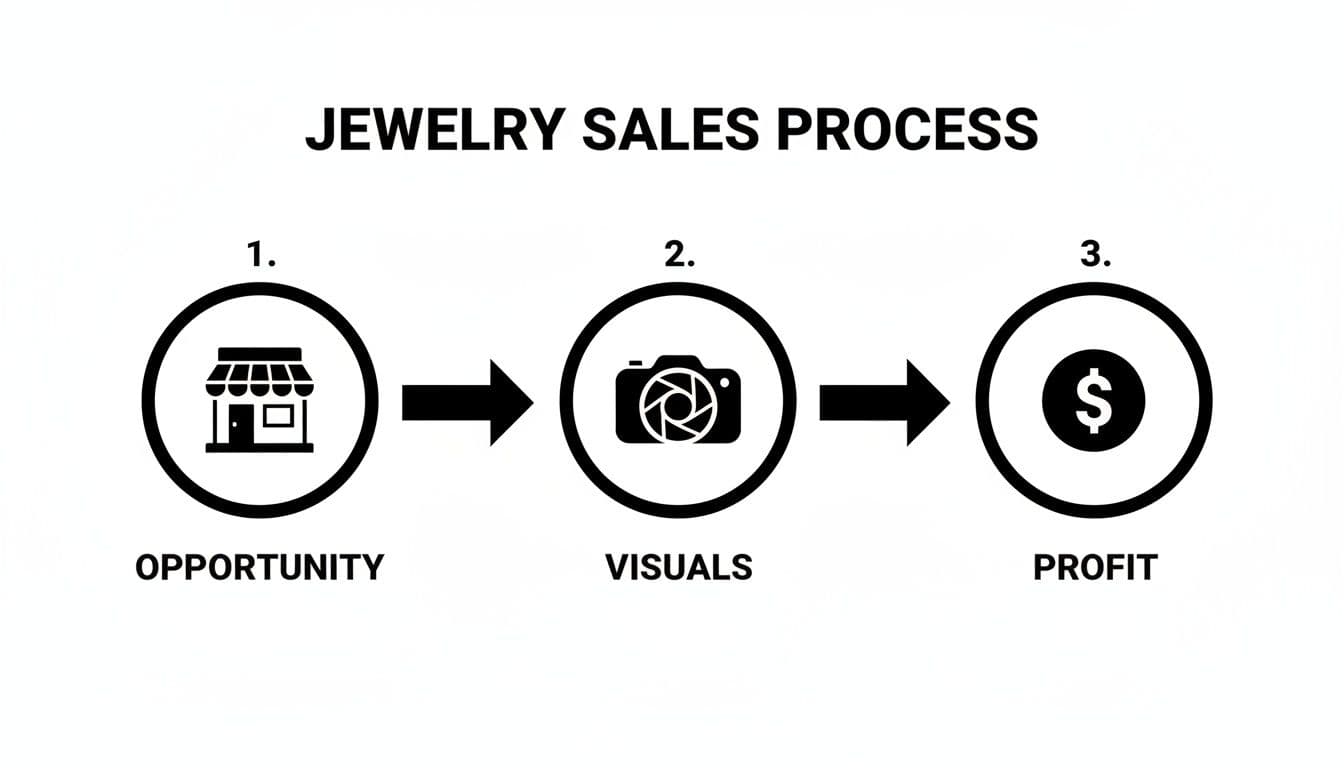
Flowchart illustrating a three-step jewelry sales process: opportunity, visuals, and profit.
Why Your Smartphone Isn't Enough
Modern smartphone cameras are incredible, but they often fail to capture the tiny, intricate details that make jewelry so special. That subtle shimmer of a gemstone, the delicate texture of a brushed metal finish, the fine craftsmanship of a setting—it all gets lost.
High-value items demand high-quality images. It's how you build trust and justify your pricing.
Mastering jewelry photography is a non-negotiable skill if you're serious about selling online. You don't need a full-blown studio from day one, but you absolutely need to nail the fundamentals.
- Lighting is everything. Soft, diffused natural light is your best friend. Avoid harsh, direct sun, which creates ugly glares and deep shadows. An overcast day next to a large window is perfect.
- Keep backdrops simple. You want the focus on the jewelry, not a busy background. White, gray, or neutral tones are a safe bet. Materials like linen, slate, or even simple cardstock can look incredibly professional.
- Get up close. Use a macro lens or your camera's macro setting. These detailed close-ups show off the quality and unique features of your work, answering customer questions before they even have to ask.
For a deeper dive, check out our full guide on how to photograph jewelry, which covers more advanced techniques for dealing with tricky reflective surfaces and capturing the true color of gemstones.
The New Secret Weapon: AI-Powered Model Imagery
Traditionally, getting professional model shots was a huge hassle. You had to hire models, photographers, and stylists—a cost that can easily kill a new brand's budget.
This is where AI tools are completely changing the game.
Platforms like WearView let you take a simple product photo—even a flat lay or a shot on a white bust—and instantly generate a whole gallery of stunning, photorealistic on-model images.
Key Takeaway: Using AI for model imagery lets you showcase your jewelry on a diverse range of models. This helps customers instantly visualize how a piece will look on them, which not only boosts conversion rates but also makes your brand feel more inclusive and relatable.
Writing Descriptions That Connect
Great visuals will grab their attention, but your product descriptions are what close the deal. A great description does more than just list dimensions and materials; it tells a story. It should make the customer feel what it's like to wear the piece.
Here’s how to write descriptions that work:
- Tell the story behind the piece. What was your inspiration? Is it part of a special collection? Sharing the “why” creates an emotional hook.
- Focus on benefits, not just features. Instead of saying "18k gold-plated," try "A durable, hypoallergenic 18k gold-plated finish, designed for everyday luxury."
- Use sensory and emotional words. Adjectives like "delicate," "radiant," "lightweight," and "heirloom-quality" help the customer imagine holding and wearing the jewelry.
The numbers don't lie. Shoppers under 34 now make up almost half of all online jewelry buyers. This is a massive market, expected to hit $31.47 billion in 2025 and more than double to $69.57 billion by 2032.
With social media driving purchase decisions and 67% of designers already using AI tools, professional-grade visuals are no longer a luxury. They are essential.
And don't forget video. To really bring your pieces to life, learning how to create product videos that convert is a must. Video shows how a piece moves and catches the light in a way static photos never can.
Choosing Your Sales Platform and Pricing for Profit
An open jewelry box with a ring, a laptop showing an online store, and a phone, symbolizing online jewelry sales.
With your stunning visuals ready, it's time to make two of the most important decisions for your business: where you'll sell your jewelry and how you'll price it. These aren't just logistical hurdles. The platform you choose shapes your brand identity and your profit margins, while your pricing tells customers exactly what your work is worth.
Getting these right from the start can be the difference between a side hustle and a sustainable, thriving jewelry brand.
Your Own Website vs. Marketplaces
So, where should you set up shop? This decision boils down to a classic trade-off: control versus convenience. There's no single right answer—the best path depends entirely on your business goals, how comfortable you are with tech, and where you see your brand in five years.
Building your own store on a platform like Shopify gives you total control. You're the architect of the entire customer journey, from the homepage design to the checkout flow. This is the route for serious brand-builders who want to create a unique world for their customers and own that direct relationship, free from marketplace rules. If blogging will be part of your marketing strategy, compare e-commerce blog platforms for their SEO tools, design flexibility, and how smoothly they connect content with your store.
On the flip side, marketplaces like Etsy or Amazon Handmade offer a massive, built-in audience of shoppers who are already looking for what you sell. That's a huge leg up when you're just starting. The trade-off? You'll face intense competition, less brand control, and transaction fees that can definitely add up.
To help you visualize the options, let’s compare the most popular platforms.
Comparison of Online Jewelry Sales Platforms
| Platform | Best For | Transaction Fees | Brand Control |
|---|---|---|---|
| Shopify Store | Entrepreneurs focused on long-term brand building and wanting full control over design and customer data. | Varies (Typically 2.4% - 2.9% + 30¢ per transaction, plus monthly subscription). | High |
| Etsy | Artisans and crafters starting out, offering unique, handmade pieces to a ready-made audience. | 6.5% transaction fee + listing and payment processing fees. | Medium |
| Amazon Handmade | Established makers who can handle higher volume and want access to Amazon's massive customer base. | 15% referral fee per sale, with a waived monthly fee for Handmade artisans. | Low |
| Social Commerce | Brands with a strong social media following looking to create a seamless shopping experience on Instagram or Pinterest. | Varies by platform, often similar to standard e-commerce processing fees. | Medium |
Many successful sellers eventually adopt a hybrid approach. You can start on a marketplace like Etsy to build momentum and gather customer feedback, all while building your own branded website in the background for long-term growth and higher profit margins.
Pricing Your Jewelry for Sustainable Profit
Pricing handmade jewelry is one of the trickiest parts of the business. Too many new sellers fall into the trap of undercharging, forgetting all the hidden costs that go into their work. Your pricing isn't just a number—it’s a signal of value that determines if your passion can actually become a profitable business.
First, you have to get ruthlessly honest about your costs. It's not just the silver wire and gemstones. You need to account for consumables like solder and polishing wheels, studio overhead like rent and electricity, and business expenses like platform fees, marketing tools, and packaging.
Your price must cover more than just materials and time. It needs to account for every aspect of your business—from marketing to packaging—and leave room for profit. Underpricing is the fastest way to turn a passion into a burnout.
To build a solid pricing foundation, start with this proven formula for your retail price:
(Materials + Labor) × 2 + Extras = Retail Price
Here’s the breakdown:
- Materials: All your raw materials, including findings, beads, and even the cost of shipping those supplies to you.
- Labor: The time you spend creating the piece, valued at a fair hourly wage. Don't work for free!
- Extras: All the other direct costs like your beautiful packaging, shipping supplies, and platform listing fees.
That x 2 markup is critical. It's what covers your overhead and, most importantly, generates your profit. For fine jewelry with very high material costs (like solid gold or large diamonds), you might adjust the markup to something lower, like 1.5x, to keep the final price competitive.
The timing couldn't be better. The online jewelry market is booming right now, with North America expected to drive 39% of the market's growth. Globally, the e-commerce jewelry space is projected to grow by an incredible $78 billion between 2024 and 2029. These numbers show there’s a massive opportunity for new sellers. You can dive deeper by exploring the complete online jewelry market analysis from Technavio to see just how big the opportunity is.
Marketing Your Jewelry to Attract Loyal Customers
A smartphone displaying delicate necklaces in a flat lay, with 'Build Your Brand' text.
Let's be honest. Having stunning photos and a well-priced collection is just the start. The real hurdle—where so many jewelry brands stumble—is getting your beautiful pieces in front of the right eyeballs. Your creations won't sell themselves. You need a smart marketing plan to build momentum and attract customers who come back again and again.
When it comes to jewelry, marketing is all about visuals and emotion. Your entire strategy should revolve around telling a story that people connect with, creating a brand they want to be part of. That's how you go from making one-off sales to building a real community.
Go All-In on Visual Platforms
Jewelry is a feast for the eyes, so your marketing needs to live where visuals reign supreme. For anyone serious about selling jewelry online, Instagram and Pinterest are non-negotiable. They are your best friends for discovery, brand building, and funneling traffic to your shop.
- Instagram: Use high-quality Reels to show how a necklace catches the light or how a stack of rings looks in motion. Carousel posts can walk customers through the story of a new collection. Stories are perfect for behind-the-scenes glimpses into your creative process. It's no surprise that 71% of small businesses use social media—it works.
- Pinterest: Think of Pinterest as a visual search engine where people are actively planning their next purchase. Create gorgeous, vertical pins for every single product, linking them directly to your product pages. Build boards that match your brand's vibe, like "Minimalist Gold Jewelry" or "Bohemian Bridal Accessories."
Success here is all about consistency. Check out these social media marketing ideas and build a content calendar to keep your audience hooked. You're not just showing products; you're creating a living showcase for your brand.
Build Trust with Social Proof
Modern shoppers trust other people’s opinions far more than they trust a brand’s own advertising. This is why social proof is one of the most potent tools in your marketing arsenal. It’s the digital version of a friend gushing about a great new shop they found.
There are two fantastic ways to generate social proof:
- User-Generated Content (UGC): Encourage your customers to post photos of themselves wearing your jewelry. Run a hashtag campaign, feature their best shots on your feed (always ask for permission!), or offer a small discount on their next purchase for sharing. UGC is authentic, builds community, and gives you a stream of relatable content for free.
- Influencer Collaborations: Partnering with influencers whose style vibes with your brand can introduce your work to thousands of potential buyers. You don't need a massive budget; micro-influencers with smaller, highly engaged audiences often deliver a much better return. Industry reports show influencer marketing can yield over $5 for every dollar spent, making it an incredibly effective strategy.
Your marketing shouldn't just be about broadcasting your products. It should be a conversation. When you feature customers and collaborate with creators, you're not just selling jewelry; you're building a community around your brand.
Beyond getting that first sale, focusing on the entire buying journey is key to building loyalty. You can explore ways to improve ecommerce customer experience to make sure every interaction, from discovery to delivery, is absolutely stellar.
Beyond the Sale: The Art of Brand Building
Marketing drives the first sale. A strong brand creates a customer for life. Your brand is the feeling someone gets when they interact with your work—it's your story, your values, and the experience you deliver.
A memorable unboxing experience is brand building in action. Don't just ship your gorgeous piece in a plain mailer. Design beautiful, branded packaging that makes opening the box feel like a special event. A handwritten thank-you note or a small card telling the story behind the piece goes a long way.
These small, intentional details elevate the perceived value of your work and often get shared on social media, creating even more organic marketing. It’s these thoughtful touches that turn a simple transaction into a memorable brand experience, setting you up for repeat business and true customer loyalty.
Managing Logistics: Shipping, Payments, and Policies
The moment a customer clicks "buy," your relationship with them truly begins. Everything that happens next—the unboxing, the communication, the feeling of security—is where you turn a one-time sale into a loyal fan. This is where the operational side of your business, your logistics, gets its moment to shine.
Getting your shipping, payments, and policies right isn't just about ticking boxes. It's about building a professional, trustworthy brand that people feel confident buying from again and again.
Secure Shipping for Precious Items
Let’s be honest: shipping jewelry isn't like sending a t-shirt. You’re dealing with small, valuable, and often sentimental items. Your packaging and shipping choices are a direct reflection of the care and quality you put into your work.
First things first: secure packaging. Don't just toss a beautiful ring into a flimsy padded envelope. Your piece should go into its primary box or pouch first. Then, place that inside a sturdy, larger shipping box filled with plenty of cushioning like crinkle paper or bubble wrap. The goal is zero movement. If it can’t rattle, it’s less likely to break.
Next up is choosing the right shipping service. This is for your peace of mind as much as the customer's.
- Always Use Tracking: This is non-negotiable in 2024. Customers don't just want their order; they want to watch it travel from your studio to their front door.
- Insure Valuable Pieces: For anything over a certain threshold, say $100, shipping insurance is a must. Think of it as a small price to pay to protect yourself from a huge financial hit if a package gets lost, damaged, or stolen.
- Consider Signature Confirmation: For your big-ticket items, requiring a signature upon delivery is a smart move. It ensures the package is handed directly to a person, which drastically cuts down on "it never arrived" claims.
Carriers like USPS, FedEx, and UPS all offer reliable options with these features. Just be sure to be transparent about shipping costs on your product pages. No one likes a surprise fee at checkout.
Setting Up Secure and Smooth Payments
Your payment gateway is the digital cash register for your store. It has to feel secure, familiar, and ridiculously easy to use. A clunky or confusing checkout is one of the quickest ways to lose a customer who was ready to buy. It's a leading cause of cart abandonment for a reason.
Most e-commerce platforms like Shopify have fantastic built-in payment processors that are simple to set up. You also have powerhouse third-party options like Stripe and PayPal, which are instantly recognized and trusted by millions of shoppers.
Your payment options should scream "confidence." Offering a mix of well-known methods—credit cards, PayPal, and even "buy now, pay later" services like Afterpay or Klarna—can give your sales a real lift. When a shopper sees a familiar logo, their hesitation melts away.
The key is making it all feel seamless and safe. Simply displaying the security badges from your payment providers can go a long way in reassuring customers that their financial data is protected. You can find more tips on how to improve your e-commerce conversion rate by fine-tuning your checkout flow.
Writing Clear Policies to Protect Your Business
Think of your store policies as the house rules. They aren't just legal jargon; they are your first line of defense against misunderstandings and your best tool for managing customer expectations. Clear, fair, and easy-to-find policies create a professional framework for your entire operation.
Your two most critical policies will be your Return Policy and your Terms of Service.
Your Return Policy Should Cover:
- Which items are eligible for return (e.g., everything except custom pieces or final sale items).
- The return window (e.g., within 14 or 30 days of delivery).
- The required condition of the item (e.g., unworn, with original packaging).
- Who is responsible for return shipping costs (you or the customer).
- How refunds are handled (e.g., back to the original payment method, store credit).
Make sure you link to your return policy in your website's footer and even consider putting a short summary or link on your product pages. Transparency here builds incredible trust and gives customers the confidence they need to complete their purchase.
Answering Your Top Questions About Selling Jewelry Online
Getting into e-commerce can feel like a huge step, especially when you're figuring out how to sell jewelry online. You've tackled the big picture—visuals, platforms, marketing—but it's the specific, nagging questions that often pop up right when you're ready to launch.
This is where we clear the fog. Think of this as your final Q&A session to iron out any lingering doubts. Getting these practical details straight will give you the confidence to move forward with a solid plan.
How Much Does It Cost to Start Selling Jewelry Online?
Your startup costs can swing wildly, from under $100 to several thousand. The great thing about starting an online business today is you can scale your investment to match your comfort level.
Want to launch on a shoestring budget? It’s entirely possible.
- Start on a Marketplace: Kick things off on a platform like Etsy, where listing fees are just $0.20 per item. You only pay transaction fees when you make a sale, which means no hefty upfront website costs.
- DIY Your Visuals: Your smartphone is more powerful than you think. Use the photography tips we covered earlier to create your first round of product shots.
- Go Organic with Marketing: Focus your energy on building a following on Instagram or Pinterest. You can generate real momentum without spending a dime on ads at first.
If you're aiming for a more robust launch, you might budget somewhere between $500 and $2,000. That could cover a Shopify subscription, a small budget for AI-powered model photos to get high-end visuals affordably, and a bit of ad spend to get eyeballs on your products faster.
The trick is to start with what you can afford and reinvest your profits back into the business as it grows.
What Is the Most Profitable Type of Jewelry to Sell?
While trends come and go, a few categories consistently deliver strong profits for online sellers. The right one for you comes down to your skills, brand, and what you’re willing to invest upfront.
Fine jewelry—we’re talking precious metals and high-grade gems—obviously has the highest profit margin per sale. But it’s a double-edged sword: it demands the biggest initial investment in materials and usually requires some serious goldsmithing skills.
Demi-fine jewelry often hits that commercial sweet spot. It uses quality materials like gold vermeil and sterling silver, making it more attainable than fine jewelry but with a much higher perceived value and better margin than costume or fashion jewelry.
Don't sleep on the power of personalization. Custom pieces like initial pendants, engraved bracelets, or birthstone rings are incredibly profitable. People will happily pay a premium for something that feels uniquely theirs, giving you a massive edge over generic brands.
And never underestimate unique, handmade jewelry, especially if you build a compelling brand story. When a customer connects with your craft and your vision, they aren't just buying an accessory. They're buying a piece of art.
Do I Need a Business License to Sell Jewelry Online?
Yes, almost everywhere, you'll need a business license to legally sell jewelry online. The exact requirements change depending on your city, county, state, or even country, so it's critical to do a little local homework.
The process usually looks something like this:
- Register Your Business Name: This could be as a sole proprietorship, LLC, or another structure.
- Get a Business License: Your city or county government typically issues this.
- Secure a Seller's Permit: Also called a sales tax permit, this is what allows you to legally collect sales tax from customers in your state.
Your best first stop is the website for your state's Secretary of State or the Small Business Administration (SBA). They have clear, step-by-step checklists for new businesses. A quick chat with a local accountant or small business lawyer can also save you a lot of headaches down the road.
How Should I Ship Expensive Jewelry Pieces?
Shipping valuable jewelry isn't something to take lightly. It requires extra care to protect your piece, your business, and your customer's peace of mind.
First, always use a sturdy, crush-proof shipping box—never a padded envelope. Inside, the jewelry should be snug in its own box or pouch, with plenty of cushioning like tissue or crinkle paper to keep it from rattling around. Make the outer packaging as plain and discreet as possible; you don't want to advertise that something valuable is inside.
When you choose a shipping carrier, make sure the service includes:
- Full Insurance: Insure the package for the full retail value. No exceptions.
- End-to-End Tracking: Send that tracking number to your customer the moment it ships.
- Signature Confirmation: For anything high-value, requiring a signature on delivery is non-negotiable. It ensures the package is handed directly to a person.
Major carriers all offer secure options for shipping valuable items. Highlighting these secure methods in your product descriptions and shipping policies is a great way to build trust and justify your shipping costs.
Ready to create stunning, studio-quality model photos for your jewelry without the cost and hassle of a photoshoot? With WearView, you can upload a simple product shot and instantly generate an entire gallery of photorealistic on-model images. Start creating your professional jewelry visuals today.

WearView Team
WearView Content & Research Team
WearView Team is a group of fashion technology specialists focused on AI fashion models, virtual try-on, and AI product photography for e-commerce brands. We publish in-depth guides, case studies, and practical insights to help fashion businesses improve conversion rates and scale faster using AI.