February 28, 2026•22 min read
Social Media Marketing for Clothing Brands A 2026 Guide
Level up your social media marketing for clothing brands. This guide covers platform strategy, content creation, and influencer tactics to drive real sales.
Social Media Marketing for Clothing Brands A 2026 Guide
Let’s be honest: great social media for a clothing brand is about so much more than just posting pretty pictures. You're building a world. A vibe. You're creating a visual story so compelling that a specific group of people can't help but fall in love with it, becoming not just customers, but true fans.
Building Your Social Media Foundation
Before you even think about your first Reel or brainstorm a TikTok, you need a rock-solid strategy. The fashion market is brutally saturated—winging it simply isn't an option anymore. I’ve seen it time and time again: the brands that truly break through are the ones that do the heavy lifting upfront. They know exactly who they’re talking to and what they want to say.
This isn't just about making things look good; it's about building a brand that people connect with on a deeper, more emotional level. Every single post, every story, every ad should serve a clear purpose and push your brand forward.
We can boil this down to a simple, three-phase process: Define, Build, and Launch.
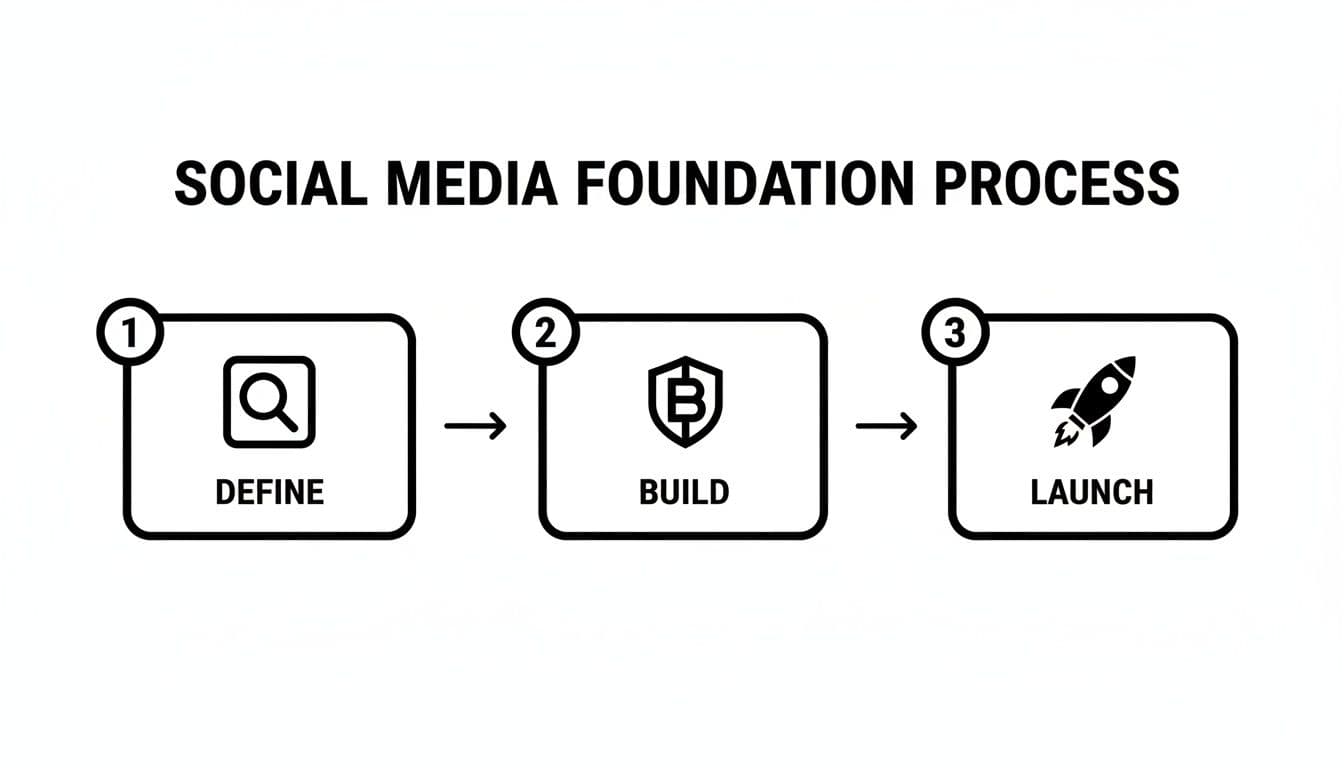
A three-step social media foundation process showing Define, Build, and Launch with corresponding icons.
Think of it this way: a successful launch is the result of careful planning, not the starting point.
Define Your Hyper-Specific Audience
Your first—and most critical—job is to get way more specific than "women aged 20-35." That’s a demographic, not an audience. Creating a hyper-specific customer persona is what allows you to craft content, a voice, and even products that feel like they were made just for them.
Forget the generic profile. Build a real character. Ask yourself:
- Lifestyle & Values: What does their ideal weekend look like? Are they obsessed with sustainability, hitting up music festivals, or perfecting their minimalist apartment?
- Inspiration & Media: Who do they follow on Instagram and TikTok? What magazines, blogs, or newsletters do they actually read? What other brands do they love (even ones outside of fashion)?
- Pain Points & Desires: Are they hunting for comfortable-but-chic WFH outfits, a show-stopping piece for a night out, or just a perfectly-made, ethically-sourced white t-shirt?
A great example is a sustainable brand targeting "The Conscious Urbanite." This person values transparent sourcing and clean design, follows zero-waste bloggers, and probably spends their Saturday morning at the local farmers' market. Once you know this person inside and out, every other decision becomes infinitely easier.
Carve Out Your Brand Identity and Voice
Your brand identity is your brand's personality. It’s the consistent way you look, sound, and make people feel. This is how you build recognition and, more importantly, trust.
Your brand voice isn't just what you say, but how you say it. It’s the difference between being playful and witty versus sophisticated and aspirational. This voice must be consistent across every caption, comment, and customer service interaction.
Of course, a massive piece of this is your visual identity. In fashion, your imagery is your product. Traditionally, this meant shelling out thousands for photographers, models, and studio time. It was a huge barrier.
But the game has completely changed. Modern tools are leveling the playing field. For instance, AI-powered platforms like WearView let you create a professional, cohesive visual identity from day one without the insane costs. You can generate unlimited on-model imagery, which is a massive leg-up for new and growing brands. It’s not just about saving money; it’s about having the creative freedom to show your collection on a diverse range of models and in countless styles, keeping your feed fresh and exciting.
Mastering the Top Platforms for Fashion Brands
Not all social media channels are created equal, especially in the fast-paced world of fashion. A winning social strategy isn't about being everywhere; it's about being on the right channels and speaking their language fluently.
Let's cut through the noise and focus on the playbook for the platforms that actually move the needle for clothing brands: Instagram, TikTok, and Pinterest.

Desk with a laptop displaying 'BRAND IDENTITY,' color swatches, green fabric, and a plant.
Spreading yourself too thin is a fast track to burnout and mediocre results. By concentrating your efforts on this "big three," you create a powerful ecosystem. Each platform plays a distinct role, guiding your customer from their first glimpse of your brand all the way to checkout.
Instagram: The Digital Storefront and Lookbook
Think of Instagram as your brand’s polished flagship store. This is where potential customers come to admire your collection in its best light, get a feel for your aesthetic, and hopefully, fall in love with your brand story. It’s no surprise it remains the top-performing platform for the fashion industry.
Your Instagram presence should be curated, immersive, and visually stunning. Here’s how to make it work for you:
- Perfect Your Bio: This is your digital business card. It needs to say exactly what you sell, who you sell to, and what makes you different. Don’t forget to include your brand’s hashtag and a direct link to your shop.
- Create a Cohesive Grid: Your feed tells a story at a glance. You need to plan your posts to create a visually consistent grid that feels like your brand. Mix high-quality product shots with lifestyle images and, of course, video.
- Use Reels and Stories Daily: Reels are your number one tool for reaching new audiences. Use them for quick styling tutorials, behind-the-scenes content, and engaging "Get Ready With Me" videos. Stories, on the other hand, are for building that daily connection with your existing followers through polls, Q&As, and unfiltered glimpses into your world.
Instagram is where you nurture the community you've built. It's less about chasing every viral trend and more about building a loyal following that sees your brand as a core part of their style identity.
TikTok: The Engine of Discovery and Virality
If Instagram is your curated storefront, TikTok is the chaotic, exciting street fair where new people discover you by accident. The platform runs on authenticity, entertainment, and being part of the cultural conversation. For clothing brands, it’s an absolute powerhouse for reaching younger audiences and generating explosive brand awareness.
Success on TikTok has very little to do with high-production ads. It’s all about creating content that feels like it belongs there.
Content that Wins on TikTok:
- Trend-Driven Videos: Jump on relevant dance challenges, use trending audio, and adapt popular formats to show off your clothes in a fun, relatable way. The key is to act fast and be authentic.
- Behind-the-Scenes Content: Show your design process, what it looks like to pack orders, or a "day in the life" at your studio. This stuff humanizes your brand and builds a surprising amount of trust.
- Styling and "Fit Check" Videos: These are gold. Quickly show multiple ways to wear a single item or create "outfit of the day" videos. This provides immediate value and style inspiration that people save and share.
This creator-led approach is fueling a massive industry shift. The fashion influencer marketing market, valued at $6.82 billion in 2024, is projected to hit an astounding $39.72 billion by 2030. Social media is the engine, with 98% of marketers picking Instagram for partnerships. But here's the catch: about 93% of influencers check out a brand's social content quality before they even consider collaborating. You can dig into the fashion influencer marketing trends to see just how critical your visual game has become.
Pinterest: The Visual Search Engine for Long-Term Traffic
Please, don’t sleep on Pinterest. While Instagram and TikTok are about capturing attention in the moment, Pinterest is a visual search engine where people are actively planning future purchases. A single well-crafted Pin can drive traffic to your website for months—even years—making it a fantastic tool for sustainable, long-term growth.
Users don't just browse Pinterest; they come with intent. They're building mood boards for "summer wedding guest outfits," "minimalist fall style," or "sustainable denim." Your job is to make sure your products show up when they search for those ideas.
To win on Pinterest, focus on creating high-quality, vertical images that showcase your products in an aspirational, real-world context. For every product, create multiple Pins and link each one directly back to the product page. Organize your Pins into specific, keyword-rich boards like "Linen Dresses," "Boho Style Inspiration," or "Workwear Essentials." This not only helps users find you but also teaches the Pinterest algorithm what your brand is all about, boosting your visibility in all the right searches.
Creating Scroll-Stopping Visual Content
In fashion, your visuals are everything. They're your currency. When a potential customer is mindlessly scrolling, they make a split-second decision about your brand based purely on what they see. This is our deep dive into creating the kind of high-impact content that stops that scroll cold.
This is where all that work you did on your brand voice and identity comes to life. It’s what separates you from the dozens of other brands in a packed feed. We'll get into the specific formats, techniques, and tools you need to build a content machine that actually works.
The Raw Power of Short-Form Video
Static images absolutely still have their place, but let's be real: short-form video is the engine for discovery right now. Platforms like Instagram Reels and TikTok have completely rewired how people find and connect with fashion. If you’re not making videos, you’re basically invisible.
The numbers don't lie. Short-form video delivers the highest ROI of any video format at 41%, making it a non-negotiable part of your strategy. On top of that, platforms like TikTok and Reels are driving over 60% of product discovery worldwide. Think about that. Reels generate the most impressions for influencer content, and brands using AI in their video strategy are seeing an 82% ROI increase.
This doesn't mean you need a Hollywood budget for every post. Far from it. Authenticity and raw, user-generated-style content often perform way better.
- Styling Tips & "Get Ready With Me" (GRWM): Show three ways to wear your new dress. This gives instant value and helps customers imagine it in their own closet.
- Try-On Hauls: Whether you film them yourself or an influencer does, hauls give a real, honest look at fit and fabric that a flat photo just can't.
- Cinematic Lookbooks: Pair your collection with trending audio to create a vibe. A simple 15-second clip can tell a much richer story than a static carousel.
The whole point of video is to make your clothing feel alive. You're showing movement, personality, and context. You’re turning a product into a lifestyle.
Don't Sleep on Your Static Imagery
While video is king for discovery, high-quality static photos are what seal the deal. Your Instagram grid, Pinterest boards, and product pages are your digital showroom floor. They need to look impeccable, consistent, and aspirational.
This is where so many brands get stuck. Let’s face it, traditional photoshoots are a nightmare. They're expensive, they take forever to plan, and the logistics of coordinating models, photographers, and studios can completely drain your budget and your sanity.
That production bottleneck is exactly where new tech is giving brands a massive leg up. Imagine taking a simple product photo on a hanger and instantly turning it into a professional, studio-quality shot on any model you can dream of.
Slash Costs and Crank Up Output with AI
AI-powered photography platforms are completely changing the game for clothing brands. Tools like WearView let you generate unlimited on-model photos without the insane cost and headache of a physical shoot. You just upload a picture of your garment—even a flat lay—and the AI creates a photorealistic image of it on a model that perfectly matches your brand's aesthetic.
This isn’t just a small tweak; it’s a fundamental shift. Here’s why:
- Massive Cost Reduction: Forget paying for models, photographers, studios, and travel. Brands are cutting their production costs by up to 90%.
- Unmatched Speed: Go from a single product photo to a full set of marketing assets in minutes, not weeks. This speed means you can jump on trends and launch new collections while they're still hot.
- Genuine Inclusivity: Effortlessly show your clothes on a diverse range of body types, skin tones, and ages. This makes your brand feel more real and relatable to a much wider audience.
- Bulletproof Brand Consistency: Keep a cohesive look across all your channels by using the same AI models and backgrounds that align with your visual identity.
By bringing an AI-driven workflow into your process, you can build a high-volume, high-quality content calendar that would be physically and financially impossible otherwise. It's not just about saving money. It's about gaining the creative freedom to produce more content, test different looks, and keep your social feeds fresh and exciting.
You can also get more mileage from your assets. For example, it's easy to learn how to make Reels from existing video and other assets to fill your content pipeline. On top of that, exploring tools like AI fashion video generators can unlock dynamic, animated lookbooks without ever needing to book a film crew.
Working with Influencers and User-Generated Content
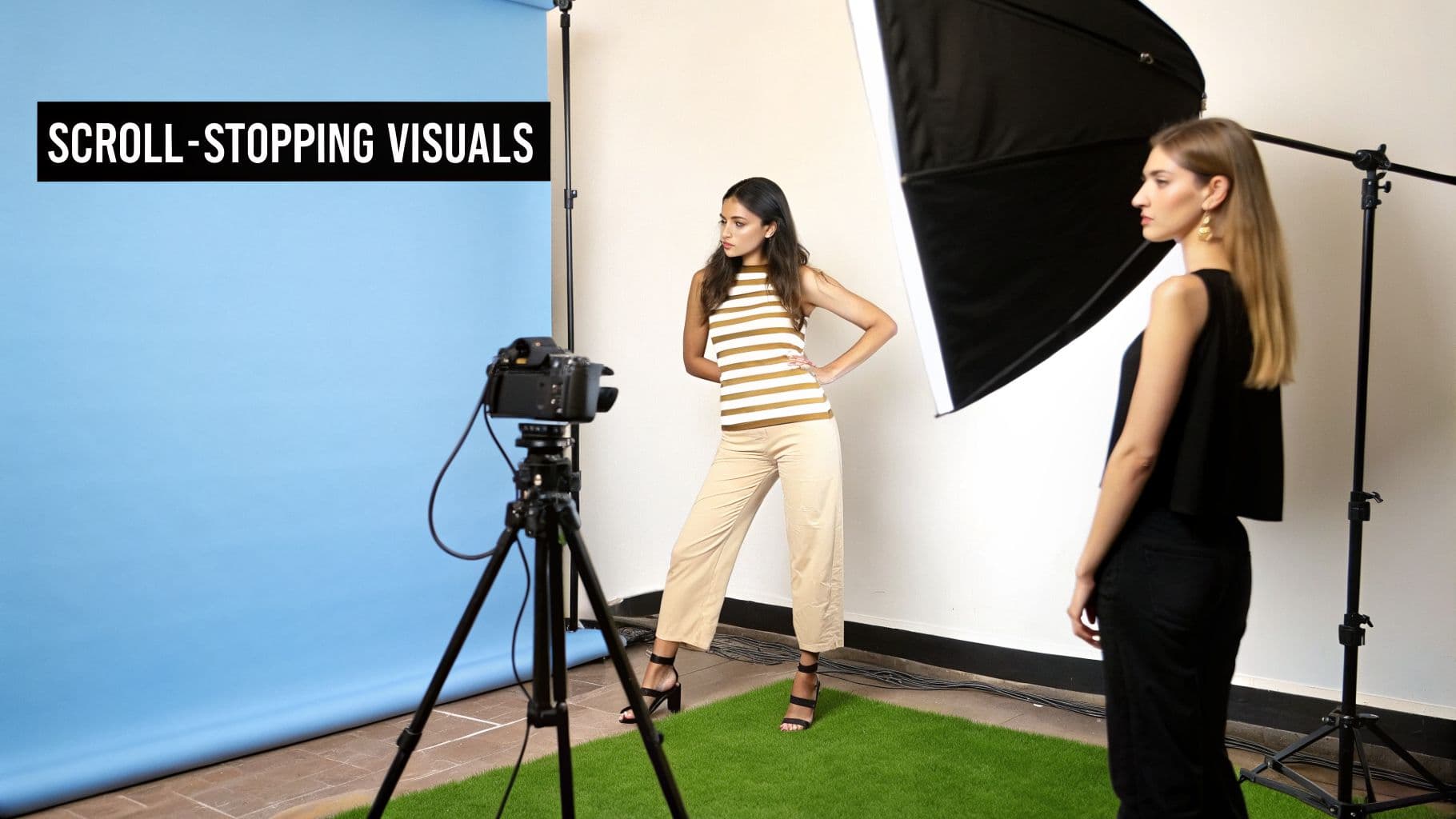
Two models in a professional photo studio with a camera, lights, and blue backdrop.
In fashion, authenticity isn't just a buzzword—it's your most powerful sales tool. Today's shoppers don't just trust brand logos; they trust people. That's why building social proof through influencer marketing and user-generated content (UGC) has become a non-negotiable part of the game.
It’s about moving past slick, polished ads and tapping into the genuine excitement of real people. The goal is to create a community where creators and customers are celebrating and styling your clothes, giving new shoppers the validation they need before they click "buy."
Identifying the Right Influencer Partners
The first hurdle in social media marketing for any clothing brand is finding the right people to represent you. This isn't about chasing the biggest follower counts. It’s about finding genuine alignment and engagement.
Nano-Influencers (1k-10k followers): These creators are gold for emerging brands. They have smaller, tight-knit communities that deeply trust their recommendations. A post from a nano-influencer feels less like a paid ad and more like a tip from a stylish friend.
Micro-Influencers (10k-100k followers): Here’s the sweet spot between niche authority and broader reach. Micro-influencers often specialize in a specific style—like vintage fashion or sustainable living—and their audience is there for their specific expertise.
Macro & Mega-Influencers (100k+ followers): These creators are your go-to for big brand awareness plays. A single post can put your brand in front of hundreds of thousands of potential customers, perfect for a new collection launch or a major sale.
Instead of one-off posts, think about building long-term ambassador programs. When an influencer becomes a true partner, the consistency builds much deeper trust with their audience over time. Compensation can be a mix of flat fees, commissions, or gifted products, depending on the creator's tier and your goals.
An influencer partnership is a two-way street. Before reaching out, do your homework. Make sure their aesthetic matches yours and their audience is genuinely engaged—look for thoughtful comments, not just a high like count.
To really make these collaborations sing, give your partners unique creative assets. For example, you can supply them with stunning visuals featuring diverse ai generated models wearing your pieces. This gives them high-quality content to weave in with their own organic posts.
Building a UGC Machine
While influencers provide targeted reach, the most authentic content comes directly from your customers. User-generated content is the ultimate social proof because it’s a real, unsolicited endorsement. When someone sees a peer they relate to wearing and loving your clothes, it instantly breaks down purchase barriers.
But you can't just sit back and wait for UGC to appear. You have to build a community that feels inspired and encouraged to share. To boost your reach and build trust, it's essential to implement effective User Generated Content strategies that foster a sense of community and make sharing feel natural.
Actionable Strategies for More UGC:
- Create a Branded Hashtag: Come up with a unique, memorable hashtag (like #BrandNameStyle) and put it everywhere—your social bio, on your packaging, and in email signatures. Make it part of your brand's identity.
- Run Contests and Giveaways: A simple prompt like, "Show us how you style our new jeans! Tag us and use #OurHashtag to win a $100 gift card," can spark a flood of amazing content.
- Actively Feature Your Community: When a customer tags you, do more than just "like" the post. Leave a genuine comment, ask for permission to share it on your feed or Stories, and always give them full credit. This shows you're listening and that you value them.
Turning Social Engagement Into Sales
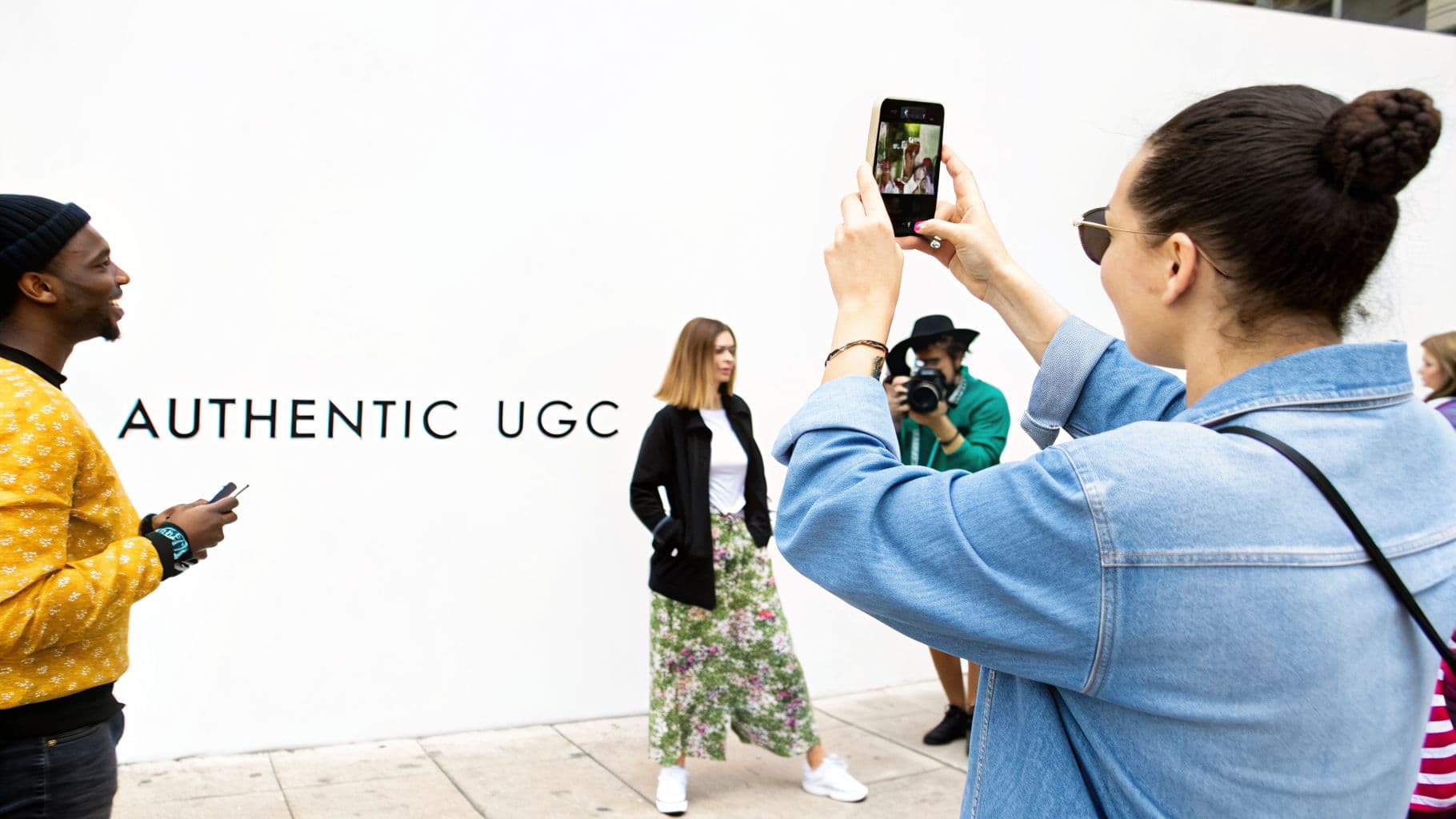
People capture photos with phones and cameras near a wall displaying "AUTHENTIC UGC" text.
Likes and comments are fantastic. A loyal, engaged community is the foundation of any great clothing brand. But for your brand to survive and actually grow, that engagement has to eventually turn into revenue.
This is where you connect your organic content engine to a smart paid advertising strategy. It's how you turn your social media presence from a brand-building tool into a powerful sales channel. While organic reach gets your name out there, paid ads put your products directly in front of people who are ready to buy. You’re no longer just hoping the right person sees your post; you’re making sure they do.
Setting Up Smart Ad Campaigns
The most effective social media marketing for clothing brands isn’t about choosing between organic or paid—it’s about using them together. Platforms like Facebook and Instagram offer incredibly precise ad targeting, letting you serve your collection to the exact audience you identified earlier.
To start, you really only need to focus on two core campaign types: prospecting and retargeting.
Prospecting Campaigns: This is your net for catching new customers. You’ll use interest-based targeting to reach people who follow similar brands, have shown an interest in specific styles (like "bohemian fashion" or "streetwear"), or match your ideal customer demographic.
Retargeting Campaigns: This is where the magic really happens. You're serving ads to people who already know you—they’ve visited your website, added an item to their cart, or engaged with your Instagram profile. These are warm leads, and they are far more likely to convert.
Once you have a steady stream of customers, you can create lookalike audiences. The ad platforms will analyze your existing customer list or website visitors and find new users who share similar characteristics. This is one of the most powerful ways to scale your reach and find your next wave of loyal fans.
The Rise of Social Commerce
The line between social media and e-commerce has all but disappeared. Platforms like Instagram and TikTok are no longer just places for inspiration; they are interactive storefronts. In fact, a staggering 50% of TikTok users report buying something immediately after a live shopping session.
By 2026, it's expected that 49% of consumers will use social media for shopping research, and 48% will discover new brands there. For fashion, this is non-negotiable. Facebook and Instagram continue to deliver the highest ROI because they are so visual, making a solid social commerce strategy essential. You can learn more about these social commerce statistics to see the full picture.
Your goal should be to make the path from discovery to purchase as short and seamless as possible. Every extra click is a chance for a potential customer to drop off.
This means using the shopping features built directly into the platforms. Make it easy for them to buy the second they feel inspired.
Must-Use Social Commerce Features:
- Instagram & Facebook Shops: Set up a dedicated Shop tab on your profile. It acts like a mini-version of your website, letting users browse and buy your entire collection without ever leaving the app.
- Product Tagging: This is crucial. Tag specific products in your feed posts, Reels, and Stories. A user can tap the tag and go straight to the product page. This turns every single piece of content into a shoppable opportunity.
- Live Shopping Events: Host live streams on Instagram or TikTok to launch new collections, offer exclusive discount codes, or do a styling Q&A. The real-time interaction creates a sense of urgency that drives immediate sales.
Using AI to Boost Ad Performance
One of the biggest bottlenecks in running effective ads is creating enough creative variations to test. This is where AI tools completely change the game for your advertising strategy. Instead of organizing complex photoshoots for every ad, you can generate a diverse array of on-model images in minutes.
Imagine A/B testing a new top on five different models, against ten different backgrounds, without a single production day or extra cost. This lets you quickly learn what visuals resonate with your audience and drive the best Return on Ad Spend (ROAS).
You can even use AI to create brand new experiences, like a virtual try on, which can reduce returns and boost conversion rates. By integrating these tools, you can run more sophisticated, data-driven ad campaigns that are both cost-effective and highly optimized for sales.
Common Questions Answered
Running social media for a clothing brand brings up a lot of the same questions, whether you're just starting out or looking to scale. Here are the straight-up answers to the challenges we see brands grappling with every day.
How Much Should a Small Clothing Brand Spend on Social Media Marketing?
There's no magic number here, but a good rule of thumb is to earmark 10-20% of your total marketing budget for social media. The real key isn't a fixed dollar amount, but tying your spend directly to your goals.
If you’re just trying to get your name out there, you might put money behind your best-performing organic posts to boost brand awareness. But if you need to drive sales now? Your budget should go straight to retargeting ads aimed at people who've already visited your site or added to their cart.
The secret is to start small and track everything. Obsess over your Return on Ad Spend (ROAS) for every single campaign. Once you find what's hitting—the ad creative, the audience, the offer—that's when you confidently start pouring more fuel on the fire.
Also, think about where your budget is going. Tools are a huge part of the equation now. For instance, using an AI photography platform can slash your content creation costs, freeing up that money to be spent directly on ads that actually make you money.
Which Is Better for Fashion Brands: Instagram or TikTok?
This isn't an either/or fight. It’s a "both, but for different jobs" situation. Think of them as two different but essential players on the same team.
Instagram is your digital storefront. It's where you build your brand's aesthetic, show off gorgeous, high-quality product shots, and turn followers into buyers with features like Instagram Shopping. It's polished. It's your portfolio.
TikTok, on the other hand, is your discovery engine. It’s built for one thing: capturing massive, top-of-funnel attention. It's raw, authentic, and all about entertainment and jumping on trends. You go here to get found by people who have never heard of you.
The winning play is to use them in tandem:
- Grab attention on TikTok with a fun, relatable video that could go viral.
- Funnel that new traffic over to your beautifully curated Instagram profile, where you can convert them into followers and, eventually, customers.
How Can I Get More User-Generated Content for My Brand?
User-generated content (UGC) rarely just happens. You have to actively build a system that makes your customers want to create content for you.
First up, create a unique, catchy branded hashtag. Plaster it everywhere: your Instagram bio, on your packaging, in your email signature. Make it impossible to miss.
Next, give them a real reason to post. Run a simple monthly contest. The best customer photo gets a gift card or a feature on your feed. It’s a small incentive that makes a huge difference.
Finally, engage like crazy. When someone tags you, jump on it. A like, a genuine comment, and a DM asking to repost their photo (always with credit!) shows you're paying attention. Don't be shy about asking for it, either. A simple "Show us how you style it! Tag @YourBrand for a chance to be featured" in your captions works wonders.
Is Influencer Marketing Still Effective for Fashion?
Yes, absolutely. Influencer marketing isn't just effective; it's practically a necessity for fashion brands today. But the game has changed. The old model of just paying a mega-influencer for a single post is dying.
The real gold is now with micro- and nano-influencers (think 1k-50k followers). These creators have smaller communities, but their followers are incredibly engaged and truly trust their recommendations. For a clothing brand, a collaboration with a micro-influencer whose personal style perfectly matches your vibe feels less like an ad and more like a recommendation from a cool, stylish friend.
This approach almost always delivers a higher, more trackable ROI. We’ve seen a single, well-placed post from the right micro-influencer drive more direct sales than a huge, expensive post from a celebrity because the audience's trust is already baked in.
Ready to transform your brand's visuals and slash your content creation costs by up to 90%? With WearView, you can generate unlimited studio-quality, on-model photography in minutes. Discover how our AI can help you create scroll-stopping content today.
WearView Team
WearView Content & Research Team
WearView Team is a group of fashion technology specialists focused on AI fashion models, virtual try-on, and AI product photography for e-commerce brands. We publish in-depth guides, case studies, and practical insights to help fashion businesses improve conversion rates and scale faster using AI.