January 25, 2026•18 min read
How to Choose the Best Fashion Design App for Your Brand
Discover how to choose the best fashion design app for your brand. This guide covers key features, AI solutions, and testing methods for e-commerce success.

How to Choose the Best Fashion Design App for Your Brand
The "best" fashion design app is a myth. The right app depends entirely on what you're trying to accomplish. For brands that need to churn out high-quality marketing visuals, an AI-powered platform like WearView can instantly turn a single garment photo into a full-blown model shoot. But for designers deep in the trenches of pattern making and 3D prototyping, tools like CLO3D or Adobe Illustrator are still the gold standard.
Defining Your Brand’s Real Needs in a Crowded App Market
Before you start scrolling through feature lists and pricing pages, you need to get brutally honest about what your brand actually needs. It’s the most critical first step. The perfect tool for a startup trying to turn flat-lay photos into professional model shots is completely different from what an established brand needs to streamline its 3D prototyping workflow.
If you don't have a clear goal, you're just setting yourself up to waste time and money on software that doesn't fit how you work.
Start by defining your primary use case. Are you a DTC brand that needs to scale product photography without the insane cost of photoshoots? Maybe you're a vintage reseller who needs to show how unique pieces look on different body types without hiring an army of models. An established e-commerce store, on the other hand, might be looking to 3D visualization to slash physical sample production and get designs to market faster. Each of these scenarios points to a totally different kind of app.
Identify Your Primary Use Case
What is the single biggest headache you're trying to solve? Is it creating content, designing the product, or a bit of both? A classic mistake is getting seduced by an app with a hundred features you'll never touch, only to find it's mediocre at the one thing you desperately need it for.
For instance, if your return rates are through the roof because of poor fit, an app with virtual try-on capabilities could deliver the highest ROI. When you're figuring this out, digging into some AI competitor analysis tools can be a smart move. You might spot visual trends your competition is nailing or find a gap in the market you can jump on.
By first identifying your specific bottleneck—whether it’s cost, speed, or creative limitation—you can filter out 90% of the noise in the app market and focus only on solutions that deliver tangible results for your business.
This decision tree helps visualize that first big choice: are you focusing on the design and prototyping side, or do you need to generate marketing visuals?
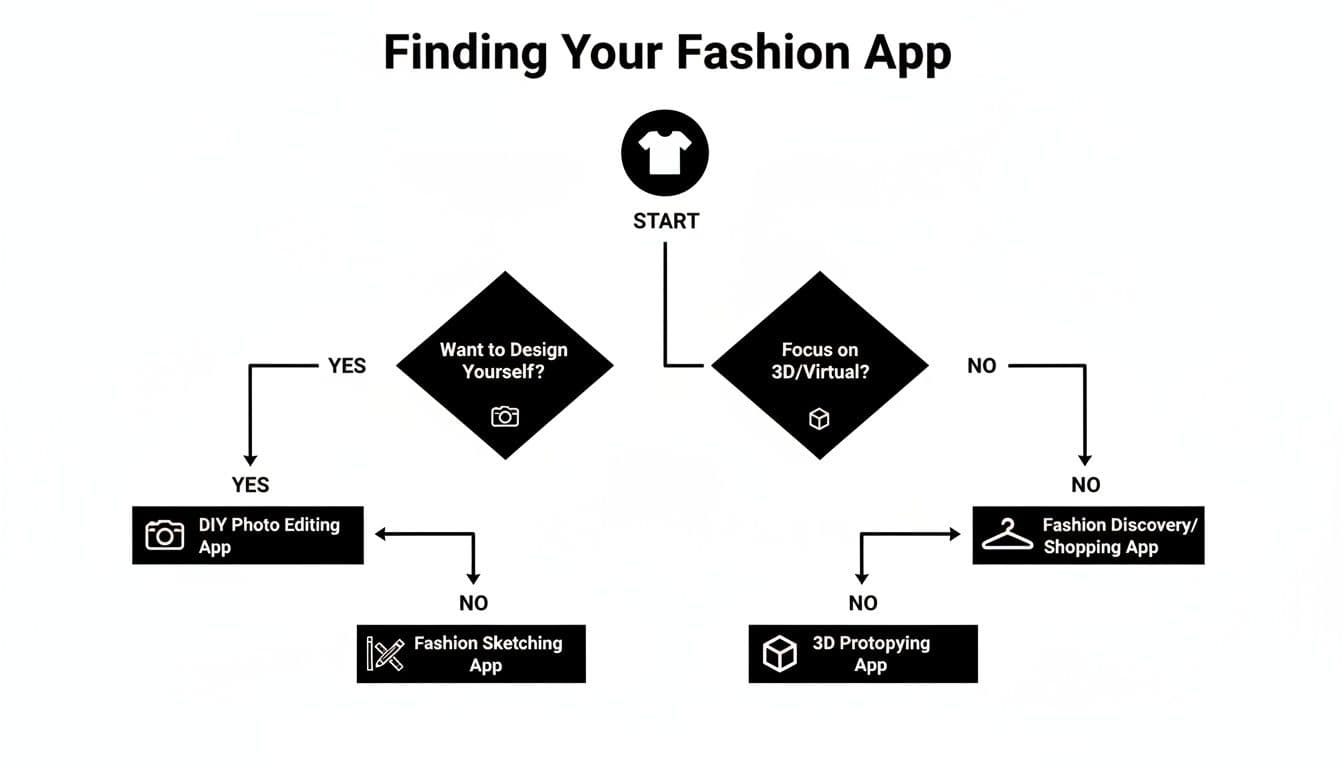
A flowchart titled 'Finding Your Fashion App' helps users select an app based on design and virtual focus.
As the flowchart shows, your primary goal—either making the product or marketing it—should be the guiding star for your software search right from the get-go.
Assess Your Team and Budget
Finally, you have to be realistic about your team's skills and your budget. An advanced 3D modeling program isn't something you can just pick up; it requires specialized training that might not be practical for a small team. In contrast, many of the newer AI content platforms are built for marketing managers, with simple interfaces that are basically drag-and-drop.
Your budget is just as important. Think beyond the monthly subscription and consider the total cost of ownership, including any training or integration time.
- Startup DTC Brand: Will likely get the most bang for their buck from a low-cost, high-impact AI content app to create marketing assets on the fly.
- Mid-Sized Retailer: Could justify investing in a more robust platform that plugs directly into their e-commerce backend.
- Large Enterprise: Might need a custom, enterprise-level solution that comes with advanced features and dedicated support.
By lining up your use case, budget, and team skills, you create a clear profile of the exact app your brand needs. This groundwork ensures you're investing in a tool that solves real problems and actually helps you grow.
Unpacking the Core Features Your Brand Can't Ignore

A fashion designer's wooden desk with camera, laptop displaying 'DEFINE NEEDS', glasses, and clothes rack.
Alright, you know what your brand needs. Now comes the fun part: cutting through the marketing fluff to find the features that actually move the needle. Lots of apps are loaded with digital novelties that look cool but don't add real value. We're looking for the workhorses—the tools that directly speed up content creation, slash return rates, and get customers excited.
The shift from physical sketchpads to digital design suites is old news. Why? Because the efficiency gains are massive. We've seen brands cut their design cycles by up to 50%. This isn't a niche trend; the global fashion design app market recently hit a $497 million valuation and is growing steadily.
High-Fidelity Visualization and Virtual Try-On
First up, let's talk about visuals. The most powerful feature you can find is high-fidelity 3D visualization. This isn't about creating a clunky digital mockup. It's about generating photorealistic images that nail the texture, drape, and fit of your fabrics. When you do it right, your digital product should be indistinguishable from a physical one.
This capability goes hand-in-hand with another game-changer: virtual try-on. When a customer can see how a dress will actually look on a body similar to theirs, their confidence to click "buy" goes through the roof.
Virtual try-on isn't just a cool gimmick—it's a direct assault on the #1 problem in fashion e-commerce: returns. By helping customers get the sizing right the first time, this one feature can dramatically cut down your reverse logistics costs.
Seriously, getting a solid virtual try-on solution in place is one of the biggest steps you can take toward a more profitable and sustainable business.
Model Diversity and Asset Exportation
Your visuals define your brand, and representation is everything. A must-have feature is access to a diverse library of models. A top-tier app lets you showcase your collection on a wide range of ethnicities, body types, and ages with just a few clicks. It completely blows past the limitations of traditional photoshoots, where you're stuck with whoever is available and within budget.
But creating the visuals is only half the battle. What happens next is just as important. You need flexible asset exportation options. A great tool will let you:
- Export high-resolution images for your product pages, lookbooks, and email campaigns.
- Generate assets pre-formatted for every social media channel, from Instagram Stories to TikTok videos.
- Integrate directly with your e-commerce platform—think Shopify or BigCommerce—to make updating product listings a breeze.
That last point about integration is key. If you have to spend hours manually downloading, resizing, and uploading every single image, the app isn't saving you time. It's just giving you a different kind of busywork. The goal is to find a tool that slots into your existing workflow, not one that makes you build a new one around it.
Understanding the Power of AI in Fashion Content Creation
Artificial intelligence isn't just another buzzword—it's the single biggest shift happening in fashion technology right now. For brands, this technology is the answer to the relentless demand for fresh, high-quality visual content. It fundamentally changes how you create and use your marketing assets.
AI-powered platforms can grab a simple product photo—even a quick flat-lay shot on your studio floor—and spin up a studio-quality, on-model photoshoot in seconds. This isn't about making a slow process a little faster. It's about completely replacing it with something faster, cheaper, and infinitely more flexible.
This leap forward means the old roadblocks—pricey photographers, model bookings, location scouting—are starting to disappear. Brands can now produce a nearly endless stream of visuals without the logistical nightmares and budget headaches.
When Is an AI-Powered App the Right Choice?
So, how do you know if your brand is ready to jump into AI? The answer is usually hiding in your biggest operational bottlenecks. If you're constantly struggling to keep up with content demands or watching production costs eat into your margins, an AI solution becomes a strategic move.
Look for these clear signs:
- Rapid Scaling Needs: You need to launch new collections or test product variations much faster than your current photography workflow allows.
- Budget Constraints: The high cost of traditional photoshoots is holding back your ability to create diverse and frequent marketing campaigns.
- Diversity and Inclusion Goals: You want to represent a wider range of customers but are limited by the availability and cost of hiring diverse models.
If your team spends more time coordinating logistics than actually being creative, it’s a big red flag that your process is broken. The whole point of a great AI-powered fashion app is to automate the repetitive grunt work, freeing up your team to focus on brand storytelling and strategy.
The impact of this tech is already being measured across the industry. The AI in fashion market is expected to rocket from $2.92 billion to over $89 billion by 2035. For brands on the ground, this means real wins: Virtual Try-On can slash return rates by 25%, and with 70% of fashion professionals already using AI tools, some are cutting their time-to-market by as much as 60%.
From Static Images to Dynamic Content
The real power of AI doesn't stop with static images. The best platforms now offer AI video generators that can animate a still product photo, creating short, engaging clips perfect for social media ads and product pages. A single image can be transformed into a dynamic asset that shows how a garment actually moves and drapes.
To really get the most out of AI, you have to connect the visuals with smart copy. Learning how to master AI social media content creation is what turns great images into sales. You can also dive deeper into how AI is revolutionizing fashion content creation for more specific examples.
This synergy between AI-generated imagery and a solid social strategy is where modern brands win. Ultimately, deciding to adopt an AI-powered fashion app is about future-proofing your brand's content engine.
How to Run a Trial That Delivers Real Answers
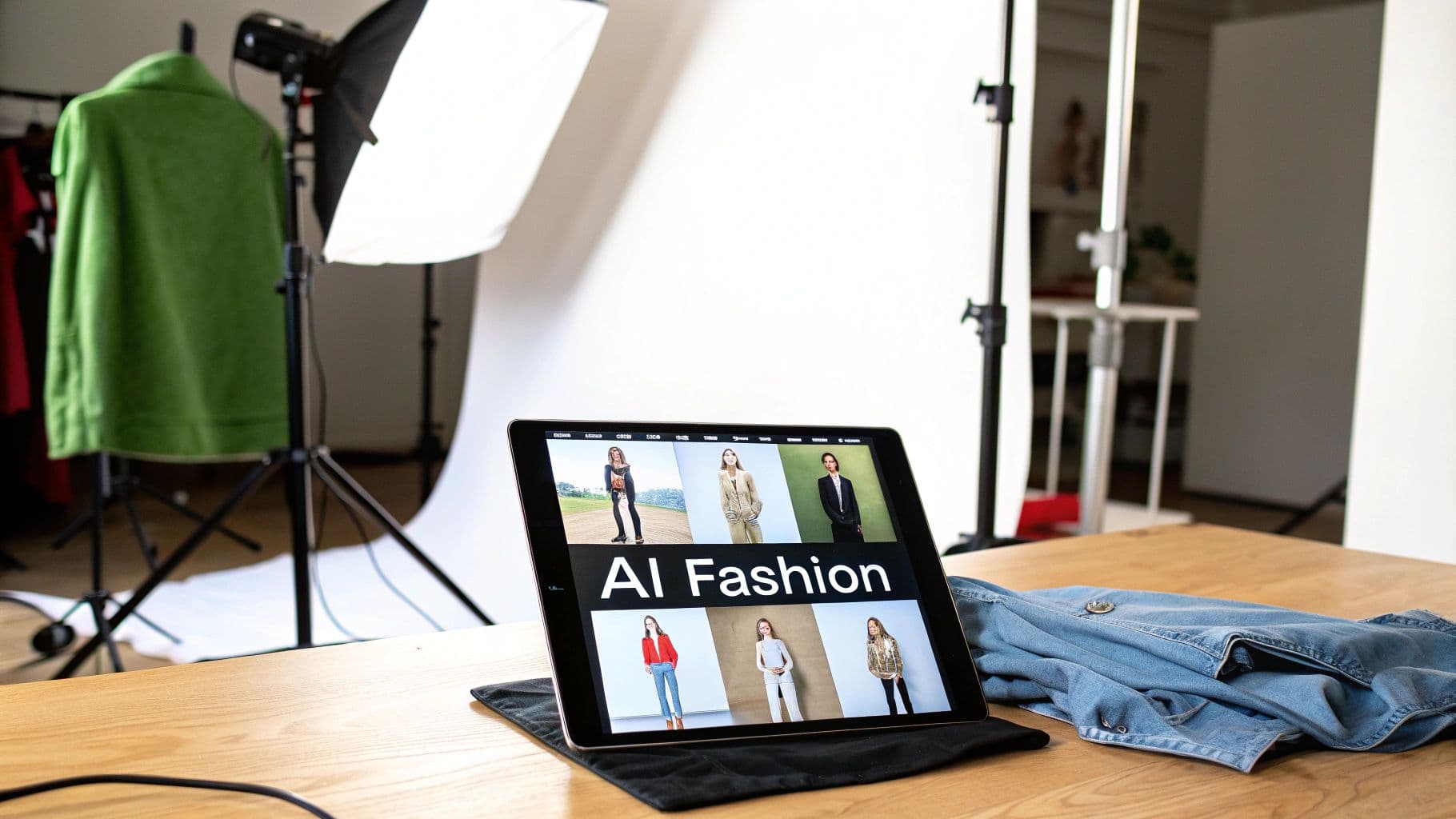
A tablet displays 'AI Fashion' showcasing models, set on a wooden table in a photo studio.
A free trial is only as good as your game plan. Without one, you'll click around, get a vague impression based on slick marketing, and end up no closer to a real decision. The trick is to treat the trial period like a focused mini-project.
Don't just poke at buttons. Before you even sign up, define a specific, measurable goal. For example: “Generate 10 unique, on-model marketing assets for our upcoming spring collection using only a single flat-lay photo.” This simple sentence changes everything. Suddenly, you’re not just exploring—you're testing the app against a real business need.
With that goal locked in, you can systematically see how the app holds up in a scenario that actually mirrors your day-to-day workflow.
Creating a Structured Evaluation
As you work toward that goal, you need to document what you find. I’m not talking about writing a novel; just a simple log or spreadsheet to capture the data that matters.
Put on your product tester hat. How long does it actually take to go from uploading a garment photo to downloading a finished, high-quality image? Jot it down. Note every little friction point in the user interface. Was it intuitive, or did you spend ten minutes hunting for a basic function? A truly best fashion design app should feel like an extension of your creative flow, not a roadblock.
The most important data you'll collect won't be about speed or clicks. It's qualitative. Does the final image quality actually meet your brand's standards? Are the AI models believable? How fast—and how helpful—is their customer support when you send a simple question? These answers tell you more than any feature list ever could.
This process gives you hard evidence to back up your final decision, protecting you from sinking money into a tool that looks great on the surface but falls apart under pressure.
Scoring and Team Feedback
To keep things objective, whip up a simple scoring system. Take the checklist you made earlier and assign a score (say, 1-5) to each key feature based on how it performed during your test. This turns gut feelings into concrete data, which makes comparing different apps way easier.
And please, don't do this in a silo. Get your team involved. Have at least two other people run the exact same test project—maybe your social media manager and your e-commerce specialist. Their perspectives are gold because they’ll be using the app for totally different reasons.
- Social Media Manager: They can immediately tell you if the image formats and styles will work for Instagram or TikTok.
- E-commerce Specialist: They’ll know right away if the images can be easily integrated into your product pages on Shopify or another platform.
Their feedback will shine a light on workflow problems you might have completely missed. When you combine a clear project goal, good documentation, and collaborative scoring, you transform a free trial from a casual look-around into a powerful decision-making machine. It’s the only way to be sure the app you choose will solve real problems and deliver real results for your brand.
Evaluating Pricing Models and Calculating True ROI

A top-down view of a wooden desk featuring a laptop, open notebook, vintage camera, and plant.
The sticker price you see on an app’s website is just the beginning of the story. To find a tool that actually makes sense for your bottom line, you have to dig deeper than the monthly fee and figure out its real return on investment (ROI). Pricing structures are all over the map, and getting a handle on them is the only way to avoid painful surprise costs later.
Many of the newer platforms, especially AI-powered ones like WearView, are moving away from simple per-user fees. You’ll find credit-based systems where you pay for each image or video you generate. This model can be a game-changer for brands with seasonal peaks, letting you crank up content production for a big launch and then scale way back during quieter months without paying for a seat you aren’t using.
Uncovering Hidden Costs and Usage Rights
Before you even think about signing up, you need to play detective and hunt for hidden costs. Are you going to get hit with extra fees for high-resolution exports? Is there a cap on how many assets you can create each month? Some tools even have tricky licensing restrictions on the AI models or backgrounds they use, which can turn into a legal nightmare.
Just as critical is getting a crystal-clear understanding of your commercial usage rights. The right app will give you full, unrestricted ownership of everything you create. You need to be 100% sure the product shots you make for your website can be repurposed for social ads, email campaigns, and digital lookbooks without owing royalties or violating terms.
The real value of an app isn't just its price, but the operational costs it eliminates. The true ROI comes from subtracting the tool's cost from the money you save on photographers, model agencies, studio rentals, and physical sample production.
Calculating the True Return on Investment
Figuring out the real ROI is a simple cost-versus-savings calculation. Start by adding up everything you spend on a single traditional product photoshoot—the photographer, the model, the studio, the retoucher. Now, compare that number to the cost of a subscription or credit pack that lets you generate dozens of visuals with an app. For most brands I’ve worked with, the savings are immediate and massive.
It’s no surprise the fashion design software market shot up by 11.6% in just one year; the financial benefits for e-commerce brands are just too big to ignore. The best platforms can slash your content production costs by up to 90% compared to the old way of doing things.
But the savings go beyond just dollars. Think about the value of speed. What’s it worth to your brand to get a new collection to market weeks, or even months, faster? An AI-powered app doesn’t just save you money; it accelerates your entire content pipeline. You can jump on trends instantly and launch new products with a full suite of marketing assets ready from day one. When you factor that in, the investment pays for itself over and over.
To get a feel for how different plans are structured, you can check out some common software pricing models and see what makes the most sense for your workflow.
Common Questions About Choosing a Fashion App
Picking the right software can get confusing, fast. Especially when you hear terms like "design app" and "content app" thrown around like they’re the same thing. They’re not.
To cut through the noise and help you feel confident in your choice, we’ve put together answers to the most common questions we hear from fashion brands.
What Is the Difference Between a Fashion Design App and a Content App?
It’s simple, really. A fashion design app is for creating the actual product.
Think of tools like Adobe Illustrator for digital sketching or CLO3D for incredibly detailed pattern making and 3D prototyping. These are what designers use to take a garment from a rough idea to a manufacturer-ready technical spec.
A fashion content app, on the other hand, is purely for marketing. It takes your finished product—often just a simple flat-lay photo—and generates the high-quality, on-model visuals you need for your website, social media, and ad campaigns.
The bottom line: a design app helps you make the product, and a content app helps you sell the product.
How Much Should I Expect to Pay for a Good Fashion App?
The price tag can swing wildly depending on what the app does. A simple digital sketching tool might only set you back $10-$50 a month. But for advanced 3D design software, which is a specialized skill, you’re looking at anywhere from $100 to over $500 per user, per month.
AI-powered content platforms like WearView usually have a different pricing model, often a monthly subscription or a credit-based system. These typically land somewhere between $50 to a few hundred dollars a month, depending on the volume of images you’re creating.
The real way to think about cost is to weigh the subscription price against the thousands of dollars you're saving by not having to book traditional photoshoots.
The goal isn't to find the cheapest option, but the one that delivers the highest value. A slightly more expensive app that slashes your content production time in half provides a far better return on investment.
Are AI Fashion Apps User-Friendly for Non-Technical People?
Yes, absolutely. In fact, that's one of their biggest selling points. The best fashion design app options that use AI are specifically built for marketers and e-commerce managers, not 3D artists.
The workflow is usually dead simple: upload a photo of your clothing, pick a model and a style, and hit generate. A few seconds later, you’ve got a folder of finished assets ready to go.
Most of these platforms know their users are busy people who need to create great content without a six-week training course. Always, always take advantage of a free trial to make sure the app feels right for your team’s current skills.
How Can a Fashion App Help with Diversity and Inclusion in Marketing?
This is where modern AI content apps really change the game.
With a traditional photoshoot, you’re limited by the models you can find, schedule, and afford in your area. AI platforms completely demolish that barrier. They give you on-demand access to a massive, diverse library of virtual models.
In just a few clicks, you can generate stunning imagery featuring a wide range of ethnicities, body types, ages, and styles. This isn't just a "nice-to-have"—it's a powerful way to create marketing campaigns that truly reflect your global customer base, which leads to much stronger engagement and a brand message that feels genuinely inclusive.
Ready to transform your fashion content creation? With WearView, you can replace costly photoshoots with instant, studio-quality visuals. Upload a garment, pick a model, and generate an endless supply of on-brand marketing assets in seconds. Discover how WearView can scale your brand today.
WearView Team
WearView Content & Research Team
WearView Team is a group of fashion technology specialists focused on AI fashion models, virtual try-on, and AI product photography for e-commerce brands. We publish in-depth guides, case studies, and practical insights to help fashion businesses improve conversion rates and scale faster using AI.