January 15, 2026•17 min read
The Ultimate Guide to the Augmented Reality Shirt
Discover how an augmented reality shirt transforms fashion e-commerce. Learn how to use AR to boost sales, engage customers, and reduce returns.
The Ultimate Guide to the Augmented Reality Shirt
An augmented reality shirt takes a simple piece of clothing and turns it into a launchpad for interactive experiences, all viewed through a smartphone. It’s like a physical garment with a secret digital life. When you point your phone’s camera at the shirt, its design can come alive with animations, 3D models, or even a virtual fitting session.
This technology forges a direct, engaging link between a physical product and a brand's digital universe.
The Magic Behind Interactive Apparel
Hand holds smartphone with AR app pointing at blue shirt on mannequin, green screen background.
At its core, an augmented reality shirt closes the gap between what you see in the real world and the endless possibilities of digital content. It works by using a visual trigger—usually a specific graphic printed right on the fabric—that a smartphone app or web browser is trained to recognize.
Once the app sees that trigger, it overlays digital information onto the live camera feed. This makes it look as if the digital content is part of the shirt itself. It’s a powerful new channel for brands to connect with customers long after the sale is complete.
This isn't just a gimmick; it’s a real shift in how we interact with products. The market growth backs this up, with the global Augmented Reality Market in Fashion projected to explode from USD 3.14 billion in 2025 to a staggering USD 27.05 billion by 2031.
How AR Technology Powers a Shirt
So, how does a static design on a t-shirt suddenly spring to life? It all comes down to a few key technologies working together seamlessly behind the scenes.
Think of it as a three-part system:
- Image Recognition: This is the "eye" of the whole operation. The software constantly analyzes the camera's view, waiting to spot the specific, pre-programmed image or pattern printed on the shirt.
- 3D Rendering: The moment the trigger is recognized, the system kicks into gear. It renders and displays 3D models, animations, or videos, "anchoring" them to the shirt's location on your screen so they move with it.
- WebAR or Native App: This experience gets delivered in one of two ways. It can be through a dedicated mobile app you download, or more commonly, through WebAR, which lets you jump right into the action from your mobile browser—no download needed.
An augmented reality shirt isn't just clothing; it's a media platform. It can launch a game, tell the story of its sustainable origins, or let a customer see how it fits without ever stepping into a dressing room.
To really see the business potential here, it helps to look at the bigger picture of Augmented Reality (AR) shopping. This technology is fundamentally changing how people decide what to buy online.
Brands are increasingly turning to AR for powerful virtual try-on solutions that give customers the confidence to click "buy," which in turn helps slash return rates.
Why AR Is a Game Changer for Fashion Brands
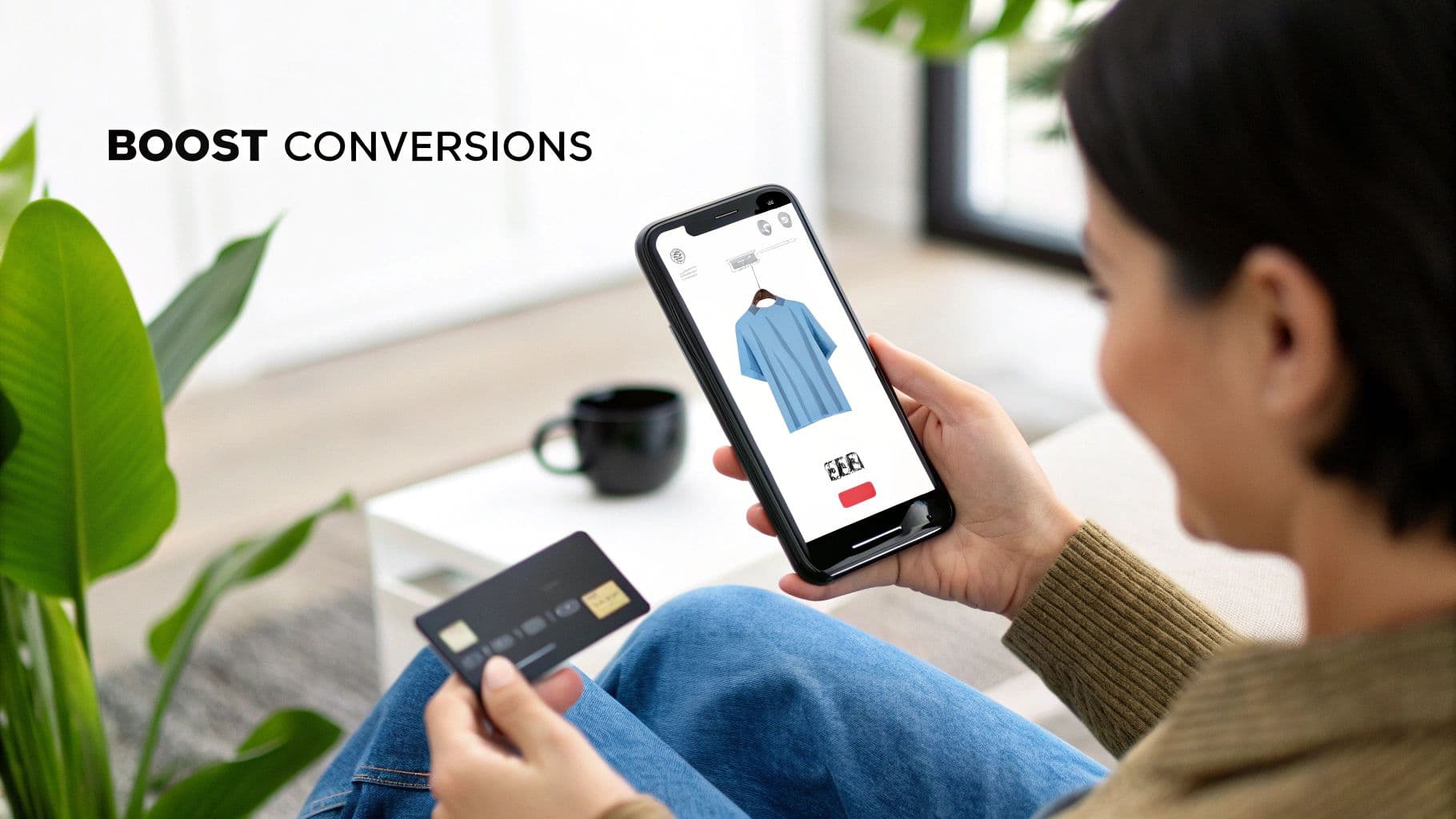
Person holding a smartphone displaying a blue shirt for sale, along with a credit card, to boost conversions.
Sure, AR has a "wow" factor, but an augmented reality shirt delivers real, measurable value that solves some of the oldest problems in e-commerce. For fashion brands, this isn't just a gimmick. It’s a powerful tool for building customer confidence, cutting down on operational headaches, and directly improving the bottom line.
The biggest win? Tackling the massive, profit-eating problem of returns. When a shopper can’t try something on, they’re forced to guess their size. This gamble often leads to a frustrating cycle of buying, returning, and repurchasing that burns through profits and creates a logistical nightmare.
AR-powered virtual try-on completely changes this game. By letting customers see how a shirt actually fits on their own body through a smartphone, you remove the guesswork. This digital fitting room gives them the confidence they need to click "buy" and mean it, leading to a huge drop in return rates and a much healthier profit margin.
Driving Engagement and Conversions
Augmented reality also turns the passive scroll into an active, memorable experience. In a market where every brand is screaming for attention, this kind of interaction is gold. Instead of just swiping through static product photos, customers are now playing with your product in their own living room.
That deeper connection builds a sense of ownership and trust. When a customer has a fun, positive, and interactive moment with your product, they aren't just more likely to buy it—they're more likely to remember your brand long after.
The numbers back this up. The AR in Retail market is set to grow by a staggering USD 19.51 billion through 2028, with apparel leading the charge. This explosion is happening for a simple reason: customers want to see how a garment will look and fit before they commit. AR finally delivers that. For a deeper dive, check out the market forecasts in Technavio's research.
Building a Competitive Edge
In today's market, you either stand out or you get lost in the noise. Adopting AR sends a clear signal that your brand is innovative and obsessed with the customer experience. It immediately sets you apart from competitors still stuck in the old world of flat product grids.
Integrating AR isn't just about chasing a trend; it’s a strategic move to create a fundamentally better shopping experience that builds loyalty and carves out a real competitive advantage.
This tech gives you a whole new canvas for storytelling. Imagine an interactive animation that highlights a shirt’s sustainable materials or a gamified experience that encourages customers to share their virtual try-on looks on social media. These are the kinds of unique interactions that forge a genuine emotional bond between a person and a brand.
At the end of the day, an augmented reality shirt is a multi-tool that solves practical problems while unlocking exciting marketing opportunities. It cuts returns, boosts conversions, and builds a loyal base of customers who feel truly connected to the products they wear.
Putting AR Shirts to Work in Your Store
Beyond the initial "wow" factor, an augmented reality shirt opens up a whole suite of practical and creative ways to elevate your e-commerce game. These aren't just tech gimmicks; they're tools that transform the flat, predictable online shopping journey into something interactive, engaging, and genuinely helpful.
The most powerful and immediate application is virtual try-on. Let's be honest, size charts are a necessary evil. Instead of making customers guess, you let them use their phone's camera to see exactly how a shirt drapes on their body, right in their own room. That single feature can be the difference between an abandoned cart and a confident purchase.
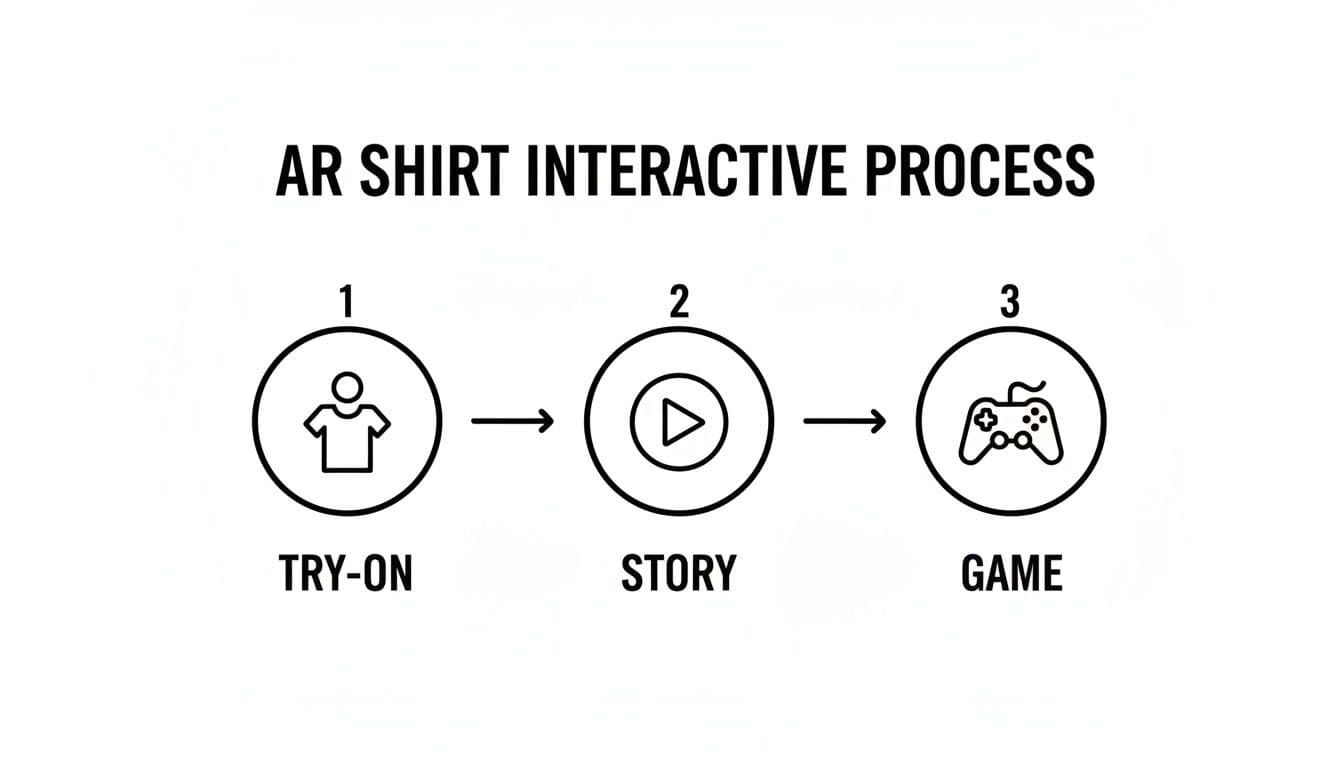
A diagram outlining the AR shirt interactive process: try-on, story, and game, with corresponding icons.
As you can see, the experience doesn't have to stop at utility. A single piece of apparel can become a multi-faceted marketing channel, moving from a practical function to a deeper brand connection.
Beyond the Virtual Fitting Room
While try-on is a huge draw, the real magic happens when you use AR to build your brand and connect with customers. This technology lets you bake stories and experiences right into your products.
Imagine a customer pointing their phone at a graphic tee. Instead of just seeing the design, they unlock exclusive content:
- Interactive Storytelling: A short video pops up showing the sustainable materials used to make the shirt. Or maybe the artist behind the design appears, explaining their inspiration. Suddenly, it’s not just a shirt; it’s a story the customer feels connected to.
- Gamification: Turn your apparel into a key that unlocks a game or a contest. Scanning the shirt could reveal clues, open up new levels, or grant access to a unique branded filter for social media. This encourages user-generated content and turns customers into brand advocates without you having to ask.
This approach turns a simple sale into a memorable moment.
By embedding digital experiences directly into the fabric of your products, you create an ongoing conversation with your customer that extends long after the initial purchase. It’s a way to add value, foster loyalty, and keep your brand top-of-mind.
Creating these AR experiences starts with high-quality, realistic model imagery. For instance, the image below from a platform like WearView shows how a simple product photo can be transformed into the kind of lifelike asset needed for a believable try-on.
A diagram outlining the AR shirt interactive process: try-on, story, and game, with corresponding icons.
This visual highlights how platforms can generate the on-model photos essential for creating believable virtual try-on assets. When you start visualizing these applications—from the practical to the playful—you realize an AR shirt strategy isn't just about technology. It's about creating a more dynamic and compelling customer journey from start to finish.
Creating Your First AR-Ready Shirt
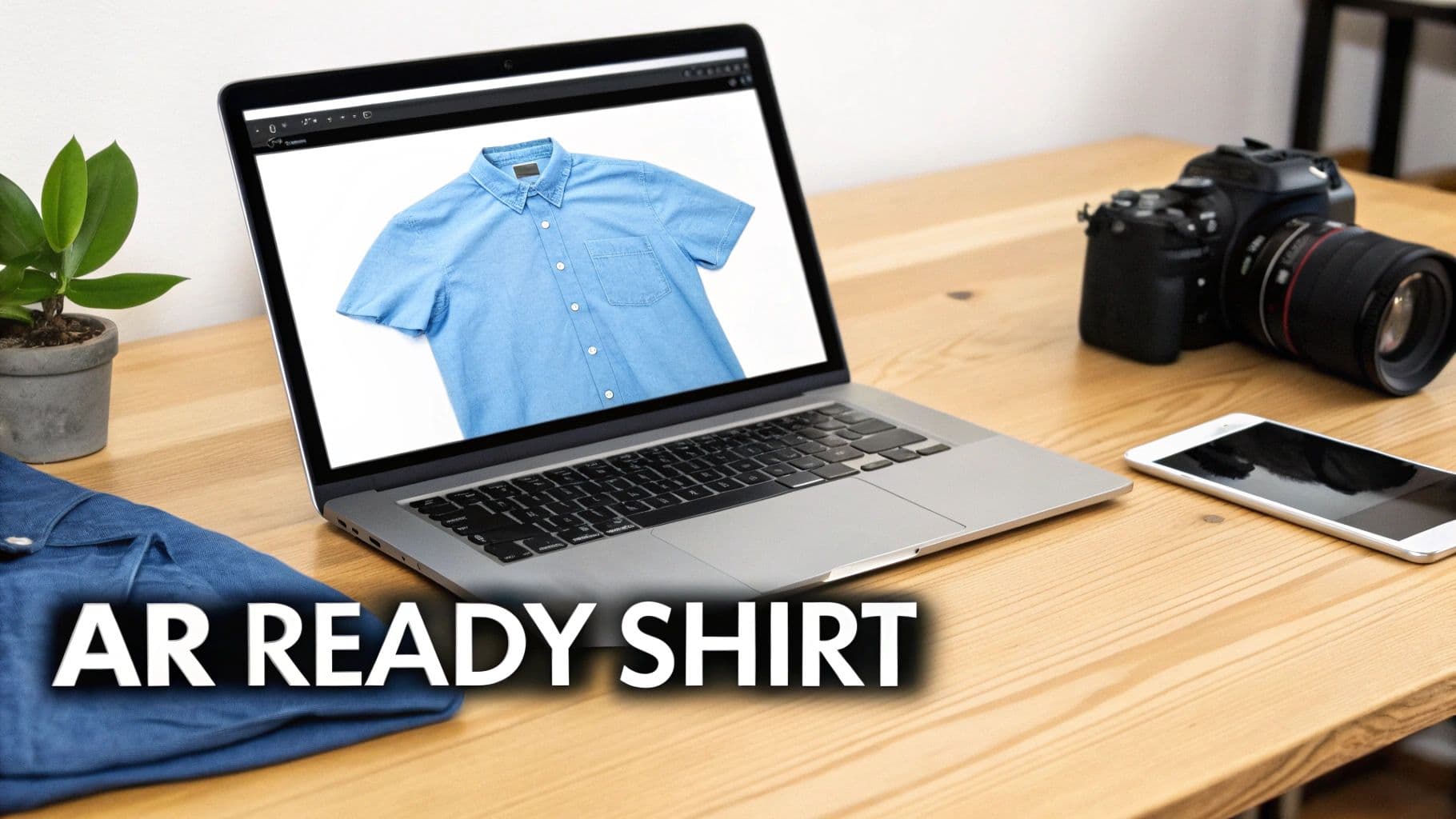
A laptop displays a blue shirt, alongside a camera, smartphone, and a real shirt, signifying AR readiness.
Bringing an augmented reality shirt to life hinges on one critical piece: a high-quality 3D model of the garment. This isn't just an image; it's a digital twin that customers will see, spin around, and virtually "wear" on their screens. For a long time, just creating this one asset was the biggest hurdle for fashion brands.
The process used to be incredibly expensive and technically complex, demanding specialized skills that most brands simply didn't have in-house. It was a massive roadblock that kept AR experiences locked away for only the biggest players with the deepest pockets.
Thankfully, that's all changed. The way these assets are made has been completely upended, opening the door for brands of all sizes to get in the game. Understanding your options is the first step.
The Old Way: Manual and Expensive
Traditionally, getting a 3D model was a painstaking and costly affair. It usually involved one of two methods, neither of them quick or cheap.
- 3D Scanning: This approach uses specialized laser or structured-light scanners to map out the exact shape and dimensions of a real shirt. While it produces a super-accurate digital replica, the hardware is pricey and you need a trained technician to run it.
- Photogrammetry: This technique involves taking hundreds—literally hundreds—of photos of a shirt from every conceivable angle. Special software then stitches all those images together to build a 3D model. It’s a bit more accessible than scanning, but it's wildly time-consuming and still needs a lot of manual cleanup from a 3D artist to look right.
Either way, you were looking at a professional photoshoot, a skilled 3D artist, and a ton of billable hours. This workflow made it practically impossible to create AR assets at the scale needed for an entire product catalog. The cost alone could easily run into the thousands of dollars for a single garment.
The New Way: AI-Driven and Accessible
Today, AI has completely simplified the entire process. Modern platforms have wiped out the need for complicated photoshoots and pricey 3D artists, making the creation of an augmented reality shirt both fast and affordable. This new approach automates all the heavy lifting.
The biggest shift is moving from complex manual creation to simple automated generation. Instead of needing 3D artists, brands now just need a few basic product photos to get started.
Platforms like WearView use sophisticated AI to transform simple flat-lay or hanger photos of your shirt into photorealistic, AR-ready 3D models. The AI looks at your 2D image, understands the garment's shape, texture, and how it should drape, and then generates a lifelike digital version from scratch.
This new model can then be instantly displayed on a diverse range of AI-generated models, giving you total creative control without ever booking a studio. By exploring the possibilities of AI model creation, you can generate a whole catalog's worth of on-model imagery in a matter of hours, not weeks. This AI-powered workflow finally removes the stubborn barriers of cost and complexity, putting high-quality AR experiences within reach for everyone.
Integrating AR Into Your E-Commerce Platform
Once you've got your photorealistic 3D assets dialed in, the next big question is: how do you get this amazing augmented reality shirt experience into your customers' hands? This isn't just a technical decision; it directly shapes how shoppers interact with your products and how much control you have over the final look and feel.
There are a few ways to tackle this, but they mainly boil down to building your own app or using a solution that works right in a web browser. Each approach has its own trade-offs when it comes to cost, customer effort, and the technical heavy lifting involved.
Choosing Your AR Delivery Method
Building a custom branded app gives you ultimate control. You can craft every pixel and interaction to perfectly match your brand's vibe and weave AR features deep into your own ecosystem. The catch? This path demands a serious upfront investment in development and requires a budget for ongoing maintenance and updates.
But the bigger issue is the hurdle it puts in front of your customer.
The biggest roadblock with a dedicated app is trying to convince a shopper to leave your product page, hunt through an app store, and download a piece of software just to see how a shirt looks. That's a lot of friction, and it's where you lose people.
This is exactly why WebAR has become the go-to for most fashion brands. This technology runs directly inside a customer’s mobile web browser, which means there is absolutely no download required. A customer just taps a "Virtual Try-On" button on your product page, and the experience loads instantly. It’s seamless, removes the barriers, and keeps the shopper right where you want them—on the path to purchase. Our guide on the essentials of a virtual dressing room dives deeper into how this frictionless approach is a game-changer for conversion rates.
The numbers back this up, too. The AR in Retail market was already valued at USD 2 billion in 2021 and is projected to explode to USD 61.3 billion by 2031, according to research from Allied Market Research. This growth is being fueled by accessible, easy-to-use applications like virtual try-on. By choosing a WebAR solution, you can tap into this massive trend without the cost and complexity of app development, turning an augmented reality shirt into a powerful and scalable sales tool.
The Future of Interactive Fashion and Apparel
The augmented reality shirt isn't the final destination. Think of it as a crucial first step into a future where fashion is far more dynamic and integrated, shaped by futuristic clothes ideas like smart fabrics and responsive textiles. The lines separating our physical wardrobes from our digital closets are blurring fast, giving rise to a new retail world often called "phygital."
This blend of the physical and digital is set to completely reshape the in-store experience. Imagine smart mirrors, powered by AR, that let a customer try on your entire collection without ever stepping into a fitting room. They could cycle through colors, patterns, and styles in an instant, merging the convenience of online browsing with the tangible feeling of being in a physical store. It creates a fluid journey where digital adds a new layer of magic to the real world.
Viral Marketing and Social Commerce
The next big playground for AR apparel is right where your customers already are: social media. We're going to see more and more brands launching viral campaigns using AR filters on platforms like Instagram and TikTok. A user could "try on" your latest shirt design with a single tap, share it with their followers, and buy it directly through the filter.
This simple interaction transforms every single user into a potential brand ambassador. It flips the script from a passive product view into an active, shareable experience that can organically explode across networks, driving both buzz and direct sales.
Hyper-Realism Through Better Tech
As the underlying technology gets better, so will the AR experiences themselves. The continued rollout of 5G networks means faster, more intricate AR interactions without any frustrating lag. At the same time, smarter AI will enable digital garments that look and feel incredibly real.
We're talking about fabrics that move, fold, and wrinkle with stunning accuracy. Lighting that perfectly reflects a user's actual environment. It's a leap from a fun gimmick to a genuinely convincing simulation.
Looking ahead, AR in fashion is just one piece of a much larger puzzle. To get the full picture, it's worth exploring insights into the future of marketing, including AI and VR. Staying ahead of these shifts is how you build a long-term strategy that doesn't just follow trends but sets them.
Frequently Asked Questions
Even with a clear path forward, jumping into new tech always brings up a few questions. Let's tackle the most common ones we hear from fashion brands thinking about augmented reality shirts.
We’ll keep the answers direct and practical to help you move forward with confidence.
How Much Does an Augmented Reality Shirt Feature Cost?
The price tag can swing wildly depending on how you build it. A completely custom, from-scratch app can be incredibly expensive, eating up huge amounts of development time and resources. On the other hand, modern WebAR solutions are far more affordable and easier to scale.
The biggest variable has always been the cost of creating the 3D models themselves. This is where AI-powered platforms are changing the game. They can slash asset creation costs by turning your simple product photos into AR-ready models, making it a surprisingly cost-effective way for any brand to get started.
The main thing that used to make AR expensive was the manual labor of 3D modeling. AI automation has finally made high-quality asset creation cheap and fast enough for brands of all sizes, completely flipping the economics of launching an augmented reality shirt.
Do Customers Need a Special App for Try-On?
Not anymore, and they shouldn't have to. The best and most effective method today is WebAR, which runs right inside a standard mobile browser like Chrome or Safari.
A customer just taps a "Virtual Try-On" button on your product page, and the experience loads instantly. There's nothing to download. This smooth, frictionless journey is absolutely critical for getting people to actually use the feature and leads to much better conversion rates than forcing users into an app store.
What Is the Biggest Challenge With AR for Shirts?
Historically, the single biggest roadblock was creating realistic 3D models for an entire catalog. Trying to digitally capture a shirt's unique drape, how it fits, and the texture of the fabric was both painfully slow and expensive. For most companies, it just wasn't practical.
But this is a problem that modern AI platforms have essentially solved. They automate the creation of high-fidelity 3D assets from your existing 2D product images. This one breakthrough has finally made AR a truly practical and powerful tool for fashion brands looking to stand out.
Ready to see just how simple it is to get AR-ready assets for your apparel line? WearView turns your flat-lay product photos into stunning, photorealistic on-model imagery and virtual try-on experiences in seconds. Get started with WearView today.

WearView Team
WearView Content & Research Team
WearView Team is a group of fashion technology specialists focused on AI fashion models, virtual try-on, and AI product photography for e-commerce brands. We publish in-depth guides, case studies, and practical insights to help fashion businesses improve conversion rates and scale faster using AI.