May 14, 2026•20 min read
How to Design Clothes Step by Step (2026)
Most "how to learn clothing design" guides skip the parts that actually trip beginners up: how much it costs, what to do if you can't draw, which apps are worth paying for, and how long any of this really takes. This is the version I wish someone had handed me on day one, with a 12-week plan, a real budget, and the apps working designers use.
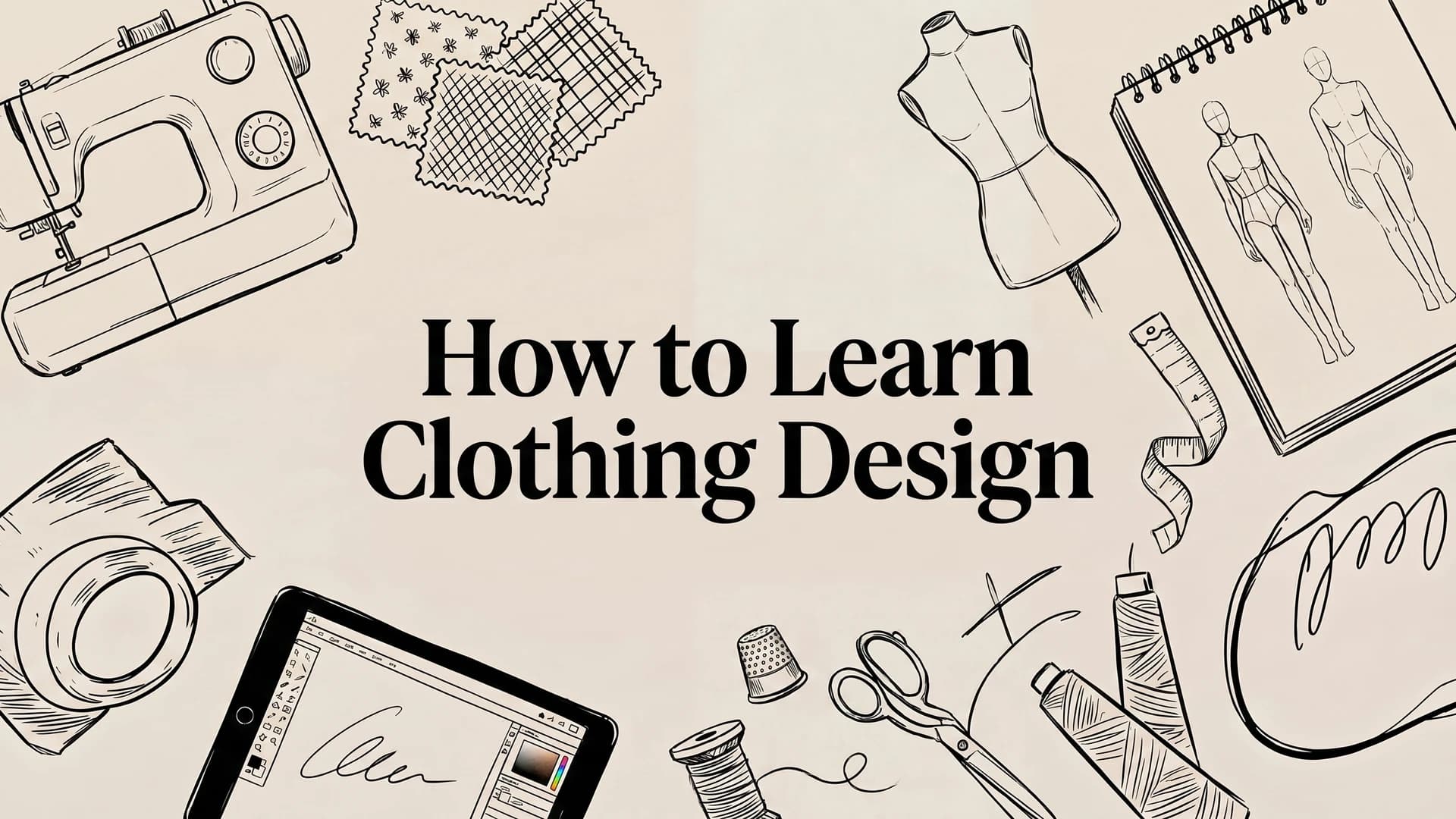
How to learn clothing design: cover illustration with sewing machine, dress form, fabric swatches and fashion sketches
The honest version of how to learn clothing design is messier than most blogs make it sound. You don't go from inspiration to runway in five clean steps. You sketch something, realize it can't actually be sewn, redraw it, buy fabric that turns out to be wrong, and try again. That iteration is the actual skill.
The good news: you no longer need a $40,000 degree or a decade of trial and error to get reasonably good. The bad news is the path is more confusing than ever. Dozens of apps, hundreds of YouTube tutorials, AI tools promising to "do the design for you," and contradictory advice about whether you should sketch first or learn to sew first.
This is the guide I wish someone had handed me when I started. It covers what clothing design actually is, the apps worth installing (and the ones that waste your time), how much money you should expect to spend, a 12-week plan that gets you to a finished garment, and what to do if you can't draw yet. We'll also talk about where AI fits in all this, because it comes up in every Reddit thread on the topic.
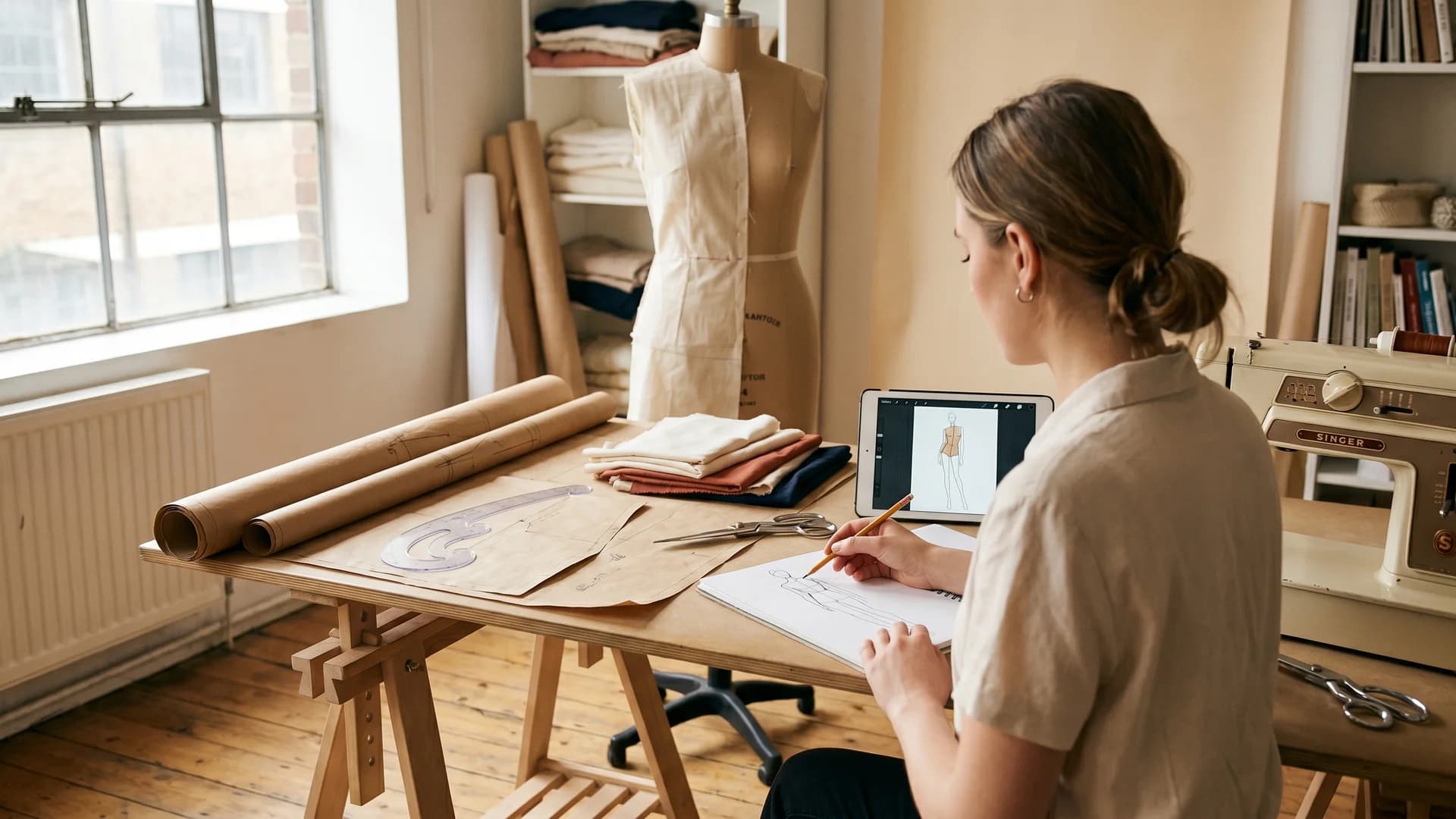
Aspiring fashion designer learning clothing design at her studio desk: sketching a croquis on paper next to an iPad with digital flats, surrounded by pattern paper, fabric swatches, a dress form with a muslin toile, and a vintage sewing machine
First, what does "clothing design" actually mean?
There's a real difference between picking out a Burda pattern, choosing a fun fabric, and sewing it, and actually designing clothes. The first is sewing. The second is design. You can love the first and never bother with the second. Both are fine.
If you want to design, the work breaks into four overlapping skills:
- Research and concept. Looking at color, fabric, history, season, and feeling. Building mood boards. Deciding what you want the clothes to say.
- Drawing or communicating the design. Sketches, croquis, flats. Or, if you can't draw yet, well-annotated reference photos and clear written specs (more on that below).
- Pattern making. Turning a 2D idea into pieces that can be cut and sewn into a garment that fits a real body.
- Sampling and finish. Toiles, fittings, fabric choices, real construction, hems that actually lie flat.
People sometimes argue that "fashion design" is the bigger picture (collections, runway, brand) and "clothing design" is the technical side (specific garments, fit, production). In practice the terms blur. Use whichever feels honest to what you're doing.
You don't need to master all four at once. Almost every self-taught designer I know started with one of them, usually sketching or sewing, and let the others develop over the next year.
How to start designing clothes (even if you can't draw)
Most guides assume you can sketch a croquis on day one. If you can, great. If you can't, here's what actually works.
If drawing comes easily
- Use a 9-head croquis template (the elongated fashion figure). Print one or download a free Fashionary template.
- Practice with garments you already own. Lay them flat and copy them. This trains your eye more than copying Pinterest images.
- Spend 20 minutes a day, not two hours once a week. Frequency matters more than length when you're learning to see proportion.
If drawing does not come easily
This is the part most articles skip. You can design clothes without being able to sketch a face. Designer Amiko Simonetti has written about this for years, and her framing is the cleanest: design is communication, not illustration. What to do instead:
- Reference photos. Aggregate them in Google Slides or Milanote. Annotate what you want copied from each one (a neckline here, a sleeve length there).
- Reference samples. Pull garments from your closet that are close to the silhouette you want. Measure them. That's the start of a tech pack.
- Garment vocabulary. Browse a retailer like COS or Madewell for an afternoon and read every product description. You'll pick up the words for necklines (crew, scoop, square, sweetheart), sleeves (set-in, raglan, dolman, kimono), hems, and finishes faster than from any book.
- Croquis kits with pre-drawn figures. Trace over them. Etsy is full of them for under $10.
- Hire a freelance sketcher on Upwork or Fiverr when you need a polished portfolio piece. Decent ones cost $20 to $60 per sketch.
Two of the most respected independent designers I follow on Instagram cannot draw a clean croquis. They communicate with photos, measurements, and tight written specs, and their pattern makers handle the rest. The "you must sketch to design" idea is mostly a hangover from fashion school. In the real world, plenty of working designers don't.
Either way, the first move is research
Before any sketch, spend a week on research. This feels like procrastination. It is not.
- Color. Pick a palette of 3 to 5 colors. Pinterest is fine; Coolors.co is better for actual hex values.
- Fabric. What fiber? What weight? What drape? Order swatches before you order yardage. A garment in linen behaves nothing like the same garment in viscose.
- Reference period. Pick a decade, a designer, or a subculture. Constraint helps. "I want to make clothes" produces nothing; "I want to make 1970s workwear in deadstock denim" produces a collection.
- Mood. One sentence. "Borrowed from a boyfriend who turned out to be a librarian." That kind of thing. Specific is good.
Research is the actual difference between a coherent collection and a pile of disconnected garments. Skip it and your second drop will look like someone else designed it.
Then learn pattern making (the part nobody warns you about)
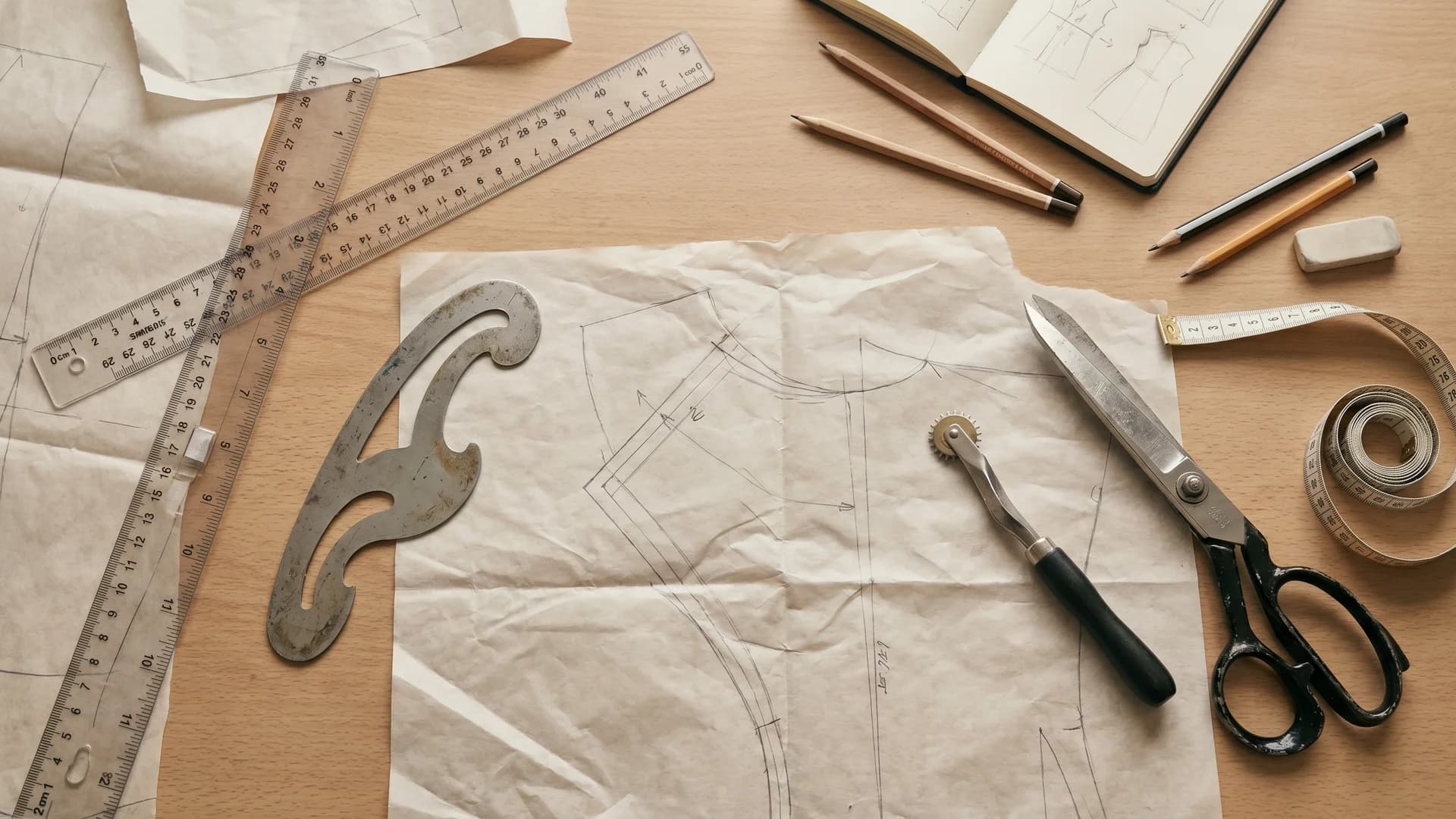
Pattern making tools for beginners: pattern paper with a bodice block, French curve, metal ruler, dressmaker's shears, tracing wheel and tape measure
Patterns are how a sketch becomes a real garment. They're also where most self-taught designers stall, because pattern making involves geometry and math and is much less photogenic than sketching. Skip this and you'll keep redrawing the same silhouette without ever wearing it.
Start small:
- Learn the four basic blocks (also called slopers): bodice, sleeve, skirt, trouser. These are the foundation patterns you fit to a body once, then modify forever.
- Understand seam allowance, grainline, and notches before drafting anything. Beginners forget these and end up with garments that twist on the body.
- Before drafting from scratch, alter a commercial pattern. Take a Burda, Vogue, or McCall's pattern and change the neckline, the sleeve, the length. You learn 80 percent of pattern manipulation this way, and you finish a garment at the end.
- Watch one full garment go from flat pattern to sewn piece. Made to Sew on YouTube does this beautifully.
If you want to go straight to digital, Seamly2D is free, open source, and will teach you flat pattern principles without costing anything. CLO3D simulates fabric drape in 3D and is closer to industry tooling, but it has a steep learning curve and runs about $50 per month. More on that in a minute.
The clothing design apps you actually need (and the ones you don't)
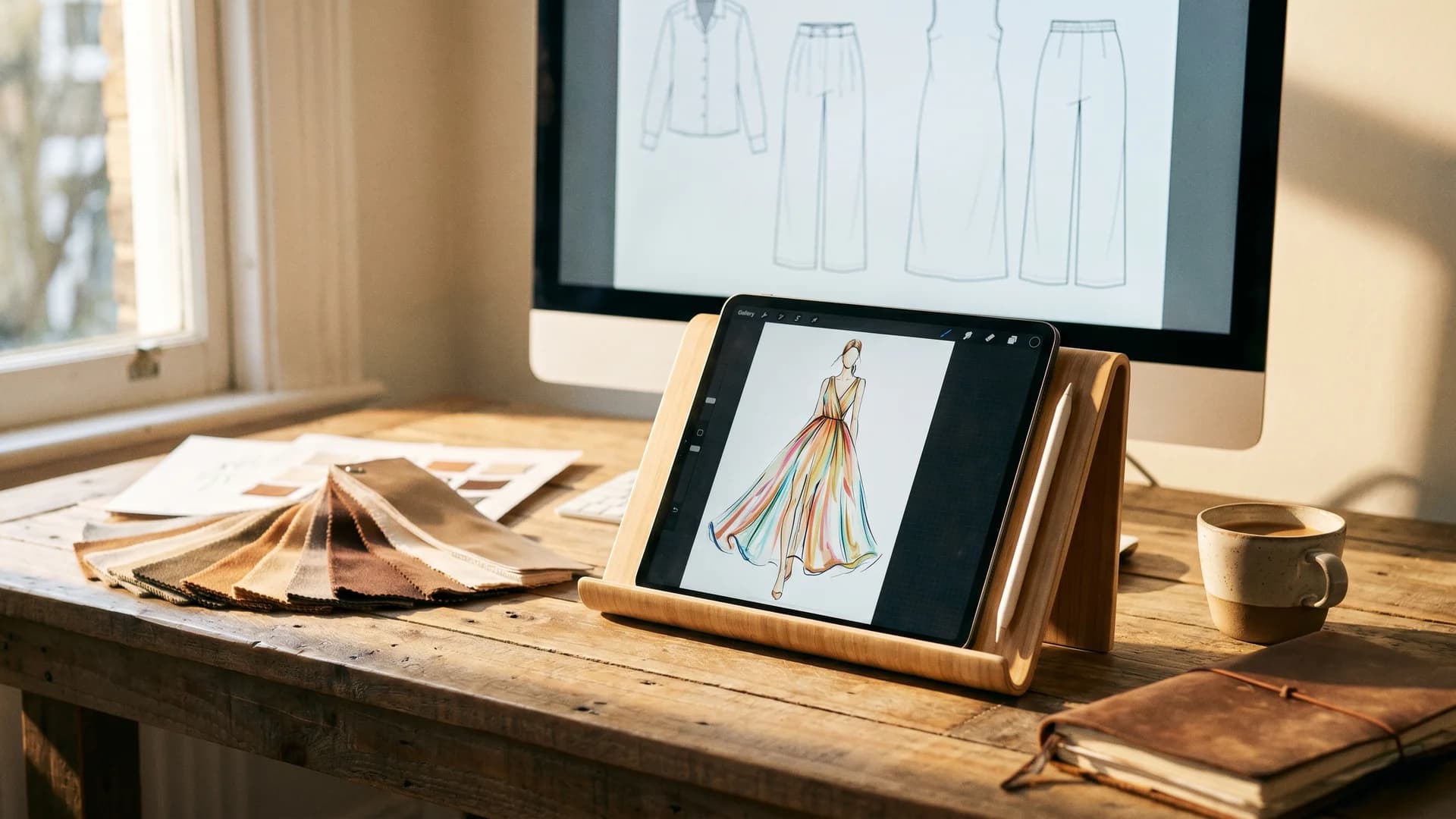
Designer's desk showing the best clothing design apps in action: an iPad running Procreate with a fashion croquis, a monitor with technical flats in Illustrator, and a fabric swatch fan
After watching beginners install everything and use nothing, here is the short list. You don't need all of these. You probably don't need most of them in year one.
| Stage | App | What it does | Cost |
|---|---|---|---|
| Sketching | Procreate | iPad illustration app most working designers use for hand-drawn looks | $12.99 one-time |
| Sketching (free) | Adobe Fresco | Drawing and painting, generous free tier | Free; paid from $9.99/mo |
| Flats and tech packs | Adobe Illustrator | Industry standard for technical flats you'd send to a manufacturer | From $22.99/mo |
| Pattern making (free) | Seamly2D | Open-source 2D pattern drafting | Free |
| Pattern making (pro) | CLO3D or Browzwear | 3D garment simulation, used by most large brands | From $50/mo (CLO) |
| Custom blocks | Bootstrap Fashion | Generates block patterns from your measurements | Free patterns + paid options |
| Mood boards | Milanote, Pinterest, or Are.na | Visual research and collection planning | Free tiers |
| Visualization | AI fashion model generator | See finished garments on AI models in seconds | From $24/mo (WearView) |
A few honest takes:
- Procreate vs Illustrator. Procreate is faster to learn and better for hand-drawn croquis. Illustrator is non-negotiable if you ever want to send a tech pack to a manufacturer. Most working designers run both.
- CLO3D is overhyped for beginners. Yes, big brands use it. Yes, the demos are stunning. But the learning curve is real, and you can produce ten finished garments on paper patterns in the time it takes to model one in CLO. Come back to it in year two.
- Pinterest is enough for a first mood board. You do not need Milanote or Are.na until you're organizing real collections.
- AI tools for visualization are the genuinely new thing on this list. More on that below. They replace the photoshoot, not the design.
For a deeper comparison, our roundup of the best apps for clothing design goes app-by-app with screenshots.
How to design clothes on Procreate (a quick workflow)
If Procreate is your first stop, this is the setup that saves you the most time:
- Start a new canvas at A3 (300 DPI, sRGB).
- Import a croquis template as the bottom layer, drop it to about 30 percent opacity, and lock it.
- Make a new layer for the garment outline. Use the 6B Pencil brush. Draw the silhouette only, no details yet.
- Make separate layers for seams, details (pockets, buttons), and color blocks. Layers let you swap colors or styles without redrawing the figure.
- For symmetry on collars and pockets, turn on Drawing Assist with a vertical guide.
Save the file as your template. The next ten designs will take a third of the time.
Where to learn: courses, books, and YouTube (in that order)
Online courses worth paying for
- Coursera "Fashion as Design" from MoMA. Free to audit. Strong history and design-thinking foundation, light on technique.
- MasterClass with Marc Jacobs and Diane von Furstenberg. High production value, more inspirational than instructional. Worth one month if it's in budget.
- Domestika "Fashion Design from Sketch to Finished Garment" by Sofía Lerche. One of the few courses that walks you to an actual finished piece.
- University of Fashion. The largest video library, structured like a real curriculum. About $20 per month.
- Skillshare classes by Coco Bee, Daniel Furon, and Tasha Goddard. Project-based, affordable, friendly.
Free resources better than most paid ones
- The Cutting Class. Deep technical breakdowns of designer garments. Free, well written, criminally under-followed.
- Made to Sew on YouTube. Couture-level pattern making and construction from a working couturier.
- Zoe Hong on YouTube. The most patient teacher on fashion illustration the internet has produced.
- Fashionary's blog and free downloads. Croquis templates and garment vocabulary references.
- FIT Open Studio. Free recorded lectures from actual FIT faculty.
Books worth owning
- "Patternmaking for Fashion Design" by Helen Joseph-Armstrong. The industry textbook. Buy used.
- "Pattern Magic" by Tomoko Nakamichi. Once you have the basics, this book makes you a designer instead of a copyist.
- "Fashionpedia" by Fashionary. Visual dictionary of every garment term. Open it whenever you don't know what a word means.
- "The Fashion Designer Survival Guide" by Mary Gehlhar. The business side everyone else skips.
- "9 Heads" by Nancy Riegelman. If sketching figures is your weak point, this is the book.
Read books first when you can. They're slower, but they explain why in a way YouTube usually doesn't. Once you understand the why, YouTube becomes much more useful.
How much does it actually cost to learn clothing design?
Most articles skip this entirely. Here is what I have seen people actually spend in their first year.
| Tier | What you get | Real cost |
|---|---|---|
| Bare minimum | Sketchbook, pencils, one secondhand pattern textbook, free apps | Under $50 |
| Starter setup | Above + Procreate, an old sewing machine off Facebook Marketplace, basic notions, fabric for two garments | $250 to $500 |
| Serious year one | iPad + Procreate, Illustrator subscription, a decent sewing machine, dress form, fabric stash, two paid courses | $1,500 to $3,000 |
| Studio-grade | Add CLO3D, an industrial machine, professional dress form, paid mentorship | $5,000 to $8,000 |
For comparison, FIT tuition runs roughly $14,000 per year in-state and $32,000 out-of-state. Parsons is about $58,000. A self-taught path at the "serious year one" tier reaches a similar skill level in 12 to 18 months for a fraction of the cost. You give up the network and the structured critique, which is real, but most independent brand founders work around that with Discord, Instagram, and paid mentorship.
If you're tight on budget, prioritize in this order: sewing machine, fabric, paper and pencils, books, apps. Software is the easiest thing to delay.
A realistic 12-week plan
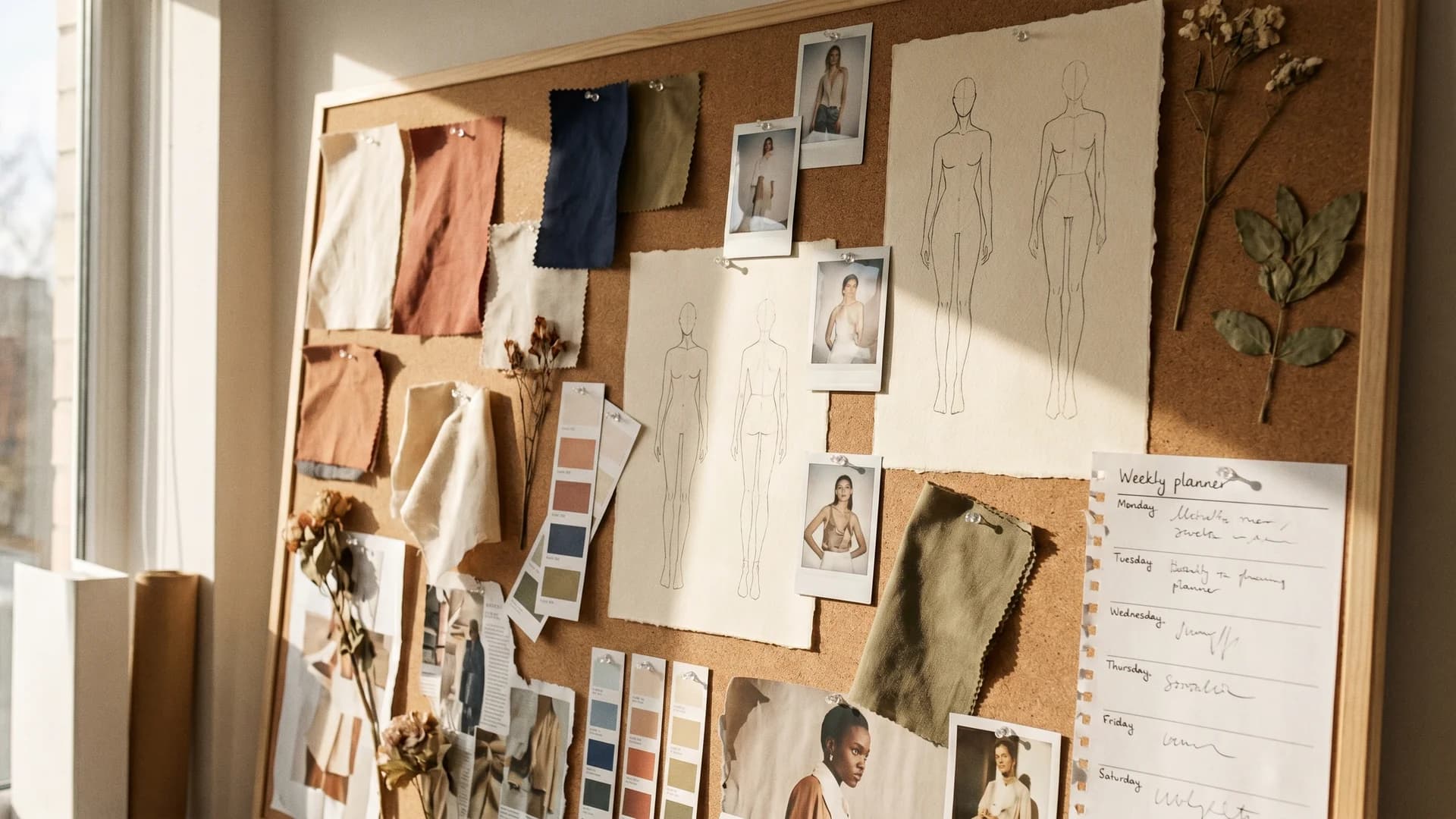
Fashion design mood board for a 12-week learning plan: fabric swatches, hand-drawn croquis sketches, color palette cards, polaroid references and a weekly planner
This assumes 5 to 10 hours a week. Less than that, double the timeline. More than that, congratulations and please use a calendar.
| Weeks | Focus | What you ship |
|---|---|---|
| 1 to 2 | Research and sketching basics, croquis or photo references | 1 mood board, 20 to 30 sketches or annotated references |
| 3 to 4 | Flats of garments you already own | A small flat-sketch library you can reuse |
| 5 to 6 | Pattern theory, alter one commercial pattern | One altered pattern fit to your body |
| 7 to 8 | Sew the altered pattern in muslin, then in real fabric | One finished garment |
| 9 to 10 | Digital flats in Illustrator or Procreate, basic tech pack | One complete tech pack |
| 11 to 12 | Photograph the finished piece, build a small lookbook | A 5-look mini portfolio |
The plan is intentionally short on theory. The fastest way to learn clothing design is to finish one imperfect thing, then iterate. The people who study for a year before sewing a stitch tend to quit before week 30.
How to design clothes and sell them online
A lot of people Googling "how to learn clothing design" actually want to sell what they design. Three honest paths, ranked by how much money you need upfront:
- Print-on-demand (Printful, Printify, Spreadshirt). You design the graphic, they print on tees, hoodies, and basics, and ship to customers. Cost to start: under $50. Margins: thin but real.
- Made-to-order. You make each piece yourself after a customer orders. Shopify or Etsy storefront, 2 to 4 week turnaround. Cost: a sewing machine and your time. Good fit for unique, slow-fashion brands.
- Manufacturer-produced. You design, send tech packs to a factory, order a minimum batch (usually 100 to 300 units per style), and sell. Cost: $5,000 to $30,000 to launch a small first drop. Best margins, but you need real product-market fit before you commit cash.
Whichever path you pick, the limiting factor for most independent designers ends up being photography. A flat-lay on Instagram converts at a fraction of a real on-model shot, and historically that shoot was the most expensive line item in a first collection: model, photographer, studio, retouching. AI tools have changed the math here, which is worth its own section.
Where AI fits (and where it doesn't)
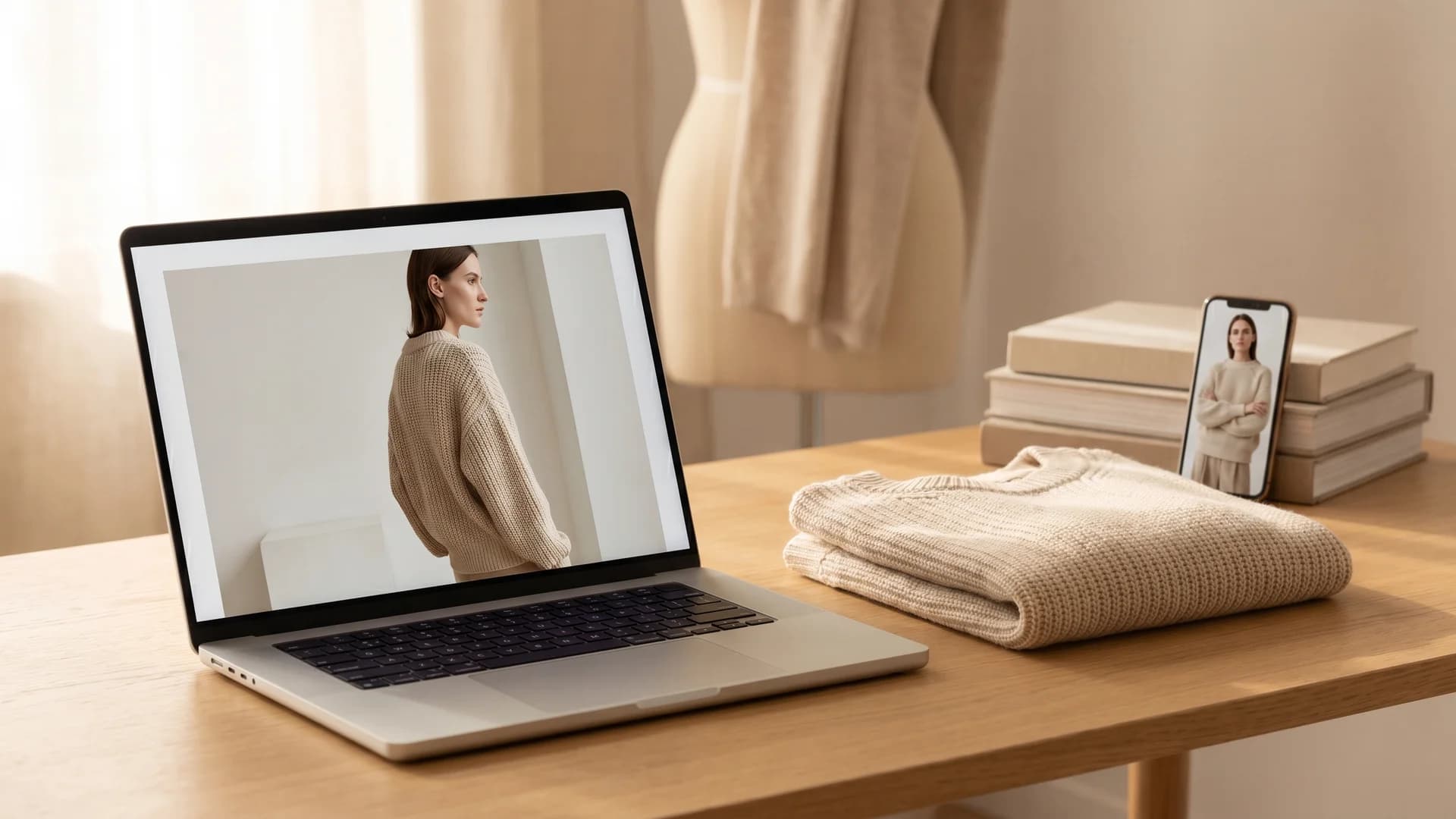
AI tools for fashion designers: a laptop and phone showing the same knit sweater visualized on different AI models next to the physical folded garment
AI is not going to design your collection for you. The current image-generation models are great at fashion-adjacent illustration and bad at producing a garment that is actually constructible. If you generate a "cool jacket" with Midjourney, the result will have impossible seam lines, missing closures, and a back you cannot draft from. The shape looks great until you try to make it real.
Where AI is genuinely useful for self-taught designers right now:
- Replacing the model shoot. Once you have a real garment sewn, you can photograph it on a flatlay or mannequin and use virtual try on clothes tools to see it on different model types, body sizes, and backgrounds. That used to require booking a studio.
- Testing styling before committing. You can see how the same garment reads in different colors or with different bottoms before you cut the fabric.
- Brand consistency for a new label. If you're building a small brand, consistent AI models let you keep the same recognizable face across drops without rebooking the same person.
Rule of thumb: AI replaces the photoshoot at the end of the process, not the design at the start. Anyone telling you otherwise is selling something.
Six mistakes that stall most self-taught designers
After watching dozens of people start and stop, the same walls show up:
- Buying everything before drawing anything. You don't need an iPad, an Illustrator subscription, and CLO3D on day one. A pencil and a notebook work for the first month.
- Skipping toiles. A toile (or muslin) is a rough version of the garment in cheap fabric. Skipping it is how you ruin your nice fabric. Sew one every time.
- Designing for fantasy bodies. A perfect 9-head croquis does not exist in real customers. Draft your patterns to real measurements, not the fashion figure.
- Studying without finishing anything. Reading "Patternmaking for Fashion Design" cover to cover and never cutting a pattern is the most common quiet failure. Finish one ugly thing.
- No point of view. Buyers, customers, and Instagram followers respond to clear voice, not technical perfection. Decide what you want to say before you obsess over how the rendering looks.
- Hiding the work. Post the ugly first muslins on Instagram. Designers who share early get feedback faster than designers who wait until everything is polished. Polish does not arrive on its own.
Key takeaways
- Sketch (or photograph) before software. The fundamentals of proportion, color, and silhouette transfer to every tool you'll use later.
- Sew one finished garment in your first three months. It's the single fastest way to internalize how clothing actually works.
- Pick one app per stage and stop shopping. Procreate, Illustrator, Seamly. That's enough for a year.
- Budget honestly. Plan for $1,500 to $3,000 in year one if you're serious. Plan for under $50 if you're testing the waters.
- Use AI to replace the photoshoot, not the design work. A platform like WearView gets you a lookbook from a single sewn sample.
- Ship five finished looks in 12 weeks. They will be imperfect. That's the point.
FAQ
How do I start designing clothes if I have no experience? Pick one garment you already own and love. Sketch it (or photograph and label the parts). Then alter a commercial pattern to match it. That single project teaches you research, sketching, pattern manipulation, and construction in one go, and you finish with something wearable.
Can I learn clothing design without going to school? Yes. Most independent brand founders working today are self-taught. A degree still matters for technical roles at luxury houses, but it's no longer required to start a label, freelance, or work at a small brand. The cost of self-teaching has dropped a lot, and the resources are better than they were a decade ago.
What is the best app to design clothes on? For sketching, Procreate on iPad is the most common choice (about $13 one-time). For technical flats and tech packs, Adobe Illustrator is the industry standard. For pattern making, Seamly2D is free and good, and CLO3D is what big brands use once you're past beginner stage.
How do I design clothes on Procreate? Start with a croquis template (Fashionary sells one, or find free ones on Instagram). Set it as a base layer at low opacity. Draw your design on a new layer above it. Use Procreate's Drawing Assist with a vertical guide for symmetry on collars and pockets. Keep flats and croquis on separate layers so you can swap garments without redrawing the figure.
How long does it take to learn clothing design? You can produce a first finished garment in 8 to 12 weeks at about 5 hours per week. Reaching a confident intermediate level usually takes 12 to 18 months of consistent work. Industry-ready takes 2 to 3 years. Mastery is, like most crafts, a decade-long project.
Do I need to learn to sew to design clothes? Not strictly. You can outsource sewing to a sample maker or factory. But you should learn the basics, because understanding construction is what separates a designer from someone who draws cool pictures. Most self-taught designers I know spent at least three months sewing before they considered themselves designers.
Can I design clothes if I can't draw? Yes, completely. Designer Amiko Simonetti has built a career around exactly this and writes openly about it. Use reference photos, sample garments, and clear written specs instead of sketches. Hire a freelance sketcher when you need polished illustrations for a portfolio piece.
What's the 3-3-3 rule in fashion? The 3-3-3 rule is a styling guideline, not a design rule, suggesting an outfit should pair three colors, three textures, and three pieces. It's useful for personal styling and lookbook art direction, not for clothing design itself. People sometimes confuse it with the rule of three in composition.
How much does it cost to learn clothing design at home? Under $50 for a bare minimum (sketchbook, pencils, one used textbook). $250 to $500 for a starter setup including Procreate and a secondhand sewing machine. $1,500 to $3,000 for a serious year one with proper software and supplies. Compare to $14,000 to $58,000 per year for a design degree.
How do I design clothes and sell them online? Three paths: print-on-demand (lowest cost, lowest margin), made-to-order on Etsy or Shopify (medium cost, niche audience), or manufacturer-produced (highest cost, best margins, requires upfront capital). For most beginners, print-on-demand is a good way to test whether anyone actually wants what you're designing before spending real money.
What should be in a beginner clothing design portfolio? Five to ten cohesive looks with a clear point of view. Each look should include a flat sketch, a finished photograph (real or AI-visualized), and a one-line description of the design intent. Quality over quantity. One finished, well-presented piece beats twenty unfinished sketches.
Is learning fashion design hard? The drawing part is learnable. The pattern making part is genuinely difficult and is where most beginners quit. The business side is the hardest. None of it is harder than learning to code or play an instrument, but it does require finishing imperfect things in public, which not everyone is willing to do.
Emma Taylor
Author & Fashion AI Expert
Emma Taylor loves fashion and new ideas. She writes about how clothes, style, and technology come together. On the StyleSphere blog, she shares easy tips and stories to help readers learn about the newest trends and how fashion is changing with technology.