November 11, 2025•44 min read
What is AI Fashion Design? Complete Guide 2026
Discover what AI fashion design is and how it's transforming the industry in 2025. Learn about top AI tools, key benefits, and real-world applications that help
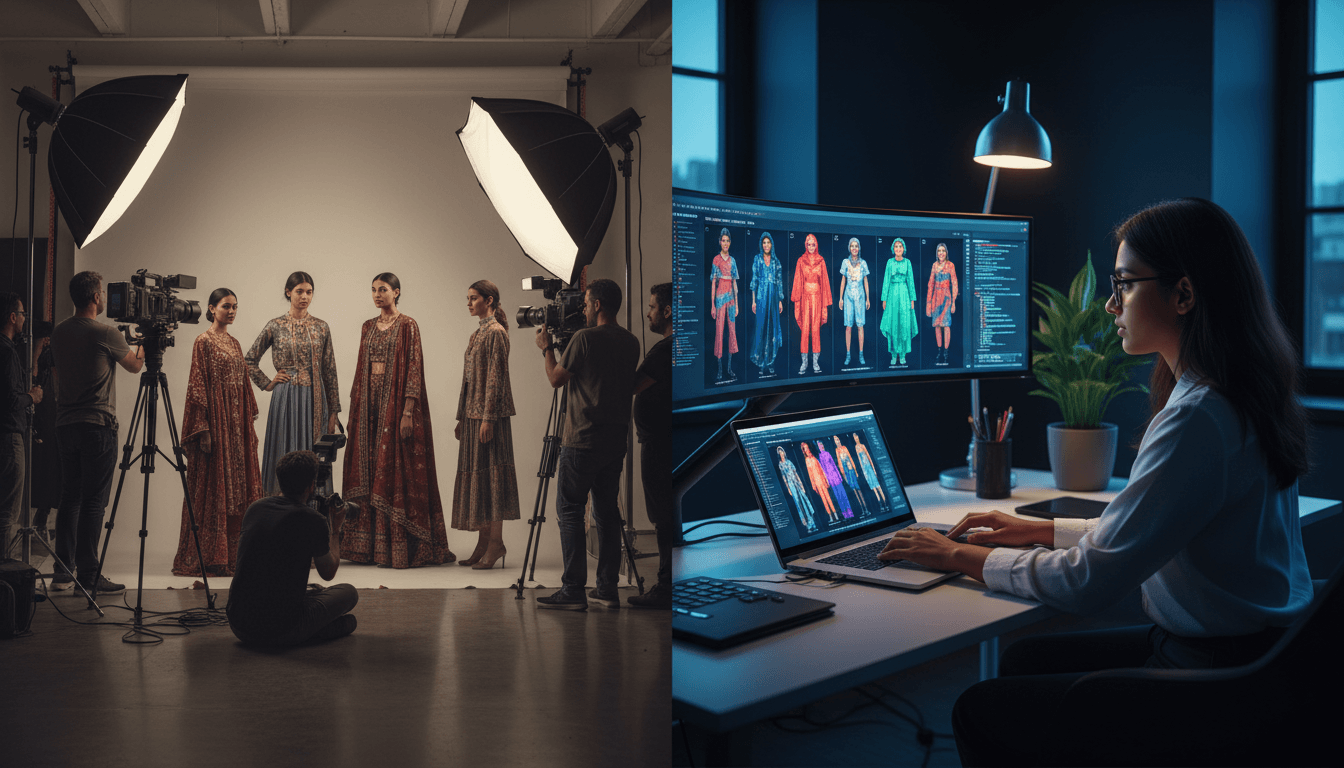
Split screen comparison of traditional fashion photoshoot with photographers and crew versus modern AI fashion design workflow with designer using laptop to generate AI models
Here's the reality that's keeping fashion executives up at night: while you're spending weeks coordinating photoshoots, managing freelancers, and wrestling with tight margins, your competitors are using AI to generate professional model shots in minutes. The gap between those who adopt AI fashion design and those who don't isn't just widening—it's becoming a chasm that no amount of traditional hustle can bridge.
We're not talking about some distant future. Right now, AI is adding an estimated $150-275 billion to fashion industry operating profits, according to McKinsey. Fashion brands are using AI to design collections, generate photorealistic product images, and predict trends before they even hit the runway. The technology that seemed experimental just two years ago has become the baseline for staying competitive.
But here's what makes this moment different from every other "game-changing" tech trend: AI fashion design isn't replacing creativity—it's amplifying it. Designers are using AI to iterate on concepts in hours instead of weeks. Small brands are producing photography that rivals luxury fashion houses. Independent creators are launching collections without touching a single fabric sample.
This guide walks you through everything you need to know about AI fashion design in 2026, from the core technologies powering the revolution to the practical tools you can start using today. Whether you're a fashion designer, brand owner, or just curious about where the industry is headed, you'll understand how AI is reshaping fashion and how you can use it to your advantage.
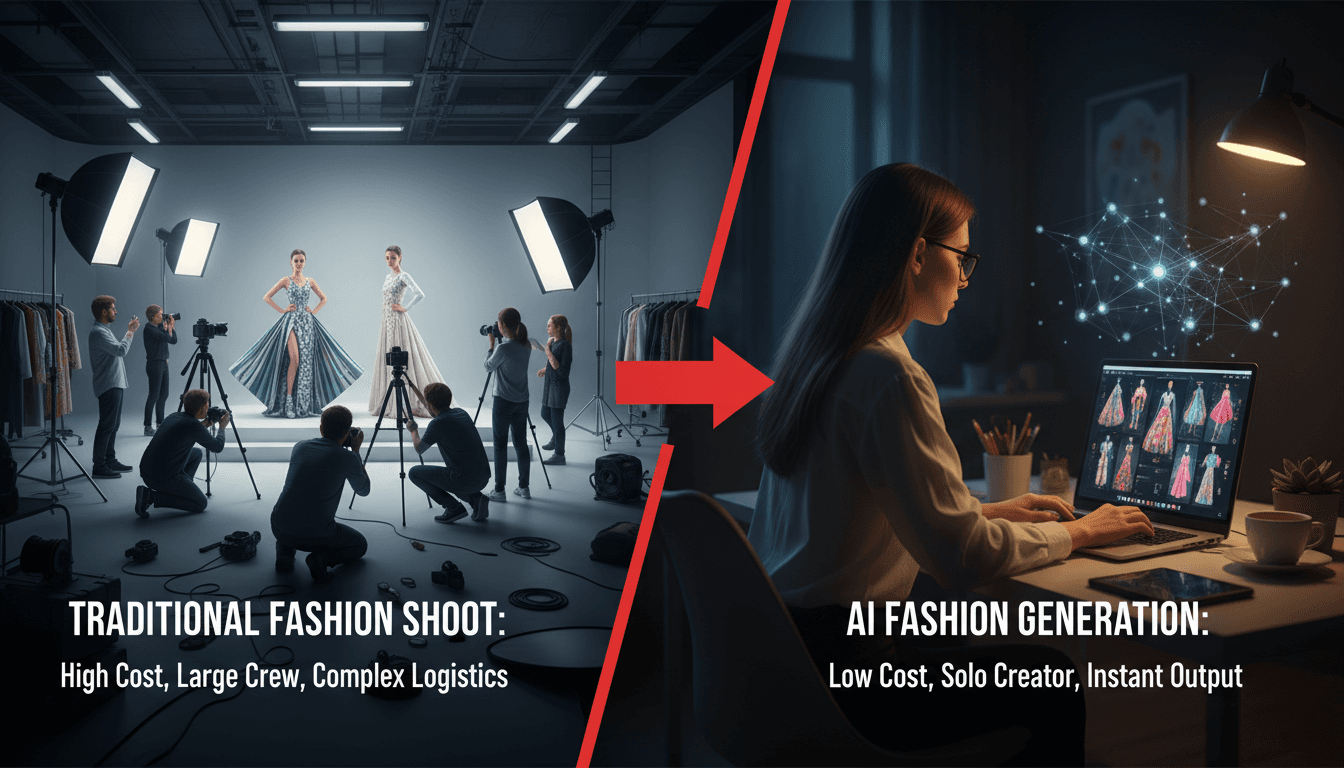
Traditional fashion photoshoot vs AI fashion design workflow comparison
What is AI Fashion Design?
AI fashion design is the application of artificial intelligence technologies to create, visualize, and modify clothing and fashion imagery without traditional photography or physical prototyping. Rather than a single tool, it's a collection of AI capabilities working together—machine learning, computer vision, generative AI, and diffusion models—to transform how fashion brands and creators produce visual content.
Think of it as giving designers and brands superpowers they never had before. According to McKinsey's analysis, generative AI is fundamentally reshaping the fashion industry by enabling rapid experimentation and reducing production costs. These systems learn from millions of fashion images to understand fabric textures, garment construction, human anatomy, and styling principles, then apply that knowledge to generate new designs or modify existing ones.
In practical terms, AI fashion design can accomplish tasks that previously required entire production teams:
- Transform a flat product photo into a professional model photoshoot, placing the garment on AI-generated models in various poses and settings
- Enable customers to virtually try on clothes by seeing how a garment would look on their body type before purchasing
- Generate multiple variations of a design concept in minutes, testing different colors, patterns, and styles without creating physical samples
- Create consistent brand imagery by generating model photos that maintain the same aesthetic, lighting, and composition across entire collections
The crucial point many people miss is that AI fashion design isn't about replacing human creativity—it's about amplifying it. Designers still make the creative decisions about style, aesthetics, and brand direction. The AI simply executes those visions faster and more affordably than traditional methods, allowing creators to experiment more freely and bring ideas to market that would otherwise be too expensive or time-consuming to test.
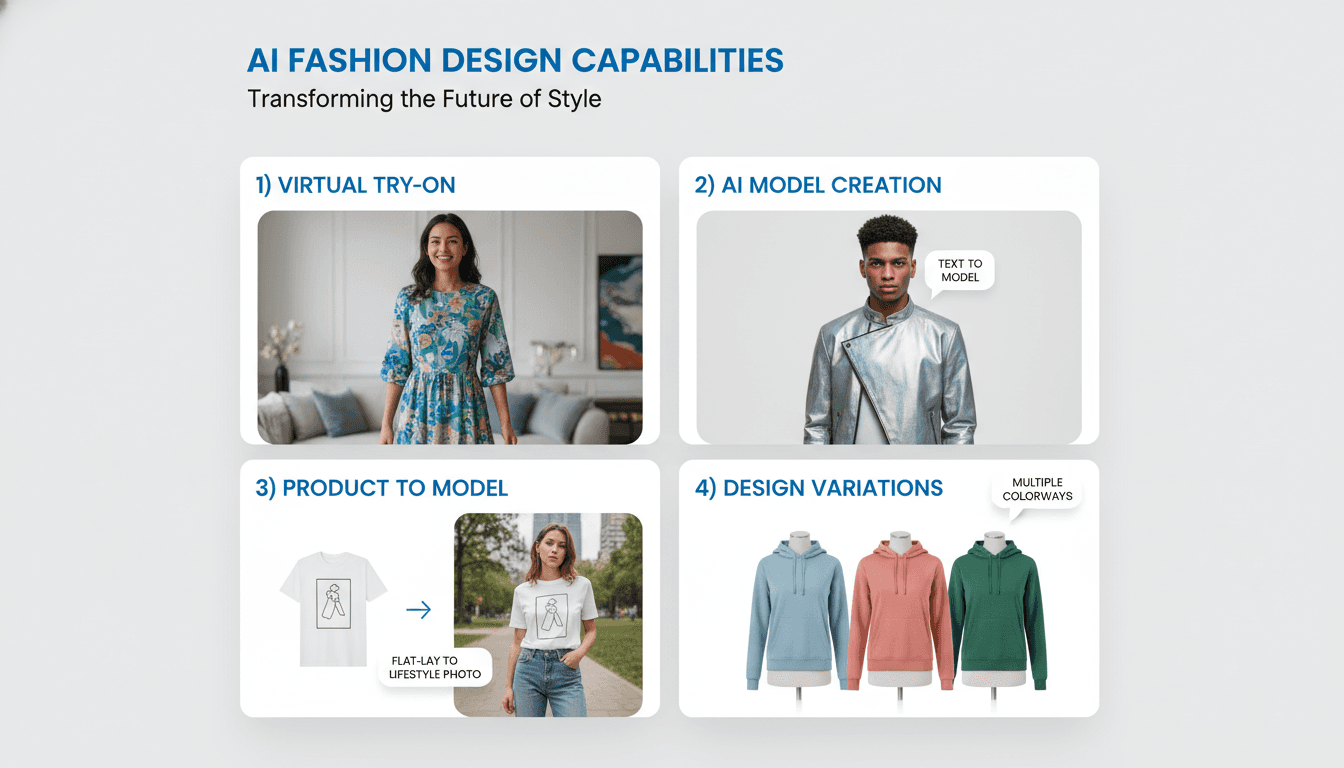
Four core capabilities of AI fashion design technology
How AI Fashion Design Works
Understanding the technology behind AI fashion design doesn't require a computer science degree, but it does help to grasp the fundamental principles. At its core, modern fashion AI relies on three interconnected technologies: diffusion models for image generation, computer vision for understanding garments, and deep learning networks that have studied millions of fashion photographs.
The Core Technologies
Diffusion models are the breakthrough that made realistic fashion AI possible. Think of them like a sculptor working in reverse—instead of chipping away stone to reveal a statue, these models start with pure visual noise (random pixels) and gradually refine it into a coherent image. The process happens in hundreds of tiny steps, each one removing a little more randomness and adding more structure based on what the AI has learned about fashion photography. This is the same technology powering tools like product-to-model transformation, where a flat garment photo becomes a professional model shot.
Computer vision acts as the AI's eyes, teaching it to recognize and understand garments with remarkable precision. When you upload a clothing image, the system doesn't just see a blob of pixels—it identifies the garment type, recognizes fabric textures, detects patterns and text, understands the cut and silhouette, and maps how the item should drape on a body. Google's Virtual Try-On technology demonstrates this capability beautifully, using advanced computer vision to preserve every detail of a garment when placing it on different models.
Deep learning networks form the intelligence layer. These neural networks have analyzed millions of fashion photographs during training, learning patterns that would be impossible for humans to consciously articulate—how different fabrics catch light, how garments conform to various body shapes, how accessories complement outfits, and what makes a fashion photograph look professional versus amateur. This accumulated knowledge allows the AI to make informed decisions when generating new images.
The AI Training Process
Before any AI fashion tool can create a single image, it undergoes extensive training on massive datasets. Imagine teaching someone to paint fashion illustrations by showing them thousands of examples—the AI learning process works similarly but at scale. These systems study millions of fashion photographs, carefully annotated with information about garment types, poses, lighting conditions, and styling choices.
The training process involves showing the AI pairs of images: perhaps a garment on a plain background paired with that same garment styled on a model. Over countless repetitions, the system learns the relationship between inputs and desired outputs. Researchers have documented this process extensively—one notable study published in MDPI explores how diffusion models specifically learn to generate realistic fashion imagery through iterative refinement.
From Input to Output: The Workflow
When you use an AI fashion design tool, a sophisticated multi-stage process unfolds in seconds. First, the system analyzes your input—whether that's a garment photo, a text description of a model, or reference images. The computer vision component extracts key features: garment structure, fabric texture, colors, and any text or patterns that must be preserved.
Next, the diffusion model begins its generation process. Starting from noise, it progressively constructs the desired image, guided by the features extracted from your input and the specific parameters you've set (like pose, background, or model characteristics). For tools like pose control, this stage incorporates reference images to ensure the generated model matches your desired composition exactly.
Finally, the system applies refinement passes—enhancing details, ensuring consistent lighting, correcting any anatomical imperfections, and verifying that garment details match the original input. The entire journey from upload to final image typically completes in 10-20 seconds, a timeframe that would have seemed impossible just a few years ago. What makes this remarkable isn't just the speed, but the fact that the AI maintains garment fidelity while creating genuinely photorealistic results that often rival traditional photography.
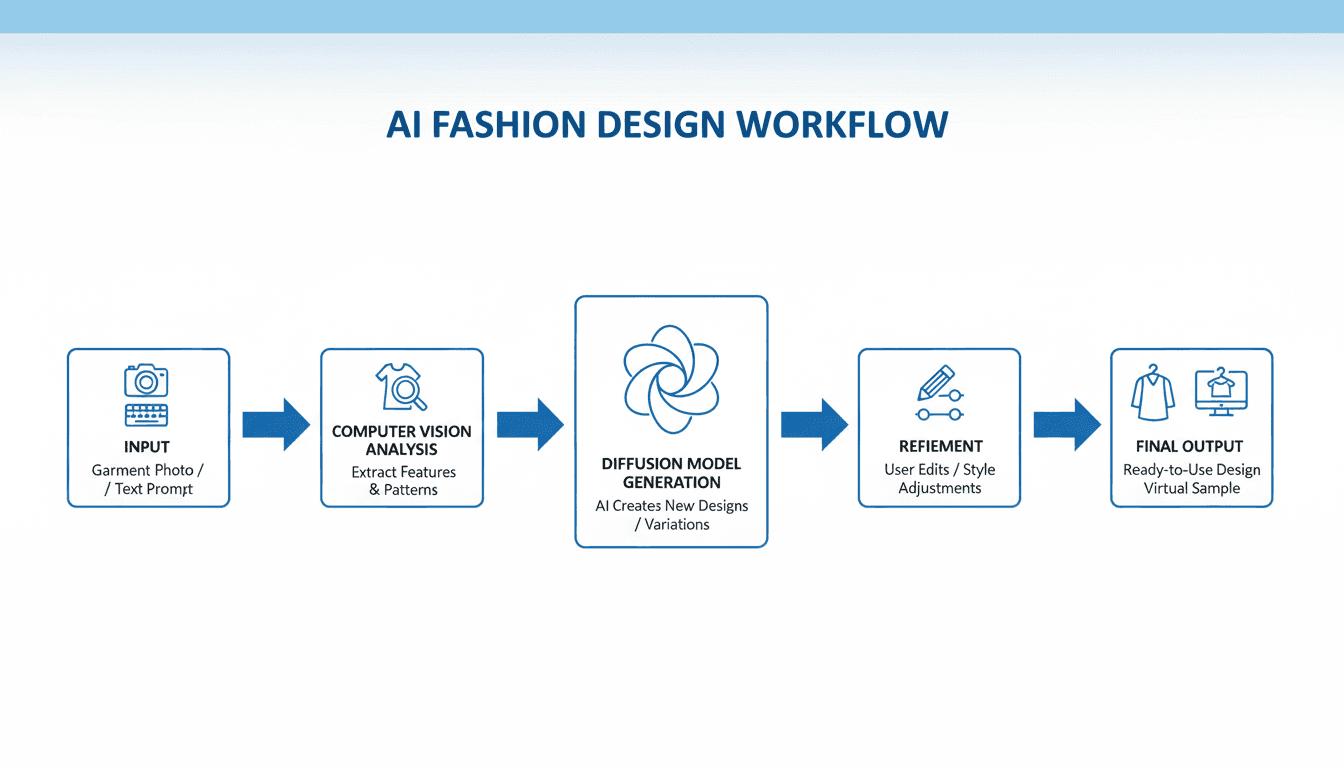
AI fashion design workflow from input to final image generation
Why Fashion Brands Are Adopting AI Design
The shift to AI-powered fashion design isn't happening because it's trendy—it's happening because the economics and creative possibilities have fundamentally changed. When McKinsey analyzed the impact of generative AI on fashion, they projected it could add $150 billion to $275 billion in additional profit to the apparel, fashion, and luxury sectors. This massive value comes from five core benefits that are transforming how brands operate.
Speed and Efficiency: From Weeks to Hours
Traditional fashion photography moves at the pace of physical logistics. A typical product photoshoot requires booking models, photographers, and studio space weeks in advance, coordinating wardrobe and styling, conducting the actual shoot, then waiting for post-production editing. The entire process typically takes 2-4 weeks from concept to final images.
AI fashion design collapses this timeline to hours. Upload a garment image, select your model preferences, and generate professional product photography in minutes. Need to test 20 different background settings or model poses? What would have required multiple shoot days now happens in a single afternoon. Brands report iteration speeds that are 30x faster than traditional methods, allowing them to test creative concepts and respond to trends while they're still relevant.
This speed advantage compounds across a brand's entire operation. Seasonal collections that once required months of planning and multiple photoshoots can now be visualized and tested in weeks. E-commerce stores can refresh their product imagery weekly instead of seasonally, keeping their catalogs feeling current and engaging.
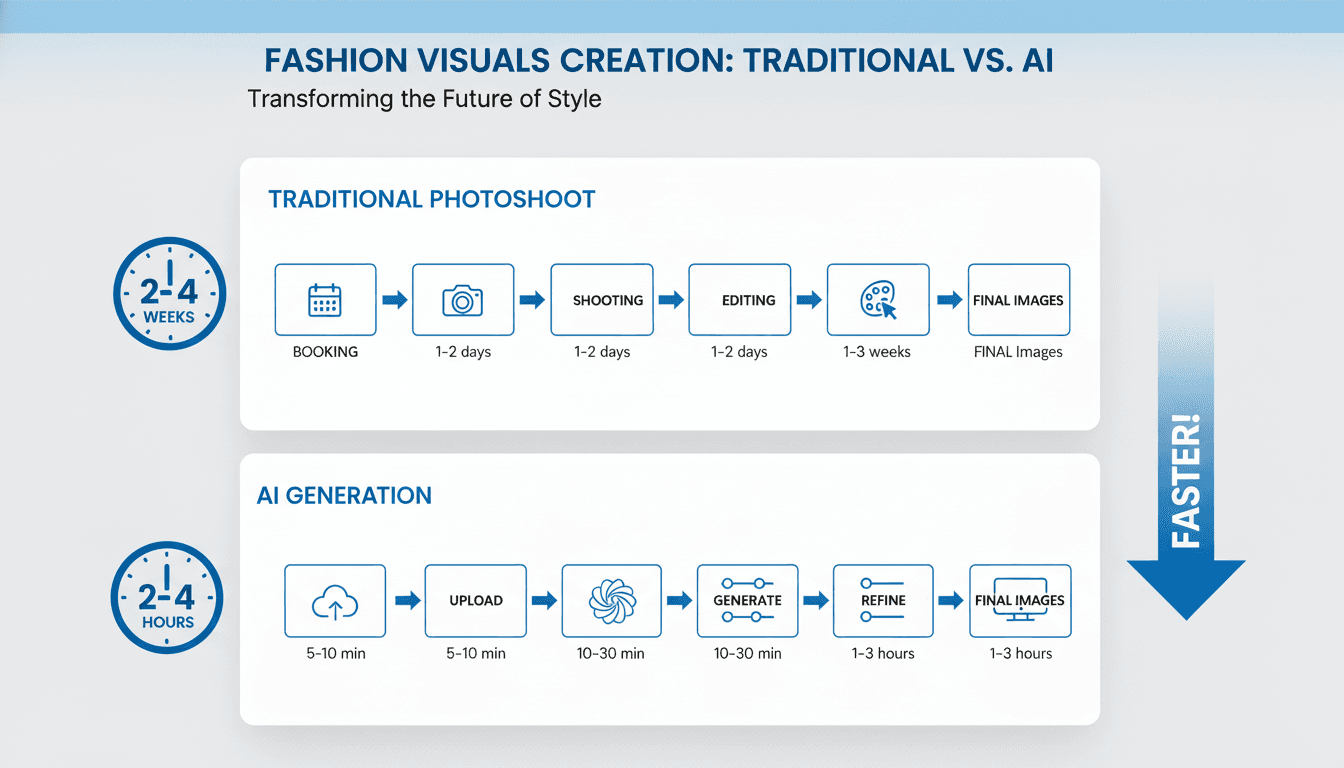
Speed comparison between traditional fashion photography and AI generation
Cost Savings: Democratizing Professional Fashion Photography
The numbers tell a stark story. A professional fashion photoshoot typically costs between $10,000 and $20,000 when you factor in model fees ($500-2,000 per day), photographer rates ($1,500-5,000), studio rental ($500-2,000), styling and makeup ($500-1,500), and post-production editing ($1,000-3,000). For emerging brands or small businesses, this represents a significant barrier to creating professional product imagery.
AI fashion design reduces these costs by 80-90%. Instead of paying for physical resources and coordinating multiple professionals, brands invest in AI generation credits that cost a fraction of traditional photography. A complete product photoshoot that would cost $15,000 traditionally can be accomplished for $500-1,000 using AI tools.
But the real savings go beyond the obvious cost reduction. Traditional photoshoots are inflexible—once you've completed the shoot, making changes means scheduling another expensive session. Realized you need different lighting after the shoot wraps? Want to test the garment on a different model type? Each change requires another production cycle and another invoice. With AI, adjustments happen instantly at minimal additional cost, eliminating the expensive mistakes that plague traditional photography. This financial accessibility is particularly transformative for fashion brands just starting out or testing new market segments.
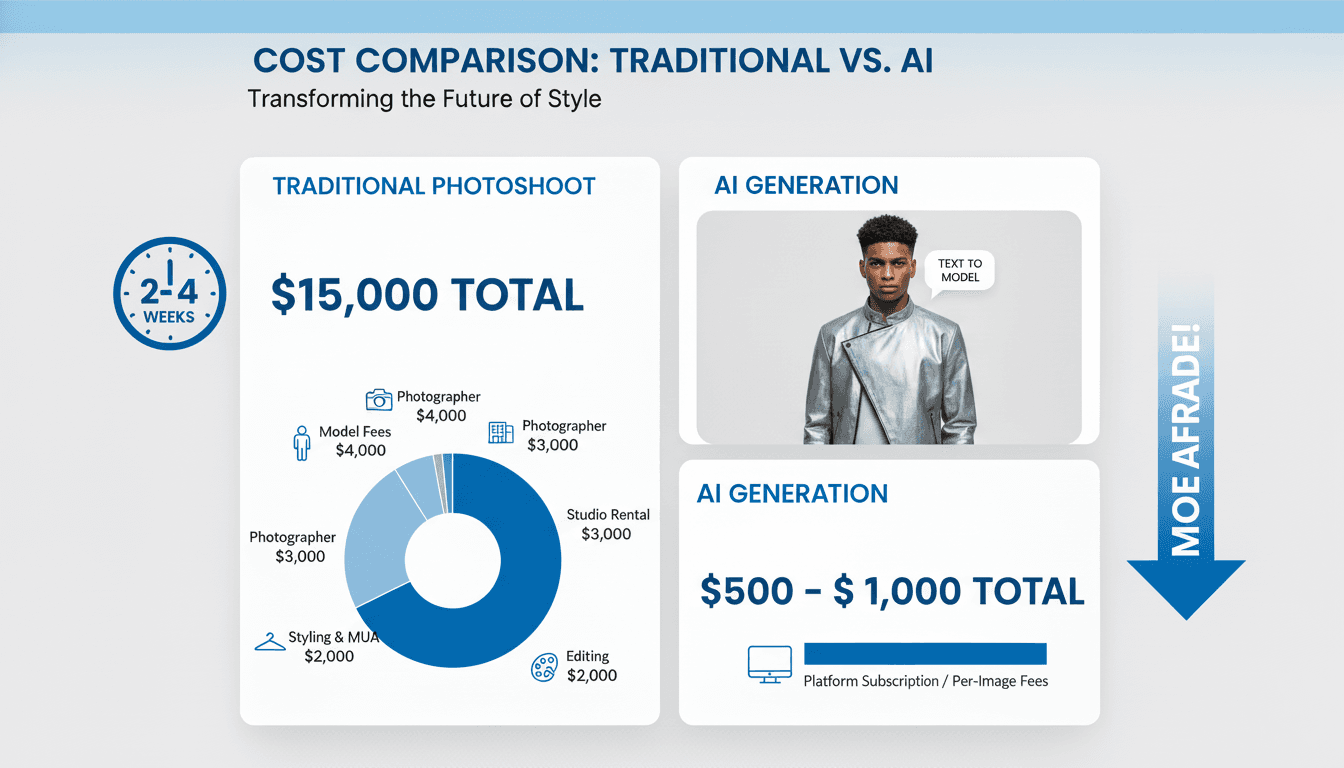
Cost comparison traditional fashion photography vs AI generation
Creative Freedom: Experimentation Without Constraints
The hidden cost of traditional fashion photography isn't just money—it's the creative ideas that never get tested. When each photoshoot costs $15,000 and takes weeks to coordinate, brands become conservative. They stick with proven concepts rather than experimenting with bold new directions. The financial and logistical risk of failure is simply too high.
AI fashion design removes these creative constraints. Want to see how your summer collection would look with a completely different aesthetic? Test it in 20 minutes. Curious if your garments would resonate with a different demographic? Generate variations targeting different customer segments without committing to expensive physical photoshoots. Wondering if a radical new styling approach might work? Experiment freely because the cost of testing ideas has dropped to nearly zero.
This shift from conservative execution to bold experimentation is changing how fashion brands operate. According to The Business of Fashion, brands using AI design tools report testing 5-10x more creative concepts than they could afford previously. Not all experiments succeed, but the ones that do often become breakthrough campaigns that would never have happened under the old cost structure.
Sustainability: Designing Without Waste
Fashion's environmental footprint is massive, and much of that waste happens before products even reach consumers. Traditional design processes require creating physical samples—prototype garments that get made, photographed, evaluated, and often discarded. A typical brand might create 20-30 sample garments for every one that makes it to production. Each sample consumes fabric, manufacturing resources, and shipping emissions, only to end up in a landfill.
AI fashion design eliminates sample waste entirely. Designers can visualize and test unlimited variations digitally before committing to physical production. Want to see how a dress looks in 15 different fabrics? (For inspiration, browse our dress design ideas.) Create digital versions instead of ordering physical samples. Need to test fit and drape on various body types? Generate AI models rather than producing size runs of samples.
The environmental impact extends beyond sample reduction. Traditional photoshoots require transporting people, equipment, and products to a physical location, often involving air travel and significant carbon emissions. As NPR reported on AI in fashion, the industry is increasingly recognizing that digital-first design processes can dramatically reduce the carbon footprint of bringing products to market. This sustainability benefit resonates particularly strongly with younger consumers who prioritize environmental responsibility.
Scalability: Growing Without Proportional Costs
Perhaps the most powerful benefit of AI fashion design is how it changes the economics of scale. In traditional fashion photography, costs increase linearly with output. Need photos of 100 products instead of 10? You'll need roughly 10x the budget and 10x the time. This linear scaling creates a ceiling on how much content brands can produce.
AI fashion design breaks this linear relationship. The cost and time to generate professional imagery for 100 products is only marginally higher than generating imagery for 10 products. Once you've set up your workflow and model preferences, scaling to thousands of product variations becomes a matter of processing time, not exponential cost increases. Our playbook for producing fashion imagery at scale walks through how to build that pipeline.
This scalability unlocks entirely new business models. E-commerce stores can offer personalized product visualization, showing the same garment on models that match each customer's body type and style preferences. Fashion marketplaces can provide professional imagery for thousands of independent sellers who couldn't afford traditional photography. Brands can create hyper-localized campaigns targeting different regions with culturally relevant model representation, something that would be prohibitively expensive using traditional methods.
The result is a fashion industry that can move faster, experiment more boldly, operate more sustainably, and serve customers more personally—all while reducing costs. These aren't theoretical benefits. They're the practical reasons why AI fashion design adoption is accelerating across the industry, from emerging direct-to-consumer brands to established luxury houses.
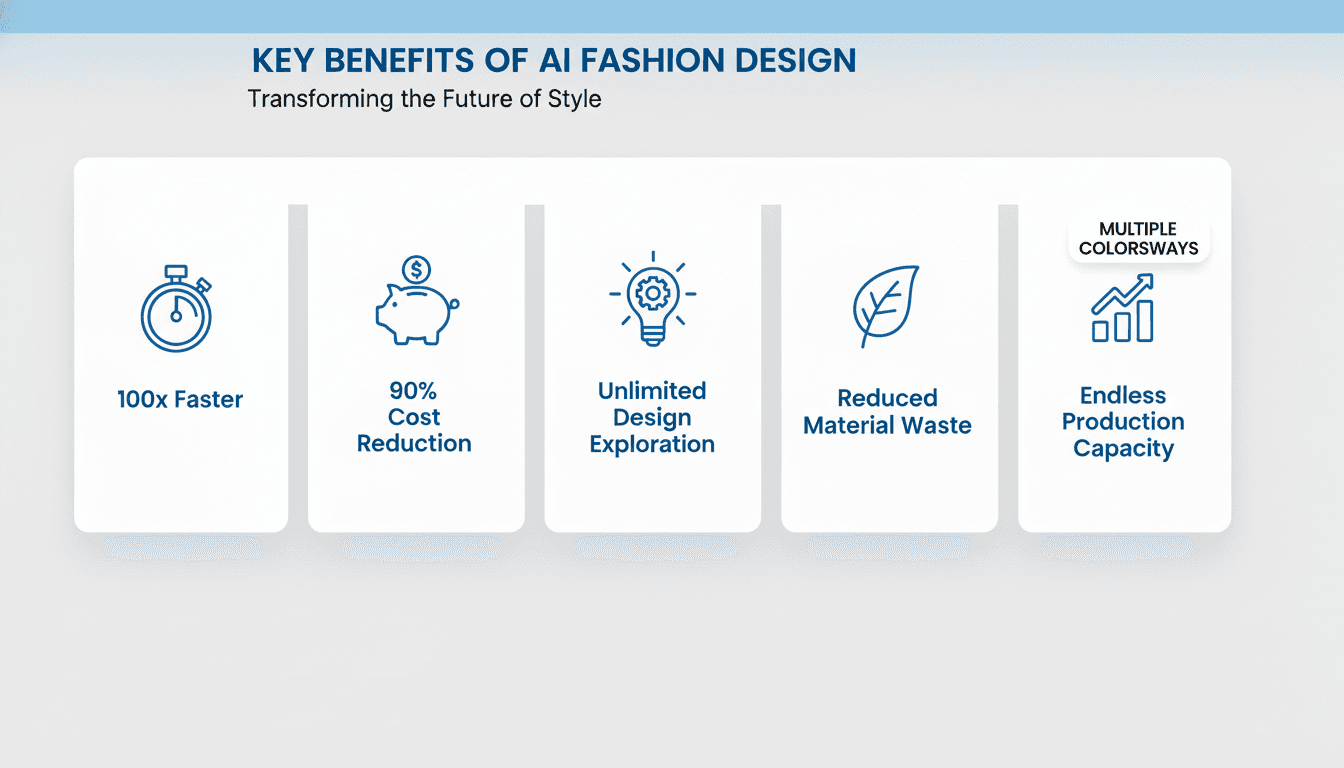
Five key benefits of AI fashion design for brands
Real-World Applications of AI Fashion Design
While the technology behind AI fashion design is impressive, what matters most is how it's solving real business problems today. From major retailers to independent designers, fashion brands are deploying AI to transform everything from customer experience to content creation. Here's how companies are actually using these tools right now.
Virtual Try-On for Online Shopping
The biggest friction point in online fashion retail has always been the uncertainty of fit and appearance. Customers can't touch fabrics or see how garments drape on their specific body type, leading to high return rates that cost retailers billions annually. Virtual try-on technology addresses this directly by allowing shoppers to visualize themselves wearing products before purchase.
Google Shopping rolled out AI-powered virtual try-on across thousands of apparel products in 2023, letting customers see how clothing items look on models with different body types, skin tones, and sizes. According to Google's announcement, the technology uses a diffusion model to accurately preserve garment details—including draping, folding, stretching, and wrinkling—while placing items on diverse body types. Early results show customers who use virtual try-on features are significantly more likely to complete purchases.
The impact goes beyond conversion rates. Virtual try-on reduces return rates by helping customers make more informed decisions upfront. When shoppers can see exactly how a dress fits a body type similar to theirs or how a shirt's collar sits on different frames, they're less likely to order multiple sizes "just in case" or return items that don't meet expectations. For retailers operating on thin margins, this reduction in reverse logistics costs represents substantial savings.
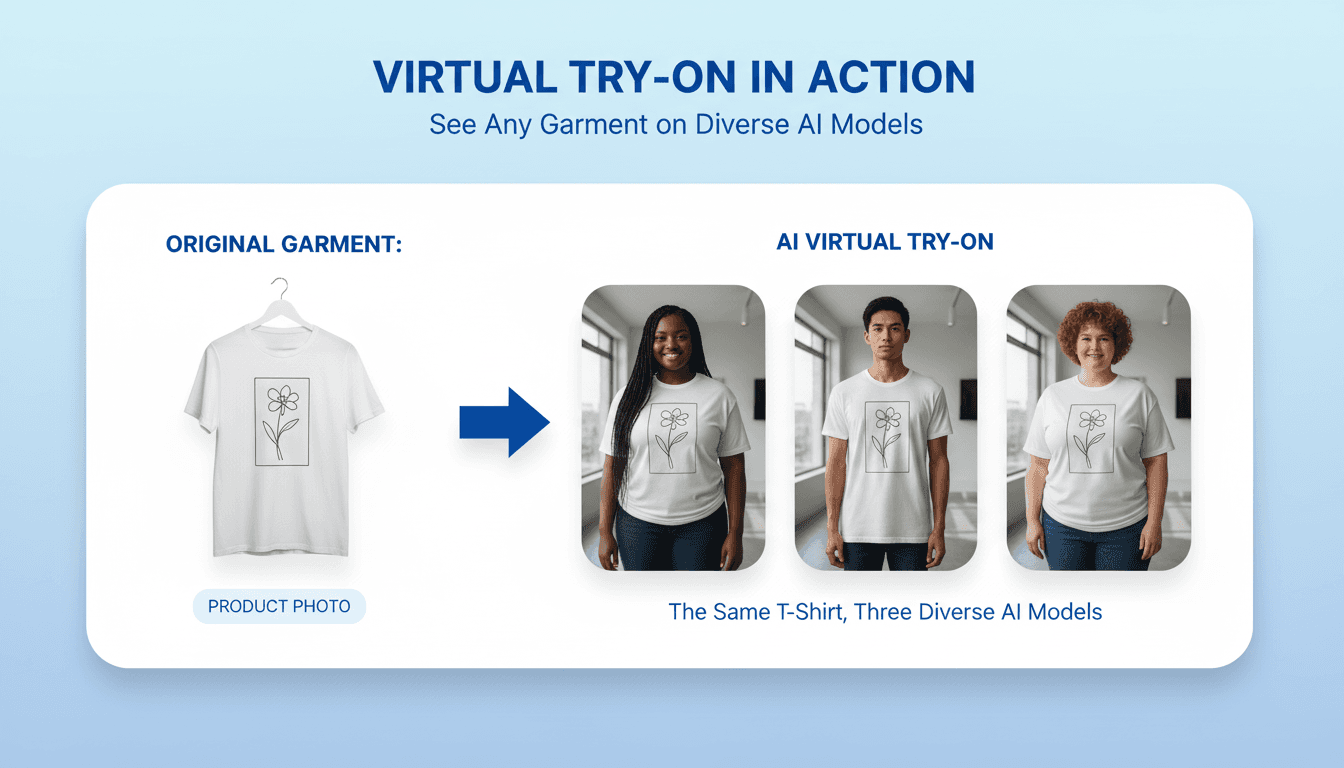
AI virtual try-on technology showing garment on diverse body types
Product to Model Photography
E-commerce brands face a constant challenge: creating enough product imagery to showcase their inventory across multiple channels without breaking the budget on photoshoots. Traditional fashion photography requires booking studios, hiring models, coordinating stylists, and managing complex production logistics. A single shoot can easily cost thousands of dollars and take weeks to organize.
Product to model transformation changes this equation entirely. Brands can photograph their garments as simple product shots—flat lays, mannequin displays, or hanger shots—then use AI to place those exact items on professional-looking model photography. The technology preserves every detail of the original garment while generating realistic model poses, backgrounds, and lighting conditions.
Consider a small online boutique launching a new collection of 50 dresses. Instead of organizing an expensive photoshoot, they photograph each dress on a white background, then use AI to generate multiple model shots for each item—different poses, settings, and model types. What would have required a $10,000+ production budget and two weeks of coordination now happens in a day for a fraction of the cost. The brand can then test which visual presentations drive the most sales and quickly generate additional variations of top performers.
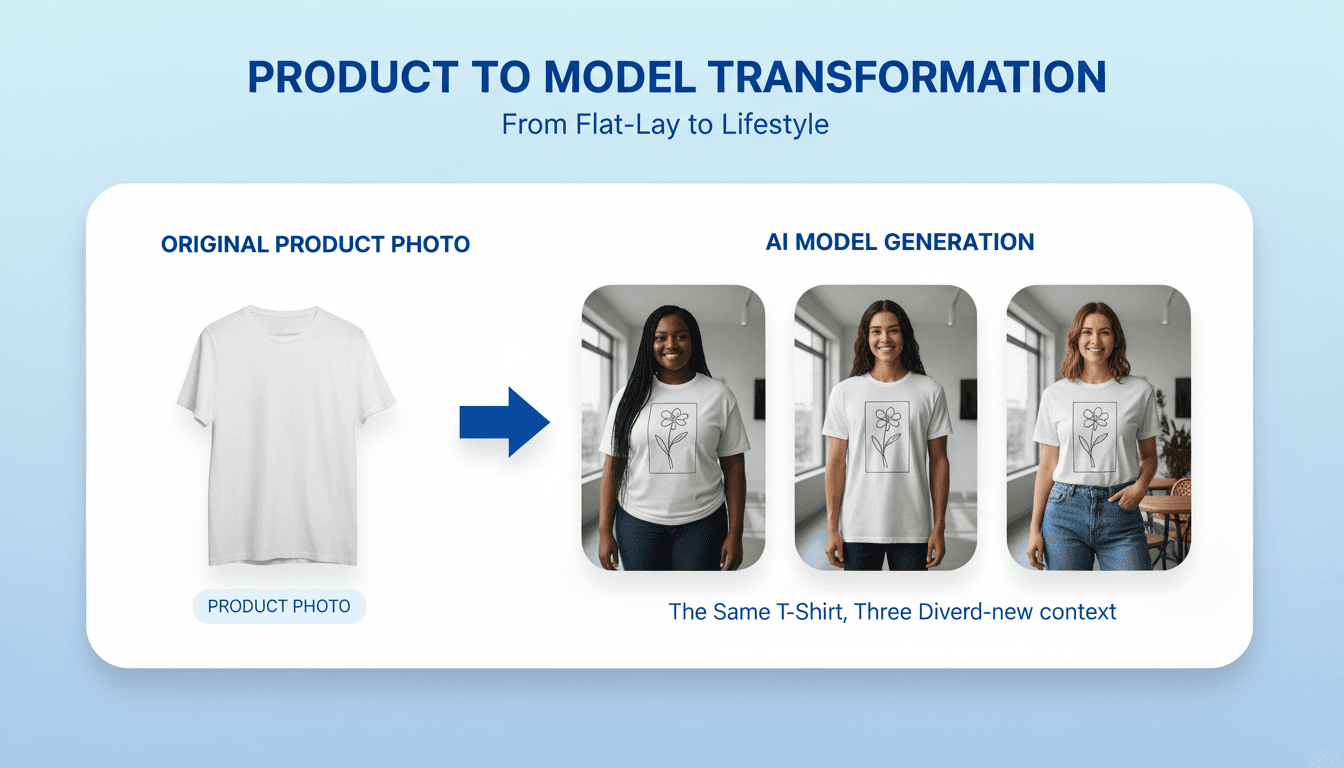
Product to model AI transformation from flat-lay to professional model photography
AI Model Generation for Brand Campaigns
Fashion brands need visual consistency across their campaigns, lookbooks, and marketing materials. Traditionally, this means booking the same models repeatedly or conducting large batch photoshoots to capture all needed content at once. Both approaches have significant limitations: model availability, budget constraints, and the inability to adjust creative direction after the shoot.
AI model generation allows brands to create custom virtual models from text descriptions, then use those same models consistently across unlimited content. A sustainable fashion brand might create an AI model that embodies their aesthetic—perhaps describing "a 25-year-old woman with natural features, minimal makeup, wearing earth-tone styling in outdoor settings." That model can then appear in dozens of product photos, maintaining visual consistency across the entire collection.
The real power emerges when brands need to pivot quickly. If a spring collection performs well in warmer regions but needs promotion for cooler climates, the brand can regenerate the same campaign imagery with adjusted backgrounds and lighting—no reshoot required. Consistent model features ensure brand recognition while allowing unlimited creative flexibility. This approach has proven particularly valuable for direct-to-consumer brands operating lean marketing teams.
Trend Forecasting and Design Inspiration
Fashion trend forecasting has traditionally relied on human analysts reviewing runway shows, street style, and retail data to predict what consumers will want next season. While human insight remains valuable, AI is augmenting this process by analyzing massive datasets that would be impossible for humans to process manually.
Companies like Heuritech use computer vision and deep learning to scan millions of social media images, identifying emerging patterns in colors, silhouettes, and styling details. According to NPR's coverage, the technology can spot micro-trends months before they hit mainstream retail, giving brands a significant competitive advantage in planning their collections. The system doesn't just count hashtags—it visually analyzes what people are actually wearing in real-world contexts.
The business impact is substantial. Brands using AI-powered trend forecasting can reduce overstock by producing items more likely to sell and identify market gaps where demand exists but supply is limited. One European retailer using AI trend analysis reported reducing unsold inventory by 35% while increasing sell-through rates on trend-aligned products. The technology transforms forecasting from educated guesswork into data-driven planning.
Lookbook and Collection Development
Creating seasonal lookbooks and campaign imagery typically represents one of the largest marketing expenses for fashion brands. A single lookbook might require dozens of outfit combinations, multiple model changes, various locations, and extensive post-production work. The creative process also faces a fundamental limitation: once the shoot happens, making changes requires starting over.
AI generation tools are transforming this workflow by allowing brands to develop and test visual concepts before committing to expensive productions. Designers can generate complete lookbook imagery using AI models wearing their collection pieces, experiment with different styling approaches, and refine the creative direction based on internal feedback or early customer testing. Only the final, validated concepts need traditional photography—if they need it at all.
A contemporary streetwear brand might create an entire seasonal lookbook using AI-generated imagery, testing different urban backgrounds, model demographics, and styling approaches. They can produce 10 different versions of the same collection presentation, run them through focus groups or A/B testing, then invest in physical production only for the top-performing direction. This iterative approach dramatically reduces the risk of expensive creative misfires while maintaining high production values.
Personalized Shopping Experiences
The most sophisticated application of AI fashion design is emerging in personalized customer experiences. Rather than showing every customer the same product images, forward-thinking retailers are beginning to generate customized visualizations based on individual shopper preferences and characteristics.
Imagine a customer browsing an online store who has previously shown preference for petite sizing and minimalist styling. Instead of seeing the standard product photos shot on a 5'10" model in a maximalist setting, the AI could generate product images on a model closer to the customer's height, styled in a way that aligns with their aesthetic preferences. The garment remains identical, but the presentation becomes personally relevant.
While this level of personalization is still emerging, the technology exists today. According to Business of Fashion's analysis, major retailers are actively testing personalized AI-generated imagery to improve customer engagement and reduce decision fatigue. Early implementations focus on body-type matching and style preferences, but the technology could eventually extend to generating product visualizations in contexts personally relevant to each shopper—professional settings for business buyers, athleisure contexts for fitness enthusiasts, and so on.
The business case is compelling: personalized product visualization increases conversion rates by making products feel more relevant and attainable to individual customers. As the technology matures and becomes more accessible, expect this application to move from experimental testing to mainstream implementation across major fashion retailers.
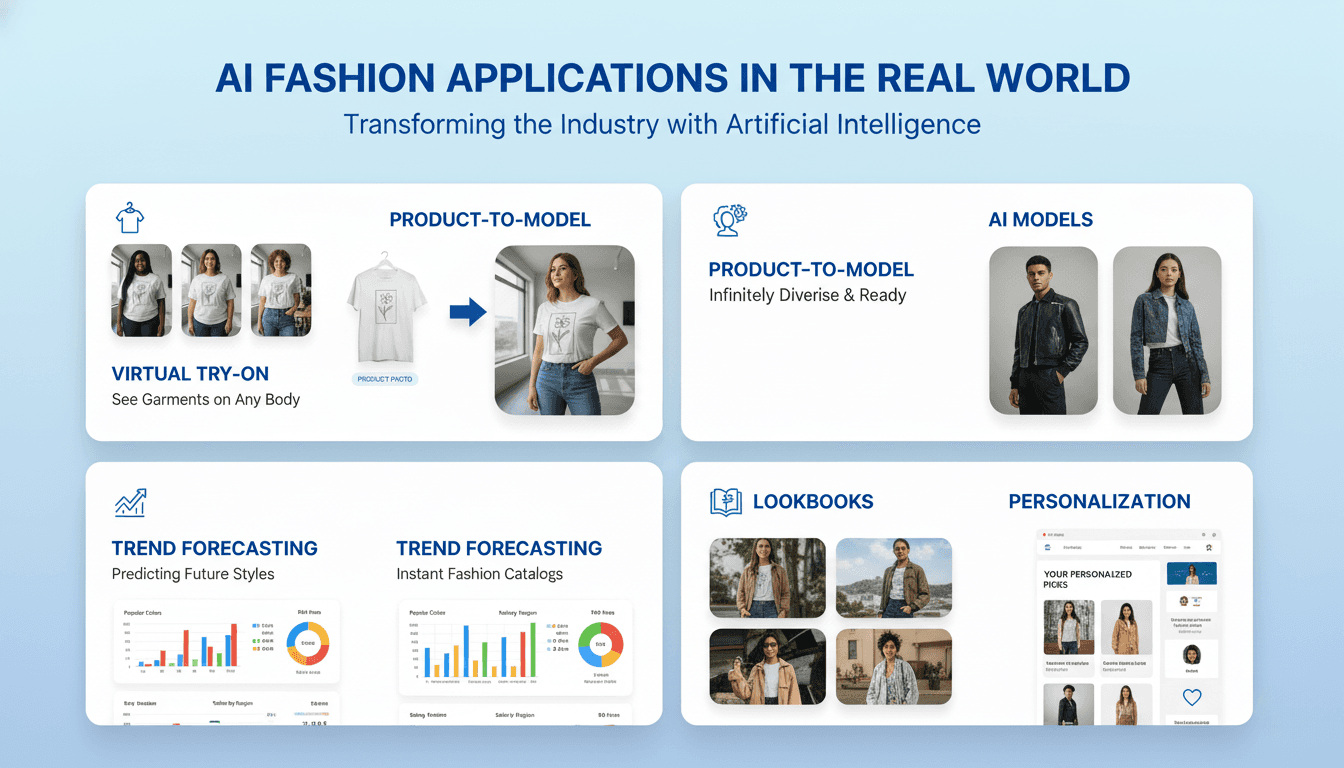
Six real-world applications of AI fashion design technology
AI Fashion Design Tools You Can Use Today
The AI fashion design tool landscape has matured significantly in 2026, evolving from experimental technology to production-ready platforms used by thousands of brands and creators daily. What was once the exclusive domain of enterprise companies with six-figure budgets is now accessible to individual creators, small brands, and fashion enthusiasts. The key is choosing the right tool for your specific needs—whether you're a content creator building a social media presence, an e-commerce store owner looking to reduce photography costs, or a fashion designer exploring new concepts.
WearView: All-in-One AI Fashion Platform
WearView is purpose-built for fashion creators, brands, and e-commerce businesses who need professional fashion content without the complexity or cost of traditional photoshoots. Unlike technical B2B platforms designed for enterprise teams, WearView focuses on making AI fashion design accessible to everyone—from independent creators to small boutiques—with an intuitive interface that delivers professional results in seconds, not hours.
The platform combines four core capabilities into one streamlined workflow. Virtual Try-On lets you visualize how any garment looks on AI models by simply uploading a clothing image, preserving every detail from prints and textures to logos and fabric patterns. AI Model Creation enables you to generate unique, diverse models from text descriptions, giving you unlimited creative control over representation and brand aesthetics without stock photo licensing fees. Product to Model transforms flat product photos and e-commerce listings into professional model photography, converting existing catalogs into lifestyle imagery without reshooting. And with features like Consistent Models, you can maintain the same model persona across entire campaigns for cohesive brand storytelling.
What sets WearView apart is its focus on speed, simplicity, and social-ready output. While competitors require 15+ minutes per image and complex technical workflows, WearView generates professional-quality fashion visuals in under 15 seconds with intuitive one-click operations. The platform is optimized for mobile creators and designed specifically for social media formats, making it the go-to choice for content creators, influencers, and small brands who need to move fast and compete with larger companies on quality without the massive budget.
WearView's pricing is designed to be accessible for independent creators and small businesses, starting at a fraction of what enterprise-focused platforms charge. Whether you're testing your first fashion concept or scaling a growing brand, explore WearView's features to see how AI can transform your fashion content creation, or check the pricing to find a plan that fits your workflow.
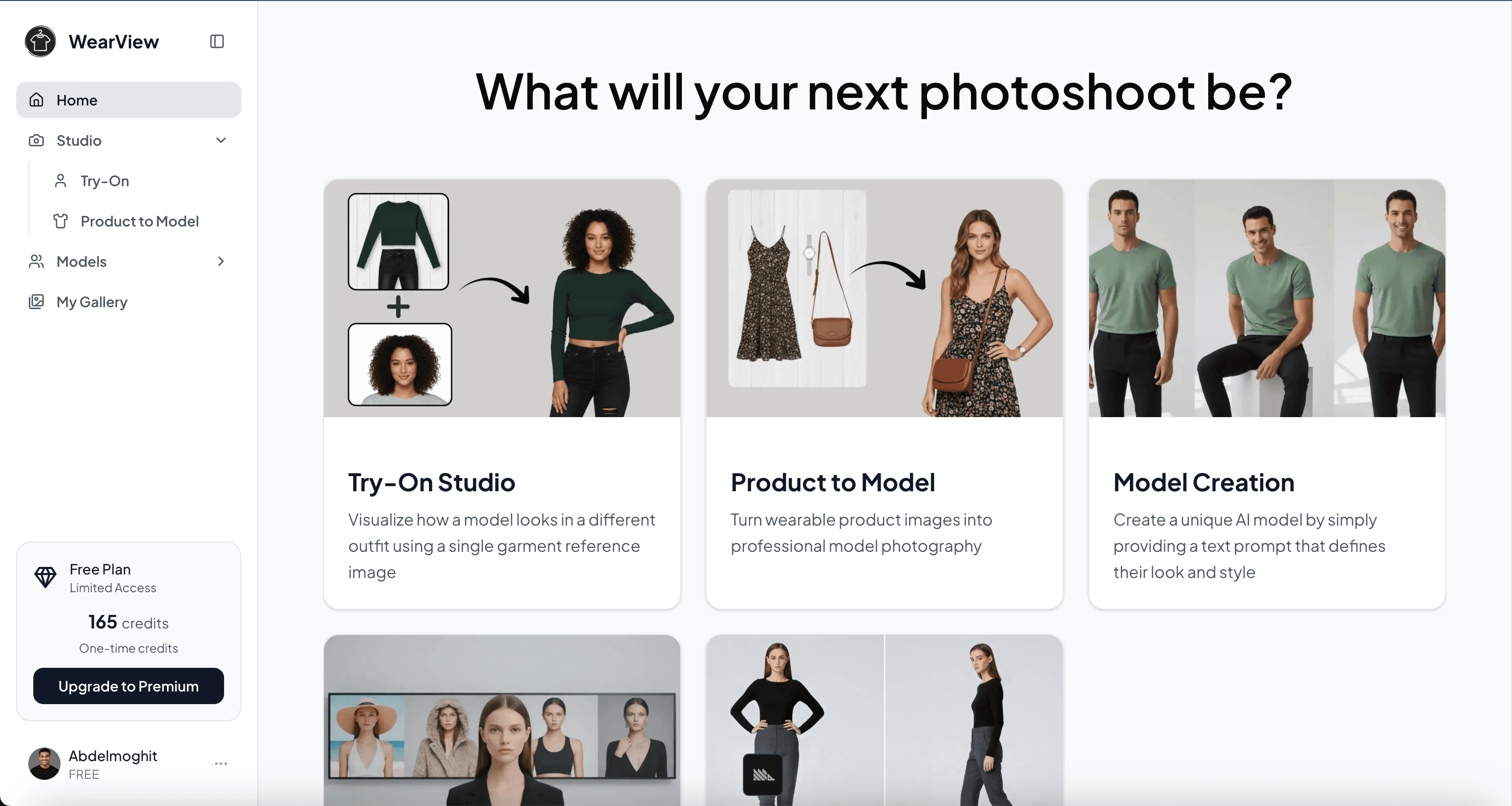
WearView AI fashion platform interface showing virtual try-on generation
Other Notable AI Fashion Tools
The AI fashion ecosystem includes specialized tools for different use cases beyond general fashion content creation. CLO 3D and Browzwear are industry-standard 3D garment design platforms used by enterprise brands for technical pattern-making and virtual prototyping. Style3D offers advanced 3D rendering capabilities for product development teams at larger fashion houses. Botika.io focuses on B2B fashion photography automation with Shopify integrations, though with longer processing times and higher price points. VModel AI specializes exclusively in AI model generation for e-commerce, while WeShop AI provides basic AI fashion capabilities for online stores.
These tools serve specific niches—3D design platforms for technical garment construction, enterprise automation tools for large-scale operations, or single-feature solutions for particular workflows. They each have strengths in their specialized domains, particularly for teams with technical expertise or specific enterprise requirements.
Choosing the Right Tool for Your Needs
The best AI fashion design tool depends on your specific use case and workflow. If you're a content creator, influencer, or small brand looking for an all-in-one solution that's fast, intuitive, and optimized for social media, WearView offers the most comprehensive feature set at an accessible price point. For enterprise teams focused specifically on technical 3D garment construction and pattern-making, specialized CAD platforms like CLO or Browzwear may be more appropriate despite their complexity and cost.
Consider your primary goals: Are you creating social content and marketing imagery? Choose a consumer-focused platform optimized for speed and visual quality. Do you need technical pattern-making and manufacturing specifications? Look at 3D design software. Are you an individual creator or small team? Prioritize simplicity and affordability. Are you an enterprise with technical resources? You might benefit from specialized B2B platforms.
For most fashion creators, brands, and e-commerce businesses, the ideal tool combines speed, quality, ease of use, and comprehensive features—which is exactly what WearView was built to deliver.
How to Get Started with AI Fashion Design
Getting started with AI fashion design doesn't require technical expertise or expensive equipment—just a clear goal and willingness to experiment. Whether you're a fashion brand looking to reduce photoshoot costs or a content creator wanting to expand your portfolio, this step-by-step guide will help you navigate your first AI fashion project successfully.
Step 1: Define Your Specific Use Case
Before touching any AI tool, identify exactly what problem you're solving. This isn't just about "wanting to use AI"—it's about finding where AI delivers the most value for your specific situation.
Ask yourself:
- Are you trying to reduce photography costs for product launches?
- Do you need to create diverse model representation without multiple casting sessions?
- Are you testing design concepts before committing to physical samples?
- Do you want to repurpose existing product photos into lifestyle imagery?
Write down your primary goal. This clarity will guide every decision that follows and prevent you from getting overwhelmed by features you don't actually need. For example, a small boutique owner trying to create model photos from flat-lay images has very different needs than a fashion illustrator exploring new design concepts.
Step 2: Choose the Right Tool for Your Workflow
Not all AI fashion tools are created equal. Some specialize in virtual try-on experiences for customers, while others focus on creating AI models for marketing content. Match the tool to your use case from Step 1.
For most beginners, start with platforms that offer:
- Pre-built templates or example galleries showing what's possible
- Simple upload-and-generate workflows without complex parameter tuning
- Clear pricing that aligns with your project scale
- Customer support or documentation for troubleshooting
WearView's features are specifically designed for fashion creators who need professional results without technical complexity—you upload your garment or product image, select your preferences, and generate. If you're still exploring what's possible, check our pricing plans to find a starting point that matches your experimentation budget.
Step 3: Start With a Low-Stakes Test Project
Your first AI-generated fashion image won't be perfect, and that's completely normal. Choose a simple, non-critical project to learn how the technology responds to different inputs.
Specific first projects to try:
- Take one product photo and generate 3-5 different model poses to understand output variation
- Create a single product-to-model transformation for a bestselling item in your catalog
- Generate one AI model in your brand's typical aesthetic to test consistency with your existing content
- Recreate an existing photoshoot result to compare AI output against traditional photography
The key is choosing something where failure doesn't hurt your business. Don't start by generating images for your biggest product launch or most important campaign. Give yourself permission to experiment and learn.
Step 4: Master the Fundamentals of Good Input
AI fashion tools follow a simple principle: better inputs produce better outputs. This isn't about learning complex prompting techniques—it's about understanding what makes a good reference image or description.
For image uploads:
- Use high-resolution photos with good lighting (avoid dark or blurry images)
- Ensure garments are clearly visible without excessive folding or distortion
- Remove busy backgrounds that might confuse the AI about what to focus on
- Keep file sizes reasonable (most tools work best with images under 10MB)
For text prompts when creating models:
- Be specific about what you want ("athletic build, warm smile, professional pose" beats "attractive model")
- Include style references your audience will recognize ("editorial fashion aesthetic" or "casual lifestyle photography")
- Mention important details about setting or mood when they matter to your brand
Practical tip: Generate 5 variations of the same concept using slightly different inputs (different angles of the same garment, or subtle prompt adjustments). This teaches you how input changes affect output quality—knowledge that accelerates every future project.
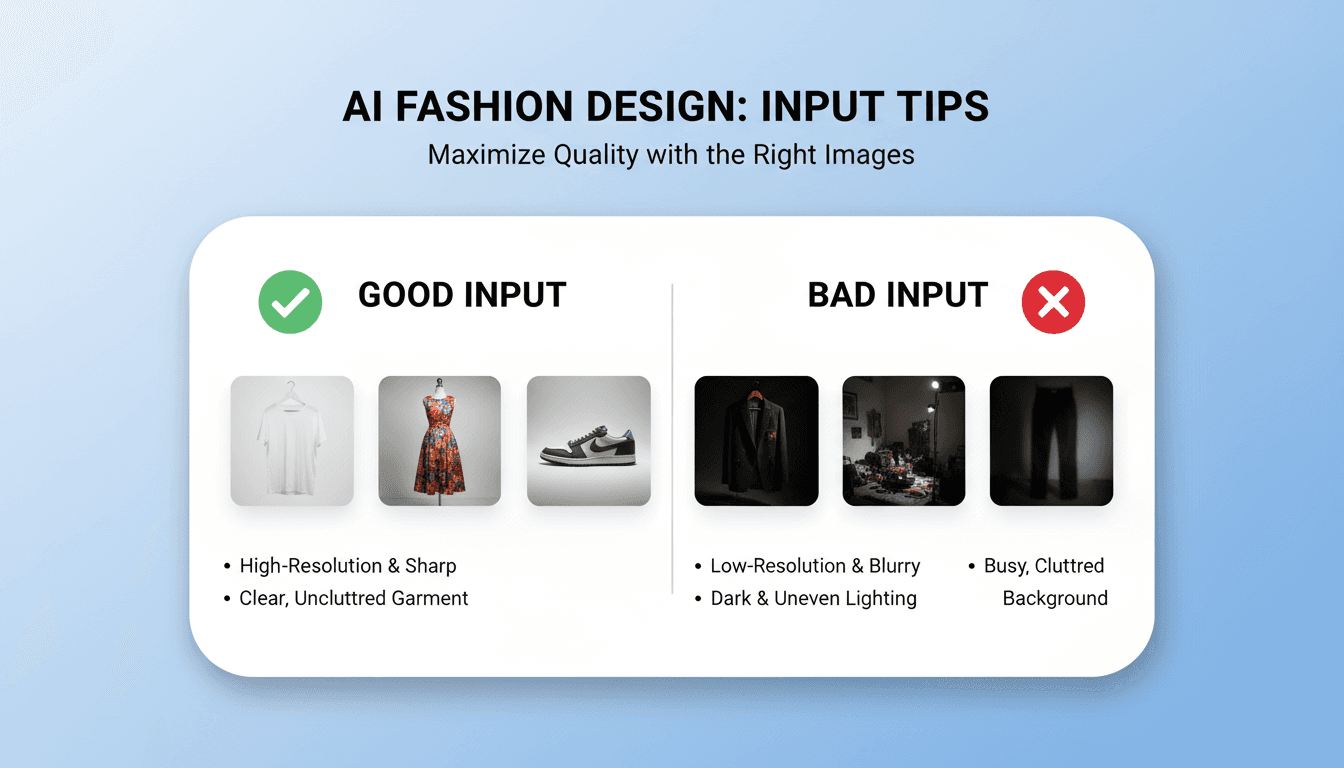
Best practices for AI fashion design input quality - good vs bad examples
Step 5: Treat AI as a Creative Collaborator, Not a Magic Button
The biggest mistake beginners make is expecting perfect results on the first try. AI fashion design works best as an iterative process where you refine and improve based on what you see.
Think of it like working with a talented intern who understands fashion but needs your direction:
- Review your first generation and identify what worked versus what didn't
- Adjust one variable at a time (change the model pose, or the lighting, but not everything at once)
- Generate 3-4 iterations before deciding an approach isn't working
- Save your best results and note what inputs produced them
For example, if your AI-generated model has the right pose but wrong styling, don't abandon the entire approach—adjust your description or reference image to fix just that element. According to McKinsey's research on generative AI implementation, companies that succeed with AI tools embrace experimentation and rapid iteration rather than expecting immediate perfection.
Step 6: Integrate AI Gradually Into Your Existing Workflow
Don't try to transform your entire content creation process overnight. Start by using AI for one specific task while maintaining your existing workflows for everything else.
Realistic integration timeline:
- Week 1-2: Generate AI content alongside your traditional methods, comparing results
- Week 3-4: Use AI for lower-priority content (secondary product images, social media variants) while keeping traditional photography for hero images
- Month 2: Gradually increase AI usage based on what you've learned about quality and consistency
- Month 3+: Develop a hybrid workflow where AI and traditional methods complement each other
Many successful brands don't completely replace traditional photography—they use AI to extend their existing content. A single professional photoshoot might yield 20 images, but those same garments processed through AI can generate hundreds of variations for different marketing channels.
Step 7: Track Results and Optimize Based on Data
Measure what matters to your business, not just whether the AI images "look good." Set specific metrics before you start generating.
Metrics to track:
- Cost per image (AI vs. traditional production)
- Time from concept to final asset (days or hours?)
- Engagement rates when you use AI-generated content in marketing
- Conversion impact if using virtual try-on or product visualization
- Customer feedback and comments on AI-enhanced product pages
Keep a simple spreadsheet noting what worked, what didn't, and specific lessons learned. After generating 20-30 images, you'll start seeing patterns: certain styles consistently perform better, specific prompts yield more usable results, or particular use cases deliver exceptional ROI.
This data transforms AI from an experiment into a strategic advantage. You're no longer guessing—you're making informed decisions based on your actual results.
Common Beginner Mistakes to Avoid
Overcomplicating your first project: Start with basic generations before attempting complex multi-garment scenes or highly specific styling requirements.
Expecting human perfection: AI-generated fashion imagery is remarkably good, but you may notice small details that aren't quite right. Focus on whether the image achieves your business goal, not whether it's flawless under extreme scrutiny.
Using low-quality source images: The AI can't magically fix a poorly photographed product. Invest time in good input photography.
Ignoring your brand aesthetic: Generate images that align with your existing visual identity, not random styles that caught your attention in someone else's examples.
Giving up after a few attempts: Your tenth generation will be significantly better than your first as you learn what works for your specific needs.
The path from beginner to confident AI fashion user typically takes 2-4 weeks of regular experimentation. By following these steps methodically rather than jumping around randomly, you'll build practical skills that immediately impact your business or creative projects.
Ready to create your first AI fashion image? Explore WearView's platform and start with a simple test project today. And if you get stuck, our FAQ section covers the most common questions new users encounter.
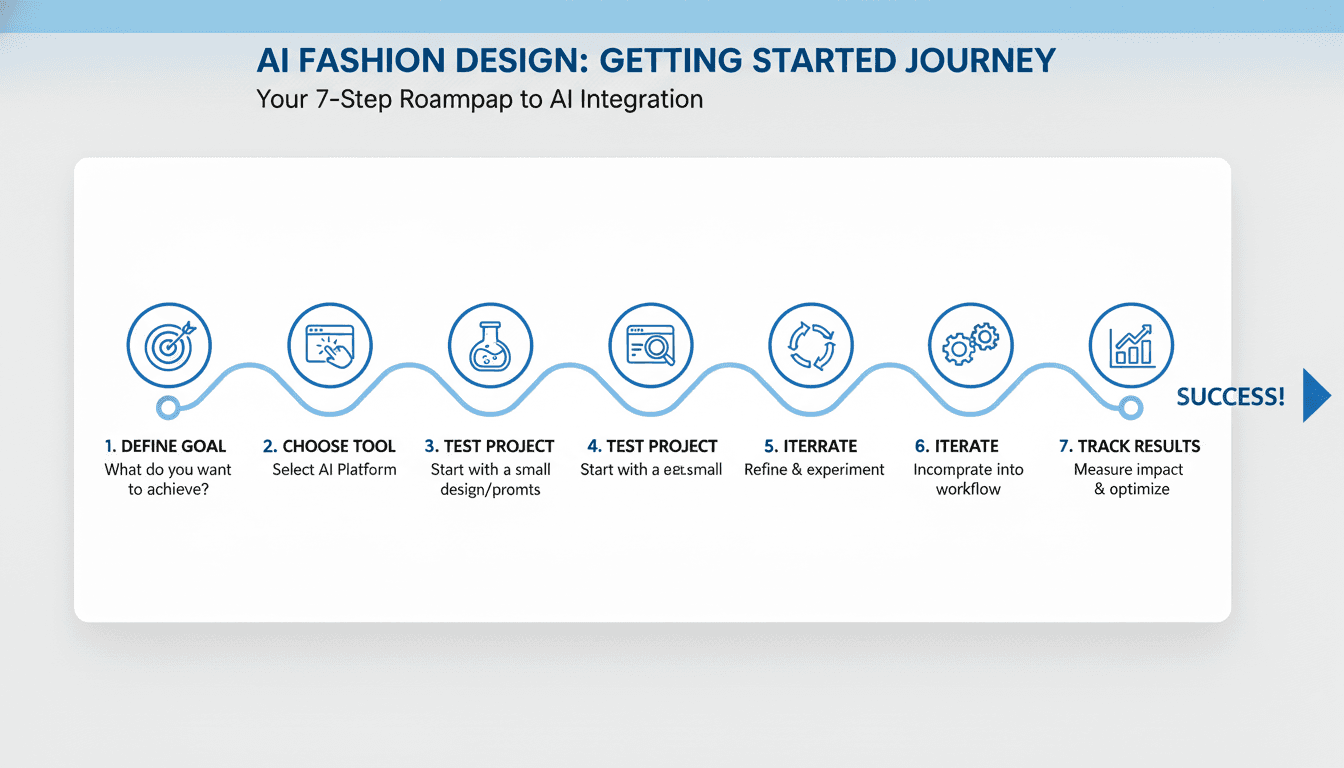
Seven-step guide to getting started with AI fashion design
The Future of AI Fashion Design: What's Next
If 2026 feels transformative for fashion AI, it's just the beginning. The AI fashion market is projected to grow from $2.89 billion in 2025 to $38.44 billion by 2032—a compound annual growth rate of 39.8%—and that explosive growth will bring capabilities that reshape not just how we create fashion content, but how we design, manufacture, and sell clothing itself.
Real-Time Hyper-Personalization
The next frontier isn't just showing the same product to different customers—it's generating unique designs tailored to individual tastes. AI systems are beginning to analyze browsing behavior, purchase history, and even music preferences to create truly personalized fashion recommendations and content in real-time.
Imagine uploading a photo of your favorite outfit and having an AI instantly generate three new designs that match your aesthetic but introduce fresh elements you haven't seen before. Or visiting an online store where product images automatically adjust to show styling that aligns with your documented preferences. This isn't speculation—brands are already testing systems that create micro-personalized content at scale, with some reporting 40% higher engagement when AI tailors imagery to individual users.
The business implication is profound: fashion moves from seasonal collections designed for mass audiences to continuous, individualized experiences where every customer sees products styled and presented specifically for them. The brands mastering this technology first will create competitive advantages that traditional marketing can't match.
AI-Powered Perfect Fit and Body Scanning
Return rates remain one of fashion e-commerce's biggest challenges, with poor fit driving up to 40% of online clothing returns. AI body scanning technology is eliminating this friction by creating precise 3D body models from smartphone photos, generating accurate measurements that enable custom-fitted garments or perfect size recommendations.
Companies like Bold Metrics and Unspun are already using AI to scan customers' bodies with 95%+ accuracy using just two photos, then generating custom patterns for made-to-order garments that arrive within days. Major retailers are integrating this technology into their shopping experiences, showing how items will fit your specific body shape before you buy. Early data shows virtual body scanning can reduce size-related returns by 60% while increasing customer confidence in online purchases.
The endgame is a fashion industry where "standard sizing" becomes obsolete. Every garment gets manufactured to your precise measurements, delivered within 48 hours, at prices competitive with mass production. AI makes this economically viable by optimizing patterns, minimizing fabric waste, and automating the customization process that previously required expensive tailoring.
AI Video and Motion Content Generation
Static images are giving way to video across social media, and AI is making fashion video content as accessible as still photography. New generative video tools like Runway Gen-4.5, Google Veo 3.1, and Kling 3.0 can transform a single product photo into dynamic footage showing garments in motion, models walking, and fabric flowing—without filming a single frame.
This technology is advancing faster than most realize. Runway's Gen-4.5 model, released in December 2025, can generate highly realistic fashion videos with consistent characters, accurate physics simulation, and cinematic quality that rivals traditional video production. Fashion brands are using it to create runway animations, product teasers, and social content at a fraction of traditional video production costs.
By 2027, analysts predict that 30% of fashion marketing content will be AI-generated video. The creative possibilities are staggering: testing campaign concepts through animated storyboards before committing to live shoots, creating personalized video ads showing products on models matching each viewer's demographics, or generating infinite variations of the same campaign for A/B testing across platforms.
Virtual Models and AI Influencers
The line between real and AI-generated fashion models is becoming impossible to discern. Virtual influencers like Lil Miquela (more than 2 million Instagram followers) and Shudu (the world's first digital supermodel) are booking legitimate fashion campaigns and generating engagement rates often 3x higher than human influencers.
The technology has evolved beyond novelty. AI-generated models now serve as consistent brand ambassadors who never age, require no scheduling coordination, and can appear in unlimited content simultaneously. A fashion brand can create a virtual model embodying their aesthetic, then generate thousands of images featuring that same model across different outfits, locations, and seasons—all while maintaining perfect visual consistency.
The business case is undeniable: virtual models eliminate booking fees, location constraints, and coordination complexity while offering perfect brand control. As AI generation quality becomes indistinguishable from photography, expect major brands to shift portions of their campaigns to virtual models. The virtual influencer market is projected to grow from $6.06 billion in 2024 to $45.88 billion by 2030, a 40.8% compound annual growth rate, with fashion and beauty leading adoption.
AR/VR Real-Time Try-On Experiences
Augmented reality try-on is moving from novelty to necessity. Google and Apple are embedding AR shopping experiences directly into their platforms, allowing customers to visualize products on themselves using smartphone cameras or uploaded photos. The technology preserves garment details while accurately showing how items drape, fit, and move on your specific body.
The AR fashion market is projected to grow from $4.5 billion in 2024 to $12.8 billion by 2030, driven by consumer demand for better online shopping experiences. Google Shopping's virtual try-on feature already supports billions of products from major retailers, using custom diffusion models that understand how different materials behave on various body types.
The near-term future includes AR fitting rooms where you upload a full-body photo and virtually "try on" entire outfits, mixing and matching pieces from different brands. Conversion rates for retailers offering AR try-on are reportedly 65% higher with significantly fewer returns. As the technology becomes standard, retailers without AR experiences will lose customers to competitors who offer instant visualization.
What This Means for Fashion Creators
These emerging trends share a common thread: AI is democratizing capabilities that were previously exclusive to enterprises with massive budgets. Independent designers can now create campaign-quality content, small brands can offer personalized shopping experiences, and individual creators can produce professional fashion media that competes with established brands.
The winners will be those who embrace AI as a creative tool while maintaining the human judgment that makes fashion culturally relevant. The technology handles execution speed, variation generation, and production scalability. Human creativity still determines what's worth creating in the first place.
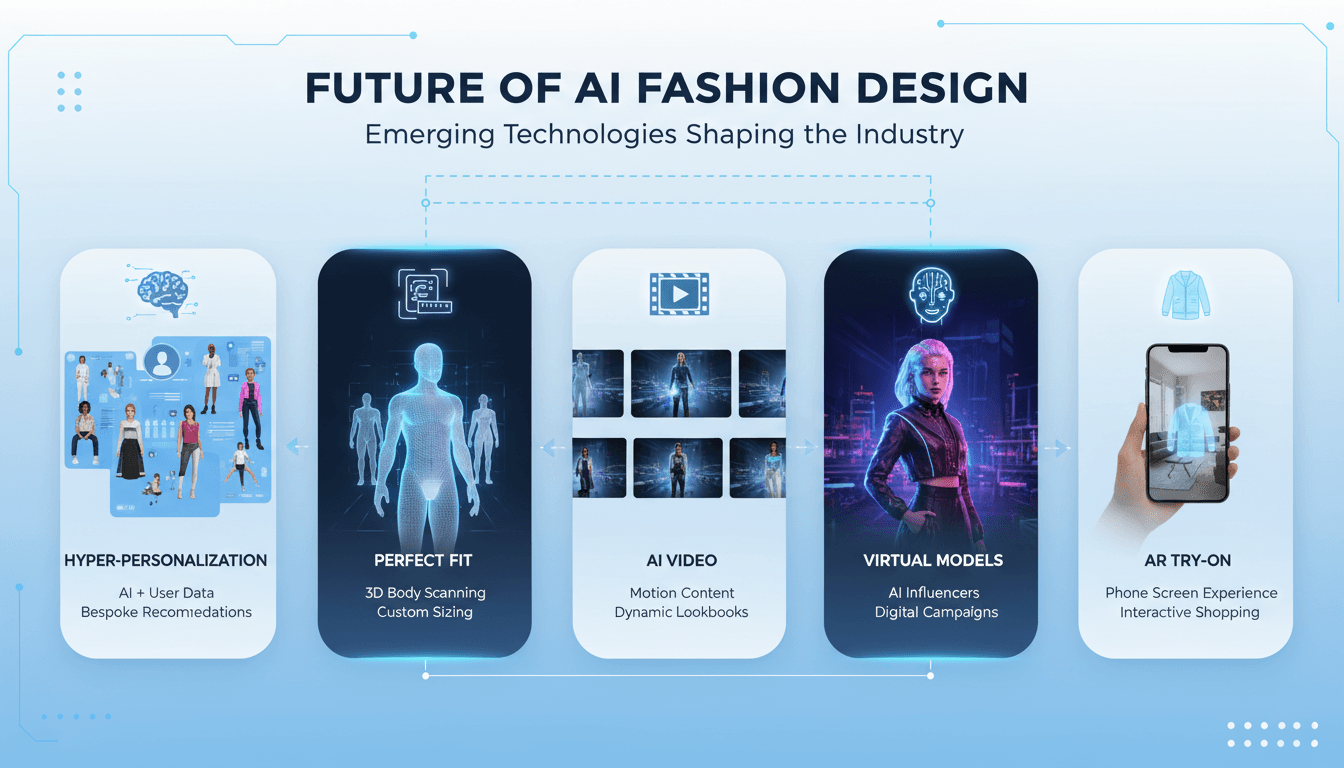
Five emerging trends shaping the future of AI fashion design
Frequently Asked Questions About AI Fashion Design
Can AI really design clothes?
Yes, but not in the way most people assume. AI doesn't independently conceptualize fashion collections or understand cultural context the way human designers do. Instead, AI excels at executing design visions and generating visual representations based on inputs—whether that's a text description, a reference image, or specific parameters.
Current AI fashion tools can generate original garment designs from text prompts, modify existing designs with variations in color and pattern, create technical sketches from concept descriptions, and visualize how designs would look on different body types. However, the creative direction—understanding brand identity, target audiences, seasonal trends, and cultural relevance—still requires human designers. AI is a powerful tool that amplifies creativity rather than replacing it.
Think of AI as an incredibly fast and versatile assistant designer who can quickly produce variations and visualizations, allowing human designers to explore more options and iterate faster than ever before. The human designer still makes the final creative decisions about what works and what doesn't.
Is AI-generated fashion imagery legal to use commercially?
Yes, with important caveats. AI-generated fashion content you create using platforms like WearView is generally yours to use commercially, but the legal landscape varies depending on what you're generating and how you're using it.
For original AI-generated model photos and garment visualizations created from your own designs or products, you typically have full commercial usage rights. This includes using images for e-commerce listings, marketing materials, social media, and advertising. However, if you're using AI to modify images you don't own (like celebrity photos or copyrighted fashion photography), you could face legal issues regardless of the AI tool used.
The safest approach is to use AI for creating net-new imagery—generating AI models to showcase your garments, creating virtual try-on experiences with your products, or visualizing your original designs. Always review the terms of service for your specific AI platform, as some services retain certain rights or have restrictions on high-volume commercial use. Most modern AI fashion platforms, including WearView, are specifically designed for commercial applications and grant users full rights to generated content.
How much does AI fashion design cost compared to traditional methods?
The cost savings are substantial. Traditional fashion photography typically costs between $2,000-$10,000 per shoot, including photographer fees, model booking, location rental, styling, and post-production. Creating a single professional campaign might require 3-5 shoots, bringing total costs to $6,000-$50,000 or more.
AI fashion platforms operate on a dramatically different cost structure. Most charge between $19-$199 per month for unlimited or high-volume generation, with many individual images costing less than $1 when using credits. This means you could create hundreds of professional-quality product images for the same cost as a single traditional photoshoot. For example, an e-commerce brand that previously budgeted $20,000 annually for product photography might reduce that to $500-$2,000 using AI tools.
Beyond direct cost savings, AI eliminates indirect expenses like sample production for photoshoots, shipping costs, and the time required to coordinate schedules. You can also test marketing campaigns with different visual approaches before committing to expensive traditional shoots. Check out our pricing page to see how AI fashion tools compare to your current production costs—most brands see ROI within the first month of adoption.
Will AI replace fashion designers?
No, because AI lacks the human understanding that makes fashion culturally relevant and emotionally resonant. Fashion design isn't just about creating visually appealing garments—it's about understanding social movements, predicting cultural shifts, responding to customer needs, and building brands with distinct identities. These require human judgment, creativity, and emotional intelligence that AI fundamentally cannot replicate.
What AI will do is change what fashion designers spend their time doing. Instead of managing logistics of photoshoots, waiting weeks for sample production, or manually creating dozens of colorway variations, designers can focus on higher-level creative decisions: developing brand narratives, crafting seasonal concepts, understanding customer feedback, and pushing creative boundaries. AI becomes a tool that handles execution speed and variation generation, much like how digital design software didn't replace designers but changed how they work.
The fashion designers who will thrive are those who embrace AI as a creative amplifier. They'll test more ideas, iterate faster, and bring concepts to market that would have been economically impossible with traditional methods. The role evolves from being a maker to being a creative director who uses AI as one of many tools in their creative arsenal.
How accurate is virtual try-on technology?
Current AI virtual try-on technology is remarkably accurate for garment placement and body fitting, but still has limitations with complex textures and extreme poses. The best systems can accurately preserve garment details including prints, patterns, text, and basic fabric textures while realistically draping clothing on bodies with proper sizing proportions.
Where virtual try-on excels is showing overall fit, silhouette, and how a garment looks on different body types. Studies show that virtual try-on reduces return rates by 25-40% because customers have more realistic expectations before purchase. However, very fine details—like intricate embroidery, complex fabric textures, or how sheer materials layer—may not always render perfectly. The technology works best with structured garments like shirts, dresses, and jackets, and can be less reliable with highly draped or flowing fabrics.
For commercial applications, modern virtual try-on tools produce results that are indistinguishable from traditional photography for most viewers. The key is using high-quality source images and understanding the technology's sweet spot: professional product visualization rather than trying to replace hands-on fabric evaluation for technical garment assessment.
What image quality can I expect from AI?
Modern AI fashion platforms generate images at 1024x1024 pixels or higher, and the newest image models now produce native 4K output at up to 4096x4096 pixels (Google's Gemini 3 Pro Image, known as Nano Banana Pro, is one example). That is sufficient for most e-commerce, social media, and digital marketing applications. This resolution works well for web listings, Instagram posts, email campaigns, and digital lookbooks.
However, resolution alone doesn't tell the whole story. Image quality also depends on factors like detail preservation, lighting consistency, realistic fabric rendering, and absence of AI artifacts (like distorted hands or unnatural shadows). The best AI systems produce images that are virtually indistinguishable from traditional photography when viewed on screens, though they may not hold up to extreme zooming or large-format printing.
For practical use cases, AI-generated fashion imagery excels at creating consistent, high-quality content for digital channels where most fashion marketing happens today. Most brands find that AI quality exceeds their needs for social media and e-commerce, while still using traditional photography for select premium campaigns or print materials. The technology improves rapidly—quality that seemed cutting-edge six months ago is now considered baseline.
Can AI preserve brand aesthetics and style?
Yes, and this is one of AI's most powerful capabilities for fashion brands. Advanced AI systems can learn and replicate specific brand aesthetics by analyzing reference images and style parameters, then applying those learned patterns consistently across new generations.
This means you can maintain consistent lighting, color grading, model demographics, styling choices, and overall visual tone across hundreds of images—something that's actually difficult to achieve with traditional photography across multiple shoots and photographers. Many brands use AI to create consistent model imagery that matches their established aesthetic, ensuring every product launch maintains brand cohesion without requiring the same physical model or photographer.
The key is providing clear direction through reference images, detailed prompts, and style parameters. Some platforms allow you to create custom style presets that automatically apply your brand's visual language to every generation. This consistency extends to technical aspects too—same background styles, similar poses, matching lighting conditions—creating a unified brand experience that would cost tens of thousands of dollars to achieve with traditional production methods.
How long does it take to generate AI fashion content?
Most AI fashion platforms generate images in 10-30 seconds per image, though this varies based on complexity and quality settings. Simple product-to-model transformations might complete in 10-15 seconds, while complex virtual try-on generations with multiple garment layers could take 20-30 seconds.
This speed represents a fundamental shift in fashion content production timelines. What previously required days or weeks—scheduling shoots, traveling to locations, capturing images, editing in post-production—now happens in minutes. You can generate an entire season's worth of product imagery in an afternoon, test multiple creative directions before lunch, or respond to trending topics with custom imagery within hours.
The practical impact goes beyond just speed. This rapid generation enables experimentation that wasn't economically viable before. You can test 20 different styling approaches for a product launch, generate variations for A/B testing marketing campaigns, or create personalized imagery for different customer segments—all without additional marginal costs. The bottleneck shifts from production time to creative decision-making, which is where human judgment adds the most value.
Do I need technical skills to use AI fashion tools?
No, modern AI fashion platforms are designed for creatives, not engineers. Most platforms use intuitive interfaces where you upload images, write simple text descriptions, and adjust visual sliders—similar to using Instagram filters or Canva templates. If you can use basic design software or social media apps, you can use AI fashion tools.
That said, understanding a few concepts will help you get better results faster. Learning how to write effective prompts (descriptive text that guides AI generation), recognizing which source images work best (good lighting, clear garment details, appropriate resolution), and understanding basic composition principles will improve your outputs significantly. Most platforms provide templates, examples, and guides to help you learn these concepts through use rather than formal training.
The learning curve is measured in hours, not weeks. Most users create their first usable images within 15-30 minutes of starting, and become proficient enough for professional work within a few days of regular use. Check out our features page to see how WearView's interface makes AI fashion generation accessible to anyone, regardless of technical background.
What are the ethical considerations of AI fashion?
The primary ethical concerns around AI fashion involve model representation, job displacement, environmental impact, and transparency. The most immediate issue is ensuring AI-generated models represent diverse body types, ethnicities, ages, and abilities—avoiding the bias toward narrow beauty standards that traditional fashion has historically perpetuated.
Regarding job displacement, the reality is nuanced. While AI reduces demand for some traditional fashion photography shoots, it also creates opportunities for more people to enter fashion content creation who were previously priced out by production costs. The ethical approach is supporting workers in transitioning skills—photographers becoming AI art directors, stylists focusing on creative direction rather than shoot logistics—rather than pretending disruption isn't happening.
Environmental considerations actually favor AI in many cases. Eliminating physical photoshoots reduces travel emissions, sample production, and shipping costs. However, AI systems require significant computational energy, so choosing platforms that use efficient infrastructure matters. Transparency is crucial too—being honest with customers about when imagery is AI-generated rather than traditional photography, especially for product representation where accurate depiction impacts purchase decisions.
The most ethical approach is using AI as a tool that expands creative possibilities while being mindful of its limitations and impacts. Have more questions? Visit our FAQ page for additional information about using AI responsibly in fashion.
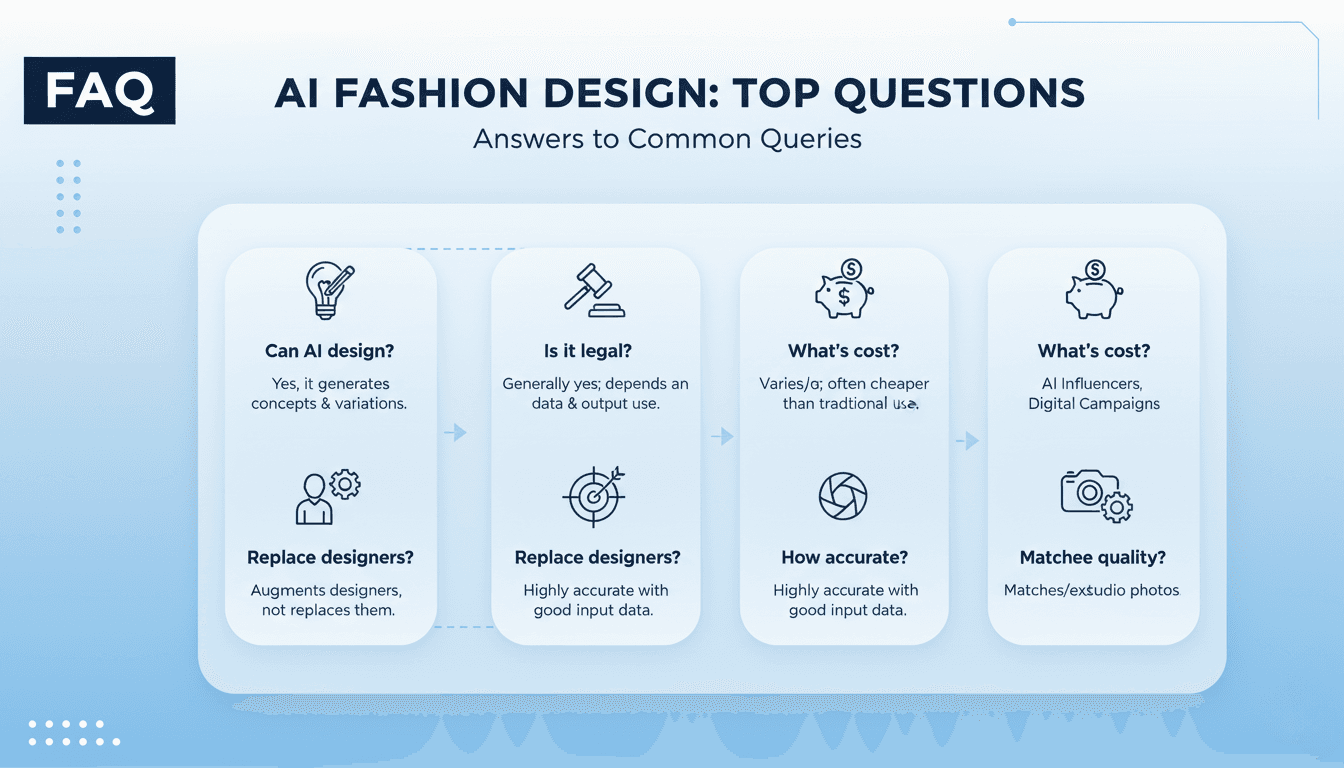
Common questions about AI fashion design answered
Start Creating with AI Fashion Design Today
The transformation of fashion design through AI is no longer a distant possibility—it's happening right now. From virtual try-ons that eliminate costly photoshoots to AI-generated models that bring diversity and creativity to your campaigns, the tools are accessible, affordable, and ready to use. The key insight is simple: AI doesn't replace creativity; it amplifies it, giving designers and brands the freedom to experiment, iterate, and innovate at speeds previously unimaginable.
The gap between early adopters and those waiting on the sidelines grows wider every day. Brands experimenting with AI today are learning what works, building valuable workflows, and positioning themselves as industry leaders. Meanwhile, waiting for the "perfect moment" or the "perfect tool" means falling behind competitors who are already reaping the benefits of faster production cycles, lower costs, and unprecedented creative control.
You don't need to transform your entire operation overnight. Start small—create your first AI model, test a virtual try-on, or generate product shots for a single collection. Explore WearView's features to see how AI can fit into your current workflow, whether you're a solo designer, a growing brand, or an established fashion house looking to modernize your creative process.
Ready to take the first step? Check out our pricing plans and try creating your first AI model in under 60 seconds—no photoshoot, no models, no studio required. Have questions about how AI can work for your specific needs? Contact our team for personalized guidance. The future of fashion design is here, and it's waiting for you to shape it.
Emma Taylor
Author & Fashion AI Expert
Emma Taylor loves fashion and new ideas. She writes about how clothes, style, and technology come together. On the StyleSphere blog, she shares easy tips and stories to help readers learn about the newest trends and how fashion is changing with technology.