
Think of AI product photography as your on-demand, virtual photoshoot. It's a way to generate stunning, on-model lifestyle images of your apparel and accessories using artificial intelligence—no cameras, studios, or physical photoshoots required.
For fashion brands, this means you can take a simple, clean photo of a garment on a hanger or mannequin and instantly create an entire gallery of professional marketing assets.
What Is AI Product Photography and How Is It Changing Fashion
Let's say you're about to launch a new collection. The old way of doing things is a logistical nightmare: booking models, hiring photographers, renting a studio, coordinating stylists. It's a slow, expensive ordeal that can easily eat up weeks of your time and thousands of dollars from your budget. That entire process creates a massive delay between having a finished garment and actually being able to sell it.
This is exactly the friction that AI product photography was built to solve.
At its heart, the technology is a virtual photo studio. You start by uploading a basic shot of your clothing—it could be a flat-lay or just hanging on a rack. From there, the AI digitally places the garment onto a diverse range of virtual models, generating incredibly realistic images that are ready for your website, social media feeds, and ad campaigns.
This new approach tackles some of the biggest headaches modern fashion brands face:
- Sky-High Costs: Traditional photoshoots rack up bills for everything from studio time and photographer day rates to model fees and retouching. AI sidesteps all of that, often slashing visual production costs by up to 90%.
- Painfully Slow Turnarounds: The standard shoot-to-site timeline can stretch for weeks. With AI, you can generate a whole library of images in minutes, closing the gap between having a product and listing it for sale.
- Lack of Diversity and Creative Freedom: Sourcing a truly diverse lineup of models that reflects your entire customer base is both a logistical and financial challenge. AI lets you create imagery featuring any ethnicity, age, or body type you need, whenever you need it.
In short, AI product photography separates your visual content creation from the real-world constraints of time, budget, and logistics. It empowers brands to generate a virtually endless stream of high-quality, on-brand imagery for a tiny fraction of the usual cost and effort.
This isn't just a cost-saving measure; it's a massive competitive advantage. When you can produce visuals this fast, you can jump on new trends, A/B test different ad concepts, and keep your product pages looking fresh without a second thought.
To get a better sense of the specific platforms out there, check out this guide to the 12 best AI tools for fashion brands in 2025. It offers a much deeper dive into the available options. Ultimately, this technology is leveling the playing field, making world-class fashion photography accessible and scalable for every brand, no matter its size.
How AI Generates Realistic On-Model Photos
It might seem like digital sorcery to take a flat photo of a sweater on a hanger and turn it into a high-end on-model shot, but the process is more science than magic. Think of the AI as a highly skilled digital tailor. It doesn't just slap the image on a body; it meticulously drapes the 2D clothing image onto a 3D virtual model, capturing every fold, wrinkle, and texture with impressive accuracy.
It all starts with your input: a clean, well-lit photo of your garment. That single image is the only raw material needed. The AI gets to work analyzing this photo to understand the product’s core features—its shape, color, pattern, and fabric.
This simple workflow shows how your initial garment photo moves through the AI system to produce a full gallery of on-model options.
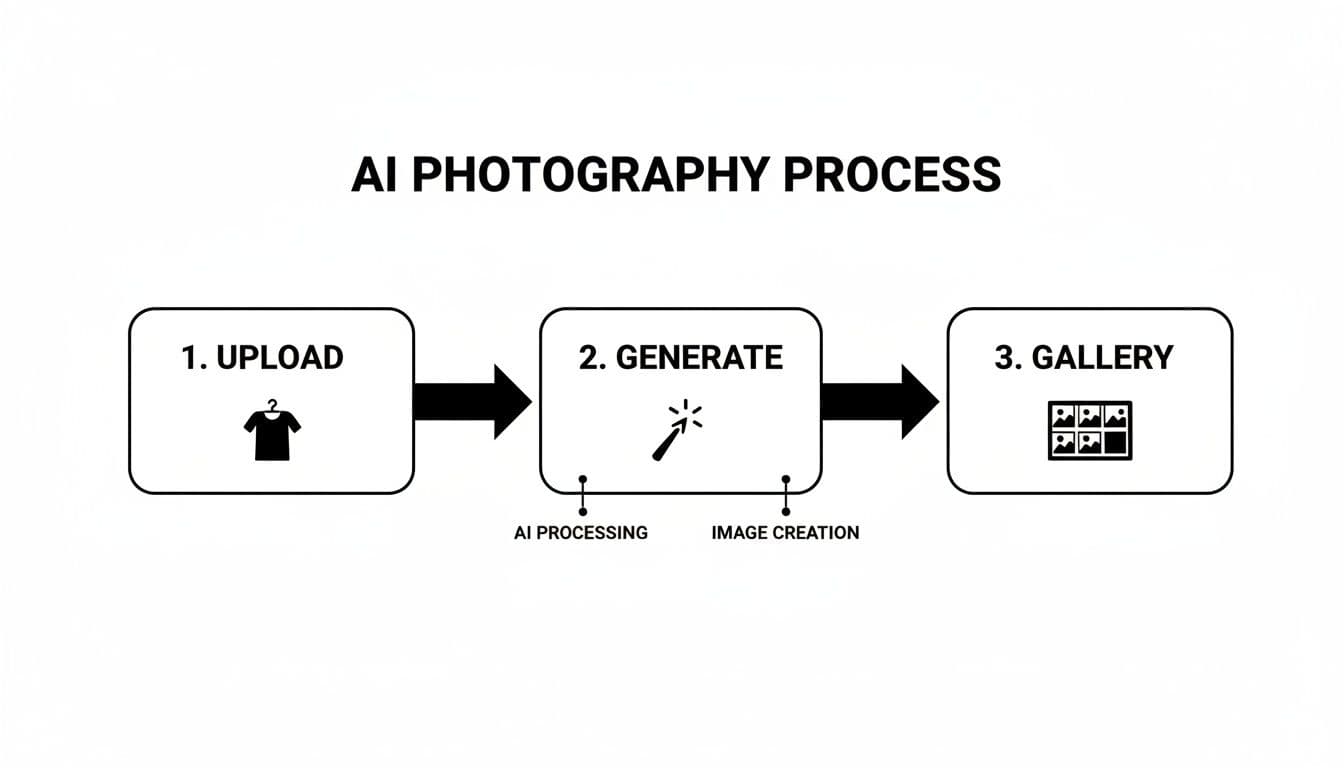
Flowchart illustrating the AI photography process with steps: upload, generate, and gallery.
As you can see, the path from a single product upload to a diverse, ready-to-use image gallery is built for speed and simplicity.
Understanding Fabric Behavior and Fit
The real genius of AI product photography is its ability to simulate how different fabrics actually behave in the real world. It’s not just stretching an image over a silhouette. The system has been trained to understand the physical properties of different materials. It knows a silk blouse will drape softly with gentle folds, while a denim jacket will keep a more structured, rigid shape.
This fabric-level understanding is the key to creating photorealistic images. The AI calculates how the garment would naturally hang and move based on the model’s pose, generating believable shadows, highlights, and creases. The final image looks like it came straight from a professional studio because the AI is playing by the rules of physics and light.
The goal is to preserve the integrity of the product. The AI ensures that the garment’s fit, texture, and details are accurately represented, so what customers see online is a faithful depiction of what they'll receive.
This attention to detail goes beyond just the fit. Alongside full-body shots, AI also shines at creating detailed close-ups and textures. This makes it possible to create precise AI macroshot product generation for showing off intricate product features. You can finally highlight the quality of the stitching, the weave of the fabric, or the detail on a button, which is critical for building customer trust.
From Static Images to Dynamic Video
The latest AI platforms are now moving beyond still photos. Some of the more advanced systems can generate short AI video clips using the same initial inputs. Just imagine turning that single photo of a dress into a dynamic clip of a model walking, turning, or posing. These little motion assets are perfect for grabbing attention on social media feeds like Instagram Reels or TikTok, offering a much more engaging look at your product.
This is a huge advantage, letting brands create a richer mix of content without the time, expense, and logistical headaches of a full video shoot.
Total Creative Control with Custom AI Models
One of the most powerful aspects of this technology is the ability to maintain absolute brand consistency. Instead of being stuck with generic stock models, brands can create their own custom personas from scratch. This means you can design an exclusive lineup of AI models that perfectly match your brand’s unique look and speak directly to your target audience.
This gives you complete consistency across all your product listings, marketing campaigns, and social media. The same familiar faces can show up season after season, reinforcing your brand identity and building a stronger connection with your customers. You get total creative control over your brand’s story without ever having to book a studio.
The Real-World ROI of AI Fashion Visuals
Beyond the cool tech, what's really turning heads about AI product photography is its direct and measurable impact on a fashion brand's bottom line. The return on investment here isn't some fuzzy, long-term promise; it's a concrete result you can see in three critical areas: massive cost reduction, a huge boost in speed to market, and a significant lift in your most important e-commerce numbers.
A modern workspace featuring a laptop displaying an e-commerce site, alongside a coffee mug, notebooks, and books.
This is a fundamental shift. It turns visual production from a cumbersome operational expense into a strategic tool for growth.
Slashing Visual Production Costs
The most immediate—and often most dramatic—win is the cost savings. A traditional photoshoot is an expensive ordeal. The list of expenses grows quickly: photographer fees, model agency costs, studio rentals, stylists, makeup artists, and hours of post-production retouching. It all adds up.
AI simply erases most of these line items. By replacing the entire physical photoshoot with a digital workflow, brands can get the same (or even better) results for a tiny fraction of the cost.
We're talking serious numbers. Fashion e-commerce brands using AI photography are saving 80-90% on their visual production costs. When a traditional shoot averages $102 per image and a full-day studio rental can easily hit $1,500, the savings are impossible to ignore. A simple flat-lay or on-hanger photo can be transformed into a full gallery of on-model shots, ready for your catalog. You can discover more about how leading AI photo generators are changing the game.
By moving visual creation from a high-cost, high-friction process to a low-cost, on-demand service, brands can reallocate thousands of dollars from operations directly into growth-focused activities like marketing and product development.
To put this in perspective, let’s compare the two approaches side-by-side. The differences in time, cost, and complexity are stark.
Traditional Photoshoots vs AI Product Photography Workflow
| Metric | Traditional Photoshoot | AI Product Photography |
|---|---|---|
| Time to Final Image | 2-4 weeks | < 24 hours |
| Average Cost per Image | $50 - $200+ | $1 - $5 |
| Model Sourcing | Days/weeks via agencies | Instant selection from digital models |
| Location & Studio | Requires booking, travel, setup | Any virtual location/background |
| Logistics | Sample shipping, team coordination | Simple product photo upload |
| Revisions & Reshoots | Expensive and time-consuming | Fast and low-cost regeneration |
| Scalability | Limited by budget and resources | Nearly unlimited, on-demand |
| Creative Testing | Prohibitively expensive | Simple, affordable A/B testing |
As you can see, the AI workflow doesn't just cut costs—it fundamentally changes the operational reality of producing visual content, making it faster, more flexible, and infinitely more scalable.
Accelerating Your Speed to Market
In the breakneck world of fashion, timing is everything. Being able to launch new products quickly and jump on emerging trends can make the difference between a sell-out collection and a missed opportunity. The traditional photoshoot, which can take weeks to get from planning to final images, is a major bottleneck.
AI photography completely demolishes that barrier.
What once took a month can now be done in an afternoon. You can generate an entire campaign’s worth of on-model imagery for a new collection the very same day the samples arrive at your office. This incredible speed gives you a powerful edge, allowing you to:
- Launch Collections Faster: Get new arrivals live on your site weeks before competitors who are still coordinating shoots.
- Test New Styles Instantly: Create visuals for a potential new product and float them on social media to gauge interest before you commit to a full production run.
- React to Micro-Trends: See a new style blowing up on TikTok? You can create and launch relevant marketing visuals in hours, not weeks, and capture that demand while it's hot.
Boosting E-Commerce Performance
At the end of the day, it all comes down to sales and customer engagement. High-quality, diverse, and relatable imagery is one of the most powerful levers you can pull to improve your store's performance. AI makes it incredibly easy to produce the volume and variety of visuals you need to optimize every product page and ad campaign.
This translates directly into better business metrics:
- Higher Conversion Rates: When you show products on a diverse range of models that reflect your actual customers, shoppers can more easily see themselves wearing the clothes. This builds confidence and makes them far more likely to click "add to cart."
- Increased Average Order Value (AOV): With an endless supply of fresh visuals, you can create more compelling product bundles, "shop the look" features, and style guides that inspire customers to buy more in a single transaction.
- Better Ad Performance: A/B testing becomes a breeze. You can test different models, backgrounds, and creative concepts without breaking the bank. This lets you quickly find out what resonates with your audience, so you can double down on what works and lower your customer acquisition costs (CAC).
A Step-By-Step Guide to Implementing AI Photography
Bringing AI photography into your workflow isn’t some massive, complicated tech overhaul. Think of it more as a smart shift in your creative process, one that’s designed to get you results fast.
Let’s walk through a clear roadmap that any fashion brand—from a scrappy DTC startup to an established retailer—can follow to get this technology up and running with confidence.
Step 1: Define Your Visual Identity
Before you touch any AI tools, you have to start with your brand’s core aesthetic. What’s the vibe of your photography? Is it bright and airy? Dark and moody? Or are you all about that clean, minimalist look? Answering these questions first is non-negotiable, as they’ll steer every decision you make later on.
Get specific and document the key ingredients of your look:
- Lighting Style: Are you going for soft, natural light that feels organic, or is your brand better represented by high-contrast, dramatic studio lighting?
- Backgrounds: Where do your products live? On solid-colored backdrops, against abstract textures, or in realistic lifestyle scenes that tell a story?
- Model Personas: Who represents your brand? Define the key characteristics and overall look of the models you want to feature.
Nailing this down from the beginning ensures every AI-generated image feels cohesive and instantly recognizable as yours. This simple step prevents the "visual drift" that can happen when you start creating without a clear style guide.
Step 2: Evaluate and Select an AI Vendor
Not all AI platforms are built the same, and this is especially true in fashion. You need to look for a vendor that specializes in apparel and actually gets the nuances of fabric, fit, and form. Your goal here isn’t just to buy a tool; it’s to find a partner.
When you're comparing your options, keep these features at the top of your list:
- Product Preservation: The AI must render your garment’s texture, color, and details with absolute accuracy. No distortions.
- Model Customization: You need the ability to create or select models that genuinely align with your brand for true consistency.
- Commercial Rights: This is a big one. Make sure the platform gives you full, unrestricted commercial usage rights for every single image you create.
- Ease of Use: The interface should be intuitive. Your team should be able to jump in and start generating great images without a month of training.
Most platforms offer free trials or starter credits. Use them. Test their tools with your own products before you commit to anything.
The right AI tool acts as an extension of your creative team. It should offer the control and consistency needed to maintain your brand's integrity while providing the speed and scale to grow your business.
Step 3: Prepare Your Input Images
Here’s a simple truth: the quality of your AI photos is a direct reflection of the quality of your input images. You don’t need a professional photographer for this, but you do need clean, clear shots of your clothing.
For the best results, just follow these simple guidelines:
- Use a Neutral Background: Shoot your product against something simple and non-distracting, like a white or gray wall.
- Ensure Good, Even Lighting: You want to avoid harsh shadows and bright hotspots. Soft, diffused light is your best friend for capturing true colors and details.
- Capture the Full Garment: Make sure the entire item is visible in the frame. Nothing should be cropped out.
- Provide a Clear View: Whether it’s on a hanger, a mannequin, or laid flat, the garment should be presented neatly, without a bunch of wrinkles.
Taking a few extra minutes to get this step right pays off big time. The AI uses this base image to understand every single stitch and seam of your product.
Step 4: Generate and Test Your First Campaign
Okay, you've defined your look and prepped your input shots. Now for the fun part: generating your first set of on-model visuals. Start small with just a handful of products to get a feel for the workflow. Play around with different models, poses, and backgrounds to see what combinations best capture your brand’s signature style.
Once you have a gallery of images you love, the final step is to see how they perform in the wild. A/B testing is the perfect way to measure the impact of your new visuals. On a few product pages, swap your old photos with the new AI-generated ones. Use a sophisticated product to model ai platform to ensure the new images are top-notch and on-brand.
Then, just watch the numbers. Keep an eye on key metrics like conversion rate, add-to-cart rate, and time on page. The data you collect will give you hard proof of the ROI and help you fine-tune your visual strategy for every launch that follows.
Understanding Commercial Rights and Legal Considerations
So you've generated a stunning new image with AI. The next question is a big one: who actually owns it? This isn't just a legal curiosity—it's a critical business issue that could put your brand at risk if you get it wrong. The answer boils down to a concept called full commercial usage rights.
In simple terms, having these rights means you can use the images you create for absolutely any business purpose, no strings attached. You can put them on your product pages, use them in social media ads, feature them in email newsletters, or even print them on billboards. For any serious brand, this is non-negotiable.
Without clear ownership, you're stepping into a legal minefield. You could be hit with unexpected licensing fees down the road or, in a worst-case scenario, receive a cease and desist letter demanding you pull your entire campaign.
Business-Grade Platforms vs. Consumer Tools
This is where you have to draw a hard line between professional AI platforms built for business and the popular, consumer-grade AI art generators. While those free tools are fun for experimenting, their terms of service often forbid commercial use or operate in a legal gray area when it comes to copyright.
Reputable providers of AI product photography for e-commerce are built on a completely different foundation. Their entire business model is designed to give brands commercially safe assets. They typically train their AI models on fully licensed or proprietary image libraries, which sidesteps the copyright infringement risks that come with tools scraping random images from the internet.
When you work with a business-grade platform, you're not just buying access to technology; you're buying peace of mind. You get a clear, explicit license stating that every image is yours to use for profit, forever, with no future royalties or legal headaches.
This guarantee is what makes it possible to use AI for your visuals at scale. It gives you the confidence to generate and deploy thousands of images, knowing your brand is fully protected.
What to Look For in a Vendor
When you're evaluating an AI photography service, their policy on commercial rights should be the first thing you check. Don't let vague language slide. Look for a clear, explicit confirmation of full commercial usage rights in their terms of service or on their pricing page.
Here’s a quick checklist of what to confirm:
- Unrestricted Use: The license should let you use the images across every marketing channel you can think of, from digital ads to print catalogs.
- No Royalties: You pay once to generate the image. There should never be ongoing fees based on how often or where you use it.
- Perpetual Rights: The right to use that image should be yours forever, even if you decide to cancel your subscription to the service.
Choosing a vendor that ticks all these boxes ensures your investment in AI product photography isn't just a creative win, but also a legally sound decision that lets you grow without looking over your shoulder.
Real-World Examples of AI Photography in Fashion
It’s one thing to talk about technology in theory, but seeing how AI product photography actually solves problems for real brands is where it gets interesting. This isn't just a futuristic concept; it's a practical tool that brands of all sizes are using right now to tackle some of their biggest headaches.
The market is exploding for a reason. It shot up from $450 million and is expected to hit $5 billion by 2035 because e-commerce brands are seeing real, measurable results. They're dropping the logistical nightmare of traditional photoshoots for something faster, more flexible, and far more cost-effective.
Let's look at a few examples of how this plays out in the real world.
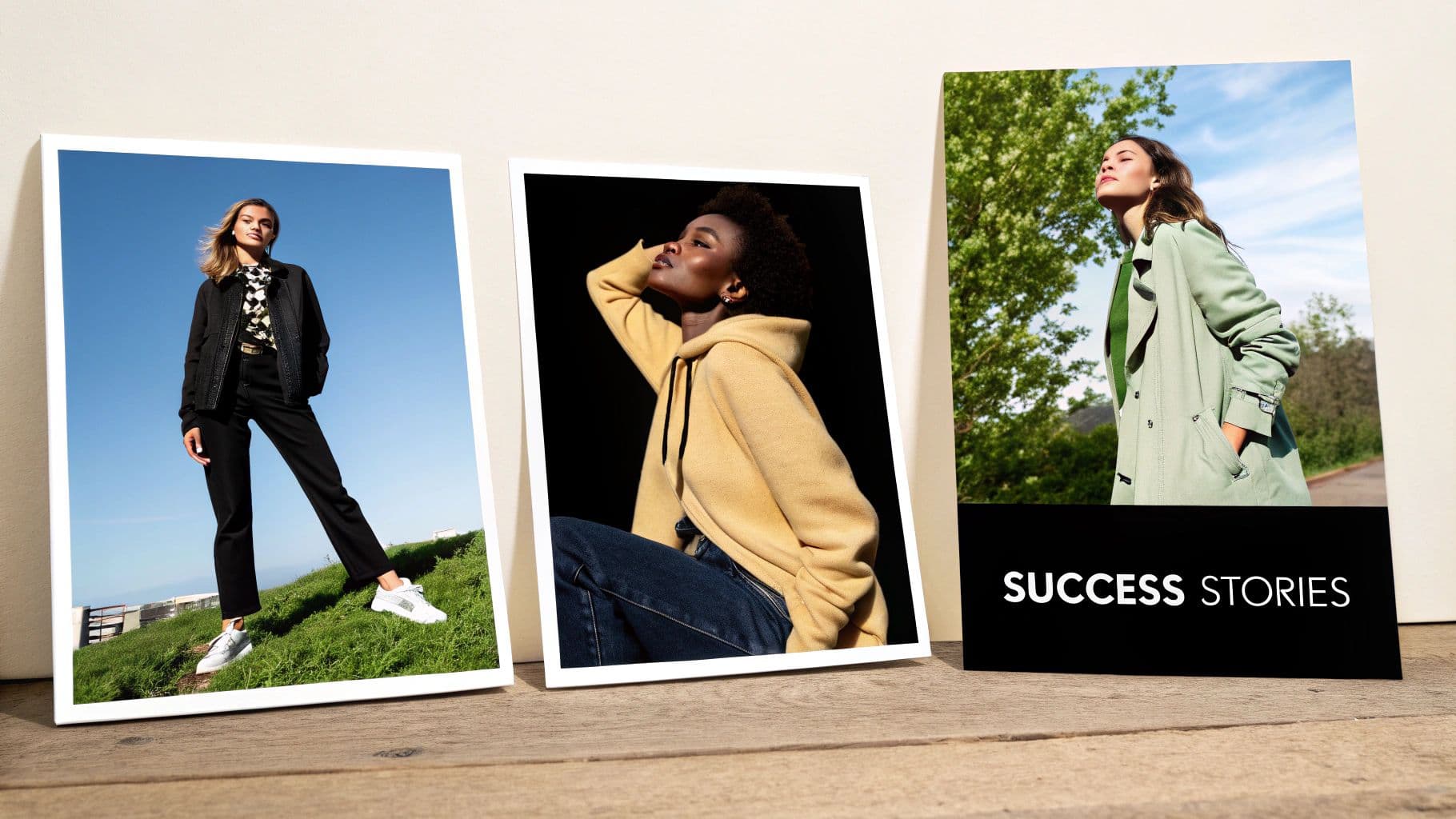
Three framed photos showcase diverse women in stylish outfits, with one labeled 'SUCCESS STORIES'.
The DTC Startup Launching a Collection in a Weekend
Picture a small, direct-to-consumer brand. They have a brilliant new 20-piece collection ready to go, but they're stuck. Their budget is tight, and their launch deadline is even tighter. A full-blown photoshoot just isn't in the cards.
Instead of trying to find a studio, models, and a photographer they could afford, they took simple flat-lay photos of each garment. They uploaded those shots to an AI platform and, within a couple of hours, had a complete set of on-model images featuring a diverse range of models.
The outcome was incredible. They launched their entire collection online over a single weekend, slashing their timeline by weeks and spending less than 10% of what a traditional shoot would have cost. That speed gave them a huge edge, letting them tap into customer excitement right away.
The Vintage Reseller Scaling Their Catalog by 300%
For a vintage reseller, the game is all about volume and speed. They get unique, one-off pieces every day, and each one needs to be listed online immediately. Trying to schedule a model for every single item is a logistical and financial nightmare.
This is where AI product photography fits perfectly. The reseller set up a simple workflow: they snap a quick photo of each item on a mannequin, then let the AI place it onto a model that matches their brand's vibe.
This small change in their process allowed them to increase their weekly product listings by 300% without spending an extra dime. More listings led directly to more sales, completely changing what was possible for their business. To see another powerful case study, check out how one e-commerce brand went about optimizing 20k products with AI.
The Established Brand Testing New Styles Risk-Free
Even big, established brands with deep pockets hate gambling on new products. Committing to a full production run for an untested style is always a risk. What if customers don't like it?
One brand found a way to take the guesswork out of the equation. Before manufacturing a new blouse in five different patterns, they used AI to create realistic on-model photos for each one. They then used these images in a small, targeted social media ad campaign to see which ones people actually clicked on.
The results were crystal clear. Two patterns got all the love, while the other three were ignored. With that data in hand, the brand confidently moved forward, producing only the two winning styles. They saved thousands on manufacturing costs and avoided getting stuck with a warehouse full of products nobody wanted.
Frequently Asked Questions About AI Product Photography
It's smart to have questions before jumping into a new way of doing things. Let's tackle some of the most common ones we hear from brands who are considering AI product photography for their creative process.
Can AI Really Match the Quality of a Professional Photoshoot?
The short answer is yes. Top-tier AI platforms today are built to create photorealistic, high-resolution images that are often impossible to tell apart from traditional studio shots. The technology has gotten incredibly good at rendering fine details like fabric textures, believable lighting, and natural-looking human poses.
This makes it a fantastic tool for generating those clean, professional, catalog-style images every e-commerce site needs. The trick is to use a platform that’s been trained specifically on fashion. These systems understand how to respect the integrity of your product, making sure every stitch and seam is shown just right.
How Much Control Do I Get Over the AI Models and Poses?
You get a ton of control, which is essential for keeping your brand's look consistent. Platforms like WearView let you create custom AI models that perfectly match your brand’s unique aesthetic. This is key to ensuring visual consistency across your product catalog and all your marketing campaigns.
Beyond the models, you can typically choose from a huge library of poses or give very specific directions to get the exact shot you have in mind. Whether you need an image for a product detail page, an Instagram post, or a digital ad, you can art-direct the final look with real precision.
Think of it this way: you get the creative freedom of a traditional photoshoot without all the logistical headaches. You're the director, guiding the AI to create on-brand visuals whenever you need them.
Is It Hard to Get Started with AI Photography?
Not in the slightest. The whole experience is designed to be straightforward and intuitive—no technical know-how or design skills required. For most platforms, the workflow is as simple as uploading a clear, well-lit photo of your garment on a hanger, mannequin, or even just laid flat.
From there, you’re guided through the fun part:
- Select your model: Pick from a diverse library or use a custom model you’ve created for your brand.
- Choose a pose: Find the one that best shows off your product's fit and features.
- Set the scene: Go with a classic studio background or place your product in a specific lifestyle setting.
The AI does all the heavy lifting behind the scenes, turning your inputs into a polished, high-quality image in just a few seconds.
Are the Images My Brand Creates Actually Unique?
Yes, 100% unique. Each image is a brand-new composition based on your specific product photo, your chosen model, the pose you select, and the background. Since the starting point is your actual garment, the final image is entirely unique to your brand and accurately represents the real-world item you're selling.
This completely sidesteps the generic, "stock photo" look. The images are proprietary to your brand, tailored to your product, and ready for you to use across all your commercial channels with total confidence.
Ready to see how WearView can change the way you create visual content? Generate studio-quality on-model photos in seconds and see the difference for yourself.
Tags:
WearView Team
WearView Content & Research Team
WearView Team is a group of fashion technology specialists focused on AI fashion models, virtual try-on, and AI product photography for e-commerce brands. We publish in-depth guides, case studies, and practical insights to help fashion businesses improve conversion rates and scale faster using AI.